If your energy bills keep climbing despite your best efforts, the culprit may be directly above your head. The attic and roof assembly is one of the most thermally vulnerable parts of any home. Heat rises in winter and gets trapped in summer, and if your attic isn’t properly insulated, air-sealed, and ventilated, you’re essentially running your HVAC system with the window open. The U.S. Department of Energy estimates that a poorly performing attic can account for 25% or more of a home’s total heating and cooling loss.
The frustrating part is that most of these problems are invisible from inside the house. You won’t see a drafty attic hatch the same way you’d feel a drafty window. Instead, you notice the symptoms: rooms that won’t stay comfortable, ice dams forming on the eaves in winter, or a second-floor bedroom that’s always five degrees hotter than the rest of the house. These are your home trying to tell you something.
This post walks you through the seven clearest warning signs that your roof and attic are leaking energy, explains the building science behind why each one matters, and gives you two actionable paths forward: a quick inspection and air-sealing fix you can do in an afternoon, and a more complete DIY or professional insulation upgrade for lasting results.
What You’ll Need
Click on an item below to shop for the recommended items for this recipe on Amazon.
As an Amazon Associate, we earn from qualifying purchases.
How to Do It
- On a cold or hot day, feel around your attic hatch or pull-down stairs for temperature differences or air movement. A noticeable draft confirms significant air leakage at this critical bypass point.
- Enter the attic during daylight without a flashlight and look for any spots where you can see light coming through from below. These are major air leak locations that need to be sealed immediately.
- Inspect the attic hatch cover itself. If it has no weatherstripping and no rigid insulation glued to the back, cut a piece of rigid foam board (at least R-10) to fit and attach it with construction adhesive. Add foam weatherstripping around the frame perimeter.
- Using a can of low-expanding spray foam, seal around every pipe, wire, and duct penetration you can find where framing meets the attic floor. Pay special attention to plumbing vent stacks and electrical junction boxes.
- Check that soffit vents along the eaves are not blocked by insulation. Use ventilation baffles (cardboard or foam) to create a clear airway from each soffit to the ridge, which is critical for proper attic ventilation.
- Measure your existing insulation depth with a ruler. The DOE recommends R-49 to R-60 for most U.S. climate zones, which equals roughly 14 to 17 inches of blown fiberglass or cellulose. Document what you have as a baseline.
- Complete all air sealing from the Quick Fix approach first. Adding insulation on top of unsealed bypasses is one of the most common and costly attic upgrade mistakes, as air movement will undermine the new insulation’s performance.
- Calculate your attic square footage and current insulation R-value. Use the DOE insulation calculator (available at energy.gov) to determine how many bags of blown insulation you need to reach R-49 or higher for your climate zone.
- Temporarily install depth markers made from wooden stakes or paint sticks placed every 50 to 60 square feet so you can confirm proper coverage depth as you work. Mark your target depth on each stake.
- Starting at the far end of the attic and working toward the hatch, blow cellulose or fiberglass insulation evenly across the attic floor. Keep the hose low and move slowly to avoid disturbing existing insulation or blocking soffit baffles.
- Maintain a clear 3-inch gap between the new insulation and the roof deck at the eaves to preserve the ventilation channel. Do not insulate over or compress the ventilation baffles you installed in the previous approach.
- Upgrade the attic hatch to a pre-insulated attic stair cover or tent if you have pull-down stairs. These prefabricated covers add R-40 or more over what is typically the single most under-insulated area in the entire attic.
- Contact your utility company or a certified BPI (Building Performance Institute) energy auditor to schedule a blower door test. This depressurizes the home and precisely measures total air leakage, identifying where the biggest losses are occurring.
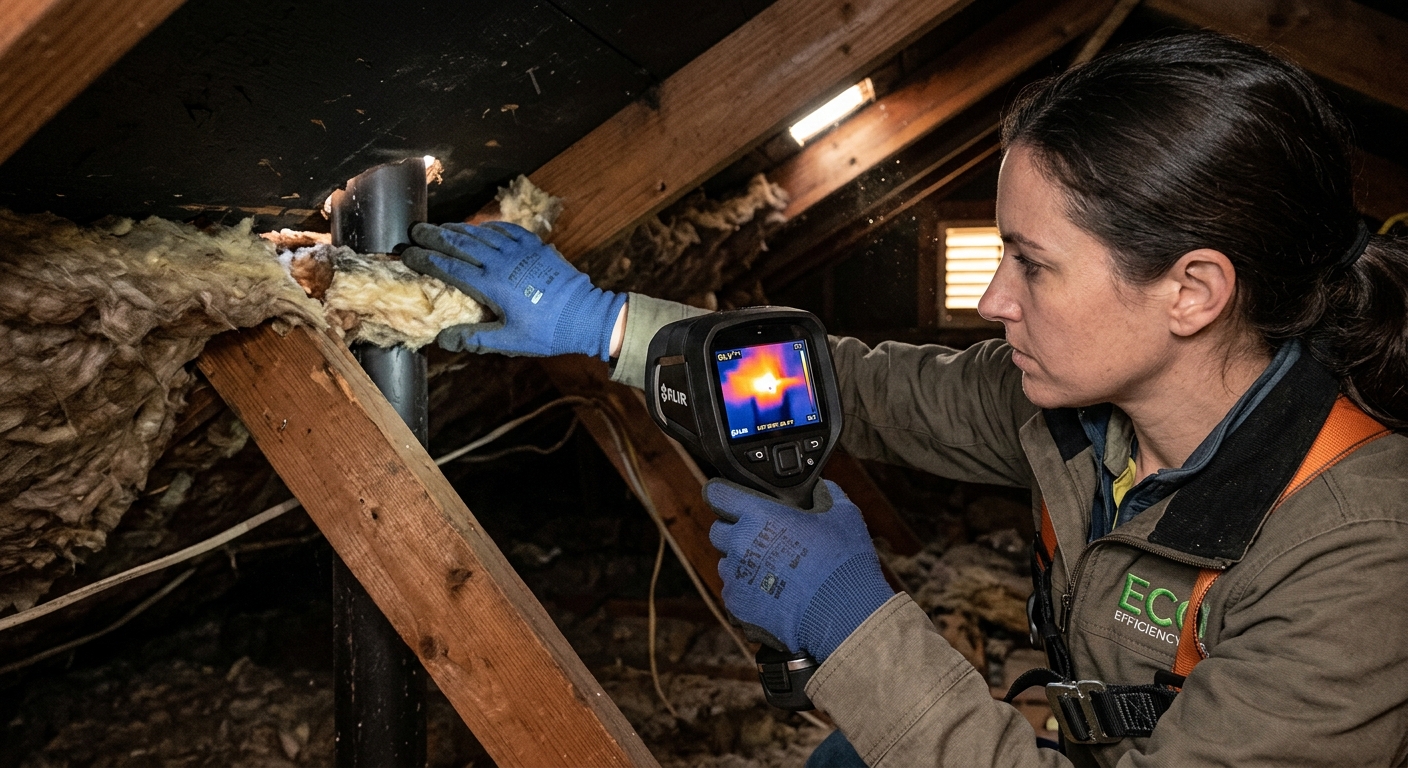
- Ask the auditor to perform a thermal imaging scan of the attic floor and ceiling plane during the test. Infrared cameras reveal hidden bypass leaks, missing insulation, and thermal bridges that are impossible to find by visual inspection alone.
- Review the auditor’s priority list and get itemized quotes from contractors for the recommended work. Prioritize air sealing first, then insulation depth, then ventilation corrections in that order.
- For homes with knee walls or complex attic geometries, consider spray foam applied by a licensed contractor for the air sealing work. Two-pound closed-cell spray foam seals and insulates simultaneously and is the most effective treatment for irregular framing and large bypasses.
- After work is complete, request a post-improvement blower door test to verify the air changes per hour (ACH) were actually reduced. A well-sealed attic should contribute to achieving under 3 ACH50 in most homes, verified by measurement not assumption.
Why It Works: The Benefits
Bringing attic insulation to the DOE-recommended R-38 to R-60 level and sealing major air bypasses can cut annual HVAC costs by 15 to 30%, saving a typical homeowner $200 to $600 per year depending on climate and home size.
Eliminating attic air leaks and improving insulation depth reduces the temperature differential between floors from a common 5 to 10 degree variance down to 2 to 3 degrees, making upper-floor rooms livable without constant thermostat fighting.
When the attic is properly sealed and insulated, the HVAC system runs shorter cycles and works less hard to maintain setpoint temperatures. This reduced runtime directly extends compressor and furnace life, delaying a $3,000 to $7,000 replacement.
Ice dams form when attic heat melts snow on the roof, which refreezes at the cold eaves. Sealing attic bypasses and adding insulation keeps attic temperatures within a few degrees of outdoor temps, eliminating the heat source that causes damaging ice dams.
Under the Inflation Reduction Act, homeowners can claim a 30% federal tax credit on qualifying insulation and air sealing improvements up to $1,200 per year, significantly reducing the out-of-pocket cost of a full attic upgrade.
💰 Savings Impact by Action
Sealing attic bypasses including hatches, plumbing penetrations, and top plates reduces whole-house air leakage by up to 20%, with immediate impact on heating and cooling bills.
Bringing attic insulation from a common existing level of R-11 to R-49 reduces annual heating and cooling energy use by 15 to 25% according to DOE data.
Insulating and weatherstripping an unimproved attic hatch or stair cover can reduce localized heat loss at that single point by up to 8% of total ceiling heat loss.
Restoring proper soffit-to-ridge airflow keeps summer attic temperatures 20 to 40 degrees Fahrenheit cooler, reducing cooling load on the living space by up to 12%.
Sealing and covering unrated recessed can lights in the ceiling below the attic eliminates one of the largest single bypass leak sources, which can account for 10% of ceiling plane air leakage.
🏠 Key Concepts Explained
The Science Behind It
Heat moves in three ways: conduction (through solid materials), convection (through air movement), and radiation (through electromagnetic waves). Your attic is a battleground for all three. In winter, warm air from your living space rises by convection and escapes through gaps in the ceiling plane, a process accelerated by the stack effect. As that warm air exits, it drags cold outside air in through lower leaks in the building envelope. Sealing attic bypasses directly interrupts this cycle at its exhaust point, which is why air sealing delivers faster and more measurable results than almost any other single improvement.
Insulation primarily slows conductive heat transfer by trapping still air within its fibers or cells. But its effectiveness depends entirely on that air staying still. When air moves through or around insulation, a process called thermal bypass or wind washing, the R-value can drop by 30 to 50% regardless of depth. This is why building scientists insist on air sealing before insulating: you have to stop the air movement before the insulation can do its job. Fiberglass batts laid loosely in an attic with open top plate cavities below them perform far worse than their label suggests because air circulates freely beneath them.
In summer, radiant heat from a sun-baked roof deck is the dominant mechanism. A dark asphalt shingle roof can reach 150 to 170 degrees Fahrenheit on a 90-degree day, and that surface radiates energy downward into the attic space. Insulation with adequate R-value slows the conductive transfer of that energy into the living space below. Attic ventilation complements this by bringing outdoor air through the soffit and exhausting heated air at the ridge, keeping the attic temperature closer to ambient rather than letting it superheat to 140 or 150 degrees, a temperature that would overwhelm even well-rated insulation.
Frequently Asked Questions
▼ My upstairs is always 5 to 10 degrees hotter than downstairs. Will fixing the attic actually solve this?
Yes, in most cases this temperature imbalance is directly caused by attic heat gain and insufficient return air pathways on the upper floor. Start by air sealing and verifying insulation depth is at least R-38. Also check that HVAC supply vents on the upper floor are fully open and that there is an adequate return air path back to the air handler, since a floor with lots of supply but poor return creates pressure imbalances that worsen temperature stratification.
▼ How do I know if I have enough insulation already without hiring someone?
Bring a ruler into the attic and measure the depth of your insulation in several spots. Blown fiberglass should be 14 to 17 inches deep for R-49 to R-60, and cellulose should be 12 to 14 inches for the same range. If you have less than 11 inches of any blown material or less than 5 inches of old fiberglass batts, you are significantly under-insulated for almost any U.S. climate zone and adding more insulation will pay back quickly.
▼ I added insulation two years ago and my bills barely changed. What went wrong?
The most common cause is that air sealing was skipped before the insulation was added. Insulation without air sealing still allows convective bypass through the ceiling plane, which can neutralize most of the thermal benefit. Go back and seal every penetration you can find around pipes, wires, recessed lights, and the attic hatch, then compare your next few utility bills to the same months from prior years.
▼ What are ice dams and is my attic definitely the cause?
Ice dams form when heat escaping from the living space through the attic warms the roof deck above the insulated area, melting snow that then refreezes when it reaches the cold eaves. If you consistently see ice dams forming at the roof edge in winter, attic air leakage is almost always the primary cause. The fix is sealing attic bypasses first, then verifying insulation depth and ventilation airflow, which together keep the roof deck cold and uniform so melting and refreezing cycles don’t occur.
▼ Can I just lay new batts on top of my existing blown insulation to add R-value?
You can, but only after completing all air sealing work first. Use unfaced batts laid perpendicular to the existing joists so they bridge across them and eliminate thermal bridging through the framing. Do not use faced batts for the top layer, as the facing acts as a vapor barrier in the middle of your insulation assembly, which can trap moisture and cause rot or mold over time.
Quick Tips
- Check insulation depth in multiple locations, especially near the eaves and attic hatch where it is commonly thin or missing entirely due to foot traffic or original installation shortcuts.
- Use a thermal imaging app or affordable IR thermometer on your ceiling surface on a cold winter night. Cold spots above 3 to 5 degrees below the room average indicate areas of missing or compressed insulation worth investigating.
- Replace any recessed can lights in ceilings below the attic with LED wafer lights or surface-mounted fixtures, which eliminate one of the most common and largest air bypass leak sources in residential ceilings.
- After any attic air sealing work, run your bathroom exhaust fans and kitchen range hood and feel around the attic hatch for suction. Reduced suction means you’ve meaningfully tightened the ceiling plane.
Variations for Your Situation
- Apartment or Condo: Residents in multifamily buildings typically cannot access or modify the attic, but you can still address the thermal ceiling plane by adding a layer of thermal curtains on skylights, requesting that management have the roof assembly audited if top-floor temperatures are extreme, and reporting visible gaps around recessed lights or ceiling penetrations to building management as a documented maintenance request. Focus your personal investment on window treatments and door weatherstripping where you have direct control.
- Tight Budget (under $100): Prioritize the attic hatch first since it costs $20 to $40 in materials and delivers the highest return per dollar spent. Next, pick up two cans of low-expanding spray foam and seal every pipe and wire penetration you can reach without disturbing existing insulation. These two steps alone commonly reduce air leakage by 15 to 20% and cost under $80 total, with no equipment rental needed.
- Older Home (pre-1980): Homes built before modern energy codes often have little to no attic insulation, open top plates connecting wall cavities directly to the attic, and knob-and-tube wiring that cannot legally be covered with insulation in most jurisdictions. Before doing any work, have a licensed electrician assess the wiring situation and check for vermiculite insulation as noted in the cautions section. Once cleared, these homes have the largest absolute gains available since starting from R-5 or less means even modest improvements cut bills dramatically.