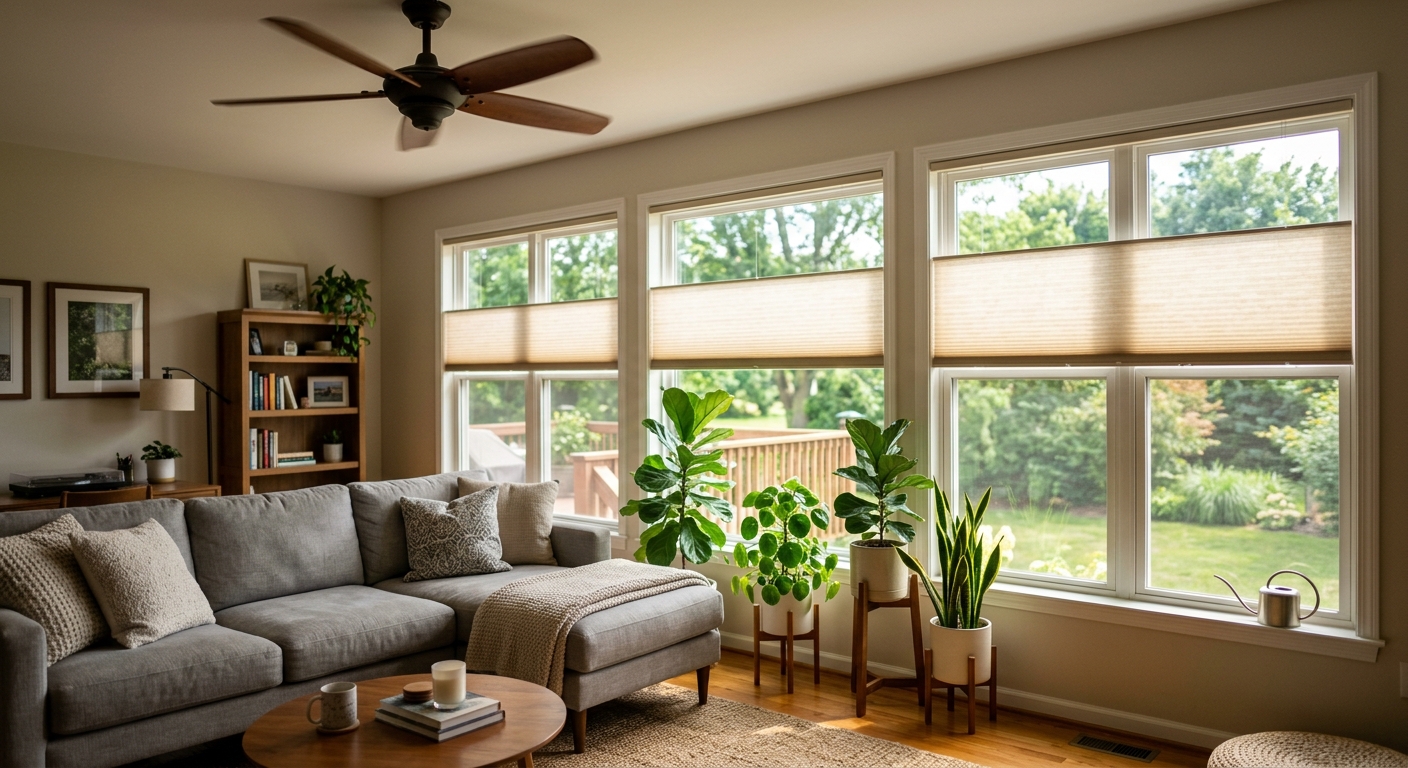
If you have a south-facing room, you already know the pattern: it feels fine in the morning, warm by 10 a.m., and genuinely miserable by 2 p.m. in July. That relentless afternoon sun drives up the room temperature, forces your AC to work overtime, and makes the space nearly unusable during the hottest hours of the day. What most homeowners do not realize is that the sun pouring through those windows is doing more damage than the outdoor air temperature alone.
South-facing glass in summer receives direct solar radiation for the longest stretch of the day. On a clear July afternoon, a single unshaded south-facing window can let in the equivalent of a 200 to 300-watt space heater worth of heat gain every hour. Multiply that by two or three windows and you have a room that your air conditioner was simply not sized to keep up with during peak sun hours.
The good news is that solar heat gain is one of the most controllable comfort problems in a home. This post walks you through the building science behind why south rooms overheat, quick fixes you can do today for zero cost, and progressively more effective upgrades that can reduce solar heat gain by up to 70%, bring the room temperature in line with the rest of your house, and trim your cooling bills at the same time.
What You’ll Need
Click on an item below to shop for the recommended items for this recipe on Amazon.
As an Amazon Associate, we earn from qualifying purchases.
How to Do It
- Close any existing blinds or curtains fully on south-facing windows by 9 a.m., before the sun reaches its peak angle. Light-colored or reflective blinds are significantly more effective than dark ones because they bounce light back out through the glass before it converts to heat.
- Move any heat-generating electronics such as televisions, desktop computers, and gaming consoles away from the south wall. These devices add 50 to 300 watts of heat each and compound the solar problem in an already hot room.
- After sunset when outdoor air drops below indoor temperature (typically after 8 to 9 p.m. in most climates), open a north-facing window low and the south-facing window high to create a convective cross-ventilation loop and flush out stored heat.
- Place a box fan in the south-facing window facing outward during evening hours to actively exhaust hot air from the room while cooler air enters from the shaded north side of the house.
- If you have ceiling fan, set it to run counter-clockwise at medium speed during the day to create a wind-chill effect on occupants, which allows you to feel comfortable at a room temperature 4 degrees higher than you otherwise would.
- Measure each south-facing window and purchase a solar control window film with a Total Solar Energy Rejection (TSER) rating of 50% or higher. Look for products rated SHGC 0.25 or lower. Brands such as Gila, BDF, and Coavas offer rolls for $30 to $60 that cover 36 square feet, enough for two standard windows.
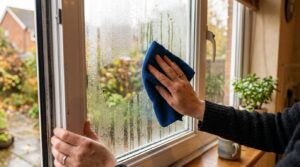
- Clean windows thoroughly with a solution of water and a few drops of dish soap. Any dust or debris trapped under the film will create bubbles and reduce adhesion. Use a squeegee to remove all streaks.
- Cut film to size leaving a half-inch margin on all sides. Spray the window glass with the same soap solution, peel the film backing, and apply the film wet to the glass. Use the squeegee to push out bubbles from the center toward the edges.
- Trim the excess film carefully with a straight edge and utility knife once the film is smoothed out. Allow 30 days for the film to fully cure and any remaining small haze to clear. Avoid cleaning the film with abrasive products during the curing period.
- Install cellular (honeycomb) shades inside each south-facing window. Choose a double-cell blackout or room-darkening fabric for maximum insulation value. Cellular shades add an R-value of 2 to 4 and create a dead-air buffer between the hot glass and the room, reducing heat transfer by an additional 20 to 30% on top of the film.
- For the best result, use the film and shades together. Film reduces the solar radiation entering the glass, and the cellular shade handles the remaining conducted heat from the warm glass surface. Together they can reduce solar heat gain by 60 to 70% compared to bare windows.
- For overhangs: calculate the ideal overhang depth using the rule that for a south-facing window, a properly designed fixed overhang should block the high summer sun angle (around 70 to 75 degrees above horizontal in July) while allowing the low winter sun (around 25 to 30 degrees) to enter. For a window that is 4 feet tall, an overhang of 2 to 2.5 feet typically achieves this balance in most U.S. climate zones.
- For a faster and reversible exterior solution, install exterior roller shades or solar screens rated at 90% openness factor or lower on south-facing windows. These mount to the exterior casing and can be retracted in winter. Quality exterior shades from manufacturers such as Phifer or Coolaroo cost $150 to $400 per window installed.
- Plant deciduous trees or large shrubs on the south side of your home. A tree positioned 10 to 20 feet from the house with a spread of 15 feet or more can shade south windows completely by July. Deciduous species such as red maple, zelkova, or serviceberry lose their leaves by November, restoring full winter solar access. Expect a 5 to 10 year wait for meaningful shade from new plantings.
- Consider awnings as a cost-effective middle ground. Motorized or manual retractable fabric awnings extend over south windows and can reduce solar heat gain through that window by up to 65%. Aluminum or fabric awnings cost $200 to $600 per window and are DIY-installable with basic tools.
- If budget allows, replace existing south-facing windows with low-e double or triple pane units rated SHGC 0.25 or lower. This is the most permanent solution and qualifies for a 30% federal tax credit under the Inflation Reduction Act through 2032. Payback period is typically 5 to 10 years on energy savings alone, but comfort improvement is immediate.
Why It Works: The Benefits
Blocking solar heat gain at the source reduces your AC’s cooling load during peak hours, which is when electricity rates are often highest. Homeowners with south-facing rooms that represent 15 to 25% of their home’s window area commonly see 15 to 30% reductions in July and August cooling costs after applying exterior shading or low-e window film.
Properly shaded south rooms typically run within 2 to 3 degrees of the rest of the house instead of the 10 to 15 degree swing common in unshaded south rooms during peak sun hours, making the space actually usable all day.
An AC unit that runs continuously during peak solar hours is one that wears out faster. Cutting the peak cooling load allows shorter, more efficient compressor cycles, which reduces mechanical wear and can extend system life by several years.
South-facing rooms receive intense direct sunlight that fades furniture, flooring, and artwork. Window films that reduce solar heat gain also block 99% of UV radiation, protecting your furnishings and eliminating harsh glare that makes screens unusable during the day.
Unlike interior blinds or exterior plantings, the right strategy can be seasonal. Removable exterior shades or deciduous trees block summer sun while allowing full winter sun to enter and provide free passive heating from November through February, reducing heating costs by 5 to 10% as a bonus.
💰 Savings Impact by Action
Exterior shades, awnings, or overhangs block solar radiation before it reaches the glass, reducing solar heat gain through south windows by up to 65%.
A quality solar control film with TSER of 50% or higher reduces solar heat gain through existing glass by 40 to 55% at a fraction of window replacement cost.
Double-cell cellular shades add R-2 to R-4 of insulating value and reduce conducted heat transfer from warm glass into the room by 20 to 30%.
Replacing single or standard double-pane south windows with SHGC 0.25 low-e units permanently reduces solar heat gain by 55 to 65% and qualifies for a 30% federal tax credit.
Flushing stored heat with cross-ventilation after sunset reduces the next-day peak room temperature by 3 to 5 degrees, reducing AC runtime by roughly 10% the following morning.
🏠 Key Concepts Explained
The Science Behind It
Solar radiation travels through glass in the form of short-wave infrared energy, which passes through glazing easily. Once that energy contacts interior surfaces like floors, walls, and furniture, it converts to long-wave infrared heat, which cannot pass back through glass as easily. This is the same greenhouse effect that warms a car on a cool sunny day, and it is why the room heats up even when it does not feel that hot outside. South-facing windows in July receive roughly 600 to 900 BTUs per square foot per day of direct solar energy in most of the continental U.S., compared to about 200 to 300 BTUs per square foot on a north-facing wall.
Interior shading treatments like blinds and drapes reduce visible light and glare but do relatively little for heat gain because by the time sunlight hits the blind, it has already passed through the glass and is now radiating heat into the room. Interior blinds intercept only about 15 to 20% of solar heat gain compared to 50 to 75% for exterior treatments that intercept the radiation before it reaches the glass. This is why building science consistently emphasizes exterior first when addressing solar overheating.
The relationship between SHGC and comfort is direct: every 0.1 reduction in SHGC for your south-facing windows reduces the peak solar heat gain through those windows by roughly 10%. In a room with 40 square feet of south glass, dropping from SHGC 0.6 to SHGC 0.25 can eliminate 1,400 to 2,100 BTUs per hour of heat gain during peak sun. That is the equivalent of removing a large space heater from the room at noon, which is exactly how it will feel.
Frequently Asked Questions
▼ I installed blackout curtains but the south room is still unbearably hot. What am I missing?
Blackout curtains reduce light but do very little for heat once the solar energy has already entered through the glass. The curtain itself heats up and radiates heat back into the room. Pair your curtains with solar control window film applied directly to the glass to intercept heat before it enters, and consider opening the room to ventilation after sundown to flush the stored heat out.
▼ Can I cool a south-facing room without running the AC all day?
Yes, but it requires a layered approach. Install solar film or exterior shades to cut the heat source, use a ceiling fan to improve perceived comfort by 4 degrees, and pre-cool the room in the early morning by lowering your thermostat before 9 a.m. then raising it during peak hours. Nighttime ventilation to flush stored heat is also essential if outdoor overnight temperatures drop below 70 degrees in your area.
▼ Will window film make the room too dark to use?
Most solar control films reduce visible light transmission by 30 to 55%, which typically shifts a bright south room to a comfortable interior brightness rather than a dim one. Films with a Visible Light Transmission (VLT) of 45 to 60% are considered medium tint and are nearly imperceptible indoors. Avoid films with VLT below 30% in rooms where you want natural light during the day.
▼ My AC runs constantly in July and my electricity bill is very high. Will these fixes actually make a measurable difference on the bill?
Yes, measurably so. If your south-facing room represents 20% or more of your home’s window area, reducing its solar heat gain by 60% can cut your total cooling load by 10 to 15% during peak summer months. On a $200 July bill, that is $20 to $30 per month, which pays back a $200 window film investment in one summer. Exterior shading provides even faster payback in hot climates.
▼ What if my south room has a glass door or sliding door instead of windows?
Glass doors have the same solar heat gain problem as windows but are trickier to treat because you need to preserve function. For sliding doors, exterior roll-up solar screens that mount above the door track are the best option and can be raised when you want to use the door. Solar film can also be applied to sliding glass door panels but choose a non-reflective variety to avoid optical distortion when looking through the door.
Quick Tips
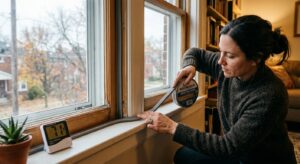
- Use a laser infrared thermometer to measure your window glass surface temperature during peak sun. Readings above 110 degrees Fahrenheit confirm that the glass itself is a radiant heat source making the room feel hotter than the air temperature alone suggests.
- Light-colored or white interior window coverings can reflect 40 to 50% of incoming solar radiation back out through the glass, making color choice nearly as important as the type of shade you buy.
- If you rent and cannot install permanent film, look for temporary static-cling solar film. It provides 30 to 45% heat reduction and removes cleanly at move-out.
- Schedule a free or low-cost home energy audit through your utility company. Many utilities identify and quantify solar gain problems with thermal imaging cameras, and some offer rebates on qualifying window treatments or low-e window replacements.
Variations for Your Situation
- Apartment or Rental: You likely cannot install permanent film or exterior shades without landlord approval, but static-cling solar film requires no adhesive and removes cleanly. Brands like Gila offer cling versions for $25 to $40 per roll. Pair that with a cellular shade on a tension-mount rod (no drilling) and a portable evaporative cooler or window AC unit rated for the room’s square footage. Total cost under $150 with no permanent modifications.
- Tight Budget (under $50): Focus on three zero-cost and near-zero-cost moves. First, close light-colored blinds by 9 a.m. every day. Second, move heat-generating electronics out of the room. Third, purchase a single roll of solar control window film for the largest south window only, targeting the window that receives the most direct afternoon sun. This prioritization often captures 70% of the benefit for 30% of the cost.
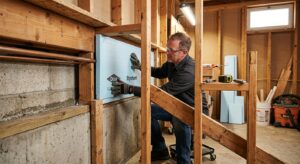
- Older Home (pre-1980): Homes of this era often have single-pane windows with SHGC values near 0.85 to 0.9, meaning almost no solar heat is blocked at all. Window film is especially high-impact here and is strongly recommended before any other step. Also check whether the south wall has any insulation at all, as pre-1980 walls in many regions were built with no cavity insulation. A blown-in insulation retrofit for a single south wall costs $300 to $600 and can reduce conducted heat gain through the wall assembly by 50 to 60%.