If your bathroom fan sounds like a small aircraft preparing for takeoff, you are not alone. Noisy exhaust fans are one of the most common homeowner complaints, and the causes are almost always fixable without calling a contractor. The culprit is usually one of three things: a dirty or clogged grille, worn-out fan blades or motor bearings, or a fan that was never properly sized for the room in the first place.
Beyond the noise, a struggling fan is quietly costing you money. An undersized or obstructed fan cannot move enough air to clear humidity after a shower, which means moisture lingers, mold gets a foothold, and your HVAC system works harder to compensate. The EPA estimates that proper bathroom ventilation can prevent thousands of dollars in moisture-related structural damage over the life of a home.
This post walks you through diagnosing the source of your fan noise, fixing it yourself in under an hour for most cases, and knowing when a full replacement makes more financial sense. We cover a free five-minute fix, a DIY cleaning and tune-up, and a full upgrade with real payback numbers so you can choose the approach that fits your budget and comfort goals.
What You’ll Need
Click on an item below to shop for the recommended items for this recipe on Amazon.
As an Amazon Associate, we earn from qualifying purchases.
How to Do It
- Turn off the bathroom fan at the wall switch. For safety on older homes, flip the breaker to the bathroom circuit before touching the fan housing.
- Pull the grille cover straight down or squeeze the side clips to release it. Most grilles snap off without tools.
- Vacuum the grille cover thoroughly using a brush attachment, then wash it in warm soapy water and let it dry completely.
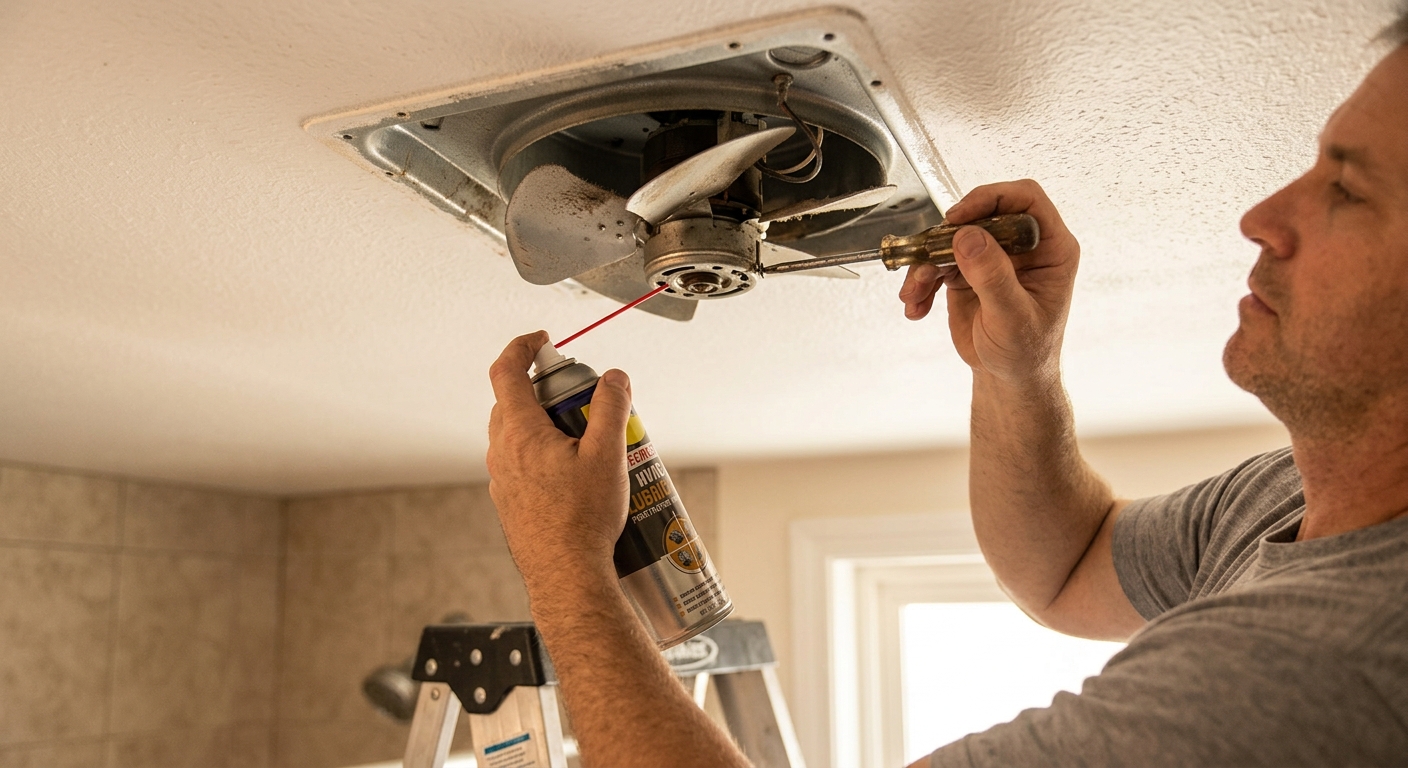
- Use a can of compressed air or a vacuum crevice tool to clear dust from the fan blades, motor housing, and duct opening you can see inside the ceiling cavity.
- Gently press on the fan housing where it meets the ceiling to feel for looseness. If it wobbles, it is vibrating against the drywall. Snug up the mounting screws if accessible from below.
- Reinstall the grille, restore power, and listen. If noise drops noticeably, the fix is done. If the grinding or rattling continues, move to the DIY approach.
- Turn off the circuit breaker for the bathroom, not just the wall switch. Verify power is off using a non-contact voltage tester before reaching into the housing.
- Remove the grille cover and unplug the fan motor module from its housing connector. Most units have a simple plug that allows the motor and blade assembly to slide out without disconnecting wire nuts.
- Inspect the fan blades for dust buildup, cracks, or wobble. Clean blades thoroughly. A blade caked with 2 to 3mm of dust can cause significant vibration and noise.
- Apply two to three drops of electric motor oil (SAE 20 non-detergent) to the motor shaft at each end where it enters the bearing sleeve. Do not use WD-40, which evaporates quickly and can damage plastic components.
- Check the duct connector at the fan housing. If the flexible duct is kinked or disconnected even partially, straighten it and secure the connection with foil HVAC tape. Never use standard duct tape, which fails quickly in humid conditions.
- Reinstall the motor module, restore power, and run the fan for 5 minutes. A well-lubricated fan in good condition will noticeably quiet down within the first minute of operation.
- Turn off the circuit breaker for the bathroom and verify power is off with a non-contact voltage tester. Take a photo of all wiring before disconnecting anything.
- Remove the old grille and motor module. Then unscrew the housing from the ceiling joist or mounting bracket. Most are held by two to four screws accessible from below.
- Select a replacement fan rated for at least 1 CFM per square foot of your bathroom (for an 8×10 bathroom, that is 80 CFM minimum). Match the duct size, typically 3 or 4 inches, to your existing duct to avoid a full duct replacement.
- Slide the new housing into the ceiling opening and secure it to the joist or use the adjustable mounting brackets included with most units. The housing should sit flush with the ceiling surface.
- Connect the wiring using the same configuration as the original: black to black, white to white, ground to ground. Most fans come with wire connectors included. Restore the motor module and snap on the new grille.
- Restore power and run the fan for 10 minutes. Use the tissue test to confirm airflow: hold a single tissue near the grille. It should be firmly held against the grille by suction if the fan is properly sized and ducted.
Why It Works: The Benefits
Replacing a 3-sone fan with a 0.5-sone model reduces perceived noise by more than 80%, making the fan nearly inaudible during normal conversation.
Modern ENERGY STAR-certified bathroom fans use as little as 8 to 15 watts compared to 60 to 100 watts for older models, cutting fan operating costs by 50 to 75% per year.
A properly functioning fan clears post-shower humidity within 15 to 20 minutes, preventing the sustained high-humidity conditions that lead to mold growth and can cost $500 to $3,000 to remediate.
Cleaning accumulated dust from the grille and motor can reduce operating temperature by 10 to 15 degrees, which meaningfully extends motor life and delays the need for full replacement.
An effective exhaust fan removes not just humidity but also volatile organic compounds (VOCs) from cleaning products, odors, and aerosolized particles, improving the air quality throughout connected living spaces.
💰 Savings Impact by Action
Replacing a 1990s-era 75-watt fan with a modern 10-watt ENERGY STAR model cuts fan electricity use by up to 70% per year.
Straightening or replacing a kinked flex duct restores up to 25% of lost airflow, allowing the fan to clear humidity faster and run for shorter cycles.
A countdown timer switch reduces total fan runtime by ensuring the fan shuts off automatically, cutting unnecessary energy use by roughly 15% compared to fans left running.
Effective bathroom ventilation reduces whole-home humidity load, lowering air conditioning energy use by up to 20% in humid climates by reducing latent cooling demand.
🏠 Key Concepts Explained
The Science Behind It
Exhaust fans work by creating a slight negative pressure zone in the bathroom, drawing humid air through the grille, into the duct, and out of the building envelope. The fan motor spins a centrifugal or axial blade assembly to move air, and the efficiency of that process depends almost entirely on two variables: how freely the motor spins and how little resistance the duct creates. When either variable degrades, the motor draws more current, runs hotter, vibrates more, and gets louder.
The noise you hear from an aging fan is usually one of three physical phenomena. Bearing noise is a grinding or whirring sound caused by metal-on-metal contact as the lubricant in the motor bearings breaks down. Resonance noise is a rattling or buzzing caused by the motor vibration transferring into the ceiling structure, which acts like a speaker cabinet and amplifies the sound. Airflow turbulence noise is a rushing or roaring sound caused by the fan trying to push air through an undersized, kinked, or blocked duct, creating turbulent rather than laminar airflow.
Modern DC motor technology has largely solved the noise problem. Where older AC induction motors run at a fixed speed and vibrate at 60 Hz (the frequency of household current), brushless DC motors run at variable speeds optimized for quiet, efficient operation. That is why ENERGY STAR fans rated at 0.3 to 0.5 sones can move 80 to 110 CFM while drawing only 8 to 15 watts. The physics of airflow have not changed, but the precision of how modern fans exploit those physics makes a dramatic real-world difference.
Frequently Asked Questions
▼ I cleaned the fan and lubricated the motor but it is still grinding loudly. What now?
If lubrication did not quiet the grinding within a few minutes of operation, the motor bearings are likely worn past the point of recovery. This is especially common in fans over 8 to 10 years old. At this stage, replacement is more cost-effective than continued repairs, and a new ENERGY STAR fan will pay back its cost in energy savings within 2 to 3 years.
▼ My fan is loud but seems to be moving air fine. Do I really need to fix it?
A loud fan is doing more work than it should to move the same amount of air, which means higher electricity consumption and accelerated motor wear. Additionally, noise discourages many people from running the fan as long as needed, leading to humidity buildup. Fixing or replacing it now prevents a larger moisture-related repair bill later.
▼ Can a renter fix a noisy bathroom fan without landlord permission?
Cleaning the grille and vacuuming the fan is always appropriate and requires no permission. Lubricating the motor or tightening housing screws is also generally acceptable maintenance. However, replacing the fan unit itself involves electrical work and modifying a fixture, which requires landlord approval in most lease agreements. Submit a written maintenance request documenting the noise and any signs of moisture, and keep a copy.
▼ How do I know if my duct is the problem and not the fan itself?
Disconnect the duct from the fan housing (with power off) and run the fan briefly without the duct attached. If the noise drops significantly, the duct is creating back pressure that is straining the motor. Check for kinks, long runs over 25 feet, or excessive 90-degree bends. Replacing crushed flex duct costs $15 to $40 in materials and often resolves the issue without touching the fan.
▼ My new fan is quieter but the bathroom is still humid after a shower. What is wrong?
Check three things: first, confirm the duct actually exits the building and is not just terminated in the attic. Second, verify the CFM rating is at least 1 CFM per square foot of bathroom area. Third, check that the exterior vent cap flap opens freely and is not blocked by debris or bird nesting material. A blocked exterior cap alone can reduce effective airflow by 50% or more.
Quick Tips
- Install a 20-minute countdown timer switch for around $20 instead of a standard switch. It ensures the fan always runs long enough after a shower without you remembering to turn it off manually.
- Use the toilet paper test once a month: hold a sheet near the grille with the fan running. If it does not stay firmly in place, airflow has dropped and it is time to clean or inspect.
- If replacing a fan, buy one with a CFM rating 10 to 15% above the minimum for your room size. This gives you headroom as the fan ages and duct resistance naturally increases.
- Always vent the exhaust duct to the exterior, not the attic. Use insulated flex duct in cold climates to prevent condensation inside the duct from dripping back into the fan housing.
Variations for Your Situation
- Apartment/Rental: Renters cannot replace the fan unit without landlord approval, but cleaning the grille and motor with compressed air and a vacuum is always permitted and often cuts noise by 30 to 40% on neglected fans. Document the noise issue in writing to your landlord with photos and reference your local building code’s ventilation requirements. Many cities require landlords to maintain functional bathroom ventilation by law.
- Tight Budget (under $50): Focus first on the free clean-and-check approach, which resolves noise for many homeowners at zero cost. If the motor needs lubrication, electric motor oil costs under $8. If a timer switch is the only upgrade you make, the $15 to $25 investment ensures the fan runs long enough after each shower to actually prevent moisture damage, delivering real value without touching the fan itself.
- Older Home (pre-1980): Homes of this era often have fans exhausting into the attic rather than to the exterior, 3-inch ducts that are undersized by modern standards, and no GFCI protection on bathroom circuits. Before any fan work, check where your duct terminates and confirm the circuit has a GFCI breaker or outlet. Correcting the duct termination to an exterior exit is the single highest-impact upgrade you can make in an older home and may require a handyman or HVAC contractor for the roof or soffit penetration.