
Most homeowners focus on heating and cooling when they think about energy bills, and for good reason. But hiding in your kitchen is a appliance that never takes a day off: your refrigerator. Running continuously, a typical refrigerator consumes between 400 and 800 kilowatt-hours of electricity per year, costing the average household $60 to $120 annually. Older models from the 1990s can push that figure above $200 per year, making them quiet but costly budget drains.
The frustrating part is that most refrigerators operate far less efficiently than they should, not because of a mechanical problem, but because of overlooked habits and settings. A dirty condenser coil, a worn door gasket, a thermostat set 10 degrees too cold, or a fridge sitting in a warm garage can each add 10 to 25% to your unit’s energy consumption. Stack a few of these together and you could easily be overpaying by $50 to $100 per year without knowing it.
This post covers exactly what makes refrigerators energy hogs, which fixes are free or nearly free, when a DIY tune-up makes sense, and when replacing an aging unit is actually the smarter financial move. Whether your fridge is brand new or pushing 20 years old, there are concrete steps you can take today to make it work harder for less money.
What You’ll Need
Click on an item below to shop for the recommended items for this recipe on Amazon.
As an Amazon Associate, we earn from qualifying purchases.
How to Do It
- Set your refrigerator temperature to 37 degrees Fahrenheit and your freezer to 0 degrees Fahrenheit using the built-in dial or digital controls. Use a simple refrigerator thermometer placed in a glass of water overnight to verify the actual temperature, not just the setting.
- Perform the dollar bill gasket test: close the door on a dollar bill and try to pull it out. If it slides out easily with no resistance, the gasket is failing and warm air is leaking in. Repeat around the entire door perimeter.
- Check that the refrigerator is level by looking at the bubble in a small carpenter’s level placed on top. A unit that tilts forward prevents the door from self-closing properly, which is a common source of warm air infiltration.
- Move any items sitting on top of or flush against the back and sides of the unit. Refrigerators need 1 to 2 inches of clearance on the sides and back so condenser heat can dissipate into the room rather than building up around the appliance.
- Check the location: if your fridge is adjacent to the oven, dishwasher, or in direct sunlight, it is fighting extra heat load. Even shifting it a few inches away from a heat-producing appliance can reduce its ambient load noticeably.
- Unplug the refrigerator before doing any maintenance. Pull the unit away from the wall carefully, protecting the floor with a piece of cardboard or an old towel.
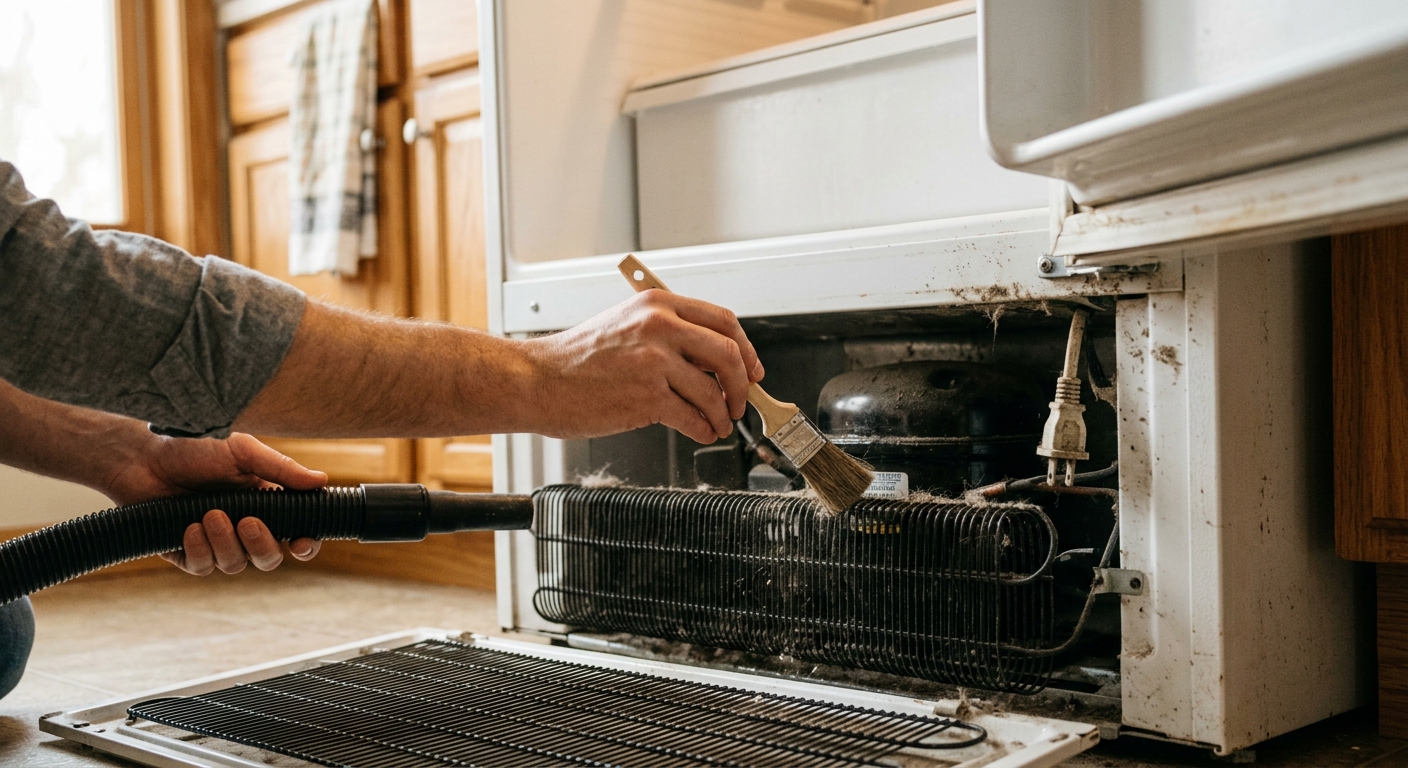
- Locate the condenser coils, which are either on the back of the unit (older models) or underneath behind a removable kick plate (most models made after 1990). Use a condenser coil cleaning brush and a vacuum with a crevice attachment to remove all dust, pet hair, and debris. This single step can recover 15 to 25% efficiency on a coil that has not been cleaned in several years.
- While the unit is pulled out, clean the condenser fan blades with a damp cloth and make sure the fan spins freely. A dirty or obstructed fan reduces airflow across the coils and compounds the heat buildup problem.
- If your dollar bill test revealed a failing gasket, order a replacement specific to your model number (found on the interior label). New gaskets typically cost $20 to $40 and press into a channel around the door frame. Soften the new gasket in warm water before installation to make it pliable, then press it firmly into the groove starting at the corners.
- Clean the interior drain pan (located underneath the unit) with a mixture of warm water and baking soda. A dirty drain pan can harbor bacteria and cause odors, and a blocked drain forces the defrost system to work harder.
- Push the refrigerator back into place, plug it back in, and place a thermometer inside for 24 hours to confirm it is holding the correct temperature. Adjust the thermostat dial one step at a time if needed and recheck.
- Find your refrigerator’s model number on the interior label and look up its annual energy consumption in kWh on the ENERGY STAR product database or the original EnergyGuide label. Multiply that number by your electricity rate (found on your utility bill, typically $0.12 to $0.18 per kWh) to find your annual operating cost.
- Compare that figure to a current ENERGY STAR certified model of similar size. Models made after 2015 use 40 to 50% less energy than models from 2000. A fridge costing $120 per year to run versus a new model costing $40 per year saves $80 annually.
- Check your state and local utility for rebate programs before purchasing. Many utilities offer $50 to $150 rebates on ENERGY STAR appliances, and some will haul away your old unit for free. Visit DSIRE (dsireusa.org) to find your state’s programs.
- Choose a right-sized model. Bigger is not better for efficiency. A 18 to 20 cubic foot refrigerator is sufficient for most households of two to four people, and larger units cost more to run. Also, top-freezer models use 10 to 25% less energy than side-by-side configurations of the same capacity.
- When your old unit is removed, ask the retailer or utility to recycle it responsibly. Do not move a working old refrigerator to the garage as a secondary unit. Running two refrigerators negates all the savings from upgrading and can add $100 to $200 per year to your bill.
Why It Works: The Benefits
Cleaning coils and adjusting the thermostat alone can reduce a refrigerator’s energy use by 15 to 25%, saving $15 to $30 per year on a typical unit and $30 to $50 on an older model.
A compressor that runs less often and at lower load degrades more slowly. Regular maintenance can add 3 to 5 years to a refrigerator’s useful life, deferring a $1,000 to $2,000 replacement purchase.
Keeping the fridge at the correct temperature (35 to 38 degrees Fahrenheit) rather than unnecessarily cold reduces food spoilage and freezer burn, which the USDA estimates costs the average household $1,500 or more in wasted food per year.
A well-maintained refrigerator with clean coils and a proper seal cycles less frequently and runs quieter, a noticeable comfort improvement in open-plan kitchens.
Replacing a pre-2000 refrigerator with a current ENERGY STAR model can save $100 to $150 per year in electricity, with a payback period of 7 to 10 years on a $900 unit, while also qualifying for utility rebates in many states.
💰 Savings Impact by Action
Cleaning heavily dust-clogged condenser coils can restore up to 25% of lost efficiency by allowing the compressor to shed heat as designed.
Correcting an over-cold thermostat from 33 to 37 degrees Fahrenheit reduces compressor workload by approximately 8 to 12% annually.
Replacing a failed door gasket eliminates continuous warm air infiltration, reducing compressor run time by up to 15%.
Replacing a pre-2000 refrigerator with a current ENERGY STAR model cuts annual energy consumption by 40 to 50% based on DOE appliance efficiency data.
Moving a refrigerator from a hot garage or away from heat-producing appliances can reduce energy consumption by 15 to 30% by lowering ambient operating temperature.
🏠 Key Concepts Explained
The Science Behind It
Your refrigerator works by moving heat, not by creating cold. The compressor pressurizes refrigerant gas, which flows through the condenser coils outside the insulated cabinet where it releases that heat to the surrounding air, then expands through the evaporator coils inside the cabinet where it absorbs heat from the food and air inside. This cycle repeats continuously. The harder it is to release heat at the condenser (due to dirty coils or a warm room), or the more heat enters through a bad door seal, the longer and more often the compressor must run to maintain the target temperature.
Thermostat settings matter because of the fundamental relationship between energy work and temperature difference. The larger the gap between the interior target temperature and the ambient room temperature, the more thermodynamic work the refrigerant cycle must perform. Setting your fridge to 33 degrees Fahrenheit instead of 37 degrees Fahrenheit does not just add 4 degrees of margin. It meaningfully increases the compressor’s workload because it is pushing against a steeper thermal gradient. The FDA recommends 35 to 38 degrees Fahrenheit as the sweet spot for food safety and efficiency.
Door gasket failures are particularly insidious because the energy penalty is continuous. Unlike leaving the door open briefly while you grab something, a cracked gasket leaks warm, humid air into the cabinet around the clock. That humid air must not only be cooled but also have its moisture condensed and removed by the evaporator coils, adding latent heat load on top of the sensible temperature load. This is why a single failed gasket, costing $25 to replace, can add $30 to $50 per year to operating costs if left unaddressed.
Frequently Asked Questions
▼ My refrigerator runs constantly and never seems to cycle off. What is wrong?
Continuous running is almost always caused by one of four things: a failing door gasket letting in warm air, dirty condenser coils preventing heat dissipation, a thermostat set too cold, or a failing defrost system causing frost buildup on the evaporator coils. Start by checking the gasket and cleaning the coils, then verify the temperature setting. If the unit still runs continuously after those fixes, the defrost heater or thermostat may have failed and you should call an appliance repair technician.
▼ How do I know if it is cheaper to repair my old fridge or replace it?
A useful rule of thumb is to multiply the repair cost by the age of the unit. If that number exceeds 50% of the cost of a new comparable refrigerator, replacement is the smarter financial choice. For example, a $300 repair on a 15-year-old fridge that would cost $1,200 new equals $4,500, well above the 50% threshold of $600, making replacement the better investment. Factor in that a new ENERGY STAR model may also save you $80 to $120 per year in electricity versus your aging unit.
▼ Can moving my old fridge to the garage really hurt my energy bill that much?
Yes, significantly. Garages routinely reach 90 to 100 degrees Fahrenheit in summer, and older refrigerators are not designed to operate efficiently in ambient temperatures above 90 degrees. In those conditions, your old unit can use two to three times more electricity than it did in your kitchen, adding $100 to $200 per year to your bill. If you need cold storage in the garage, look for a refrigerator or chest freezer specifically rated for high-ambient environments.
▼ How often should I really clean the condenser coils?
For most households, once per year is sufficient. If you have pets that shed heavily, every six months is a better target, because pet hair clogs condenser coils dramatically faster than regular household dust. You will know it is overdue if the motor sounds like it is working harder than usual or if the sides of the refrigerator feel unusually warm to the touch.
▼ My refrigerator is only 8 years old. Is it worth replacing for efficiency reasons?
Probably not based on efficiency alone, since modern refrigerators made after 2010 are already reasonably efficient and the payback period on replacement would be 15 or more years on energy savings. Focus instead on the maintenance tune-up steps: clean the coils, check the gasket, and verify your temperature settings. Reserve the replacement conversation for when the unit needs a major repair or crosses the 15-year mark.
Quick Tips
- Keep the freezer at least 75% full. Frozen food acts as thermal ballast, so the compressor cycles less often and the freezer recovers faster after the door opens. Use water-filled containers or ice packs to fill empty space if needed.
- Let hot leftovers cool to room temperature before putting them in the refrigerator. Placing a pot of hot soup directly in the fridge forces the compressor to work hard to bring down the temperature, wasting energy and potentially raising the temperature of nearby food.
- If you have a water and ice dispenser, be aware that refrigerators with through-the-door ice dispensers use 10 to 20% more energy than models without them, due to the break in door insulation required for the dispenser mechanism.
- Check the door hinges annually. Sagging hinges misalign the door and cause uneven gasket compression, creating air leaks even if the gasket itself is in good condition. Tightening the hinge screws takes two minutes and costs nothing.
Variations for Your Situation
- Apartment or Rental: Renters typically cannot replace a landlord-supplied refrigerator, but the Quick Tune-Up approach applies fully and requires no permission. Clean the coils, check the gasket integrity, verify the temperature with a $10 thermometer, and ensure proper clearance around the unit. If the gasket is clearly failing, document it in writing and notify your landlord, since appliance maintenance is typically the landlord’s responsibility and a failed gasket is a legitimate repair request.
- Tight Budget (under $20): Skip the parts and focus on zero-cost wins. Adjust the thermostat to 37 degrees Fahrenheit, perform the dollar bill gasket test, ensure proper clearance, clean the coils with a vacuum and a stiff brush (an old paintbrush works fine), and fully stock the fridge and freezer to improve thermal mass. These steps alone can recover 10 to 20% efficiency at no cost.
- Older Home with an Aging Refrigerator (pre-2000 model): Prioritize calculating your current unit’s actual annual operating cost before spending money on repairs or maintenance. Find the EnergyGuide kWh rating (on the label inside the door or via the model number online) and multiply by your rate. Units from the 1990s routinely cost $150 to $250 per year to run versus $40 to $60 for a current ENERGY STAR model. In this scenario, replacement delivers the highest return, especially when utility rebates of $50 to $150 are factored in.