If your home has large windows on the south side, you are sitting on one of the most powerful free energy sources available to any homeowner. In winter, those windows can act like a solar collector, warming your living spaces with zero fuel cost. But if you are not managing them correctly, those same windows may be costing you hundreds of dollars extra every summer as your air conditioner battles direct solar gain hour after hour.
The difference between an asset and a liability comes down to a few key factors: window glazing type, the presence or absence of exterior shading, interior treatments, and your local climate. A south-facing window without a proper overhanging eave or interior shade in Phoenix is an expensive mistake. That same window in Minneapolis, managed correctly, could reduce your heating load by 15 to 25% during the coldest months. The physics works in your favor if you know how to use it.
This post breaks down exactly what makes south-facing windows behave the way they do, how to quickly assess whether yours are helping or hurting your energy bills, and the specific steps you can take at every budget level to get the most out of them year-round.
What You’ll Need
Click on an item below to shop for the recommended items for this recipe on Amazon.
As an Amazon Associate, we earn from qualifying purchases.
How to Do It
- Identify your true south-facing windows using a compass app on your phone. Any window within 30 degrees of true south qualifies. Note their approximate square footage.
- In winter: Open all blinds and curtains on south-facing windows between 8am and 3pm to maximize solar heat gain. Close them at sunset to trap the heat inside and reduce nighttime conductive loss through the glass.
- In summer: Keep south-facing window coverings closed during the day, especially between 10am and 4pm. Even basic horizontal blinds reduce solar gain by 40 to 45% compared to uncovered glass.
- Check for low-hanging tree branches or shrubs on the south side. In winter these can block useful sun. If easily trimmed, clearing them can noticeably increase solar gain to those rooms.
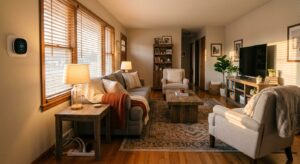
- Place a dark-colored rug, stone tile, or dense furniture (like a bookshelf filled with books) in the direct sun path inside the room. These materials absorb and slowly re-radiate heat, improving overnight comfort without any cost.
- Measure each south-facing window precisely: width at top, middle, and bottom; height at left, center, and right. Use the smallest measurement for inside-mount shades to ensure a proper fit.
- For summer cooling: Install cellular (honeycomb) shades rated as light-filtering or room-darkening on all south windows. Cellular shades reduce solar heat gain by 40 to 60% and also improve winter insulation with an R-value of roughly 2 to 3.5 per shade. Expect to pay $30 to $70 per window from retailers like Blinds.com or Home Depot.
- For south windows in rooms you want to cool without blocking all light, apply a solar window film with a visible light transmission of 30 to 50% and a low SHGC rating (0.25 to 0.35). These films reject 55 to 75% of solar heat while keeping rooms bright. They cost $25 to $60 per window and take about 20 minutes each to apply with a squeegee and soapy water solution.
- Clean the glass thoroughly with a lint-free cloth and isopropyl alcohol before applying window film. Bubbles and peeling are almost always caused by inadequate surface prep, not the film itself.
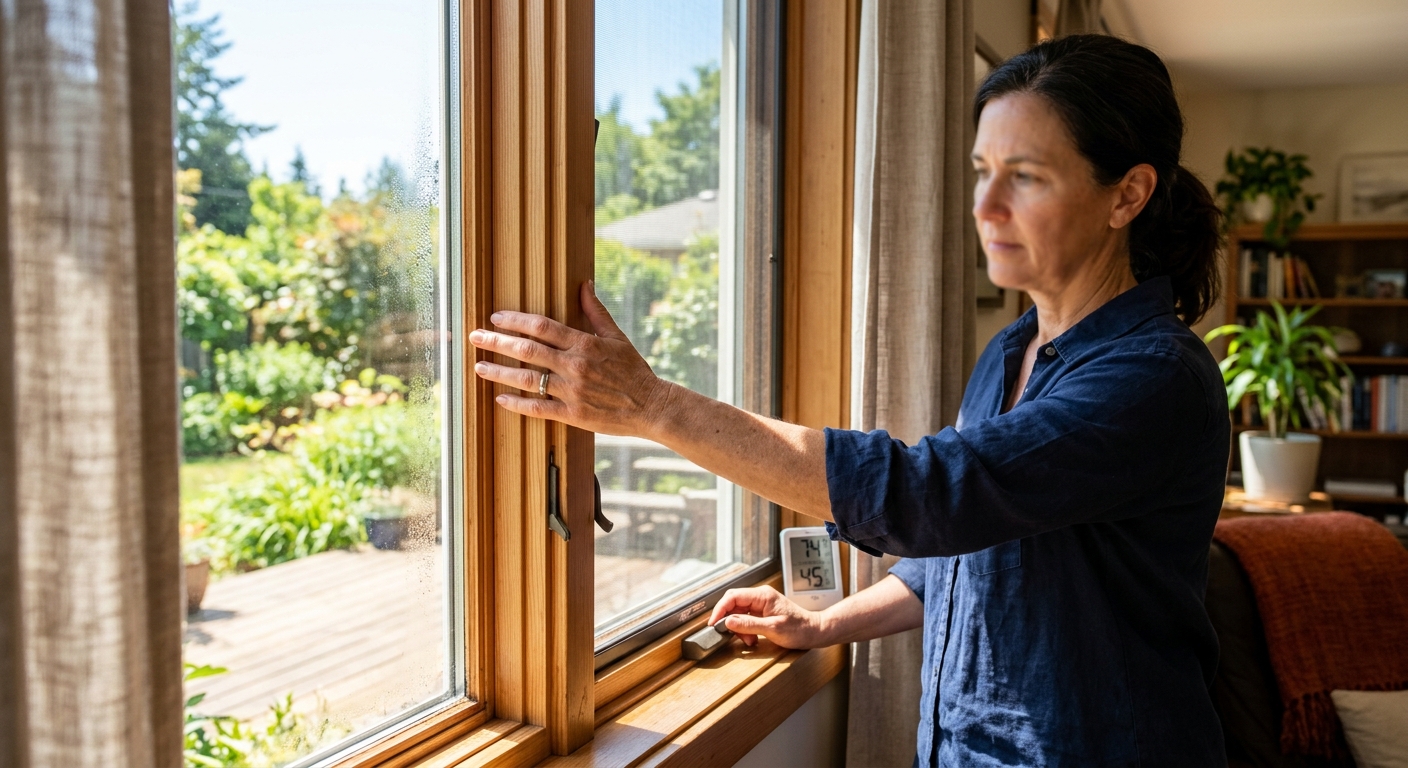
- After installation, use a simple room thermometer to compare the temperature near your south window before and after treatment on a sunny afternoon. A well-applied film or shade should reduce the radiant temperature felt near the glass by 8 to 15 degrees Fahrenheit.
- Get a solar shading assessment from a window contractor or energy auditor. They can calculate the ideal overhang depth for your latitude using the formula: overhang depth equals window height multiplied by the tangent of the summer solstice sun angle. For most US homes at 35 to 45 degrees latitude, a 12 to 18 inch fixed overhang shades the summer sun completely while allowing full winter sun penetration.
- For fixed overhangs or extended eaves, hire a contractor to extend the roofline or add a structural awning bracket system. Cost ranges from $500 to $1,500 for a single window section. This is permanent, low-maintenance, and highly effective.
- For flexibility without structural changes, install retractable motorized awnings on south-facing windows and doors. These can be extended in summer and retracted in winter. Expect to pay $600 to $1,500 per awning installed. Look for models with wind sensors that auto-retract in high winds.
- If your south windows are single-pane or older double-pane with a U-factor above 0.40, consider replacing them with ENERGY STAR certified windows rated for your climate zone. Look for a U-factor below 0.30 and an SHGC of 0.35 to 0.55 for cold climates, or 0.25 or below for hot climates. Window replacement costs $400 to $900 per window installed but may qualify for the federal 25C tax credit (up to 30% of cost, capped at $600 for windows as of 2024).
- After any exterior shading installation, have an energy auditor verify the shading geometry with a sun angle tool or software model to confirm winter sun penetration is not being blocked.
Why It Works: The Benefits
Properly managed south-facing windows with high SHGC glazing can offset 15 to 25% of a home’s annual heating load, according to DOE passive solar design data. That translates to $150 to $400 per year in savings for a typical 2,000 square foot home in a cold climate.
Adding exterior shading (a fixed overhang, retractable awning, or exterior shade screen) to south windows can cut summer solar heat gain by 65 to 77%, directly reducing your cooling load and lowering AC runtime by a measurable amount.
Unmanaged south windows cause cold radiant discomfort in winter (sitting near cold glass) and hot spots in summer. Proper glazing and shading strategies eliminate these problems, creating more even temperatures across rooms.
South-facing windows deliver consistent, glare-reduced natural light compared to east or west exposures. Managing them well reduces dependence on artificial lighting, which can save an additional 5 to 10% on electricity depending on your current lighting setup.
Homes with intentional passive solar features and quality window treatments are increasingly valued by energy-conscious buyers. ENERGY STAR certified windows with proper shading can add to appraised value and reduce time on market in most US regions.
💰 Savings Impact by Action
Properly managed south windows with appropriate SHGC glazing can reduce annual heating load by 15 to 25% in cold climates according to DOE passive solar building design data.
A correctly sized fixed overhang or retractable awning blocks 65 to 77% of summer solar heat gain through south-facing glass, directly reducing cooling load.
Insulating cellular shades on south windows reduce solar heat gain by 40 to 60% in summer and reduce nighttime conductive heat loss by up to 40% in winter.
High-rejection solar film with an SHGC of 0.25 to 0.30 blocks 55 to 75% of incoming solar radiation before it converts to interior heat.
Replacing single-pane or degraded double-pane south windows with ENERGY STAR certified units reduces combined heating and cooling energy use by 12 to 24% for those zones.
🏠 Key Concepts Explained
The Science Behind It
The reason south-facing windows behave so differently in winter versus summer is entirely explained by solar geometry. Earth’s axial tilt of 23.5 degrees means the sun follows a dramatically different path across the sky depending on the season. At 40 degrees north latitude (roughly Denver, Indianapolis, or Philadelphia), the sun reaches only about 26 degrees above the horizon at solar noon on the winter solstice. That shallow angle sends sunlight streaming nearly horizontally through south-facing glass, deep into interior rooms. In contrast, on the summer solstice, the sun climbs to about 73 degrees above the horizon at solar noon, shining almost straight down. A fixed overhang that projects 18 inches out from the top of a 4-foot tall window can completely block that high summer sun while allowing the full low winter sun to enter unobstructed.
Once solar radiation passes through glass, it converts to longer-wavelength infrared radiation when it strikes interior surfaces. Standard glass is largely opaque to this long-wave infrared, which is the greenhouse effect in miniature. This is why a car interior gets far hotter than the outside air even on a mild sunny day. Managing how much short-wave solar radiation enters via SHGC ratings, films, and shading is the only practical way to control this gain before it becomes heat you have to pay to remove with your air conditioner.
Thermal mass amplifies the benefit of passive solar gain by acting as a thermal battery. Materials like concrete slab flooring, brick, stone, and tile have high heat capacity, meaning they absorb large amounts of energy with only a modest temperature rise, then slowly release that energy over several hours after the sun sets. A room with 4 to 6 inches of concrete or masonry in the direct sun path can moderate temperature swings by 10 to 20 degrees Fahrenheit compared to the same room with only carpet and drywall, providing warmth well into the evening without any mechanical system running at all.
Frequently Asked Questions
▼ My south-facing room is freezing in winter even though the windows get direct sun. What am I doing wrong?
The most common cause is high nighttime heat loss back through the glass after the sun sets, combined with lack of thermal mass to store daytime heat. Make sure you are closing insulating shades at sunset, not just at bedtime. Also check if the windows have a U-factor above 0.40 since that level of conductivity can negate most of the daytime solar gain, especially in climates below 20 degrees Fahrenheit at night. Upgrading to cellular shades is the fastest fix, and window replacement is the permanent solution.
▼ I installed solar window film on my south windows and my house still overheats in summer. Did I get the wrong film?
Interior film is significantly less effective than exterior shading because the glass still absorbs and re-radiates heat into the room even when some radiation is reflected back. Check the SHGC rating of the film you used. It should be 0.25 to 0.35 for meaningful summer cooling benefit. If the film is above 0.40 SHGC, it was likely designed more for UV blocking than heat rejection. The most effective next step is adding exterior shading, even a simple retractable awning, which can cut solar gain by an additional 40 to 50% on top of the film.
▼ How do I know if my south windows are actually helping my energy bill or hurting it?
Pull two months of utility bills: one from January or February and one from July or August. If your heating bills are unusually low for your climate zone and your summer cooling bills are high, the windows are working in winter but not managed correctly in summer. You can also do a simple test: on a sunny winter day, leave shades open and note how long your furnace runs compared to a cloudy day. Noticeable reduction in furnace runtime on sunny days confirms meaningful passive solar contribution.
▼ My south windows face a neighbor’s house or fence that blocks some of the sun. Are they still worth managing?
Yes, but the passive solar benefit is reduced proportionally to how much sky the obstruction blocks. An obstruction that blocks the lower 15 degrees of sky (typical of a neighbor’s two-story house 20 feet away) can reduce winter solar gain by 20 to 40% since winter sun angles are low. In this case, prioritize the summer liability side, since high summer sun will still enter around the obstruction and create cooling loads. Focus your investment on interior shading rather than upgrading glazing for passive solar benefit.
▼ Can I apply window film myself or should I hire a professional?
DIY film application works well for standard flat residential glass up to about 40 square feet per pane. The critical steps are immaculate glass cleaning and working in low-humidity, low-dust conditions. Large panes, curved glass, or any window with an existing factory coating should be handled by a professional installer to avoid thermal stress damage or adhesion failure. Professional installation for a standard home runs $8 to $14 per square foot all-in and comes with a warranty.
Quick Tips
- Use a free tool like the National Renewable Energy Laboratory’s PVWatts or a sun angle calculator app to find the exact solar altitude at your latitude for both solstices. This tells you exactly how deep an overhang you need to block summer sun without touching winter sun.
- Light-colored interior walls opposite south windows reflect solar gain deeper into the room and onto more thermal mass. Dark walls absorb heat near the window and can cause localized overheating without spreading the benefit.
- In mixed climates (hot summers, cold winters), look for windows with a dual-purpose SHGC between 0.35 and 0.45 and a low U-factor below 0.30. This balance captures useful winter heat while limiting summer gain to a manageable level that exterior shading can handle.
- If you rent and cannot install any window treatments, a removable window film is your best tool. Many brands are held in place by static cling with no adhesive, making them fully renter-safe and removable in minutes.
Variations for Your Situation
- Apartment/Rental: Renters cannot modify windows or install exterior shading, but removable static-cling window film (brands like Gila or BDF) can be applied and removed without tools or damage, typically costing $15 to $30 per window. Pair this with a freestanding room-darkening cellular shade hung with a tension rod inside the window frame. Both are completely renter-safe and between them can reduce solar heat gain by 50 to 60% in summer.
- Tight Budget (under $50): Focus entirely on behavioral changes and low-cost interior treatments. Opening south shades during daylight in winter and closing them at sunset costs nothing. A set of blackout curtains on a tension rod for your south windows runs $20 to $35 and can reduce summer solar heat gain by 33 to 45%. A $10 room thermometer helps you track whether the changes are working.
- Older Home (pre-1980): Homes built before modern window standards are likely to have single-pane or early double-pane windows with U-factors of 0.80 to 1.30, meaning they lose heat rapidly overnight regardless of solar gain during the day. In these homes, the liability side of south windows is amplified. Prioritize adding interior insulating shades (cellular or Roman with blackout backing) immediately. Budget for window replacement within 1 to 3 years, and check for the federal 25C tax credit which can offset 30% of replacement costs.