Hold your hand near an electrical outlet on an exterior wall on a cold winter day and you may feel a faint but steady draft. That is not your imagination. Most standard outlet boxes are not sealed to the wall cavity behind them, creating a direct channel for outdoor air to pour into your living space. Multiply that across a dozen or more outlets and switches in a typical home, and you have a significant source of energy loss hiding in plain sight.
The U.S. Department of Energy estimates that air leakage accounts for 25 to 40% of the energy used for heating and cooling in a typical home. Electrical outlets, switch plates, and light fixtures on exterior walls contribute meaningfully to that total. The good news is that fixing them is one of the cheapest and fastest improvements a homeowner can make, often costing less than $20 in materials and requiring no special skills or tools.
In this post, you will learn exactly why outlets leak, how much it costs you, and two practical approaches to sealing them: a quick five-minute fix using foam gaskets, and a more thorough DIY method using low-expansion spray foam inside the wall cavity. Both approaches pay for themselves within months, not years.
What You’ll Need
Click on an item below to shop for the recommended items for this recipe on Amazon.
As an Amazon Associate, we earn from qualifying purchases.
How to Do It
- Turn off the circuit breaker for the outlet you are working on and use a non-contact voltage tester to confirm the power is off before touching anything.
- Remove the outlet cover plate using a flathead or Phillips screwdriver. Set the screw somewhere safe.
- Place the pre-cut foam gasket behind the cover plate, aligning the cutouts with the outlet slots or switch toggle.
- Press the cover plate and gasket firmly back against the wall and reinstall the screw. The gasket should compress slightly and seal the gap between the plate and the drywall.
- Restore power at the breaker and move to the next outlet. Prioritize outlets on north and west-facing exterior walls, which face the harshest weather in most U.S. climates.
- After finishing all outlets, do the same for light switch plates and any low-voltage cable plates (cable TV, ethernet, phone) on exterior walls.
- Turn off the breaker for each outlet you will be working on. Confirm power is off with a non-contact voltage tester before proceeding.
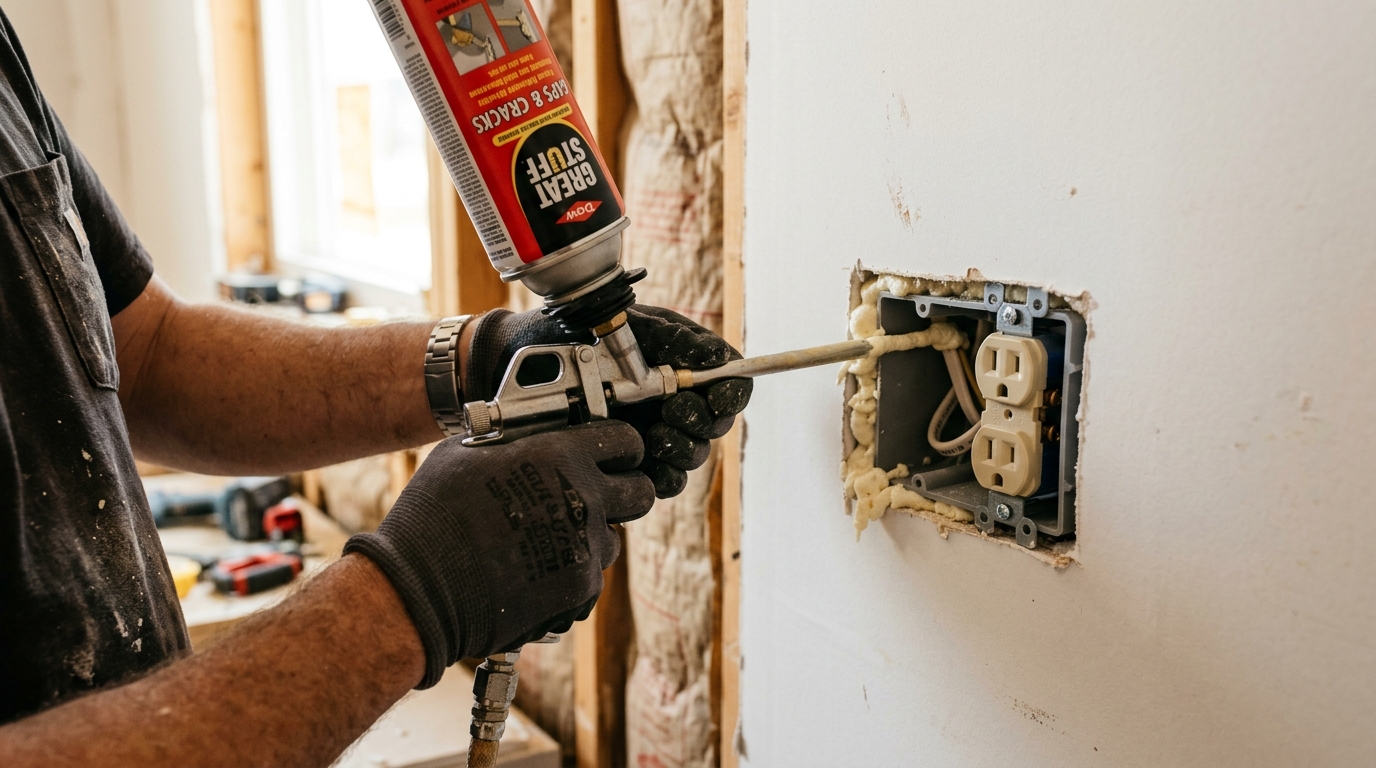
- Remove the cover plate and carefully pull the outlet or switch slightly out of the box by its ears to access the gaps around the box perimeter. Do not disconnect any wires.
- Using a can of low-expansion fire-rated foam sealant, insert the straw tip into the gap between the electrical box and the surrounding drywall. Apply a thin bead around the full perimeter of the box, filling the gap without overfilling.
- Also apply foam into the knockouts at the back or sides of the box where wires enter, as these are major air pathways into the stud cavity.
- Wait 15 to 30 minutes for the foam to tack up, then gently push the outlet back into the box and reinstall the cover plate with a foam gasket layered on top for a two-layer seal.
- Restore power and test the outlet with a lamp or phone charger. Check the foam seal visually in 24 hours and trim any excess with a utility knife before replacing the cover plate if needed.
Why It Works: The Benefits
Comprehensive air sealing including outlets, switches, and penetrations can reduce annual heating and cooling costs by 10 to 20%, translating to $150 to $400 per year for a typical home spending $1,500 to $2,000 annually on energy.
Sealing outlet air leaks eliminates cold drafts along exterior walls in winter, making rooms feel warmer at the same thermostat setting and reducing the need to bump the heat up by 2 to 3 degrees just to feel comfortable.
Every cubic foot of outdoor air that sneaks in must be heated or cooled. Sealing outlets reduces the total load on your system, shortening run cycles and potentially extending equipment life by reducing compressor and furnace starts.
Blocking the air pathway at outlets prevents humid air from condensing inside wall cavities, protecting insulation, wood framing, and drywall from moisture damage that can cost thousands of dollars to remediate.
Air sealing materials used as part of a broader home weatherization project may qualify for the federal 25C energy efficiency tax credit, which covers 30% of costs up to a combined annual limit of $1,200 starting in the 2023 tax year.
💰 Savings Impact by Action
Adding foam gaskets behind cover plates on all exterior-wall outlets and switches reduces air infiltration at those points by up to 80%, contributing roughly 3 to 5% to whole-home energy savings.
Combining gaskets with low-expansion foam inside the box-to-framing gap can reduce per-outlet air leakage by 90 to 95%, roughly doubling the energy benefit of gaskets alone.
Sealing outlets alongside attic bypasses, rim joists, and window trim as part of a complete air sealing project delivers 10 to 20% annual savings on heating and cooling per DOE data.
Blocking air movement through wall cavities at outlet gaps restores up to 50% of the lost effective R-value of existing batt insulation by eliminating convective bypass airflow.
🏠 Key Concepts Explained
The Science Behind It
Air moves from high pressure to low pressure, and it does not care whether it travels through a window, a crack in the foundation, or an electrical box. Inside a wall cavity, the air gap between the electrical box and the rough framing creates a direct conduit between your conditioned living space and the insulated but not airtight stud bay. Because insulation materials like fiberglass batts resist heat flow by trapping still air, any pathway that allows air to move through or around the insulation dramatically reduces its effective R-value. Research from Oak Ridge National Laboratory found that convective airflow through wall cavities can reduce installed insulation performance by 30 to 50% in cold climates.
The stack effect amplifies this problem seasonally. In winter, warm indoor air rises toward the ceiling and escapes through high openings, creating a slight negative pressure at lower levels of the home. This pressure difference draws cold outdoor air in through every available low gap, including outlets near the floor or mid-wall on exterior surfaces. In summer, the dynamic can reverse depending on whether the home is air-conditioned, with conditioned air being pushed out through high outlets. Either way, your HVAC system must work harder to compensate for air it is conditioning but never getting to use.
Foam gaskets address the gap between the cover plate and the drywall surface, which is the most visible leak point. Low-expansion spray foam inside the wall targets the deeper leak at the box-to-framing interface, which is typically larger and more impactful. Using both layers together creates a redundant seal that can reduce air infiltration through a single outlet by 80 to 95%, according to field testing by building science researchers at Lawrence Berkeley National Laboratory. At scale across 20 or 30 outlets in a home, that adds up to a measurable reduction in whole-house air changes per hour.
Frequently Asked Questions
▼ Will spray foam inside the outlet box create a fire hazard?
As long as you use fire-rated low-expansion foam rated for electrical penetrations and apply it around the outside of the box rather than inside the box itself, it is not a fire hazard. Avoid getting foam on the wires, terminals, or inside the box cavity. If you are uncomfortable working near wiring, stick to gaskets on the cover plate exterior, which involve no contact with the electrical components at all.
▼ I sealed all my outlets but the room still feels drafty. What am I missing?
Outlets are one of many air leakage points. Check the baseboard gap where the wall meets the floor on exterior walls, the window and door rough openings behind the trim, recessed lights in the ceiling if you have a room above a garage or attic, and any pipe or wire penetrations through exterior walls. A $25 smoke pencil or incense stick on a windy day will help you locate the remaining leaks visually.
▼ Can renters do this without landlord permission?
Yes, foam gaskets are completely reversible. You simply remove the cover plate, peel off the gasket, and replace the plate when you move out, leaving no trace. Low-expansion spray foam inside the wall cavity is more permanent and you should ask your landlord before using it. For renters, the gasket-only approach is the right call and still delivers meaningful savings.
▼ How much will I actually see on my utility bill?
Outlet sealing alone may not produce a dramatic single-line-item drop on your bill, but as part of whole-home air sealing it contributes to the 10 to 20% annual savings range documented by the DOE. Most homeowners who seal outlets along with attic bypasses, basement rim joists, and window trim report noticeably lower bills within the first full heating or cooling season, typically one to three billing cycles.
▼ My home has old knob-and-tube wiring. Can I still use this method?
Do not use spray foam around knob-and-tube wiring without consulting a licensed electrician first. Knob-and-tube conductors are designed to dissipate heat through open air, and sealing them in foam can cause overheating and create a fire risk. An electrician can assess whether the circuits in question are still active and advise on safe options. Gaskets on the cover plate exterior are generally considered low-risk since they do not enclose the wiring itself.
Quick Tips
- Prioritize outlets on north and west-facing exterior walls first since these experience the greatest temperature differential and therefore the highest air pressure driving infiltration.
- Use fire-rated foam labeled for electrical penetrations. It is UL-listed for use near wiring and costs only marginally more than standard foam at hardware stores.
- Do not forget low-voltage plates such as coaxial cable, ethernet, and telephone jacks on exterior walls. These have no gasket options built in and are almost universally unsealed from the factory.
- After sealing, hold a lit incense stick or a smoke pencil near the sealed outlet during a windy day to verify the seal is effective. No smoke movement means the air pathway is closed.
Variations for Your Situation
- Apartment/Rental: Renters can safely use pre-cut foam gaskets on all outlet and switch cover plates with no landlord permission needed and no permanent alteration to the unit. A full pack of 25 gaskets costs around $8 to $12 at any hardware store. Focus on exterior-facing walls, which are usually the walls shared with the building exterior rather than neighboring units or interior hallways. Skip the spray foam method unless you have written permission.
- Tight Budget (under $20): Buy a single pack of foam gaskets for $8 to $12 and spend one hour walking your home to identify every outlet and switch on an exterior wall. Install gaskets on all of them in a single session. This zero-tool approach requires only a screwdriver, costs under $15 total, and can be completed by anyone in an afternoon. It will not deliver the same performance as the spray foam method but gets you 60 to 70% of the benefit for a fraction of the effort.
- Older Home (pre-1980): Homes built before 1980 tend to have far more air infiltration through walls because air sealing was not a code requirement and insulation was often installed without vapor barriers or airtight rough framing. In these homes, outlet gaps are larger and more numerous, making the spray foam method substantially more impactful. If your home has knob-and-tube or aluminum wiring, get an electrician’s sign-off first. Consider pairing outlet sealing with a professional blower-door test to identify the highest-impact leaks before investing in more extensive weatherization upgrades.