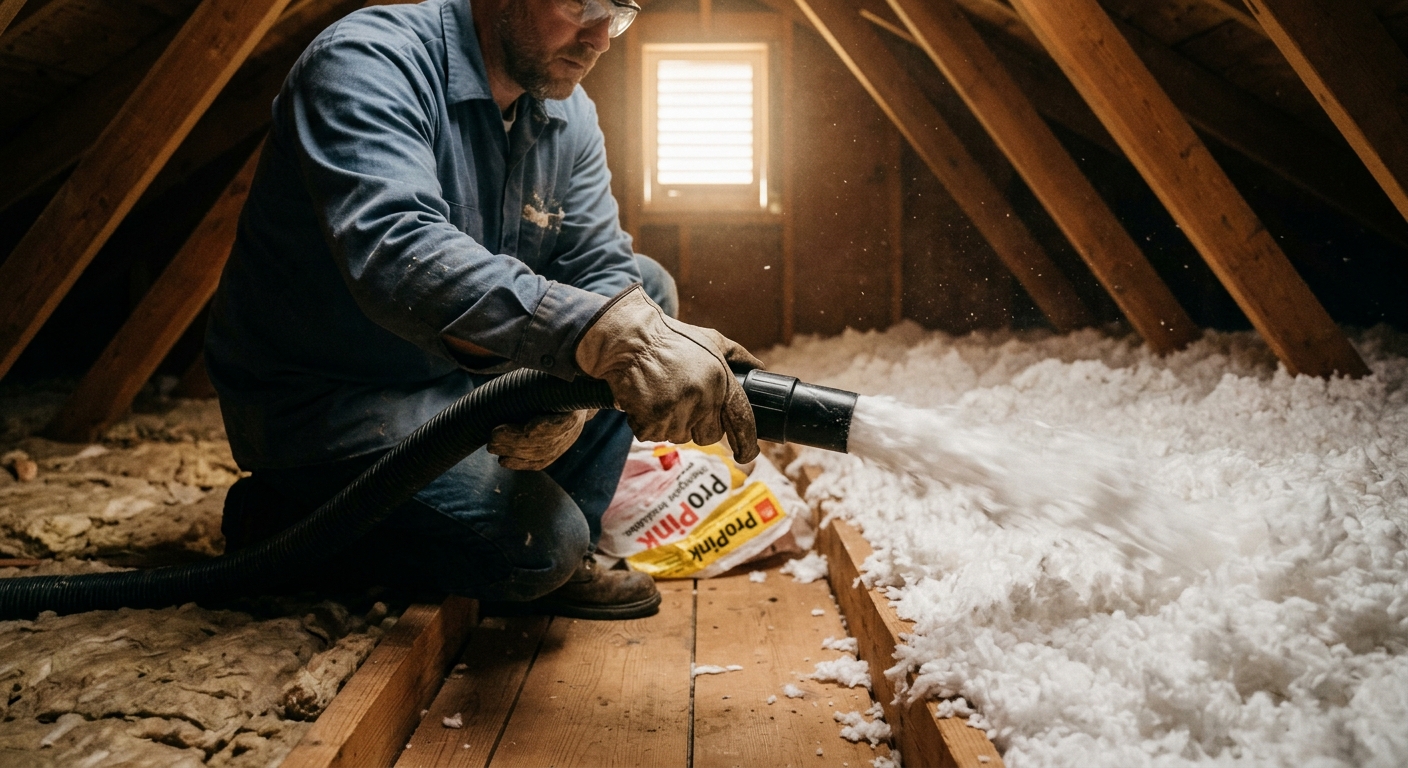
If your home feels like an oven in July and a freezer in January despite running your HVAC constantly, your attic is almost certainly the culprit. Heat moves relentlessly from warm areas to cool ones, and a thin or degraded layer of attic insulation gives it almost no resistance. The Department of Energy estimates that a properly insulated attic can cut heating and cooling costs by 15 to 25%, and in homes with older, compressed, or water-damaged insulation, the savings are often even greater.
Most homes built before 1990 have attic insulation rated at R-11 to R-19, well below the current DOE recommendation of R-38 to R-60 depending on your climate zone. That gap between what you have and what you need is costing you money every single day. The good news is that adding insulation is one of the most straightforward home upgrades available, and in many states, utility rebates and federal tax credits can cut your out-of-pocket cost by 30% or more.
In this post, we cover how to measure what you have, what you need, and exactly how to get there, whether you want to tackle it yourself over a weekend or bring in a professional crew. We include real cost estimates, payback calculations, and the building science behind why this upgrade works so well.
What You’ll Need
Click on an item below to shop for the recommended items for this recipe on Amazon.
As an Amazon Associate, we earn from qualifying purchases.
How to Do It
- Bring a ruler or tape measure into the attic and measure the depth of existing insulation in several spots. Multiply depth in inches by the R-value per inch for your insulation type: roughly R-3.2 per inch for fiberglass batts, R-3.7 per inch for cellulose. Write down your current total R-value.
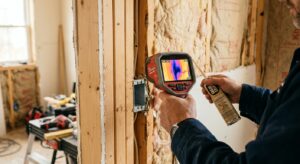
- Look for obvious attic bypasses: gaps around recessed light cans, open stud bays above interior walls, plumbing and electrical penetrations, and the attic hatch itself. These are the biggest air leakage points.
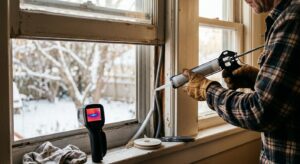
- Use a can of low-expansion spray foam to seal all small gaps and penetrations up to about 1 inch wide. For larger gaps around top plates or open stud bays, use rigid foam board cut to fit and sealed around the edges with foam.
- Seal the attic hatch with weatherstripping around the frame and add a rigid foam cover or insulated attic stair cover rated at least R-10 on top.
- If you have recessed light cans in the ceiling below, check whether they are rated IC (insulation contact) and airtight. Non-IC cans must have a sealed cover box built around them before insulation is added to prevent fire risk and air leakage.
- Photograph the completed air sealing work for your records. This step qualifies as part of the insulation improvement for the federal tax credit when combined with added insulation.
- Calculate how many bags you need using the coverage chart on the insulation bag label. For R-49 with blown fiberglass, plan on roughly 1 bag per 40 square feet at the required depth. Add 10% for waste. Purchase all bags at once from a store offering free machine rental.
- Complete all air sealing from the Quick Fix approach above before blowing any insulation. This is the most important sequencing rule of the entire project.
- Suit up properly: wear a respirator rated N95 or higher, safety glasses, long sleeves, gloves, and a hat. Attic insulation work is dusty and the fibers are irritating.
- Install depth rulers or mark the target insulation depth on attic joists using a marker every 4 to 6 feet across the attic floor. This gives you consistent visual targets as you work.
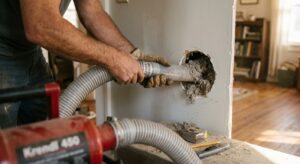
- Set up the blowing machine outside or in the garage with the hose running through the attic access hatch. Work from the farthest corners of the attic back toward the hatch, keeping the hose moving steadily to build up even layers. Aim for a consistent depth matching your target R-value, typically 12 to 16 inches of blown fiberglass for R-38 to R-49.
- Keep insulation back 3 inches from eave soffit vents to maintain attic ventilation. Use cardboard baffles or foam ventilation chutes if they are not already installed. Blocked soffit vents cause moisture problems and reduce insulation effectiveness over time.
- After completing the job, take photos of the depth rulers showing achieved depth, and save your receipts. Both are needed for the federal tax credit and any utility rebate applications.
- Get quotes from at least 3 BPI-certified (Building Performance Institute) insulation contractors. Ask each to do a visual attic assessment before quoting, not just a square footage estimate over the phone.
- Ask each contractor to specify the current R-value, the target R-value, the insulation material they will use, and whether comprehensive air sealing is included. Cheaper quotes often exclude air sealing, which undercuts the project’s value.
- Request that the contractor use dense-pack cellulose or open-cell spray foam for air sealing of bypasses before blown-in material is installed. Spray foam applied to bypasses by a professional is faster and more thorough than DIY foam cans.
- Confirm the contractor will provide a Certificate of Completion showing installed R-value, insulation type, and square footage. This document is required for the 30% federal tax credit under IRS Form 5695.
- Apply for your utility company’s insulation rebate before or immediately after the project. Many utilities offer $100 to $500 rebates for attic insulation upgrades. Some require a pre-inspection or pre-approval, so check the program rules first.
- After installation, verify depth with a ruler in several spots before the crew leaves. Also confirm soffit vent baffles are intact and the attic hatch is insulated and weatherstripped.
Why It Works: The Benefits
Upgrading from R-19 to R-49 in a typical 1,500 square foot ranch home saves $200 to $600 per year depending on climate, fuel type, and current energy prices. Homes in hot-humid or cold climates see savings at the higher end of that range.
Rooms directly below the attic, often bedrooms on upper floors, stop overheating in summer and feeling cold in winter once the attic floor is properly insulated. Many homeowners report a noticeable comfort improvement within the first heating or cooling season.
When your attic is properly insulated, your heating and cooling system runs fewer cycles to maintain the set temperature. Shorter runtimes mean less wear on compressors, fans, and heat exchangers, extending equipment life and reducing maintenance costs.
Under the Inflation Reduction Act, homeowners can claim a 30% federal tax credit on insulation materials and installation costs, up to $1,200 per year. On a $2,000 insulation project, that is $600 back at tax time, cutting your payback period significantly.
Sealing attic bypasses before insulating reduces the infiltration of dusty, humid, or moldy attic air into living spaces. Homes with properly sealed and insulated attics typically show measurably lower indoor particulate levels and reduced humidity swings.
💰 Savings Impact by Action
Upgrading from R-19 to R-49 reduces annual heating and cooling costs by 15 to 25% in most U.S. climate zones according to DOE estimates.
Sealing attic bypasses and penetrations before insulating reduces conditioned air loss by up to 20% above what insulation alone achieves.
Insulating and weatherstripping an uninsulated attic hatch or pull-down stair eliminates a concentrated bypass that accounts for up to 5% of total ceiling heat loss.
The 30% federal tax credit under the Inflation Reduction Act reduces net project cost by up to $1,200, shortening the payback period by 6 to 10 months on a typical project.
🏠 Key Concepts Explained
The Science Behind It
Heat always moves from hot to cold, and it does so through three mechanisms: conduction, convection, and radiation. In an attic, all three are at work simultaneously. Insulation primarily addresses conduction by trapping millions of tiny air pockets within its fibers or foam cells. Those trapped air pockets have very low thermal conductivity, which is why a thick layer of fluffy material can resist the flow of heat that even a thin piece of metal would conduct instantly.
The R-value scale quantifies this resistance. Each additional R unit means the heat flow rate drops proportionally. Going from R-19 to R-38 does not double your savings, however, because of the law of diminishing returns. The first layers of insulation do the heaviest lifting. Going from R-0 to R-19 blocks about 95% of conductive heat loss through that assembly. Going from R-19 to R-38 blocks roughly half of the remaining 5%, which is still meaningful but less dramatic. This is why the DOE recommends R-38 to R-60 rather than R-100, the point of diminishing returns occurs well before triple-digit R-values in most climates.
Air sealing addresses the convective side of the equation. No amount of insulation stops air from physically moving through gaps and carrying conditioned air out of your home. A single 1-inch hole in the attic floor can allow as much heat transfer as several square feet of missing insulation, because warm air moving through that gap carries its full heat content with it rather than slowly conducting through a material. This is why building scientists consistently emphasize sealing first and insulating second. The two strategies target different physical mechanisms, and together they produce results that neither can achieve alone.
Frequently Asked Questions
▼ How do I know if my current attic insulation is good enough or needs upgrading?
Bring a ruler into the attic and measure the actual depth in several spots, including corners where settling is most pronounced. If you have fiberglass batts, multiply depth in inches by 3.2. If you have loose cellulose, multiply by 3.7. If your total is below R-30, an upgrade will almost certainly pay back within 2 years. Below R-19, it is almost certainly your single highest-return improvement.
▼ My energy bills are still high even after adding insulation. What went wrong?
The most common cause is that air sealing was skipped before the insulation was added. Insulation alone does not stop air movement, and an unsealed attic floor with new insulation piled on top still allows significant heat transfer through air infiltration. The second most common cause is blocked soffit vents, which trap heat in the attic and reduce insulation effectiveness. Check both before assuming the insulation itself is the problem.
▼ Can I add blown insulation on top of my existing fiberglass batts?
Yes, and this is actually the recommended approach in most cases. You do not need to remove existing insulation unless it is wet, moldy, or pest-contaminated. Blown-in material layered over existing batts fills gaps between the batts, covers the joists to eliminate thermal bridging, and brings the total R-value up to target. Just make sure to air seal bypasses before adding the new layer.
▼ What if my attic has very low clearance and I cannot move around easily?
Low-clearance attics under 24 inches are genuinely difficult to work in safely. In this situation, a professional with a long hose run from outside the attic hatch is often the practical solution. Some contractors also offer dense-pack insulation blown in from above through holes drilled in the roof sheathing, which avoids entering the attic entirely. Get quotes specifically mentioning low-clearance experience.
▼ Will attic insulation help in summer as much as in winter?
Yes, and in hot climates the summer savings often exceed winter savings. When the outdoor temperature is 95 degrees Fahrenheit and your roof surface is 150 to 160 degrees, a well-insulated attic floor prevents that heat from radiating into your living space and forcing your AC to run constantly. Homeowners in climate zones 1 through 3 (the South and Southwest) often see their largest gains during the cooling season.
Quick Tips
- Check your climate zone on the DOE’s Zip Code Insulation Program website before buying materials. Recommended R-values vary from R-30 in Zone 2 (South Florida) to R-60 in Zone 7 (Northern Minnesota).
- Blown cellulose made from recycled paper is denser than fiberglass, settles less over time, and performs better at blocking air movement. It costs slightly more per bag but delivers better long-term R-value retention.
- Utility rebate programs often have expiration dates or limited funding. Apply as soon as possible after your project, and check your state energy office website for programs in addition to your utility’s own offerings.
- If your attic access is a pull-down stair rather than a hatch, buy or build an insulated stair cover. An uninsulated pull-down stair is essentially a 10-square-foot hole in your insulation layer with an R-value close to zero.
Variations for Your Situation
- Apartment/Rental: Renters in top-floor units can request that their landlord add attic insulation by framing it as a property improvement that reduces vacancy and wear on HVAC equipment. If the landlord declines, focus on sealing your own unit’s ceiling penetrations with removable rope caulk and adding a heavy door sweep on any ceiling hatch access in your unit. These steps are reversible and require no permission.
- Tight Budget (under $50): Start with the attic hatch. An uninsulated pull-down stair or hatch cover loses as much heat as several square feet of uninsulated ceiling. A DIY rigid foam cover costs $15 to $25 in materials and takes under an hour to build. Add weatherstripping around the hatch frame for another $10 to $15. Together these two fixes address one of the most concentrated heat loss points in the entire house with no machine rental or specialized tools.
- Older Home (pre-1980): Homes built before 1980 are far more likely to have knob-and-tube wiring, inadequate soffit ventilation, and no vapor barrier on the attic floor. Before adding any insulation, hire an electrician to assess the wiring and an energy auditor to check for moisture issues. Many older homes also have open chimney chases and balloon-framed walls with open cavities running from basement to attic, which are major air leakage paths that must be sealed before insulation is added. Budget an additional $300 to $800 for this pre-work in a pre-1980 home.