If you live in the Sun Belt, Florida, the Southwest, or anywhere that sees long, brutal summers, your attic is likely your home’s biggest enemy. On a 95°F day, an unventilated attic can reach 150°F to 160°F. That superheated air radiates downward through your ceiling, adding significant load to your air conditioner and pushing your energy bills higher every single month from May through September.
Radiant barriers work on a simple principle: reflective surfaces block heat transfer by radiation, which is the dominant form of heat gain in a sunny attic. Unlike traditional insulation that slows conductive heat flow, a radiant barrier physically reflects the sun’s infrared energy before it ever gets the chance to warm your living space. The U.S. Department of Energy estimates that radiant barriers can reduce cooling costs by 5 to 17% in hot, sunny climates, with the largest gains in homes with air ducts running through the attic.
This post breaks down exactly how radiant barriers work, what they cost, whether the investment makes sense for your specific home, and how to get them installed correctly whether you go DIY or hire a professional. We will cover two main approaches, real payback math, and the situations where a radiant barrier delivers its best return.
What You’ll Need
Click on an item below to shop for the recommended items for this recipe on Amazon.
As an Amazon Associate, we earn from qualifying purchases.
How to Do It
- Purchase a perforated radiant barrier foil rated at emissivity of 0.05 or lower. Perforated foil allows moisture vapor to pass through, which prevents condensation buildup in mixed climates. Estimate about 1.1 times your attic floor square footage in material to allow for overlaps and waste.
- Gather your tools and safety gear before entering the attic: knee pads, a respirator rated N95 or better for insulation particles, safety glasses, a headlamp, a staple gun with 3/8-inch staples, a utility knife, and a measuring tape.
- Enter the attic in the early morning when temperatures are below 100°F. Identify your rafter bays and confirm you have at least 1.5 inches of clear airspace below the roof deck before any existing insulation begins.
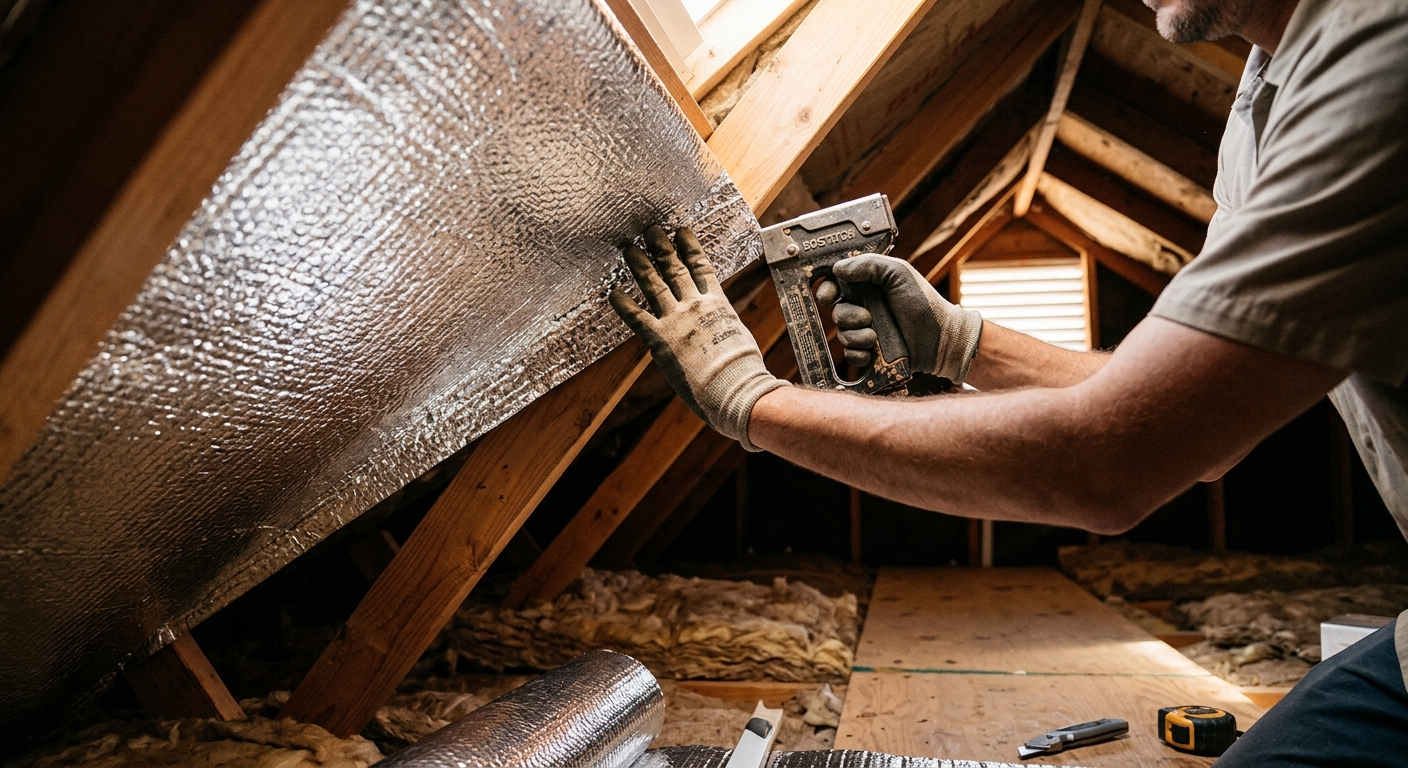
- Starting at the roof peak and working down toward the eaves, unroll the radiant barrier foil and staple it to the underside of the rafters with the reflective side facing down into the attic air space. Overlap seams by at least 2 inches. Do NOT seal the foil all the way to the eaves as you must preserve attic ventilation airflow from soffit to ridge.
- Cut around obstructions like roof vents, plumbing stacks, and electrical junction boxes using your utility knife. Leave a 1-inch gap around heat-producing fixtures and any recessed lights rated IC-AT.
- After completing installation, verify that your soffit vents remain unobstructed by pushing a flashlight toward each eave to confirm visible light. Blocked soffit ventilation will trap moisture and reduce the benefit of the barrier. Note the installation date for future performance reference.
- Request quotes from at least three insulation or energy efficiency contractors. Ask specifically for contractors experienced in radiant barrier installation, not just general insulation. Ask whether they will perform an attic assessment first to confirm your home is a good candidate.
- Before signing a contract, ask the contractor to measure your current attic R-value, inspect your duct system for leakage, and note whether any recessed lights or attic bypasses exist that should be air-sealed before the barrier goes in. Combining air sealing with radiant barrier installation improves total savings significantly.
- Confirm the product spec sheet before installation begins. The barrier should have an emissivity rating of 0.05 or lower and be perforated if your climate sees winter humidity. Request documentation showing the product meets ASTM C1313 or ASTM E1815 standards.
- On installation day, ensure the crew leaves all soffit vent areas clear. Ask them to walk you through the completed installation with a flashlight so you can verify no vents are blocked and foil overlaps are fully stapled with no large gaps at the ridge or eaves.
- Request a written invoice specifying product name, emissivity rating, square footage installed, and any warranty terms. Some radiant barrier manufacturers offer 10 to 25 year product warranties that are only valid with documented professional installation.
- Consider scheduling a post-installation blower door or duct leakage test through your local utility company, many of which offer free or low-cost energy audits. This gives you a measurable baseline to track actual savings against your utility bills over the first full cooling season.
Why It Works: The Benefits
DOE data shows radiant barriers reduce cooling energy use by 5 to 17% in hot climates. For a home spending $200 per month on summer cooling, that is $10 to $34 in monthly savings, or $60 to $200 over a 6-month cooling season.
By cutting the radiant heat load entering through the ceiling, your AC compressor runs fewer cycles per day, which extends equipment life and reduces the risk of breakdowns during peak heat months when repair costs are highest.
Homeowners in two-story homes often report 3°F to 5°F temperature reductions on upper floors after radiant barrier installation, improving comfort without increasing thermostat setpoints.
Homes with attic ductwork can recover 5 to 10% of cooling capacity lost to duct heat gain. Cooler attic conditions mean the air in your ducts stays cooler from supply plenum to register, delivering more of the cooling your AC produces.
Once installed correctly with foil facing downward on the rafters, a radiant barrier requires no seasonal adjustments, no filter changes, and no ongoing maintenance for its estimated 10 to 20 year effective lifespan.
💰 Savings Impact by Action
DOE data shows radiant barriers reduce cooling energy use by up to 17% in hot climates with attic duct systems by blocking up to 97% of downward radiant heat from the roof deck.
Sealing attic bypasses like top plates, recessed lights, and plumbing penetrations reduces conditioned air loss and can cut total heating and cooling costs by 10 to 20%.
Bringing attic insulation from R-11 to R-38 reduces conductive heat gain through the ceiling by up to 65%, translating to 15 to 25% lower cooling bills in hot climates.
Reducing attic temperature by 20°F through radiant barrier installation can recover 5 to 10% of cooling capacity lost to duct heat gain in homes with attic-mounted HVAC systems.
🏠 Key Concepts Explained
The Science Behind It
Heat moves in three ways: conduction (direct contact), convection (air movement), and radiation (infrared energy traveling through space). In a hot attic, all three are at work, but radiation is the dominant driver on sunny days. Your roof shingles absorb solar energy and heat the roof deck to temperatures of 150°F to 170°F. That hot surface then radiates infrared energy downward toward everything below it, including your ceiling joists, attic floor insulation, and any ductwork in the space. Standard fiberglass or cellulose insulation is excellent at resisting conductive heat flow, but it does very little to block radiant energy arriving from above.
A radiant barrier works by interposing a low-emissivity surface between the hot roof deck and the living space below. With an emissivity rating of 0.03 to 0.05, aluminum foil radiant barriers reflect 95 to 97% of incoming infrared radiation back toward the roof rather than absorbing and re-radiating it downward. The air gap between the foil and the surface below is essential because radiation requires a clear line of sight to transfer heat. If you compress the foil against insulation, you eliminate the air gap and the radiant barrier becomes just another layer of material with negligible insulating value on its own (typically R-1 or less).
The compounding effect on duct systems is significant from an engineering standpoint. A duct carrying 55°F supply air through a 140°F attic gains heat rapidly along its length. Studies by the Florida Solar Energy Center found that duct heat gain can reduce delivered cooling capacity by 20 to 30% in poorly insulated attic systems. When a radiant barrier drops attic air temperature by 20°F to 30°F and reduces radiant load on duct surfaces, it directly improves the efficiency of your entire HVAC system, not just the building envelope. This is why the DOE savings range skews toward the higher end of 17% for homes with attic ducts compared to homes with ductwork entirely within conditioned space.
Frequently Asked Questions
▼ How much will a radiant barrier actually save me per year in real dollars?
The honest answer depends on your climate, cooling costs, and whether you have attic ducts. A home in Phoenix or Orlando spending $2,400 per year on electricity with 60% going to cooling ($1,440) could save $72 to $245 annually at the DOE’s 5 to 17% range. Homes with leaky attic ducts tend toward the high end, while tight homes with ducts in conditioned space see savings closer to 5%. Use your actual summer utility bills and apply those percentages for a realistic estimate.
▼ Does a radiant barrier work in cooler climates or does it only make sense in the South?
Radiant barriers deliver their best return in Climate Zones 1 through 3 (the hot and mixed-hot regions of the South, Southwest, and parts of the West Coast). In Climate Zones 4 and above, cooling seasons are shorter and heating seasons are longer, which means the payback period stretches to 7 to 15 years or more, making additional attic insulation almost always a better first investment. If you are unsure of your climate zone, look up your zip code on the DOE’s Building America climate zone map.
▼ My contractor says I should add insulation instead of a radiant barrier. Who is right?
They may both be right at different stages. If your attic insulation is below R-30 (about 9 inches of fiberglass batts), adding insulation will typically deliver a faster payback than a radiant barrier, because conductive losses through under-insulated ceilings are large. The ideal sequence is: air seal all attic bypasses, bring insulation up to at least R-38, and then add a radiant barrier. If your insulation is already adequate, a radiant barrier is the logical next step.
▼ My attic has spray foam on the roof deck already. Do I still need a radiant barrier?
No. If your attic has closed-cell or open-cell spray foam applied directly to the roof deck, creating a conditioned or semi-conditioned attic space, you do not need a radiant barrier. The spray foam already eliminates the air gap between the roof deck and living space and dramatically reduces radiant and conductive heat gain. Adding a radiant barrier in this configuration would provide no measurable benefit.
▼ How do I know if my radiant barrier is actually working after installation?
On a sunny afternoon, use an infrared thermometer to measure the surface temperature of your ceiling drywall from inside the living space before and after installation on comparable weather days. A properly installed radiant barrier typically reduces ceiling surface temperature by 5°F to 10°F, which you can measure directly. You can also compare monthly utility bills against the same month from the prior year, though weather variation makes this less precise without degree-day adjustments.
Quick Tips
- Buy perforated radiant barrier foil rather than solid foil in any climate that sees meaningful rainfall or humidity. The perforations allow moisture vapor to pass through and prevent condensation from building up on the foil surface.
- Check your attic ventilation before installing a radiant barrier. A minimum ventilation ratio of 1 square foot of vent area per 150 square feet of attic floor is required by most building codes. Adding a barrier to a poorly ventilated attic can trap heat rather than reduce it.
- If your attic insulation is below R-30, adding insulation will almost always deliver a better return on investment than a radiant barrier alone. Stack both improvements for maximum savings: air seal first, insulate second, add radiant barrier third.
- Take before-and-after thermostat readings at the same time of day on comparable weather days to measure comfort improvement. For precise savings data, compare your utility bills month-over-month against the same months from the prior year, adjusting for any significant weather differences.
Variations for Your Situation
- Apartment/Rental: Renters cannot modify attic insulation, but if you are in a top-floor unit with a hot ceiling in summer, ask your building manager or HOA about adding a radiant barrier to the shared attic. Many property owners will consider it once shown the energy cost reduction data. In the meantime, insulated cellular window shades and draft snakes under doors help reduce solar gain and air leakage at the individual unit level for under $100.
- Tight Budget (under $200): Skip the professional assessment and focus on a partial DIY install covering the largest unobstructed rafter bays directly above your main living areas and hallways. A 500-square-foot partial installation covering high-traffic zones costs roughly $75 to $125 in materials and can still deliver noticeable comfort improvement upstairs, even if overall savings are proportionally lower than a full installation.
- Older Home (pre-1980): Homes built before 1980 often have less than R-11 in the attic (3 to 4 inches of original insulation) and significant air leakage through unsealed top plates, recessed lights, and attic hatches. In these homes, air sealing and insulation upgrades will almost always outperform a radiant barrier dollar for dollar. Complete a full attic air seal and insulate to at least R-38 first. Once that is done, a radiant barrier becomes a high-value add-on that can extend savings further, especially if original ductwork is still routed through the attic space.