You know the feeling: the rest of the house is comfortable, but one room stays unbearably hot no matter what you do. Maybe it’s a west-facing bedroom that bakes all afternoon, a home office above the garage, or a sunroom that turns into a sauna by 2 PM. Before you bump the thermostat down another two degrees and add $30 to your electric bill, it’s worth understanding what’s actually making that room hot.
Heat enters a room through three pathways: radiation (sunlight streaming through windows), conduction (heat moving through walls, ceilings, and floors from outside), and internal gains (appliances, lighting, and even your own body heat). Your central AC is designed to handle an average load across the whole house, not a concentrated heat problem in one room. That’s why targeted fixes almost always outperform thermostat adjustments for single-room comfort problems.
In this post, you’ll learn exactly how to identify where your room’s heat is coming from, and then tackle it with two levels of solutions: a zero-cost quick fix you can do in 15 minutes, and a DIY upgrade that can bring lasting relief for under $150. Real numbers, real results, and no HVAC technician required.
What You’ll Need
Click on an item below to shop for the recommended items for this recipe on Amazon.
As an Amazon Associate, we earn from qualifying purchases.
How to Do It
- Close window coverings on sun-exposed windows before the sun hits them, not after. For a west-facing room, close blinds by noon so the glass doesn’t heat up in the first place. A closed light-colored blind reflects 45% of incoming solar heat back out through the glass.
- Reverse the airflow strategy: open one low window on the shaded north or east side of the house and crack a high window or interior door on the opposite side. This cross-ventilation using the stack effect can move 200 to 400 cubic feet of air per minute with no fan at all.
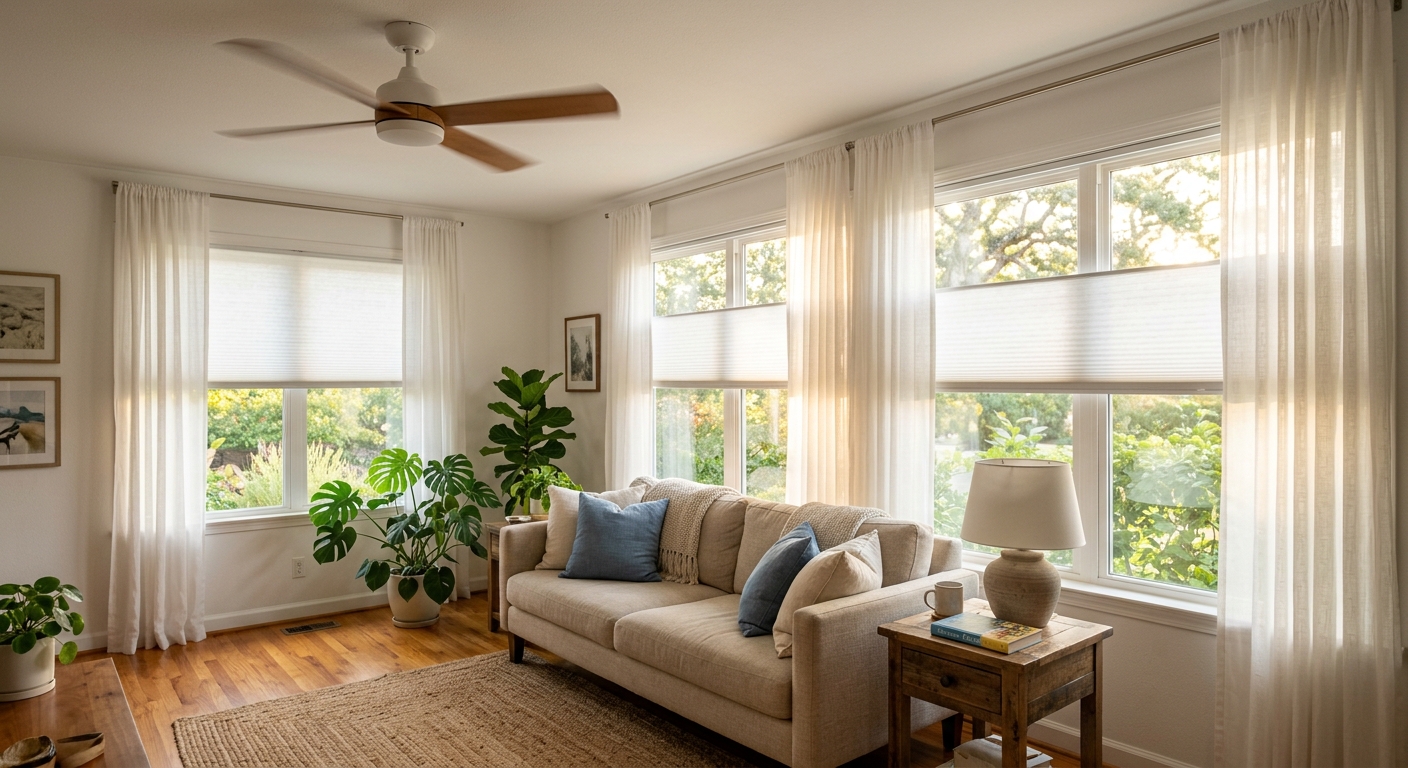
- Set your ceiling fan to counterclockwise rotation (look up and confirm the blades push air straight down) and run it on high. This creates a wind-chill effect that makes 78 degrees feel like 72 to 74 degrees. Remember: fans cool people, not rooms, so turn it off when you leave.
- Unplug or switch off electronics and lamps you are not actively using. A gaming console in standby, a cable box, and a desk lamp together can add 100 to 200 watts of continuous heat to a small room. Power strips with switches make this a one-second habit.
- Place a shallow bowl or tray of ice in front of a portable fan positioned to blow across the ice toward your seating area. As the ice melts, evaporation drops the air temperature immediately in front of the fan by 5 to 10 degrees for roughly 30 to 45 minutes, enough to get through the hottest part of the afternoon.
- Install blackout or solar shade window film on your hottest windows. Reflective window film costs $25 to $60 for a standard window and blocks 55 to 70% of solar heat gain while still allowing daylight. Clean the glass thoroughly, cut the film 1/8 inch smaller than the pane, and use the included application solution to position it without bubbles. Most films last 10 to 15 years.
- Add thermal blackout curtains or cellular shades on a south or west-facing window if film is not your preference. Look for products with a white or reflective backing. A quality cellular shade with a white exterior face can reduce solar heat gain through that window by up to 60%, costing $30 to $80 per window at most home improvement stores.
- Seal any air gaps around the room’s window frames and baseboards with paintable latex caulk. Hold a lit incense stick near window edges on a windy day to find leaks: smoke that wavers indicates a gap. Even a small gap around a window frame leaks enough conditioned air to cost $20 to $40 per year. A $6 tube of caulk takes 20 minutes to apply.
- Install a smart plug or smart power strip ($15 to $35) to automatically cut power to entertainment electronics and chargers during peak afternoon hours. Programming a power-off from 1 PM to 6 PM on weekdays eliminates phantom and standby heat during the hottest part of the day without you having to think about it.
- Add a low-profile USB or battery-powered window exhaust fan ($30 to $60) sized to fit your window opening. Position it to exhaust air outward in the hottest room at sunset, then switch it to intake mode once outdoor temperatures drop below indoor temperatures, typically after 8 PM in summer. This flushes stored heat from the room’s walls and ceiling rapidly.
- Add a ductless mini-split or portable AC unit dedicated to the problem room. A 6,000 to 8,000 BTU portable unit ($250 to $450) or a 9,000 BTU mini-split ($700 to $1,500 installed) gives you precise zone control. This is the most effective solution for a room with structural heat problems, such as a bonus room above a garage or a sunroom.
- Install an attic radiant barrier above the problem room if the space below the roof deck is accessible. A radiant barrier foil ($50 to $150 for a 500-square-foot roll) stapled to the underside of roof rafters reflects up to 97% of radiant heat before it reaches the attic floor insulation, reducing attic temperatures by 20 to 30 degrees and ceiling heat gain into the room below by 25 to 40%.
- Upgrade attic insulation directly above the hot room to at least R-38 (about 12 inches of blown cellulose or fiberglass). This is especially impactful in homes built before 1990 that often have only R-11 to R-19. Adding insulation to R-38 in an under-insulated attic can reduce ceiling heat transfer by 40 to 60% and has a payback period of 2 to 4 years through energy savings alone.
- Replace a single-pane window with a low-E double-pane unit if your home still has original single-pane glass. A single-pane window has an R-value of roughly 1. A low-E double-pane window reaches R-3 to R-4, cutting heat transfer through the glass by 50 to 70%. Many utilities offer $50 to $150 rebates per window, and the 25C federal tax credit covers 30% of installation costs through 2032.
Why It Works: The Benefits
Every degree you raise your thermostat set point saves roughly 3% on your cooling bill. Dropping a room’s felt temperature by 8 to 10 degrees through targeted fixes means you can set the whole-house thermostat 4 to 6 degrees higher, saving 12 to 18% on your monthly AC costs without any comfort sacrifice.
The ideal sleep temperature is 65 to 68 degrees Fahrenheit. A bedroom that stays 75 to 78 degrees at night disrupts deep sleep cycles measurably. These fixes can bring a hot bedroom into that optimal range without overcooling the rest of the house or running the AC all night.
Every hour you reduce AC runtime extends compressor life and delays costly repairs. Cutting a room’s heat load by 30% can reduce total system runtime by 1 to 2 hours per day during summer, which adds up to meaningful wear reduction over a season.
Unlike lowering the thermostat, which takes 20 to 45 minutes to cool a room, many of these fixes, especially fan repositioning and window covering, deliver a noticeable temperature drop within 5 to 10 minutes.
During heat waves above 95 degrees, many central AC systems run continuously and still can’t keep every room comfortable. These passive and low-power strategies reduce heat gain at the source, so the AC doesn’t have to fight as hard against extreme outdoor temperatures.
💰 Savings Impact by Action
Blocking direct sunlight with film or cellular shades reduces solar heat gain through windows by up to 60%, cutting a room’s total cooling load by 25 to 30%.
Using a ceiling fan correctly allows you to raise the thermostat 4 degrees with no comfort loss, saving approximately 12 to 14% on cooling costs per ENERGY STAR data.
Upgrading attic insulation to R-38 above an under-insulated room reduces ceiling heat transfer by 40 to 60%, cutting that room’s cooling load by 20 to 25%.
Sealing gaps around windows, outlets, and baseboards reduces conditioned air loss and infiltration, lowering overall cooling energy use by 10 to 20% per DOE estimates.
Eliminating standby electronics and switching to LED lighting reduces internal heat gains by 100 to 300 watts in a typical room, cutting room-level cooling demand by 5 to 10%.
🏠 Key Concepts Explained
The Science Behind It
The reason one room can be 10 to 15 degrees hotter than the rest of your house comes down to heat flux, the rate at which thermal energy moves through or into a surface. Windows are the biggest culprit: standard double-pane glass has an R-value of about 2, compared to R-13 to R-21 for an insulated wall. That means glass transfers heat roughly 7 to 10 times faster than the surrounding wall per square foot. On a sunny afternoon, a west-facing window can be responsible for 50 to 70% of all the heat entering a room, even though it represents a small fraction of the total wall area.
Convection and stratification compound the problem indoors. Heat is less dense than cool air, so it rises and collects at the ceiling. In a room with 9-foot ceilings, the temperature gradient between floor and ceiling can be 8 to 12 degrees in still air. That trapped ceiling layer radiates downward onto furniture, floors, and people below, raising the mean radiant temperature (what your body actually senses) even when the thermostat air temperature seems acceptable. This is why a room can feel hot at 76 degrees measured by a thermostat but comfortable at 76 degrees in a different room with better airflow.
Evaporative cooling and the wind-chill effect work because human comfort is governed by heat loss rate, not just air temperature. Your body continuously produces about 100 watts of heat at rest and must shed that heat to stay comfortable. Moving air increases convective heat loss from skin and accelerates evaporation of perspiration, both of which help your body shed heat faster. This is why a ceiling fan’s wind-chill effect is real and measurable: it doesn’t lower the air temperature, but it increases your body’s cooling rate, which your nervous system interprets as feeling cooler by 4 to 8 degrees Fahrenheit.
Frequently Asked Questions
▼ I closed the blinds and added a fan but the room is still unbearably hot. What am I missing?
The most overlooked cause is heat coming through the ceiling from a hot attic, not the windows. On a 90-degree day, an under-insulated attic can reach 140 to 160 degrees, and that heat radiates down through the ceiling continuously. Use an infrared thermometer to check your ceiling surface temperature. If it reads above 85 degrees, attic insulation or a radiant barrier is your real fix, not window treatments.
▼ Why does my bedroom feel so hot at night even after the outdoor temperature drops?
Your walls, ceiling, and furniture absorbed heat all day and are now releasing it slowly, a phenomenon called thermal mass re-radiation. The fix is to flush that stored heat out as quickly as possible after outdoor temperatures drop below indoor temperatures, usually around 8 to 9 PM in most climates. Open windows on opposite sides of the room and use a fan to exhaust air outward, which pulls cooler outdoor air across the room and accelerates the purge. This can drop a bedroom temperature by 5 to 8 degrees within 30 to 45 minutes.
▼ Can I do any of this as a renter without damaging the apartment?
Yes, most of the quick fixes require zero modifications. Repositioning fans, using blackout curtains on tension rods, placing a bowl of ice in front of a fan, and unplugging unused electronics are all renter-safe and free or nearly free. For window film, look for static-cling versions that leave no adhesive residue and can be peeled off cleanly. Avoid pressure-sensitive adhesive films without landlord permission, as they can damage coatings on modern low-E glass.
▼ How long before I see the savings show up on my electric bill?
Zero-cost changes like fan use, window covering habits, and unplugging devices will show up in your very next billing cycle if you’re consistent. Window film and insulation improvements show the clearest savings when you compare the same month year-over-year, since weather variation makes month-to-month comparison unreliable. Most homeowners who do the full DIY approach report a noticeable bill reduction within 30 to 60 days during cooling season.
▼ What if my hot room is above the garage? Is that a special case?
Yes, rooms above garages are notoriously difficult to cool because the garage ceiling (which is the room’s floor) is often uninsulated or under-insulated, and garages trap heat aggressively. The most effective fix is insulating the garage ceiling to at least R-19 with rigid foam or batt insulation, which is a weekend DIY project for about $150 to $300. Also verify that your room above the garage has no air gaps around ductwork or wiring penetrations in its floor, as garages can introduce carbon monoxide and exhaust fumes through those gaps.
Quick Tips
- Hang light-colored or white curtains instead of dark ones. A white curtain reflects up to 55% of solar radiation back out the window before it converts to heat inside the room.
- Run heat-generating appliances like dishwashers, ovens, and clothes dryers after 8 PM in summer to avoid adding waste heat during the hottest part of the day.
- Place heat-generating electronics like routers, cable boxes, and gaming consoles in a cabinet with ventilation holes rather than enclosed shelving, or move them to a hallway or cooler room.
- Use a $15 infrared thermometer to scan your walls, ceiling, and windows on a hot afternoon. Surfaces reading above 90 degrees Fahrenheit are active heat radiators and should be your first targets for improvement.
Variations for Your Situation
- Apartment or Rental: Focus on zero-modification strategies since you cannot alter windows, insulation, or HVAC. Start with static-cling window film ($20 to $40 per window at hardware stores), tension-rod blackout curtains, and a tower fan positioned to create cross-ventilation between a cracked window and an interior door. A portable evaporative cooler ($60 to $120) works well in dry climates and requires no installation.
- Tight Budget (Under $50): Start with the ice bowl fan trick and strict window covering habits, which cost nothing. Then spend $6 on a tube of caulk to seal window frame gaps, $10 on an outlet timer to auto-shut electronics during peak hours, and $20 on a single window film kit for your worst-offending window. Done right, these three purchases can drop a room’s temperature by 5 to 7 degrees for under $40 total.
- Older Home (Pre-1980): Homes built before 1980 often have single-pane windows, minimal ceiling insulation (R-11 or less), and significant air leakage around window and door frames. Prioritize the attic insulation upgrade first since it delivers the largest heat reduction per dollar in older construction. Then address air sealing around window frames and electrical outlets on exterior walls using foam gaskets ($3 per pack) before investing in window coverings, since air infiltration in older homes can account for 25 to 40% of cooling loss.