It is 3am, the house is dead quiet, and then it starts: a single, piercing chirp every 30 to 60 seconds. Your smoke detector has decided this is the perfect moment to demand attention. You stumble around in the dark trying to figure out which unit is complaining, and by the time you yank out the battery, you are wide awake and frustrated. Sound familiar? You are not alone. This is one of the most common homeowner complaints, and the good news is that it is almost always a simple fix.
The culprit in the vast majority of cases is a low or dying battery. Smoke detectors are designed to chirp when battery voltage drops below a safe threshold, and because temperatures inside walls and ceilings dip slightly overnight, battery voltage temporarily drops too, crossing the alarm threshold right around the coldest part of the night. It is not a coincidence that the chirping starts at 3am. It is basic chemistry and thermodynamics working against your sleep schedule.
In this post, we cover the four most common reasons a smoke detector chirps, how to silence it in under five minutes, how to replace and upgrade the unit properly, and how to set a maintenance schedule so this never happens at 3am again. We will also cover the difference between a chirp (manageable) and a full alarm (evacuate immediately), because knowing which is which matters.
What You’ll Need
Click on an item below to shop for the recommended items for this recipe on Amazon.
As an Amazon Associate, we earn from qualifying purchases.
How to Do It
- Locate the chirping unit: stand in the center of each room and wait for the next chirp. Chirps come from the specific unit that needs attention, not from all units simultaneously. Check hallways, bedrooms, and any unit you have not looked at recently.
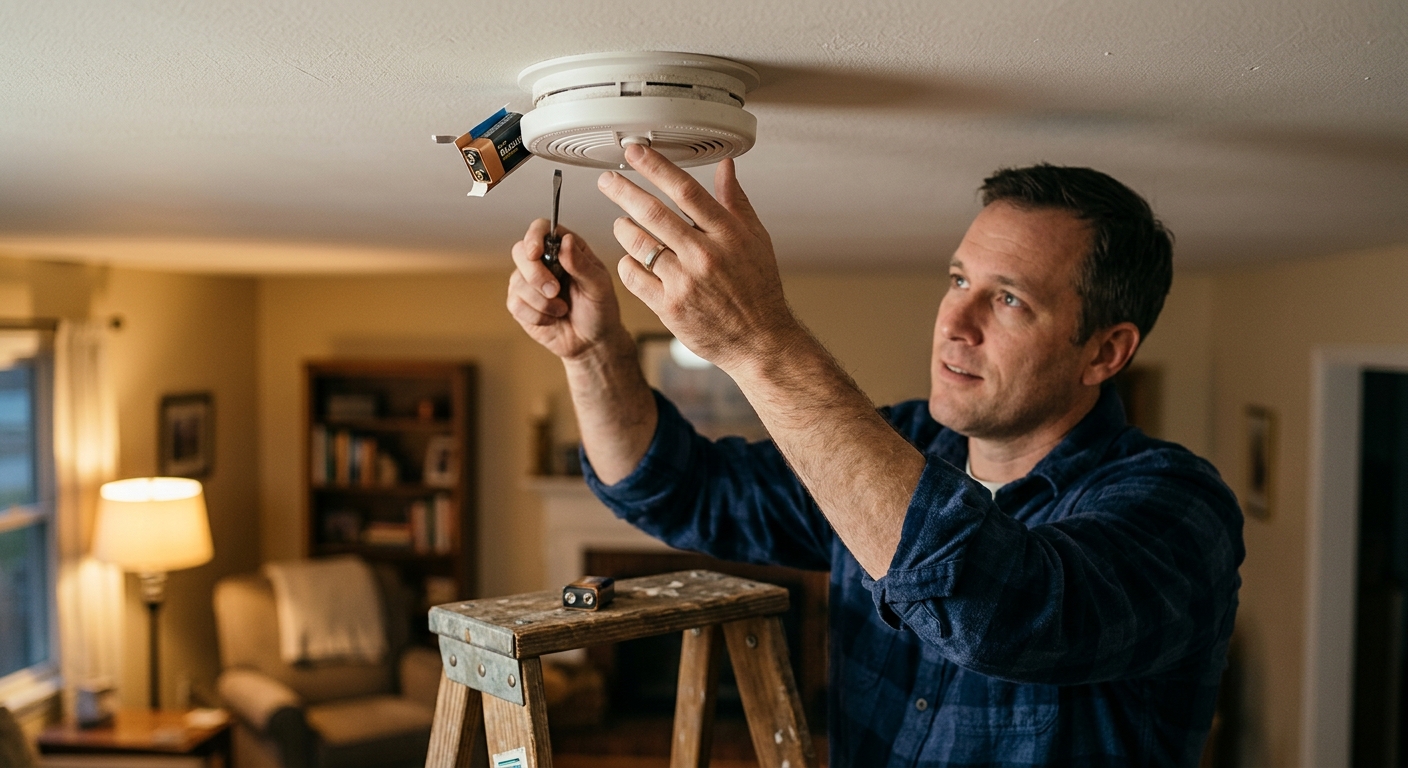
- Remove the detector from its mounting bracket by twisting it counterclockwise about a quarter turn. Most detectors unlock from the base with a simple twist.
- Open the battery compartment and remove the old battery. Note the type: most use a standard 9-volt, but some newer sealed units use a 10-year lithium battery.
- Press and hold the test button for 15 to 20 seconds with the battery removed. This drains the residual charge from the capacitor and clears the chirp memory, which is critical for hardwired units.
- Insert a fresh 9-volt alkaline or lithium battery. Lithium batteries are worth the extra $2 to $3 because they maintain stable voltage across a wider temperature range, which is exactly what causes 3am chirping with alkaline batteries.
- Reinstall the detector on its bracket, wait 30 seconds, and press the test button once to confirm it sounds a full alarm tone rather than a chirp. You are done.
- Check the manufacture date on the back of the detector. It is printed on a label or stamped into the plastic. If the unit is 10 or more years old, replace it regardless of whether a new battery stops the chirping temporarily.
- For battery-only detectors: purchase a direct replacement unit of the same type (ionization or photoelectric) and match the mounting footprint so the existing bracket works. Kidde and First Alert both make universal-bracket models for around $20 to $35.
- For hardwired detectors: turn off the circuit breaker feeding the smoke detector circuit, usually labeled ‘smoke alarms’ or ‘life safety’ in your panel. Confirm power is off by pressing the test button and confirming silence.
- Twist the old detector off its base and unplug the wiring harness connector. Most hardwired detectors use a proprietary push-in connector. Purchase a replacement from the same brand to ensure the harness is compatible, or purchase a universal hardwired detector that includes adapters.
- Clean the mounting location with a dry cloth before installing the new base. Vacuum any dust from the wiring junction box. Plug in the wiring harness, twist the new detector onto the base, and restore power at the breaker.
- Press and hold the test button for 5 seconds to run a full self-test. The alarm should sound for 3 to 5 seconds and then go silent. If multiple detectors are interconnected, all units should sound briefly during the test, confirming the circuit is intact.
- Inventory every detector in your home, noting age, type (battery or hardwired), and location. NFPA 72 requires a detector inside every bedroom, outside each sleeping area, and on every level including the basement.
- Choose a smart detector platform. Google Nest Protect ($119 each) offers the best false-alarm control with its app-based silencing and voice alerts. Kidde and First Alert offer more affordable WiFi-connected models at $50 to $70 each that still send phone notifications.
- Turn off the smoke detector circuit at the breaker before replacing any hardwired unit. Work one detector at a time so you do not lose track of which wires feed which location.
- Replace all detectors in the home within the same service window rather than staggering replacements. Mixed-age detectors on an interconnected circuit create diagnostic confusion when one unit fails years before the others.
- Download the manufacturer app and register each detector. Configure low-battery and alarm notifications to go to your phone. Many apps also log alarm history and remind you of the 10-year replacement date automatically.
- Label the inside of your electrical panel with the replacement year for your smoke detectors so any future owner or electrician knows when the next cycle is due.
Why It Works: The Benefits
Fixing the root cause eliminates recurring 3am wake-ups entirely. A properly maintained detector on a 10-year replacement schedule and annual battery swaps should never chirp unexpectedly.
A standard electrician call to diagnose and replace a chirping hardwired detector costs $150 to $300 including labor. Doing it yourself with a $10 battery or a $25 to $40 replacement detector saves that entire cost.
A detector that chirps constantly often gets its battery removed out of frustration, leaving a home unprotected. Fixing the problem correctly means your smoke detection system is actually working as intended, which reduces fire-related risk.
Cleaning dust from the sensing chamber every 6 months and using fresh lithium batteries can extend the functional life of a detector right up to its recommended 10-year replacement date, avoiding premature replacement costs.
💰 Savings Impact by Action
Replacing a detector yourself costs $10 to $40 versus $150 to $300 for an electrician, saving 80 to 90% of the total cost.
Switching to a 9-volt lithium battery reduces temperature-related false chirps by an estimated 60% compared to standard alkaline batteries in cooler climates.
Monthly detector tests and annual battery replacement maintain 100% detection reliability and eliminate unexpected failure, according to NFPA 72 maintenance standards.
Replacing detectors at or before the 10-year mark avoids reactive emergency replacement costs that average 40% higher due to urgency and late-night electrician rates.
🏠 Key Concepts Explained
The Science Behind It
The chemistry behind why smoke detectors chirp at night is simpler than most people expect. Alkaline batteries generate electricity through a chemical reaction between zinc and manganese dioxide. Like most chemical reactions, this one slows down in cooler temperatures. As your home cools overnight, especially in rooms near exterior walls or with less insulation, the battery’s output voltage drops. Smoke detectors are calibrated to chirp at approximately 7 volts, which is intentionally above true dead-battery level to give you warning time. A battery that reads 7.8 volts at 4pm might read 6.9 volts at 3am, crossing the chirp threshold for just a few hours before warming back up in the morning.
Photoelectric detectors work by bouncing an LED light beam across a sensing chamber at a specific angle away from the receiver. When smoke particles enter the chamber, they scatter light toward the receiver, triggering the alarm. Over months and years, household dust, cooking grease, and airborne particles accumulate on the chamber walls and the LED lens. This contamination scatters light even without smoke present, causing the detector’s microprocessor to interpret the false signal as either a low-level smoke event or a sensor fault, both of which can trigger chirping. Ionization detectors use a tiny amount of Americium-241 to ionize air between two charged plates. The ionization current drops when smoke particles interrupt the path, triggering the alarm. These sensors also degrade over time as the radioactive source decays and chamber geometry shifts slightly, which is precisely why a 10-year replacement cycle exists.
The residual-charge phenomenon that confuses so many homeowners is caused by a small capacitor inside the detector’s circuit board. This capacitor stores enough energy to power the chirp circuit for several minutes after the battery is removed or power is cut. That is why pressing and holding the test button after removing the battery is not optional: it actively discharges the capacitor, clears the fault memory in the microprocessor, and ensures the unit starts fresh when a new battery is installed. Skipping this step is why so many homeowners install a brand-new battery and still hear chirping two minutes later, leading them to conclude (incorrectly) that the new battery is also dead.
Frequently Asked Questions
▼ I replaced the battery and it is still chirping. What is wrong?
The most likely culprit is residual charge in the capacitor that you did not fully drain. Remove the battery again, press and hold the test button for a full 20 seconds, then install a fresh battery and wait 60 seconds before deciding anything is wrong. If it still chirps after that, your detector is past its service life or has a failed sensor and needs to be replaced entirely.
▼ How do I know which smoke detector is chirping when I cannot tell where the sound is coming from?
Chirps from a single detector sound subtly louder and cleaner when you are standing directly below the faulty unit. Walk slowly through each room and hallway and wait for the next chirp. Check any unit that is easy to miss, like detectors in closets, attic hatches, or basement stairways. If your detectors are interconnected, only the faulty unit chirps during a low-battery event, not all of them simultaneously.
▼ My smoke detector is hardwired. Can I still replace it myself?
Yes, in most cases. Hardwired smoke detector replacement is a straightforward DIY task as long as you turn off the correct circuit breaker first and confirm the power is off with a non-contact voltage tester before touching the wiring harness. The wiring harness connector typically pulls apart without tools. Buy a replacement from the same manufacturer to ensure harness compatibility, or purchase a universal model with adapter plugs.
▼ My smoke detector is less than 2 years old. Why is it already chirping?
On a newer detector, chirping almost always means the battery is weaker than expected, which can happen with cheap or counterfeit batteries, extreme temperature swings near the installation location, or a battery that was already partially depleted before installation. Swap in a fresh name-brand lithium 9-volt battery and the issue should resolve immediately. If the chirping continues on a unit less than 5 years old, the unit may be defective and still under the manufacturer’s warranty.
▼ Can I just take the battery out to stop the chirping and deal with it later?
Technically yes, but you should not leave it that way. A battery-only detector with no battery provides zero smoke or fire detection, which is a genuine safety risk. For a hardwired detector, removing the battery disables the battery backup but the unit will still function on AC power as long as it is connected. Fix the underlying issue within 24 hours, and never leave a battery-only detector without a working power source overnight.
Quick Tips
- Write the installation date on a piece of masking tape and stick it inside the battery compartment every time you replace the battery. You will always know exactly how old the current battery is.
- Replace all smoke detector batteries on the same day each year. Pick a memorable date like daylight saving time, a birthday, or January 1st so it becomes a habit rather than a reactive fix.
- Use a can of compressed air to blow out the sensing chamber every 6 months. This takes 10 seconds and significantly reduces false alarms caused by dust accumulation in photoelectric detectors.
- If you have multiple interconnected hardwired detectors and cannot identify which one is chirping, disconnect them one at a time from the wiring harness while the circuit is live. The chirping will stop when you disconnect the faulty unit.
Variations for Your Situation
- Apartment or Rental: Renters typically cannot replace hardwired smoke detectors without landlord approval, but you can replace the battery yourself in almost every case without permission. If the detector is past 10 years old or malfunctioning, submit a written maintenance request to your landlord immediately and keep a copy. Portable, plug-in smoke detectors like the Kidde RF-SM-DC (around $25) are a legal, renter-safe supplement if you feel the landlord-installed unit is unreliable.
- Tight Budget (under $20): A fresh 9-volt lithium battery from a name brand like Energizer or Duracell costs $8 to $12 and solves the problem in 90% of cases. Skip the smart detector upgrade for now. Focus on the battery swap, the capacitor drain step, and cleaning the sensing chamber with compressed air. These three zero-to-minimal-cost steps will restore full function to any detector that is under 10 years old.
- Older Home (pre-1990): Homes built before 1990 often have older wiring, outdated detector models, and interconnected systems that predate modern harness standards. If your detectors are original to the house, they are well past the 10-year replacement threshold and should be replaced as a priority, not just re-batteried. Budget $150 to $250 to replace all units at once with modern photoelectric or dual-sensor detectors. Have a licensed electrician inspect the wiring if junction boxes show signs of aluminum wiring, old cloth insulation, or any previous DIY splices.