Every spring, millions of homeowners are blindsided by the first serious heat wave. Windows that worked fine all winter suddenly let in a wall of radiant heat, ceiling fans spin the wrong direction, and an AC system that sat idle for months struggles to hold 78 degrees on a 95-degree day. The result is a home that stays stuffy well into the evening and a utility bill that jumps 30 to 50% compared to May.
What most people do not realize is that your home’s ability to stay cool during a heat wave has very little to do with how powerful your air conditioner is. It has everything to do with how well the building itself manages heat gain, airflow, and thermal mass. Small changes, made before the first heat wave hits, can meaningfully reduce how hard your system has to work and how comfortable your family stays during those critical first hot days.
This guide covers everything from zero-cost adjustments you can make in 15 minutes to a focused DIY upgrade weekend that can cut your cooling load by 20 to 30%. Whether you have central AC, window units, or no mechanical cooling at all, these strategies will help you stay ahead of the heat.
What You’ll Need
Click on an item below to shop for the recommended items for this recipe on Amazon.
As an Amazon Associate, we earn from qualifying purchases.
How to Do It
- Reverse your ceiling fans to counterclockwise rotation (summer mode) so they push air straight down, creating a wind-chill effect that makes a 78-degree room feel like 72 degrees. This alone can let you raise the thermostat 4 degrees without discomfort.
- Close blinds, curtains, or shades on south and west-facing windows before 10 AM and keep them closed until after 5 PM. Even basic blinds can block 30 to 45% of solar heat gain through a single-pane window.
- Set your thermostat to 78 degrees while home and 85 degrees when away. Avoid dropping the setpoint below 78 during a heat wave because the AC loses efficiency and struggles to recover quickly, costing more without added comfort.
- Switch cooking to the microwave, slow cooker, or outdoor grill for the duration of the heat wave. Running a gas range or oven adds 3,000 to 6,000 BTUs of heat directly into your kitchen, which your AC must then remove.
- Run your bathroom and kitchen exhaust fans for 15 minutes after any heat-generating activity like showering or cooking to exhaust hot humid air directly outside rather than letting it circulate back into living spaces.
- If nighttime temperatures drop below 72 degrees, open windows on opposite sides of the house for 30 to 45 minutes before bed to flush stored heat. Close everything again before sunrise to trap the cool air inside.
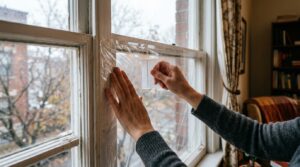
- Install reflective window film on south and west-facing windows. Solar control films cost $1 to $3 per square foot and reduce solar heat gain by 50 to 70% without meaningfully darkening the room. Measure your windows, purchase from a hardware store, and follow the included squeegee instructions for a bubble-free installation.
- Check and top off attic insulation if accessible. If your attic floor insulation is less than 10 inches deep (roughly R-30), adding blown-in insulation to reach R-38 to R-49 can reduce ceiling heat transfer by 20 to 30%. Bags of blown-in insulation cost $35 to $50 each and many hardware stores loan the blower machine for free with purchase.
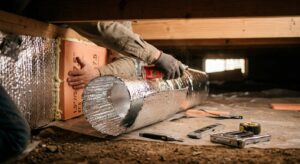
- Air seal around your AC air handler and duct connections in unconditioned spaces using mastic sealant or metal-backed tape. Leaky ducts in hot attics can reduce system efficiency by 20 to 30%, and sealing just the most accessible joints often recovers half of that loss.
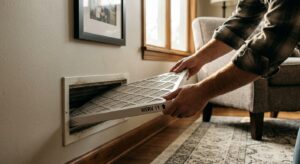
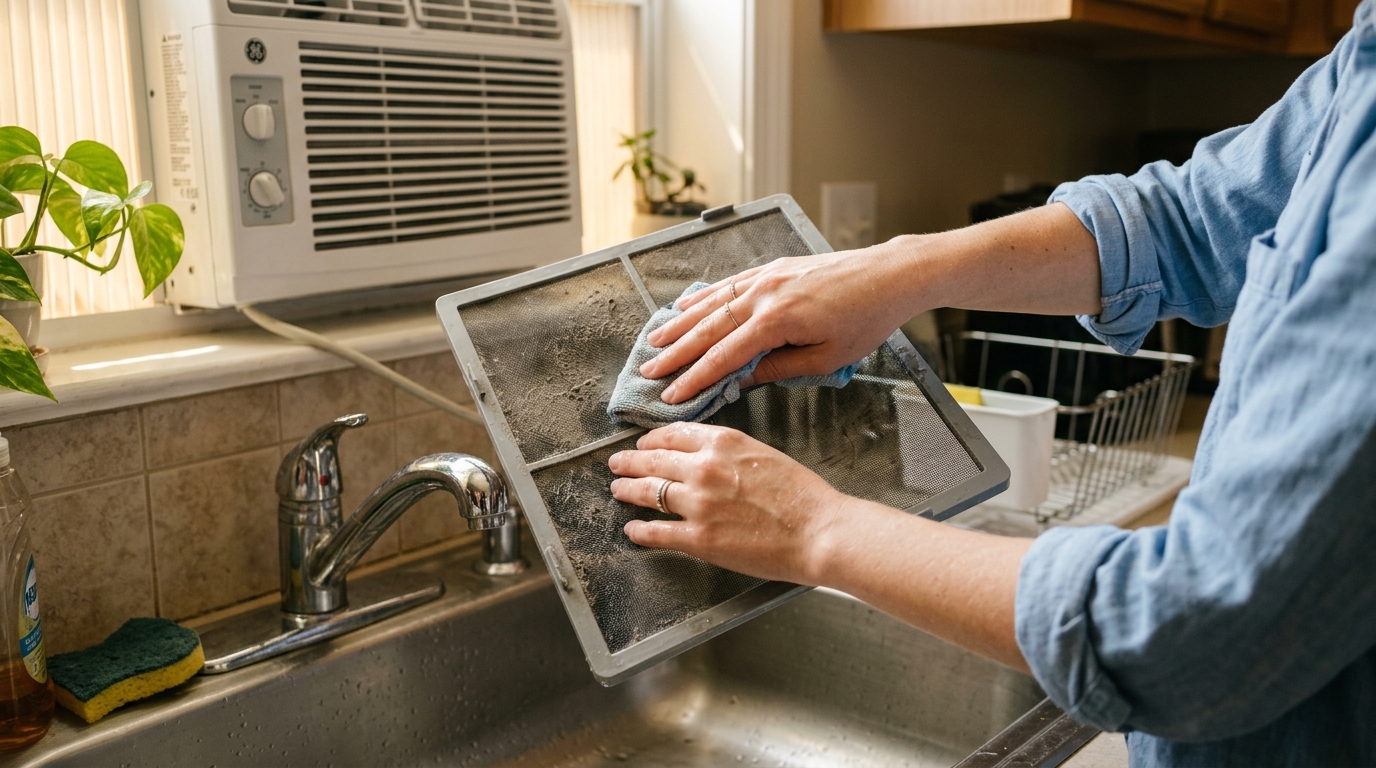
- Replace your AC filter if it has been more than 60 days since the last change. A clogged filter reduces airflow by 15 to 25%, meaning your system works harder and longer to move the same amount of cooled air. Use a MERV 8 to 11 rated filter for a good balance of air quality and airflow.
- Install a programmable or smart thermostat if you do not already have one. Models from Honeywell, Ecobee, or Google Nest cost $30 to $250 and allow automatic setbacks when you are away, which the DOE estimates saves 10% per year on heating and cooling combined.
- Add temporary or permanent exterior window shading on west-facing windows using an awning, shade sail, or bamboo roller shade mounted above the window exterior. Exterior shading is 3 to 5 times more effective than interior blinds because it stops heat before it passes through the glass.
- Schedule a professional AC tune-up that includes refrigerant level check, coil cleaning, capacitor and contactor inspection, and airflow measurement. A system running low on refrigerant can lose 20 to 40% of its rated cooling capacity while consuming the same electricity.
- Ask the technician to measure static pressure in your duct system. High static pressure (above 0.5 inches of water column) indicates duct restrictions or leaks that reduce efficiency and comfort. Many technicians will flag this for free during a tune-up.
- Request a blower door test or whole-home air leakage assessment if your home has not been tested in the last 5 years. Many utility companies offer this free or subsidized, and results pinpoint the specific gaps worth sealing to reduce both cooling load and humidity infiltration.
- Have the technician inspect and clean evaporator and condenser coils. Dirty coils can reduce system efficiency by 5 to 15% and in severe cases cause the system to ice over during a heat wave, resulting in no cooling at the worst possible time.
Why It Works: The Benefits
Combining window shading, air sealing, and thermostat scheduling can reduce summer cooling costs by 15 to 30%, saving the average household $50 to $150 over a single summer season depending on climate and home size.
Blocking solar heat gain at west-facing windows and improving airflow through the home reduces hot spots by 5 to 10 degrees in problem rooms, so every room stays livable rather than just the ones nearest the vents.
Reducing cooling load means your system cycles less frequently during the hottest afternoons, extending compressor life and lowering the chance of a breakdown during the first major heat event of the year when HVAC contractors are busiest.
Using nighttime ventilation strategies to flush stored heat from walls and floors can lower bedroom temperatures by 4 to 8 degrees compared to keeping windows closed all day, which significantly improves sleep quality without running the AC all night.
For homes without central AC or those facing a power outage during a heat event, passive strategies like window management, ceiling fan optimization, and shading can keep interior temperatures 10 to 15 degrees below outdoor peak temperatures on moderately hot days.
💰 Savings Impact by Action
Blocking solar heat gain on south and west windows with film or exterior shades reduces cooling load by up to 25% during peak afternoon hours.
Sealing duct leaks and envelope gaps prevents conditioned air loss and hot air infiltration, reducing cooling energy use by up to 20%.
Setting proper setbacks when away or asleep saves 10% annually on combined heating and cooling costs according to DOE data.
Upgrading attic insulation to R-38 or R-49 reduces heat transfer through the ceiling by 20 to 30%, directly cutting how long the AC runs.
Using ceiling fans in summer mode allows raising the thermostat by 4 degrees with no comfort loss, saving roughly 8% on cooling costs per degree of setpoint increase.
🏠 Key Concepts Explained
The Science Behind It
Your home gains heat through three mechanisms during a heat wave: conduction, convection, and radiation. Radiation from the sun through windows is the fastest and most intense, delivering heat at up to 300 BTUs per square foot per hour on a west-facing window in late afternoon. Conduction moves heat slowly through walls and ceilings, which is why a well-insulated home stays cool for hours after outdoor temperatures peak. Convection carries hot air in through gaps and leaks around doors, windows, and penetrations, which is why a drafty older home heats up so much faster than a tight newer one even with the same insulation.
The goal of every cooling strategy is to interrupt at least one of these pathways. Window film and exterior shading attack radiation at the source, stopping heat before it can enter. Attic insulation slows conduction from a 150-degree attic into your 75-degree ceiling. Air sealing reduces convective infiltration of hot outdoor air. When you layer all three, the cumulative effect is a home that your AC can realistically maintain at 76 to 78 degrees even when outdoor temperatures hit 100 degrees, because the heat flowing in is manageable relative to the system’s capacity.
Nighttime ventilation works on a separate principle called thermal mass cooling. During the day, your walls, floors, and furniture absorb heat. At night, if you flush cooler outdoor air through the home, those materials release their stored heat to the outdoor air rather than back into your living space. By morning, the thermal mass has reset to a lower temperature and acts as a slow heat sink throughout the next day, reducing peak indoor temperatures by 3 to 8 degrees in well-ventilated homes. This is why a properly managed home with no air conditioning can often stay 10 to 15 degrees below outdoor peak on moderately hot days, while a poorly managed one with AC still feels stuffy.
Frequently Asked Questions
▼ Why is my AC running all day but the house still feels hot during a heat wave?
On days above 95 to 100 degrees, most residential AC systems are designed to maintain an indoor temperature 20 to 25 degrees below outdoor conditions, which means 75 to 80 degrees indoors is actually working as designed. If indoor temperatures are 85 or higher with the system running, check the air filter first since a clogged filter is the most common cause of reduced capacity. If the filter is clean, the system may be low on refrigerant or have a failing capacitor, both of which require a licensed HVAC technician.
▼ Can I use a window fan instead of AC during a heat wave?
Window fans work well when outdoor temperatures are below indoor temperatures, typically in the evening and early morning. During the hottest part of the day (2 to 6 PM), bringing in 95-degree outdoor air will make your home hotter, not cooler, even though the moving air feels refreshing on skin. Use fans for nighttime ventilation and rely on blocking strategies like window coverings and minimizing internal heat loads during peak afternoon hours.
▼ How long before I see savings on my electricity bill after making these changes?
Behavioral changes like thermostat scheduling, window management, and shifting appliance use show up in your very next billing cycle, often reducing the bill by $20 to $60 depending on your climate and home size. Physical upgrades like window film and attic insulation begin paying back from day one of installation. Most homeowners see the full impact within the first complete cooling season, with total savings of $100 to $300 depending on climate zone and prior energy use.
▼ What if my home is older than 30 years?
Homes built before 1990 typically have more air leakage, less insulation, and single-pane or early double-pane windows, all of which make heat wave management harder but also mean the improvement potential is much larger. Start with air sealing around outlets, plumbing penetrations, and the attic hatch, since these older homes often leak 2 to 3 times as much conditioned air as a newer home. A free or low-cost energy audit from your utility company is especially worthwhile for pre-1990 homes because it will identify the highest-impact projects specific to your construction.
▼ My upstairs is unbearably hot but the downstairs is fine. What is causing that?
This is almost always an attic insulation and ventilation problem combined with duct leakage in the attic space. Heat conducts through an under-insulated ceiling all day, and if return ducts in the attic are leaky, the system pulls hot attic air directly into circulation. Check the attic insulation depth and inspect accessible duct connections for gaps. If the ceiling above your upstairs is warm to the touch after a hot afternoon, adding insulation to reach R-38 is likely the single highest-return project you can do.
Quick Tips
- Pre-cool your home overnight before a forecasted heat wave by dropping the thermostat to 72 to 74 degrees. The thermal mass of walls and floors will hold that coolness longer than trying to pull temperature down mid-afternoon.
- Place a box fan in an upper-story window facing outward in the evening to actively exhaust hot air while open lower-level windows bring in cooler outside air, accelerating the stack effect.
- Use light-colored or white window coverings rather than dark ones on the interior. Dark blinds absorb solar heat and re-radiate it into the room, while white or reflective coverings bounce much of it back out.
- Check that your outdoor AC condenser unit has at least 18 to 24 inches of clearance on all sides and is not blocked by overgrown shrubs. Restricted airflow around the condenser raises discharge pressure and cuts efficiency by 5 to 10% on hot days.
Variations for Your Situation
- Apartment or Rental: Renters cannot modify central HVAC or install permanent window film, but cellular shades or tension-mounted blackout curtains require no tools and no landlord approval. A portable evaporative cooler (in dry climates, under 40% humidity) or a portable air conditioner with a window exhaust kit costs $200 to $600 and can lower a bedroom temperature by 8 to 12 degrees. A box fan placed in a window at night is free and highly effective when outdoor temperatures drop. Focus on blocking sunlight and eliminating internal heat sources since those strategies work in any rental without modification.
- Tight Budget (under $50): At zero cost, reverse ceiling fans, manage window coverings aggressively, raise the thermostat to 78 degrees, and shift cooking and laundry to cooler parts of the day. For under $20, a set of blackout curtain panels for west-facing windows delivers the highest return of any physical purchase. For under $50, a basic programmable thermostat replaces a manual one in about 30 minutes and saves $100 to $150 per year on combined heating and cooling according to DOE estimates. Skip window film and insulation until budget allows since behavioral changes alone can cut cooling costs 10 to 20%.
- Older Home (pre-1980): Older homes typically have attic insulation at R-11 to R-19, gaps around every penetration, and single-pane or jalousie windows that are effectively open to the outdoors. Prioritize air sealing the attic floor before adding insulation since blowing insulation over large gaps just buries them. Expanding foam sealant around plumbing and wiring penetrations in the attic costs under $30 and can reduce air leakage by 15 to 25% on its own. Window replacement may be cost-effective in extreme climates at 10 to 15 year payback periods, but interior storm window inserts cost $50 to $100 per window and offer 50 to 75% of the thermal performance of a full replacement at a fraction of the cost.