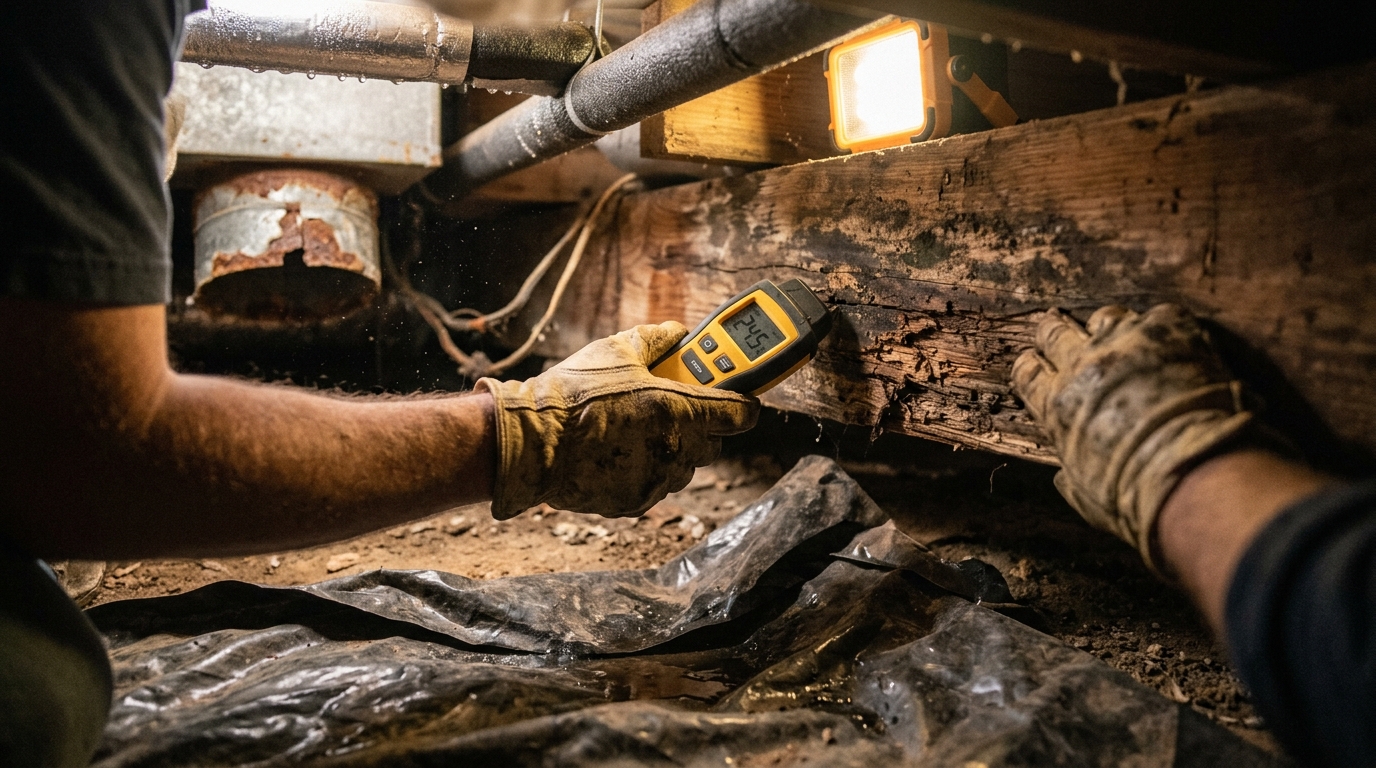
Most homeowners never think about their crawl space until something goes seriously wrong. But beneath your floors, an unconditioned, moisture-laden crawl space is actively working against you every single day. Humid air condensing on cold surfaces creates the perfect breeding ground for mold, wood rot, and pest infestations, all of which attack your floor joists, subfloor, and the mechanical systems that run through that space.
The financial stakes are significant. Replacing rotted floor joists and a damaged subfloor can cost $5,000 to $15,000 or more. A corroded HVAC system running through a humid crawl space loses efficiency and fails years ahead of schedule. Meanwhile, that same moisture migrates upward into your living space, forcing your air conditioner to work harder to remove humidity it shouldn’t have to deal with in the first place. The EPA estimates that moisture problems in crawl spaces can increase HVAC energy use by 15 to 25%.
This post walks you through how to diagnose your crawl space moisture problem, what is actually causing it, and two proven approaches to fix it, ranging from a basic vapor barrier you can install yourself in an afternoon to a fully encapsulated, conditioned crawl space that building scientists now consider the gold standard for long-term home health.
What You’ll Need
Click on an item below to shop for the recommended items for this recipe on Amazon.
As an Amazon Associate, we earn from qualifying purchases.
How to Do It
- Put on a respirator rated for mold (N95 or P100), safety glasses, knee pads, and gloves before entering. Crawl spaces are confined spaces with potential mold, animal waste, and poor air quality.
- Inspect the crawl space with a bright flashlight. Look for standing water, active leaks, sagging insulation, white fuzzy mold on joists, and any pest evidence. If you see standing water, address the drainage source before laying any barrier.
- Remove all debris, old insulation that has fallen, and any organic material from the ground surface. Rake the soil as flat and smooth as possible to prevent the barrier from puncturing on sharp rocks or debris.
- Roll out 6-mil polyethylene vapor barrier sheeting across the entire ground surface. Overlap seams by at least 12 inches and run the barrier 6 to 12 inches up every foundation wall and pier, taping seams with vapor barrier tape rated for the application.
- Secure the edges to the foundation wall using construction adhesive or mechanical fasteners rated for concrete. Weigh down the field of the barrier with clean stones, bricks, or purpose-made stakes every 6 feet to prevent it from shifting.
- Check that existing crawl space vents are not blocked by the barrier. Proper ventilation ratios for a vented crawl space are 1 square foot of net free vent area per 150 square feet of floor area per the IRC.
- Hire a licensed contractor who specializes in crawl space encapsulation or a building performance contractor certified by BPI or RESNET. Get at least three quotes and ask for references from projects completed in your climate zone.
- The contractor will seal all crawl space vents completely. In an encapsulated system, outdoor air is no longer allowed to enter the crawl space. This is code-compliant in most jurisdictions when done with a conditioned or dehumidified crawl space.
- A heavy-duty reinforced vapor barrier, typically 12 to 20 mil polyethylene or reinforced laminate, is installed across the entire floor and up all walls, fully sealed at every seam, penetration, and column with manufacturer-rated tape and adhesive.
- Rigid foam insulation (typically R-10 to R-15) is installed on the interior foundation walls rather than between the floor joists above. This brings the crawl space inside the thermal envelope of the home.
- A crawl space dehumidifier sized to the square footage is installed and plumbed to drain automatically. These units maintain relative humidity at 50 to 55%, the range where mold cannot establish. Alternatively, a small supply duct from the HVAC system can condition the space.
- After completion, use a hygrometer to monitor crawl space RH monthly for the first year. Target readings below 60% at all times. In year one, the dehumidifier will work hard as the structure dries out, then workload drops significantly.
Why It Works: The Benefits
Encapsulating a crawl space and adding rigid insulation to the perimeter walls reduces heating and cooling loads by 15 to 25% according to research from Advanced Energy Corporation and the DOE Building America program, translating to $200 to $600 per year in most climates.
Keeping relative humidity below 60% stops wood rot and prevents the fungal decay that destroys floor joists and subfloor sheathing. Replacing a damaged crawl space subfloor with joists runs $5,000 to $20,000, making moisture control one of the highest-return investments in the home.
Because of the stack effect, up to 40% of the air on your first floor has passed through the crawl space. Eliminating mold and reducing humidity at the source directly reduces airborne mold spores, allergens, and musty odors throughout the entire house.
HVAC equipment and ductwork running through a dry, encapsulated crawl space corrodes far more slowly and maintains efficiency. Reducing the moisture burden on your air conditioner can extend its useful life by 3 to 5 years and prevent costly premature compressor failure.
Moist wood and humid conditions attract termites, carpenter ants, and rodents. A dry, sealed crawl space with a thick vapor barrier is significantly less hospitable to these pests, reducing the likelihood of infestations that can cause thousands in damage.
💰 Savings Impact by Action
A properly installed ground cover vapor barrier reduces soil evaporation by up to 98%, cutting crawl space humidity enough to reduce HVAC latent load by approximately 15 to 20%.
Full crawl space encapsulation with sealed vents and wall insulation reduces total heating and cooling energy use by 15 to 25% per DOE Building America research.
Sealing leaky ducts running through the crawl space recovers 20 to 30% of conditioned air that would otherwise be lost to the unconditioned space below.
Installing or restoring R-19 to R-30 insulation in the floor joist bays reduces winter heat loss through the floor by 10 to 15%, improving first-floor comfort and lowering heating bills.
A crawl space dehumidifier holding RH below 55% reduces the moisture load on the home’s HVAC system, cutting cooling energy use by 8 to 12% in humid climates.
🏠 Key Concepts Explained
The Science Behind It
The core problem in a vented crawl space is psychrometric, meaning it involves the relationship between air temperature, moisture content, and dew point. In summer, outdoor air at 85 degrees Fahrenheit and 70% relative humidity enters through foundation vents. When that air contacts the cooler surfaces of the crawl space, such as cold water pipes, metal HVAC ducts running at 55 degrees, and floor sheathing cooled by the air-conditioned space above, it rapidly reaches its dew point and deposits liquid water. This is exactly the same process as condensation forming on a cold glass on a humid day.
Ground evaporation compounds the problem significantly. Soil acts as a reservoir that continuously releases water vapor, even when dry to the touch. Research from the Advanced Energy Corporation measured evaporation rates of 10 to 18 gallons of water per day from a bare soil crawl space of 1,000 square feet. A quality 12-mil vapor barrier reduces that evaporation by 98%, immediately and dramatically reducing the moisture load in the space. This is why even a basic ground cover barrier produces measurable improvements in both crawl space humidity and the moisture levels in the living space above.
In an encapsulated crawl space, building scientists take advantage of the fact that the crawl space temperature naturally stabilizes between interior and exterior conditions. By moving the insulation from the floor joists down to the foundation walls, the crawl space becomes part of the conditioned envelope. Duct losses drop because supply and return ducts are now inside the thermal boundary. Floor temperatures increase by 4 to 8 degrees Fahrenheit in winter, improving comfort on the first floor. And the dehumidifier or conditioned air supply maintains the space at a humidity level where biological growth simply cannot occur, protecting the structure for the life of the building.
Frequently Asked Questions
▼ My crawl space smells musty but I don’t see any mold. What’s going on?
A musty odor is produced by microbial volatile organic compounds (MVOCs) released by mold and mildew colonies, often before they are large enough to see with the naked eye. Use a flashlight and check the underside of the subfloor and the top faces of joists where moisture condenses. Measure relative humidity with a hygrometer. If RH is above 70%, mold is almost certainly present in amounts too small to see but large enough to smell. Start with a vapor barrier and improved drainage immediately.
▼ I installed a vapor barrier but my crawl space is still humid. What did I miss?
A ground cover barrier stops soil evaporation but does nothing to prevent humid outdoor air from entering through foundation vents. In humid climates, vented crawl spaces will stay humid even with a perfect vapor barrier because outdoor air is the dominant moisture source in summer. The next step is either closing the vents and adding a dehumidifier sized to your square footage, or adding a supply duct from your HVAC system to condition the space. Check that all seams in your existing barrier are taped and that no soil is exposed around piers or at wall edges.
▼ Can I close my crawl space vents myself, or do I need a permit?
Closing foundation vents requires that you simultaneously provide an alternative means of moisture control, specifically a dehumidifier or conditioned air. Without that, sealing vents traps moisture and accelerates damage. Most jurisdictions allow this under the prescriptive path in IRC Section R408.3, but permit requirements vary. Check with your local building department before closing vents, especially if you plan to add insulation to foundation walls, as that combination typically requires a permit and inspection.
▼ There is standing water in my crawl space after rain. Should I encapsulate first or fix the water entry first?
Always fix the water entry first. Encapsulating over an active water intrusion problem traps liquid water and accelerates rot, mold, and structural damage. Identify whether the water is coming through the foundation wall (a drainage or waterproofing issue), up through the floor (a groundwater or grading issue), or in through vents during driving rain. Correct the source, let the space dry completely, then install your vapor barrier or encapsulation system. A sump pump may be necessary if groundwater is the source.
▼ How do I know if my floor joists are already damaged and need replacement before I encapsulate?
Press a flathead screwdriver firmly into the wood at several points along each joist, especially at the ends near the foundation sill. Sound, dry wood will resist penetration. Rotted wood will give way easily or feel spongy. Also look for white or brown fungal growth, any joist that has visibly deflected or sagged, and any wood that crumbles or splits without effort. If you find soft spots in more than 20% of the joists, hire a structural engineer to assess before proceeding, as encapsulation cannot reverse structural damage that is already present.
Quick Tips
- Check your crawl space after every significant rain event. Water entry points are easiest to identify when conditions are wet, and catching a drainage problem early prevents it from becoming a rot problem.
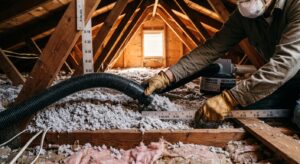
- If your existing fiberglass batt insulation between the floor joists is sagging, wet, or falling, remove it entirely before installing a vapor barrier. Wet fiberglass provides almost no insulation value and traps moisture against wood surfaces.
- Grade the soil around your foundation so it slopes away from the house at least 6 inches over 10 feet. Up to 90% of basement and crawl space moisture problems originate from surface water draining toward the foundation.
- Make sure gutters and downspouts discharge at least 4 to 6 feet from the foundation. A disconnected downspout dumping water against the house is one of the most common causes of chronic crawl space moisture.
- In hot, humid climates like the Southeast, closing foundation vents and encapsulating is almost always the correct solution. Research from Oak Ridge National Laboratory consistently shows that vented crawl spaces in humid climates perform worse than encapsulated ones.
Variations for Your Situation
- Apartment or Condo: Residents in ground-floor apartments or condos over a crawl space typically cannot access or modify the crawl space directly. Your best action is to notify your property manager or HOA in writing with documentation of musty odors, elevated indoor humidity readings above 60% RH, or visible efflorescence on walls. Request a professional moisture inspection. Lease agreements typically require landlords to address conditions that affect habitability. You can improve your unit’s air quality by running a portable dehumidifier ($150 to $300) in affected rooms and sealing any visible gaps at the floor perimeter with removable rope caulk.
- Tight Budget (under $300): Focus on the two highest-impact free and low-cost steps. First, correct all exterior drainage by regrading soil if needed and extending downspouts, both of which cost nothing but effort. Second, install a 6-mil polyethylene ground cover barrier on the entire soil surface, available at home centers for roughly $80 to $150 for a 1,000 square foot crawl space. Overlap seams 12 inches and tape with poly tape. This single step can reduce crawl space humidity by 20 to 30 percentage points in many cases. Add a digital hygrometer for $25 to monitor results and plan your next step.
- Older Home (pre-1980): Homes built before 1980 frequently have undersized or poorly placed foundation vents, deteriorated wood sill plates already showing early decay, and no vapor barrier at all. Before installing any barrier, have the structure assessed by a pest control inspector for termites and a building inspector or contractor for wood rot, as installing a vapor barrier over compromised framing without repairs accelerates hidden decay. Also have any pipe insulation in the crawl space tested for asbestos before disturbing it, a requirement in homes built before 1978. Budget an additional $500 to $2,000 for sill plate sistering or joist repair before encapsulation if the structure has been wet for years.