Picture this: your thermostat reads 72 degrees, your system has been running for two hours, and the back bedroom still feels like a sauna in July. You adjust the vents, replace the filter, and call it a mystery. But in most homes built before 2000, the real answer is hiding in the attic or crawlspace: leaky ductwork. The U.S. Department of Energy estimates that the typical home loses 20 to 30% of its conditioned air through duct leaks, holes, and poorly connected joints before that air ever reaches a living space.
Duct leaks are sneaky because they are invisible. You cannot see the conditioned air escaping into your attic, and your thermostat has no way to tell you it is happening. What you can see are the symptoms: rooms that never reach the set temperature, HVAC systems that run constantly, unusually high energy bills, and that one room everyone avoids in summer. These are not HVAC failures. They are duct failures, and they are almost always fixable without replacing your entire system.
This post breaks down exactly why duct leaks happen, how to find them yourself, and two practical approaches for sealing them, from a DIY afternoon project to a professional duct test and seal. Whether you tackle it yourself with mastic sealant and foil tape or hire a contractor for blower door testing, fixing your ducts is one of the highest-return comfort upgrades you can make to your home.
What You’ll Need
Click on an item below to shop for the recommended items for this recipe on Amazon.
As an Amazon Associate, we earn from qualifying purchases.
How to Do It
- Turn off your HVAC system and let it sit for 15 minutes. Walk through your home and note which rooms feel too warm, too cool, or stuffy. These are your target zones and will help you identify which duct runs to prioritize.
- Put on a respirator, safety glasses, and gloves. Access your attic, basement, or crawlspace and visually inspect all visible ductwork. Look for disconnected flex duct sections, gaps at boot connections where ducts meet floors or ceilings, open joints at the air handler, and any duct that is visibly collapsed or kinked.
- Feel along every joint and connection while the system is running. A duct leak will produce a noticeable air movement. You can also hold a stick of incense near connections and watch the smoke for disturbance, which indicates escaping air.
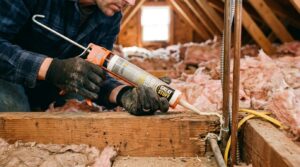
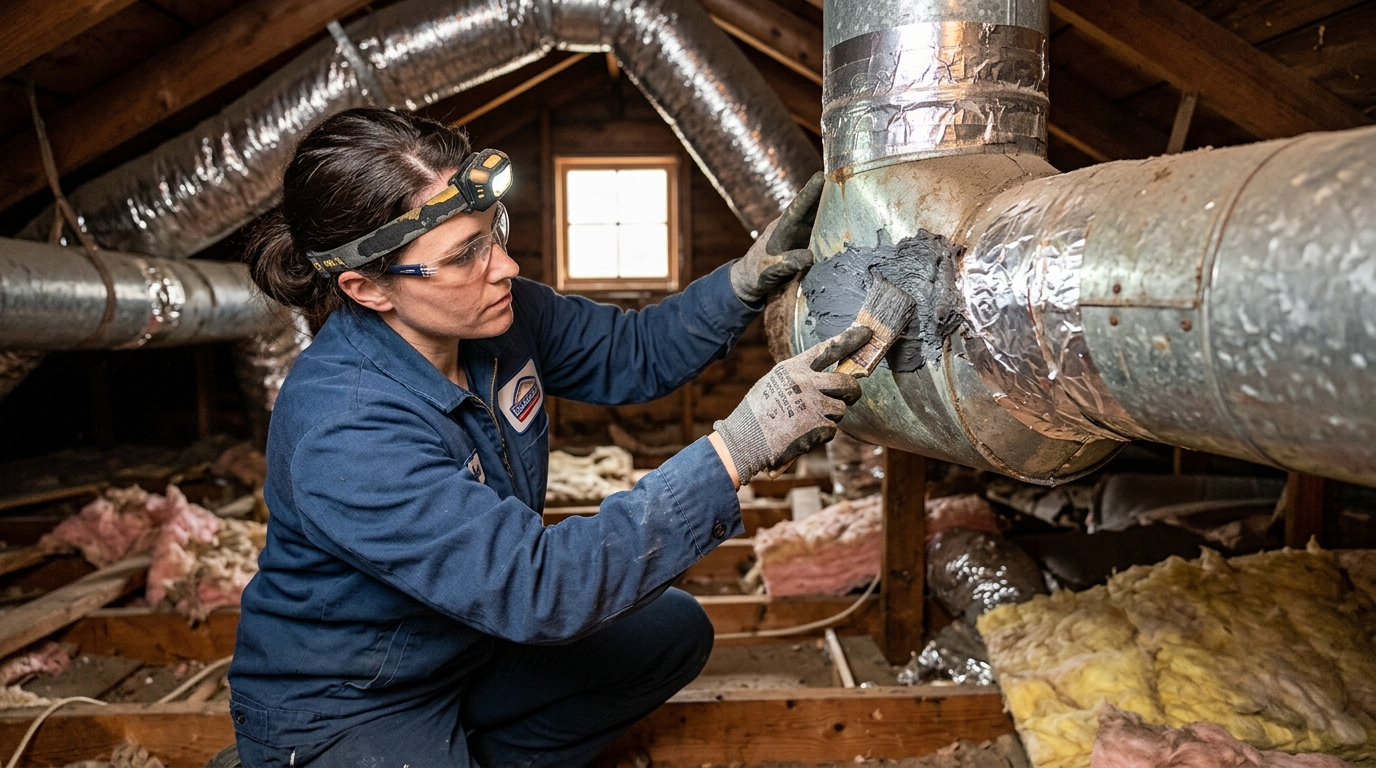
- Seal all gaps and joints with water-based mastic duct sealant, not standard gray duct tape, which fails within a few years due to heat cycling. Apply mastic with a disposable paintbrush to all joints, gaps, and seams. For gaps larger than 1/4 inch, embed fiberglass mesh tape into a first coat of mastic before applying a second coat.
- Use UL 181-rated foil tape (not cloth duct tape) on flexible duct connections at collars and boots. Press firmly and smooth out all edges to ensure adhesion. Foil tape handles the temperature cycling that destroys regular tape.
- Once sealed, consider wrapping exposed ducts in unconditioned spaces with R-6 or higher duct insulation wrap, securing it with zip ties every 12 inches. This reduces heat gain in attic ducts during summer and heat loss in cold crawlspaces in winter.
- Contact a certified HVAC contractor or energy auditor who offers duct blower testing, sometimes called a duct blaster test. This pressurization test measures exactly how much air your duct system is leaking and identifies which zones are worst, giving you a baseline and a post-seal comparison.
- Review the duct leakage report with the contractor. A well-sealed system should leak less than 4 CFM per 100 square feet of living space (CFM25 metric). Many existing homes test at 15 to 25 CFM25, meaning enormous amounts of conditioned air are escaping.
- For homes with accessible ducts, the contractor will manually seal all accessible joints using commercial mastic and tape, starting with the air handler cabinet, plenums, and main trunk lines where leakage is typically highest.
- For inaccessible ducts (between floors or in walls), ask about Aeroseal duct sealing. In this process, a non-toxic aerosol polymer is injected into the duct system under pressure. Particles accumulate at leak sites and bond to seal holes up to 5/8 inch in diameter from the inside, reaching places no hand can.
- Request a post-sealing duct blaster test to confirm results. A good contractor will show you before and after numbers. Quality professional sealing typically reduces duct leakage by 70 to 90%, with immediate improvements in room-to-room temperature consistency.
- Ask your contractor about utility rebates before paying the full invoice. Many utilities and state programs offer $200 to $500 rebates for verified duct sealing, and homes sealed to program standards may qualify for additional weatherization incentives.
Why It Works: The Benefits
Sealing leaky ducts can reduce heating and cooling costs by 20 to 30% annually, saving the average homeowner $200 to $400 per year depending on climate and home size.
Properly sealed ducts deliver the designed airflow to every register, eliminating the hot and cold rooms that frustrate homeowners and lead to thermostat wars. Rooms can feel 3 to 5 degrees more consistent after sealing.
When ducts stop leaking, your system runs fewer cycles to hit the set temperature, reducing compressor starts and extending equipment life by an estimated 2 to 5 years on a system that was previously overworked.
Leaky return ducts near attics, crawlspaces, or garages pull in dust, insulation fibers, mold spores, and even carbon monoxide. Sealing these leaks stops that contamination at the source and reduces airborne particulates throughout the home.
Restoring proper airflow through the air handler allows the evaporator coil to remove 10 to 20% more moisture per hour, reducing indoor humidity and eliminating that sticky, uncomfortable feeling on humid summer days.
💰 Savings Impact by Action
Sealing supply and return duct leaks can reduce heating and cooling energy use by 20 to 30% by eliminating conditioned air lost to unconditioned spaces.
Adding R-6 insulation wrap to uninsulated attic ducts reduces heat gain into the supply airstream, cutting cooling load by 10 to 15% in hot climates.
Sealing the air handler cabinet and plenum connections alone captures an estimated 40 to 50% of total system leakage, reducing runtime by up to 10%.
Professional Aeroseal duct sealing reduces total duct leakage by 80 to 90%, translating to average energy savings of 18 to 25% on HVAC operating costs.
🏠 Key Concepts Explained
The Science Behind It
Your HVAC duct system is designed as a closed loop: conditioned air travels from the air handler through supply ducts to each room, then returns through return ducts back to the handler to be reconditioned. Every leak in that loop breaks the pressure balance the system depends on. Supply duct leaks create positive pressure loss, meaning conditioned air that paid to be heated or cooled is dumped into an attic or wall cavity. Return duct leaks create negative pressure problems, pulling hot, dusty, or humid unconditioned air directly into the system before it reaches the living space. Both failure modes increase the work your HVAC must do to achieve the same result.
Temperature loss compounds the problem in a physics-driven way. A duct running through an attic that sits at 140 degrees Fahrenheit in July is surrounded by air that is nearly 70 degrees hotter than the 70-degree supply air inside. Even with duct insulation, heat conducts through the duct wall. A leaking joint in that environment does not just lose air volume, it actively introduces superheated attic air into the cool airstream, raising the supply air temperature before it reaches the register. By the time that air comes out of a ceiling diffuser in a distant bedroom, it may be 10 to 15 degrees warmer than it was when it left the air handler, making it nearly impossible for that room to reach the thermostat setpoint.
From an efficiency standpoint, duct leakage is treated by building scientists as a direct subtraction from your system’s effective capacity. A 3-ton air conditioner (36,000 BTU/hour) operating with 25% duct leakage delivers the equivalent of a 2.25-ton system to your living space, while still consuming the electricity of a 3-ton unit. This is why homes with severe duct leakage often have systems that run nearly continuously without achieving comfort. The fix is not a bigger system, it is sealing the one you have so it can perform as designed.
Frequently Asked Questions
▼ My HVAC runs constantly but the house never reaches the set temperature. Could this be duct leaks?
Yes, this is one of the most common symptoms of significant duct leakage. If your system is properly sized but cannot maintain the setpoint, it is often because 20 to 30% of its output is being lost before reaching the living space. Try the incense test at accessible duct joints in your attic or basement, and if you find multiple air leaks, professional duct testing will quantify exactly how severe the problem is.
▼ Can I just use the gray duct tape I already have instead of buying special foil tape?
Do not use standard cloth duct tape on ductwork. Despite its name, it is not rated for the temperature cycling inside ducts and typically fails within 1 to 5 years, leaving gaps that are now hidden under peeling tape. Use only UL 181-rated foil tape or water-based mastic sealant, both of which are specifically engineered for duct systems and available at any home improvement store for under $20.
▼ How long before I see savings on my utility bill after sealing ducts?
Most homeowners see the improvement in the first full billing cycle after sealing, typically 30 to 60 days. The savings depend on how leaky your ducts were to begin with, but homes with moderate to severe leakage commonly see a 20 to 30% reduction in heating and cooling costs. Your comfort improvement (fewer hot and cold spots, lower humidity) will likely be noticeable within the first day or two of system operation.
▼ My ducts are in the walls and ceiling where I cannot reach them. Is there anything I can do?
Yes. Aeroseal is a professionally applied process that seals leaks from inside the duct system without requiring physical access. A contractor pressurizes your duct system with a non-toxic aerosol polymer that bonds at leak sites, sealing holes up to 5/8 inch in diameter from the inside. It typically costs $1,000 to $1,500 for a full home and can reduce duct leakage by 80 to 90%, reaching spots no manual sealing method can touch.
▼ What if my home is older than 30 years? Is duct sealing still worth it?
Older homes are actually the best candidates for duct sealing because ductwork from that era was rarely air-sealed at installation and has had decades to loosen at joints. The savings potential is higher, and the baseline discomfort problems are usually more severe. Just check for asbestos insulation on older duct wrapping before disturbing anything, and have a professional inspect combustion appliances afterward if your home uses a gas furnace.
Quick Tips
- Start your inspection at the air handler cabinet. Gaps around the filter slot, access panel edges, and blower compartment are among the highest-leakage areas in most systems and take only minutes to seal with mastic.
- Check every register boot where the duct meets the floor or ceiling. These connections loosen over time and are a leading source of supply leakage directly into wall or floor cavities rather than into the room.
- After sealing, run your system for an hour and then walk the home with a bare hand near every register. Noticeably improved airflow at weak registers confirms the sealing is working.
- If your home has a crawlspace with return ducts, prioritize sealing those first. Crawlspace air is often loaded with moisture, mold spores, and radon, and return duct leaks there represent both an efficiency and a health risk.
Variations for Your Situation
- Apartment/Rental: Renters typically cannot access or modify central ductwork, but you can improve comfort by sealing around register boots where supply vents meet walls or floors using removable weatherstrip foam or non-damaging HVAC register gaskets. Report rooms that are consistently uncomfortable to your landlord in writing, since duct issues are a maintenance responsibility in most lease agreements. Portable air purifiers can also offset the air quality impact of leaky return ducts pulling in dust and allergens.
- Tight Budget (under $50): Focus entirely on the air handler cabinet and the first few feet of supply and return plenums, which cost almost nothing to seal and capture the most leakage per dollar spent. A $12 can of water-based mastic and a disposable brush can seal the air handler cabinet gaps, filter slot edges, and visible plenum joints in under two hours. This targeted approach can eliminate 30 to 40% of total system leakage with minimal investment.
- Older Home (pre-1980): Homes built before 1980 often have duct systems made of bare sheet metal with no mastic ever applied, meaning virtually every joint leaks to some degree. Before sealing, visually inspect all duct insulation for crumbling or fibrous wrapping that may contain asbestos and call a licensed inspector if you are unsure. Once clearance is confirmed, a full professional duct test and seal is strongly recommended for these homes because the leakage baseline is typically far worse than what DIY sealing alone can address.