If your home was built before 1980, chances are it was designed in an era when energy was cheap and insulation standards were minimal. The result is a house that leaks conditioned air from dozens of small gaps, has insulation rated far below modern standards, and puts enormous strain on an HVAC system that was never sized to compensate for all that loss. You end up with rooms that are too hot in summer, too cold in winter, and energy bills that seem impossible to control.
The good news is that a full HVAC replacement is rarely the first answer. In most older homes, the system itself is not the primary problem. The building envelope, meaning the walls, attic, floors, windows, and the gaps between all of them, is where conditioned air escapes and outdoor temperatures invade. Fix the envelope first, and your existing HVAC will suddenly seem far more capable. Many homeowners report a 20 to 35% drop in energy bills after envelope improvements alone, with no new equipment purchased.
This guide walks you through the highest-impact improvements you can make to an older home, from free behavioral changes to weekend DIY projects to targeted professional upgrades. Each approach is ranked by cost, effort, and return so you can start where it makes the most sense for your budget and comfort goals.
What You’ll Need
Click on an item below to shop for the recommended items for this recipe on Amazon.
As an Amazon Associate, we earn from qualifying purchases.
How to Do It
- Set your thermostat to 78 degrees in summer and 68 degrees in winter when home, then program setbacks of 7 to 10 degrees for overnight and away periods. This alone saves about 10% annually according to DOE data.
- Check all exterior door thresholds by sliding a piece of paper underneath. If it moves freely, the seal is inadequate. Purchase foam door sweeps for $5 to $8 each and install them without any tools in under 10 minutes per door.
- Locate your electrical outlets on exterior walls and feel for cold air in winter or warm air in summer. Foam outlet gaskets cost about $3 for a pack of 12 and press in behind the cover plate with no tools required.
- Reverse your ceiling fan direction. In summer, blades should spin counterclockwise (creating a downdraft) at higher speed. In winter, switch to clockwise at low speed to push warm air that has pooled at the ceiling back down. This can reduce perceived temperature by 4 degrees in summer.
- Close the fireplace damper tightly when not in use. An open damper is equivalent to leaving a 12-inch diameter hole in your ceiling. If your damper is warped or missing, a fireplace balloon insert costs $50 to $70 and blocks the opening completely.
- Access your attic and use a can of spray foam (Great Stuff or equivalent) to seal around every pipe, wire, and duct penetration through the attic floor. Pay special attention to top plates of interior walls, which are often open cavities that connect directly to living space air. This step alone can reduce infiltration by 15 to 20%.
- Seal the attic hatch with weatherstripping around the perimeter and glue rigid foam board (R-10 or better) to the back of the hatch cover. An unsealed attic hatch loses as much heat as an uninsulated wall section of the same size.
- Check your existing attic insulation depth. Fiberglass batts should be at least 10 to 14 inches deep for R-38. If you are below that, add blown-in insulation over the existing layer. Renting a blower from a home improvement store typically costs $0 when you purchase the insulation bags, which run about $1.50 to $2.00 per square foot installed.
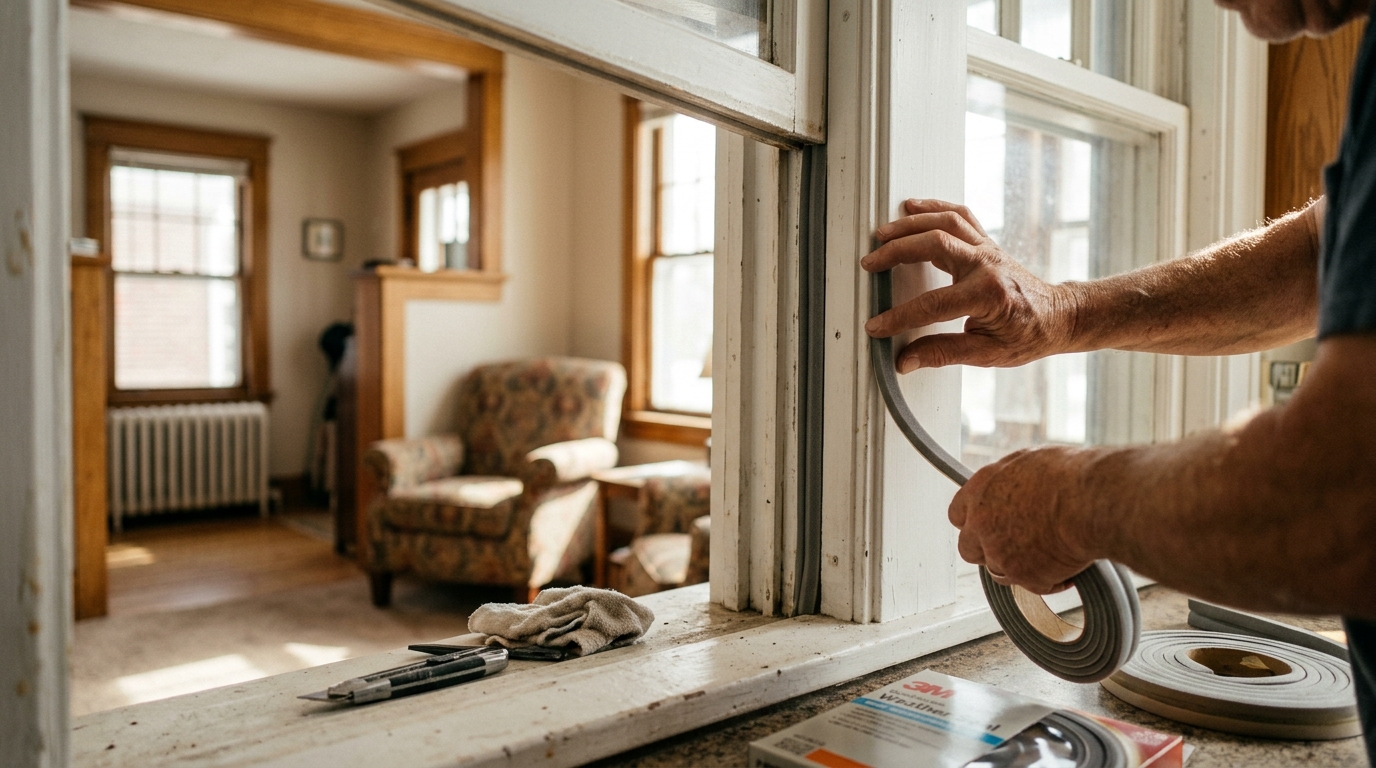
- Apply weatherstripping to all exterior doors that show visible light gaps or feel loose when closed. Self-adhesive V-seal weatherstrip ($8 to $12 per door) handles moderate gaps, while door-and-window foam tape handles larger gaps. Replace both the hinge-side and latch-side seals together.
- Caulk around all window frames on the interior side where the trim meets the drywall. Use paintable latex caulk for interior applications and silicone for exterior. Older homes frequently have gaps here that were never sealed during original construction.
- Wrap exposed hot water pipes in the basement or crawlspace with foam pipe insulation (about $0.50 per linear foot). This prevents heat loss from hot water pipes before they reach fixtures and keeps pipes from freezing near exterior walls.
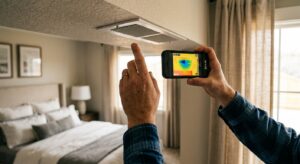
- Schedule a professional blower door energy audit with a certified BPI or RESNET auditor. The test depressurizes your home and uses infrared thermal imaging to pinpoint exactly where air and heat are escaping. Audits typically cost $200 to $400 and the findings will prioritize every dollar you spend after.
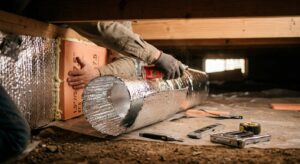
- Have the auditor pressure-test and visually inspect your duct system. In older homes, duct leakage commonly accounts for 25 to 40% of HVAC energy loss. Mastic sealant applied by a technician to accessible duct joints can recover that loss for $300 to $600, with a payback period of 1 to 2 years.
- If the audit confirms duct leakage in unconditioned spaces, consider aeroseal duct sealing, a process where a technician pumps sealant particles through the duct system to seal leaks from the inside. This costs $1,500 to $2,500 but can seal leaks that are physically inaccessible and reduce duct losses by up to 90%.
- Use the audit findings to prioritize professionally installed dense-pack cellulose insulation in exterior walls. Unlike batts, dense-pack cellulose is blown in through small holes drilled in the siding or drywall, achieving R-3.5 to R-3.8 per inch and also reducing air infiltration through the wall cavities. Cost is typically $1.50 to $3.00 per square foot of wall area.
- If your windows are single-pane and in poor condition, ask for a window replacement quote but also price interior window insulation film or exterior storm windows as alternatives. Storm windows can achieve 50 to 70% of the performance gain at 20 to 30% of the replacement cost.
Why It Works: The Benefits
Combining air sealing with attic insulation upgrades typically reduces annual heating and cooling costs by 20 to 35%, which translates to $300 to $600 per year for an average older home spending $1,500 annually on energy.
Reducing infiltration and improving insulation eliminates the hot and cold spots that make certain rooms unusable. Homeowners commonly report a 5 to 8 degree improvement in room-to-room temperature consistency after air sealing and duct improvement work.
When the building envelope holds conditioned air longer, your system cycles less frequently and runs for shorter periods. This directly extends equipment life and reduces maintenance costs over time.
Uncontrolled air infiltration in older homes pulls in attic dust, crawlspace moisture, and outdoor allergens through gaps and cracks. Sealing these pathways gives you control over where fresh air enters, reducing particulate and humidity-related issues.
Many older HVAC systems run nearly continuously during peak weather because the envelope losses are so severe. Reducing that load by even 20 to 25% means the system can finally maintain setpoint comfortably, eliminating the feeling that the AC or furnace just cannot keep up.
💰 Savings Impact by Action
Sealing top-plate bypasses and penetrations in the attic floor reduces whole-house infiltration by up to 20%, directly cutting heating and cooling load.
Upgrading attic insulation from R-11 to R-38 reduces heat gain and loss through the ceiling by 15 to 25% depending on climate zone.
Sealing duct leaks in unconditioned spaces recovers 25 to 40% of HVAC energy that would otherwise be dumped into the attic or crawlspace.
Programming 7 to 10 degree setbacks during sleeping and away hours saves approximately 10% on annual heating and cooling costs according to DOE data.
Dense-pack cellulose in previously uninsulated exterior walls reduces wall heat loss by up to 70% and can lower total energy use by 10 to 15%.
🏠 Key Concepts Explained
The Science Behind It
Every home exists in a constant battle between the conditioned air inside and the outdoor environment trying to equalize with it. Heat always moves from warm to cool, and air pressure always tries to balance across any gap it can find. In an older home, those gaps are abundant: the average pre-1980 house has the equivalent of a 1 to 2 square foot hole in its exterior when you add up every crack, penetration, and unsealed joint. Your HVAC system is essentially trying to keep a leaky bucket full.
The stack effect is particularly punishing in two-story older homes. As warm interior air rises and escapes through gaps at the upper levels (attic bypasses, top-floor window frames, exhaust fan gaps), replacement air must enter somewhere. It enters low, through crawlspace vents, basement rim joists, and ground-floor outlets on exterior walls. This creates a continuous convective loop that your HVAC has to counteract continuously. Sealing the top of the house first, specifically the attic floor bypasses and ceiling penetrations, is the single most effective way to break this cycle because it eliminates the driving force that pulls cold air in below.
Duct losses add another layer of inefficiency that is invisible to homeowners. When ducts run through a 130-degree attic in July, the temperature differential between the 55-degree supply air inside the duct and the surrounding attic air drives rapid heat transfer through the duct walls. Even well-insulated ducts lose energy this way, and ducts with leaky joints simply dump conditioned air into the attic entirely. The building science community now considers duct sealing one of the top three highest-return improvements available in existing homes, alongside attic air sealing and attic insulation, precisely because the losses are so large and the fix is relatively inexpensive.
Frequently Asked Questions
▼ My furnace or AC runs almost continuously but never seems to catch up. Why?
In older homes this almost always indicates envelope losses that exceed what the system was originally sized to handle. Start with attic air sealing and check whether your duct system is losing conditioned air into unconditioned spaces. Before replacing equipment, have a contractor perform a Manual J load calculation to determine whether the system is actually undersized or whether it is simply fighting too large an envelope load.
▼ One room is always 10 degrees hotter or colder than the rest of the house. What do I do?
Check the duct serving that room first. Disconnected, kinked, or undersized duct runs are the most common cause of extreme room-to-room temperature differences in older homes. Also check for missing insulation directly above or below the problem room. If the duct and insulation check out, a contractor can add a supplemental mini-split to that zone for $1,500 to $3,000 without touching the rest of your system.
▼ I sealed and insulated but my bills barely changed. What went wrong?
The most likely explanation is that you addressed secondary leakage points while leaving major bypasses open. Top-plate penetrations in the attic floor, the chase around a central flue or chimney, and the rim joist in the basement are the three biggest air leakage sites in most older homes and are often overlooked. If those three areas were not addressed, they can account for 50 to 60% of total infiltration on their own. Consider scheduling a blower door test to measure the actual change and identify what remains.
▼ Is it worth adding insulation if my windows are still single pane?
Yes, absolutely. Windows typically represent 10 to 15% of a home’s heat loss while the attic and walls represent 40 to 60%. Attic insulation delivers 5 to 10 times more savings per dollar spent than window replacement in most climates. Add interior window insulation film or exterior storm windows as a lower-cost bridge until full replacement makes financial sense.
▼ My home is very old and I am worried about creating moisture problems by sealing it too tight. Is that a real risk?
It is a real consideration but rarely a problem at the level of DIY air sealing. The concern is that if you seal a home so tightly that natural ventilation drops below about 0.35 air changes per hour, moisture from cooking and bathing can accumulate. At the DIY level with caulk and weatherstripping, you are unlikely to approach that threshold in a pre-1980 home. For professional air sealing that achieves very low infiltration rates, a contractor should also install a heat recovery ventilator to supply controlled fresh air and manage moisture.
Quick Tips
- Start every improvement project at the attic floor, not the roof. Attic air sealing before insulation is the single highest-return hour you can spend in an older home.
- Use a stick of incense near suspected air leak locations on a windy day. The smoke will visibly flutter toward or away from any gap, making hidden leaks easy to find without expensive equipment.
- If your home has a crawlspace, encapsulating it with a vapor barrier and sealing the vents can reduce first-floor temperature swings by 3 to 5 degrees and cut crawlspace humidity dramatically, preventing wood rot and mold that silently degrades your floor structure.
- Replace your HVAC filter with a MERV 8 to 11 rated filter and check it every 30 days in an older home. Higher infiltration rates mean more particulates entering the system, and a clogged filter can reduce airflow by 15 to 20%, making your comfort problems worse.
- Keep interior doors open between rooms whenever possible. Closing them in homes with central return-air HVAC creates pressure imbalances that push conditioned air out of the building through exterior wall gaps and pull unconditioned air in from attics and crawlspaces.
Variations for Your Situation
- Apartment or Rental: Renters in older buildings can still achieve meaningful comfort improvements without structural changes. Focus on interior window insulation film kits ($25 to $50 per window), draft stoppers at the base of exterior doors, and foam outlet gaskets on exterior walls. A portable smart thermostat with a plug-in sensor can also help you manage window AC or electric baseboard units more efficiently. Always ask your landlord about weatherstripping repairs, as maintenance of exterior seals is typically the landlord’s legal responsibility.
- Tight Budget (under $100): Prioritize in this order: outlet gaskets on exterior walls ($3 to $5), door sweeps on exterior doors ($6 to $8 each), attic hatch weatherstripping ($10), and fireplace damper balloon if applicable ($50 to $70). These five actions target the most common high-volume leakage points and can reduce infiltration noticeably with a combined investment under $100 and no specialized tools.
- Historic or Architecturally Sensitive Home: If your older home has original windows, plaster walls, or other features you want to preserve, focus air sealing work entirely in the attic and basement where it is invisible and reversible. Interior window insulation film is removable and non-destructive. Avoid spray foam in visible areas and use rope caulk (a removable putty-like product) on window sashes during cold months, which peels off cleanly in spring. This approach can deliver 60 to 70% of the benefit without touching any protected interior finishes.