A screened porch is one of the most loved features in American homes, yet the average one sits unused for 4 to 5 months out of the year. In spring and fall, temperatures drop into the low 50s and the space becomes uncomfortable by late afternoon. In summer, direct sun can push porch temperatures 15 to 20 degrees above the outdoor air temperature, making it unbearable even when the rest of the yard is pleasant.
The good news is that you do not need to spend $10,000 enclosing your porch to fix this. Strategic use of outdoor radiant heaters, thermal curtains, ceiling fans, and simple shade solutions can shift your comfortable-use window from roughly 5 months to 8 months in most U.S. climates. This post walks you through every level of investment, from zero-cost changes you can make today to a weekend DIY project that pays for itself in a single season of actual use.
We will cover the building science behind why porches get so uncomfortable, which products and upgrades actually work, and how to layer solutions so you get maximum comfort per dollar spent. Whether your porch faces south into brutal afternoon sun or sits in a shady corner that chills out too fast in October, there is a practical fix here for you.
What You’ll Need
Click on an item below to shop for the recommended items for this recipe on Amazon.
As an Amazon Associate, we earn from qualifying purchases.
How to Do It
- Reverse your existing ceiling fan direction: in summer run counterclockwise on high to push air down and create a cooling breeze. In fall run clockwise on low to gently circulate warm air from the heater without creating a wind chill.
- Place an outdoor-rated area rug over any concrete or tile floor. Bare concrete wicks heat away from your feet rapidly, making the porch feel 5 to 8 degrees colder than the air temperature. A thick outdoor rug breaks that contact and makes a noticeable comfort difference within minutes.
- Position a portable propane patio heater (40,000 BTU pyramid or tabletop style) in the corner of the porch where people gather most. Run it 30 minutes before you plan to use the space to warm the surrounding surfaces. A standard 1-pound propane canister runs a tabletop heater for about 2 hours at medium setting.
- Close any interior doors that lead from the house into the porch. This prevents conditioned indoor air from escaping onto the porch and wasting energy. It also makes the porch feel more like a defined outdoor room rather than a drafty hallway.
- Hang an outdoor solar shade cloth on the sunniest side of the porch using tension hooks or a simple rod during summer. A 90% block rating shade cloth costs $20 to $40 for an 8 by 10 foot panel and can drop surface temperatures by 10 to 15 degrees on the hottest afternoons.
- Measure each open bay of your porch screening from top rail to floor and from post to post. Order clear vinyl curtain panels (20 gauge or 30 gauge vinyl) cut to size from an online supplier or a local canvas shop. Budget roughly $8 to $15 per square foot for hemmed, grommeted panels. For a typical 12 by 16 foot porch with three open sides, expect to spend $180 to $350 on panels.
- Install a heavy-duty stainless steel curtain rod or 3/4-inch galvanized pipe with flanges across each open bay, mounted to the structural posts or beam just inside the top rail. Use stainless or coated hardware throughout to prevent rust staining on your screens and frame.
- Hang the vinyl curtain panels on the rods using the grommets and stainless S-hooks or marine-grade snap hooks. Leave panels overlapping at corners by 6 to 8 inches to minimize wind infiltration at the seams. Panels should drape to within 1 inch of the floor to prevent cold air from drafting underneath.
- Select a ceiling-mounted electric infrared heater rated for the square footage of your porch. For a 150 to 200 square foot porch, a 1,500 to 2,000 watt unit is typically sufficient down to about 40 degrees outside. Mount it to the ceiling joist per the manufacturer instructions, centering it over the main seating area. Most units require a dedicated 20-amp 120-volt circuit; confirm your porch outlet is rated appropriately before purchasing.
- Wire the heater to a weatherproof wall switch or use a heater with a built-in remote. If running a new circuit is needed, hire a licensed electrician for that step only. The cost is typically $100 to $200 for a simple circuit extension from an adjacent panel.
- On the exterior of the sunniest porch face, install a motorized or manual exterior roller shade rated for UV and moisture resistance. Mount it above the roofline overhang using surface-mount brackets. A 10-foot-wide motorized shade costs $150 to $400 and drops surface temperatures by 12 to 18 degrees, making the space usable on summer afternoons that would otherwise be unbearable.
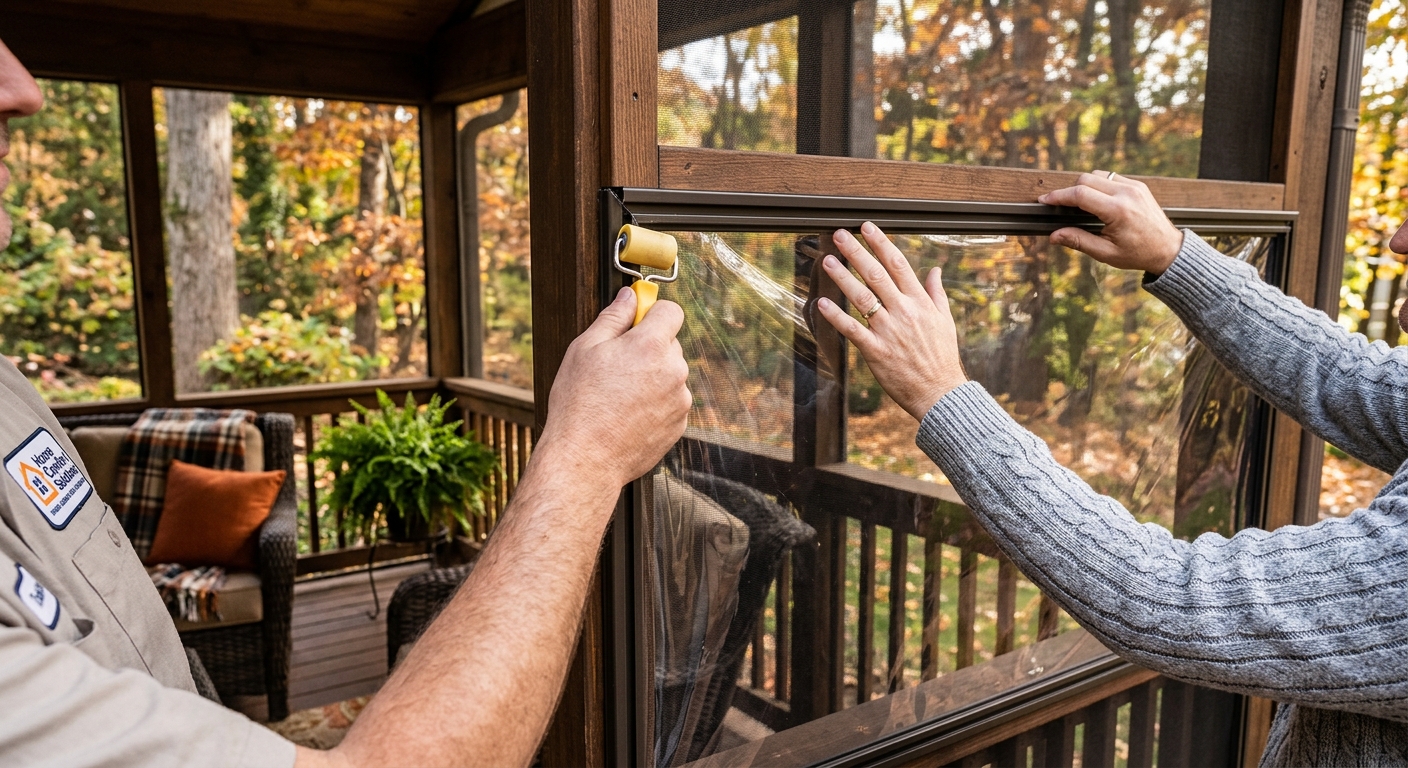
- Research panel systems designed specifically for screened porches such as Eze-Breeze, Craft-Bilt, or Vinyl Eze panel windows. These systems install into existing screen frames and slide or fold open for warm-weather ventilation. Get at least two quotes from local dealers or installers who specialize in porch enclosures.
- Verify with your local building department whether track-mount vinyl panel systems require a permit in your jurisdiction. Most do not since they are considered removable, but rules vary by municipality. This step can save you a code violation later.
- Order panels sized to your existing screen bays. Most systems are custom-manufactured. Lead times are typically 4 to 8 weeks. Professional installation is available but DIY installation is feasible with two people and basic carpentry skills using the manufacturer instructions.
- Install a wall-mounted electric radiant heater or a through-wall vent-free propane heater rated for the now-semi-enclosed space. With the vinyl panels closed, your heating load drops by 60 to 70% compared to a fully open screened porch, so a smaller unit is now adequate.
- Add weatherstripping foam tape around each panel frame perimeter after installation to reduce cold air infiltration at the track edges. This simple step improves performance significantly and costs under $15 in materials.
- Consider adding a programmable outdoor thermostat that controls the electric heater automatically. Set it to begin warming the space 20 minutes before typical use times. This extends comfort without wasting energy when the porch is not occupied.
Why It Works: The Benefits
Extending the comfortable season from 5 months to 8 months means roughly 90 additional days of use from a space you already own. Homeowners who enclose porches report paying $8,000 to $25,000 for that same outcome. The DIY approach achieves 70 to 80% of the result for under $500.
Moving outdoor entertaining to the porch instead of indoors during shoulder-season months reduces how often you run central air conditioning. If your porch is adjacent to a room with a door, keeping the activity outside rather than inside can reduce that room’s cooling load by 15 to 25% on mild days.
A fully enclosed and conditioned sunroom costs roughly $150 to $300 per year to heat and cool. A screened porch with add-on heating and curtains costs $30 to $80 per season to operate using a propane or electric radiant heater, making it dramatically cheaper to run than conditioned square footage.
A well-appointed outdoor living space consistently returns 50 to 80% of improvement cost in home resale value, according to the National Association of Realtors Remodeling Impact Report. Functional, extended-season porches are a frequently cited buyer preference in markets with variable climates.
Access to fresh outdoor air without insects has been linked in multiple studies to lower stress and improved sleep quality. Extending the usable season gives household members more nights of outdoor relaxation during the shoulder seasons when open windows are not practical inside.
💰 Savings Impact by Action
Ceiling-mounted radiant heaters warm occupants directly rather than heating open air, making them 70% more efficient per BTU delivered than forced-air methods in open or semi-open spaces.
Clear vinyl curtain panels reduce wind speed inside the porch by up to 80%, eliminating the forced convection that is the dominant heat loss mechanism in screened spaces.
A 90% block rating exterior shade cloth can reduce direct solar heat gain on a south or west facing porch surface by 40 to 47%, keeping porch temperatures 10 to 15 degrees cooler on summer afternoons.
Running a ceiling fan counterclockwise on high creates a wind chill effect that makes the perceived temperature 6 to 8 degrees cooler, reducing the need for mechanical cooling by roughly 15% on mild days.
An outdoor area rug over concrete or tile reduces conductive heat loss through foot contact by up to 30%, making the porch feel measurably warmer without any energy input.
🏠 Key Concepts Explained
The Science Behind It
Screened porches are thermal disasters by design, and that is not a criticism. Screens are intentionally maximally open to airflow, offering essentially zero resistance to heat transfer. When outdoor temperatures drop below about 60 degrees, your body loses heat to the surrounding air and unheated surfaces faster than metabolic activity can replace it, which is the physical definition of feeling cold. The key insight from building science is that you do not need to heat the air; you need to heat the people and slow the rate at which their body heat escapes into the environment.
Radiant infrared heaters work on the same principle as sunlight. They emit electromagnetic radiation in the near-infrared spectrum that passes through air without warming it, and is absorbed directly by solid surfaces including people, furniture, and flooring. This is why you can feel warm standing in sunlight on a 45 degree day when the air itself is cold. A quality outdoor radiant heater creates a hemisphere of warmth in its beam radius of roughly 8 to 12 feet, making it highly efficient for spot heating in open or semi-open spaces. Forced-air heaters, by contrast, simply waste energy trying to heat air that immediately escapes through the screens.
Clear vinyl curtain panels address the convective heat loss problem. Wind moving across your skin significantly accelerates heat loss through forced convection, and even light wind can reduce perceived temperature by 5 to 10 degrees. The vinyl panels create a still-air buffer zone that traps a thin layer of warmed air close to occupants, similar in principle to how a windbreaker works on a cold day. They are not insulation in the building science sense, but they eliminate forced convection which is the dominant heat loss mechanism in an open screened space. Combined with a radiant heater, this creates a layered thermal comfort strategy that is surprisingly effective for a very modest investment.
Frequently Asked Questions
▼ My porch gets unbearably hot by noon even with a shade sail. What else can I do?
A single shade panel helps but may not be enough on a south or west facing porch in summer. Add a second layer of protection by installing an exterior roller shade above the existing overhang and using light-colored or reflective furniture covers. Also confirm your ceiling fan is running counterclockwise on high, which can make an 85 degree porch feel 6 to 8 degrees cooler through the wind chill effect alone. If the porch roof itself is dark-colored metal or asphalt, consider a radiant barrier paint or foil board applied to the underside of the roof deck, which can cut heat radiation downward by 25 to 40%.
▼ How do I keep the vinyl curtain panels from sagging or ballooning in wind?
Thin vinyl panels (20 gauge or lighter) are the most common cause of sagging and ballooning. Upgrade to 30 gauge vinyl and add bottom-edge grommets with bungee tie-downs to a bottom rail or floor anchor points. Overlapping panels at corners by at least 6 to 8 inches and weighting the bottom hem with a rod threaded through a hem pocket also dramatically reduces wind movement. If you are in a consistently windy location, consider a track-mounted panel system rather than rod-hung curtains.
▼ Can I use a portable propane heater inside the screened porch with the vinyl curtains closed?
This is a genuine safety concern. Propane combustion consumes oxygen and produces carbon monoxide, so a sealed or near-sealed space is dangerous. If you plan to use the porch with vinyl curtains partially or mostly closed, use an electric radiant heater instead. If you prefer propane, leave at least two full panels open on opposite sides of the porch to maintain fresh air exchange, and never run the heater unattended or while sleeping.
▼ Will installing vinyl curtain panels count as enclosing the porch and affect my property taxes or HOA status?
In most jurisdictions, removable vinyl curtain panels do not trigger a permit or reclassification because they are not permanent structures and do not change the conditioned square footage of the home. However, some HOAs specifically prohibit visible vinyl or fabric panels on porches, so check your CC&Rs before purchasing. Track-mounted systems like Eze-Breeze exist in a grayer regulatory area and may require a permit variance in some areas; contact your local building department to confirm before ordering.
▼ How much does it actually cost per month to run a ceiling-mounted electric radiant heater on the porch?
A 1,500 watt electric heater running for 3 hours per evening at the average U.S. electricity rate of $0.16 per kilowatt-hour costs about $0.72 per evening, or roughly $22 per month if you use the porch every day. In practice, most homeowners run the heater 10 to 15 evenings per month during shoulder season, bringing the realistic monthly cost to $7 to $11. A 40,000 BTU propane heater burning at medium output for 3 hours uses roughly half a standard 1-pound canister, costing about $1.00 to $1.50 per session.
Quick Tips
- Face your radiant heater toward the primary seating cluster, not toward the center of the room. The goal is to heat people, not average air temperature across the whole space.
- Use outdoor-rated LED string lights on a timer in the porch ceiling during fall evenings. Beyond ambiance, the physical light fixture housings hold a small amount of residual heat and contribute to the overall warmth of the space.
- Roll up or remove vinyl curtain panels during summer and store them indoors out of UV exposure. Sun degradation is the primary cause of vinyl yellowing and cracking, and keeping them rolled up during the months you do not need them can double their lifespan.
- Place a simple outdoor thermometer with a hygrometer (humidity sensor) inside the porch. Knowing the real temperature and humidity on the porch helps you decide which combination of heater, fan, or dehumidifier to run, and prevents over-conditioning the space unnecessarily.
Variations for Your Situation
- Apartment or Condo Balcony: Renters with open balconies cannot install permanent curtain rods or ceiling heaters without landlord approval, but portable solutions work well. Clamp-on umbrella bases with a 90% solar shade cloth can block summer sun with no drilling. A freestanding propane tabletop heater or a plug-in electric tower heater rated for damp outdoor use adds warmth without modification. A thick outdoor rug and a set of portable railing-mount planters as windbreaks can make a balcony 6 to 8 degrees warmer on calm fall evenings. Total investment for this setup runs $100 to $250.
- Tight Budget (under $100): Focus on the three highest-impact free and low-cost steps first. Reverse your ceiling fan direction for summer cooling at zero cost. Add a thick outdoor area rug from a discount retailer for $25 to $50 to eliminate cold floor contact. Hang a 90% shade cloth on the sunniest side using tension hooks and a $6 rope for about $30 to $50 total. These three steps alone can extend your comfortable season by 3 to 5 weeks without a significant financial investment.
- Older Home with Non-Standard Screen Bay Sizes: Homes built before 1980 often have irregular screen bay widths that do not match standard vinyl panel sizes. In this case, order custom-cut panels from an online supplier such as Porch Shade or Buy Fabrics Direct, which cut to any dimension for roughly $10 to $14 per square foot hemmed and grommeted. Measure each bay independently since older construction is rarely perfectly square. Also inspect the screen frame condition before hanging heavy vinyl panels; older wood frames may need reinforcement with a 1 by 2 inch sistered support before carrying the additional weight and wind load.