Indoor air can be two to five times more polluted than outdoor air, according to the EPA, yet most homeowners never think about ventilation until something goes wrong. Cooking fumes, humidity from showers, off-gassing from furniture, and everyday dust all accumulate in a tightly sealed home. Without the right airflow strategy, you are essentially living inside a slowly filling jar.
The good news is that the three biggest ventilation failures in a typical home are all fixable, and none of them require a full mechanical overhaul. Whether your home feels stuffy, smells musty, or someone in your household struggles with allergies, targeted ventilation improvements deliver faster and more noticeable results than air fresheners or portable purifiers alone. This post breaks down exactly which fixes matter most, in what order to tackle them, and what realistic improvements you can expect.
We cover spot ventilation in kitchens and bathrooms, whole-house fresh air exchange, and filter upgrades, giving you both quick no-cost steps and deeper DIY or professional options. By the end you will know precisely where your home is losing the air quality battle and what to do about it today.
What You’ll Need
Click on an item below to shop for the recommended items for this recipe on Amazon.
As an Amazon Associate, we earn from qualifying purchases.
How to Do It
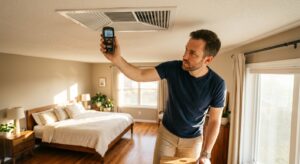
- Check every bathroom exhaust fan by holding a sheet of toilet paper near the grille while the fan runs. If the paper does not get pulled firmly toward the grille, the fan is underperforming and needs cleaning or replacement.
- Clean bathroom and kitchen exhaust fan grilles with a vacuum and damp cloth. Dust-clogged grilles cut airflow by 30 to 50% and are the single most common ventilation problem in homes older than five years.
- Replace your HVAC filter right now if you cannot remember when you last changed it. Upgrade from a basic fiberglass filter to a MERV 8 or MERV 11 pleated filter, which costs $8 to $15 and immediately improves particle capture.
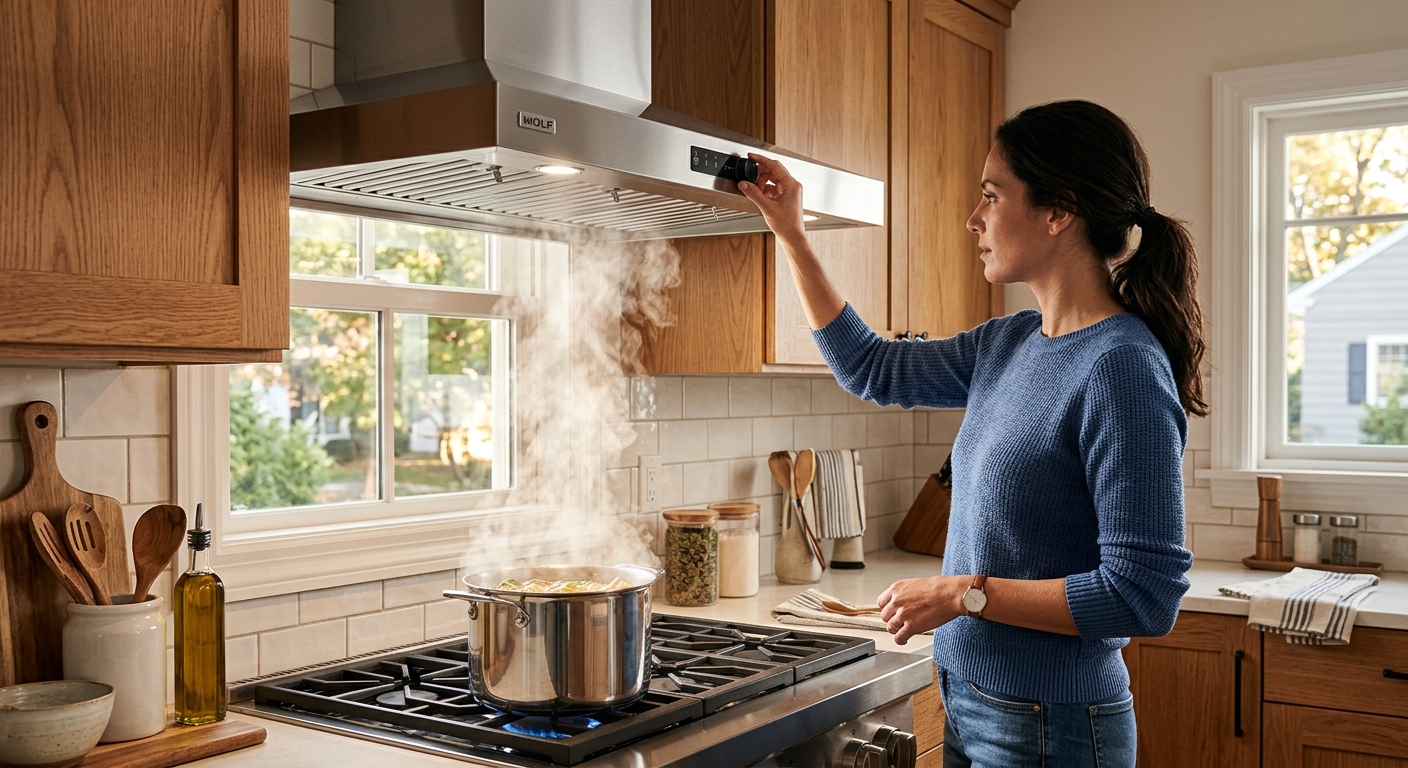
- Make a habit of running your kitchen range hood on medium during all stovetop cooking and for five minutes afterward. If you do not have a range hood, crack a nearby window two inches during cooking to provide makeup air and exhaust a portion of fumes.
- Set bathroom fans to run for 20 minutes after every shower. If your fan switch lacks a timer, use a simple manual countdown rule or a $10 to $15 plug-in mechanical outlet timer wired inline with the fan switch by an electrician.
- Calculate the correct fan size for each bathroom using the rule of 1 CFM per square foot of floor space, with a minimum of 50 CFM for any bathroom. Most builder-grade fans are 50 CFM, which is undersized for bathrooms larger than 50 square feet.
- Purchase a replacement exhaust fan rated at the correct CFM and with a sone rating of 1.5 or lower for quiet operation. Brands like Panasonic WhisperCeiling and Broan AE series offer $60 to $120 options that replace most existing ceiling cutouts without new drywall work.
- Install a countdown timer wall switch ($20 to $35) in place of the standard on/off switch for each bathroom fan. These require a neutral wire connection, which most modern switch boxes have. Set the timer default to 20 minutes.
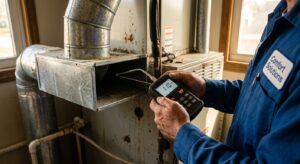
- Inspect the exhaust duct from each bathroom fan all the way to the exterior termination cap. Kinked or disconnected flex duct in the attic is extremely common and dumps moist air directly into the attic instead of outside, causing mold and reducing effective CFM by 50% or more. Straighten, reconnect, and insulate any exposed ducts.
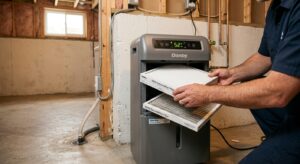
- For the kitchen, clean or replace the grease filter in your range hood every one to three months depending on cooking frequency. A clogged grease filter reduces airflow by up to 40%. Replacement filters cost $10 to $30 and install in seconds.
- Set a recurring phone reminder every 60 to 90 days to check and replace your HVAC filter, keeping a two-pack on hand so the task never gets delayed by a hardware store trip.
- Schedule an indoor air quality assessment or HVAC consultation to confirm your home is tight enough to benefit from mechanical fresh air. A home with natural air changes above 0.5 per hour (common in pre-1980 houses) may not need an ERV yet.
- Choose between an HRV and an ERV based on climate. HRVs are better for cold, humid climates (upper Midwest, Northeast) where you want to expel moisture. ERVs are better for hot humid climates (Southeast, Gulf Coast) because they transfer moisture back and prevent over-drying in winter.
- Have a qualified HVAC contractor size the unit to ASHRAE 62.2 standards: roughly 7.5 CFM per occupant plus 1 CFM per 100 square feet of floor area as a baseline.
- The contractor will connect the ERV or HRV to your existing duct system or install dedicated supply and exhaust ducts. The unit pulls stale air out and brings fresh air in while recovering 70 to 80% of the heating or cooling energy from the outgoing air stream, keeping operating costs low.
- After installation, confirm the unit cycles on your thermostat or a dedicated controller and test airflow at supply registers with a tissue or anemometer app on your phone to verify the system is balanced.
Why It Works: The Benefits
Running a properly sized kitchen exhaust fan during cooking reduces airborne particulates and NO2 from gas stoves by 60 to 80% compared to cooking with no ventilation, according to Lawrence Berkeley National Laboratory research.
Upgrading to a MERV 11 filter and maintaining humidity below 50% can reduce airborne allergen concentrations by up to 50%, providing measurable relief for the roughly 50 million Americans with allergies.
A bathroom exhaust fan that runs for 20 minutes after a shower removes 90% of post-shower moisture, keeping relative humidity below the 60% threshold where mold colonies begin forming on wall surfaces within 24 to 48 hours.
Better filtration and controlled ventilation reduce dust buildup on evaporator coils, which is a leading cause of AC efficiency loss. Dirty coils can increase energy consumption by 15 to 20% and shorten system life by two to three years.
Studies from Harvard T.H. Chan School of Public Health found that reducing indoor CO2 from 1,000 ppm to 550 ppm, achievable with adequate fresh air exchange, improved cognitive function scores by up to 61% in tested environments.
💰 Savings Impact by Action
Running kitchen and bathroom exhaust fans correctly reduces whole-home relative humidity by up to 25%, lowering summer cooling loads and mold remediation risk.
Upgrading from MERV 4 to MERV 11 captures up to 50% more airborne allergens and particulates per air handler pass, reducing surface dust accumulation and recirculation.
Reconnecting a disconnected or kinked exhaust duct restores up to 40 to 50% of lost fan airflow with no hardware cost beyond foil tape.
An ERV or HRV recovers 70 to 80% of conditioned air energy while delivering continuous ASHRAE-compliant fresh air exchange, dramatically reducing the energy cost of ventilation.
A 20-minute countdown timer ensures fans run long enough after showers to remove 90% of post-shower moisture, reducing bathroom humidity spikes by approximately 30%.
🏠 Key Concepts Explained
The Science Behind It
Ventilation works by dilution and removal. Every cubic foot of stale, polluted indoor air that gets exhausted to the outside is replaced by a cubic foot of cleaner outdoor air. The rate at which this happens is measured in Air Changes per Hour (ACH). ASHRAE Standard 62.2 recommends a minimum of 0.35 ACH for residential buildings, meaning the entire volume of air in your home should turn over at least once every three hours. In a tightly sealed modern home with no mechanical ventilation, actual ACH can drop to 0.1 or lower, allowing CO2, VOCs, and particulates to accumulate far above safe thresholds.
Spot ventilation is so effective at the source because of concentration gradients. When you cook on a gas stove, NO2 concentrations directly above the burners can reach 200 to 400 parts per billion, well above EPA outdoor air quality standards. An exhaust fan pulling 200 CFM directly over that source removes pollutants before they ever mix with the whole-house air volume. Trying to dilute those same pollutants after they have spread through a 1,500 square foot home would require moving thousands of cubic feet of air to achieve the same reduction. Source control is always more efficient than dilution after the fact.
Heat and Energy Recovery Ventilators add an elegant layer of building science: they use a heat exchanger core to transfer thermal energy between the outgoing stale air and incoming fresh air streams. In winter, the warm exhaust air preheats the cold incoming fresh air, recovering 70 to 80% of the heat energy that would otherwise be lost. This means you can ventilate your home to ASHRAE standards without the heavy energy penalty that opening a window in January would incur. In a well-sealed 2,000 square foot home, an ERV typically adds only $5 to $15 per month to operating costs while delivering continuous fresh air exchange 24 hours a day.
Frequently Asked Questions
▼ My bathroom fan is running but the room still feels humid after showers. What is wrong?
The most likely culprits are an undersized fan, a disconnected or kinked duct in the attic, or a blocked exterior cap. Start by going into the attic and tracing the entire duct run from the fan housing to the exterior termination. A surprisingly large percentage of homes have flex ducts that were never connected to the exterior cap or have sagged into a U-shape that traps moisture and blocks airflow. Reconnect and straighten the duct, then retest by holding tissue at the grille during operation.
▼ My house smells musty but I cannot find any mold. Could ventilation fix it?
Yes. Musty odors without visible mold usually mean mold is growing in a hidden location such as inside wall cavities, under flooring, in the attic, or behind drywall near a bathroom or kitchen wall. Poor ventilation that allows relative humidity to stay above 60% for extended periods is the most common cause. Fix spot ventilation first to lower daily humidity loads, then investigate the crawl space and attic since these are the two most common hidden mold locations in homes without mechanical fresh air systems.
▼ Can renters improve ventilation without landlord permission?
Renters can do quite a bit without any modifications. Run existing exhaust fans longer and more consistently, upgrade HVAC filters if you change them yourself, use a portable HEPA air purifier ($80 to $150) in the bedroom and main living area, and open windows strategically for cross-ventilation. For fan upgrades or timer switches, most landlords will approve a simple written request since these improvements protect the property. Always get approval in writing before any hardware changes.
▼ I upgraded my filter to MERV 13 and now my HVAC is running longer. Is that normal?
Yes, and it is a problem. MERV 13 filters have enough resistance that many residential HVAC systems, particularly older or lower-capacity systems, cannot pull adequate airflow through them. Restricted airflow causes the system to run longer, reduces efficiency, and can freeze the evaporator coil. Stick to MERV 8 to 11 for most residential systems unless your equipment is specifically rated for higher-resistance filters. Check your furnace manual or ask your HVAC technician for the maximum recommended MERV rating for your specific equipment.
▼ How do I know if my home actually needs an ERV or HRV, or if simpler fixes will be enough?
If your home was built before 1990 and has not had professional air sealing work done, natural infiltration is probably providing enough fresh air turnover that an ERV is not yet necessary. Focus on spot ventilation fixes first. If your home was built after 2000, has had a blower door test showing tight construction, and occupants regularly experience headaches, fatigue, or condensation on windows in winter, these are signs that mechanical fresh air is genuinely needed. A whole-home energy audit with a blower door test, which typically costs $200 to $400, will give you a definitive answer.
Quick Tips
- Cook on back burners whenever possible. Gas range front burners are farther from the exhaust fan center and result in 20 to 30% higher room pollutant levels compared to using back burners directly under the hood.
- If your home has a crawl space, ensure it is ventilated or encapsulated. A damp crawl space is a direct source of mold spores and soil gases that the stack effect pulls up into living areas regardless of how good your upstairs ventilation is.
- Open two windows on opposite sides of your home for just 10 minutes on mild-weather mornings to flush overnight CO2 and VOC buildup. This natural cross-ventilation is free and can reduce indoor pollutant levels by 40 to 60% in minutes.
- Never use an exhaust fan in the kitchen while the fireplace or wood stove is running without first cracking a window. Powerful exhaust fans can depressurize the house enough to backdraft combustion gases from the fireplace flue directly into living spaces.
Variations for Your Situation
- Apartment/Rental: Renters cannot modify central HVAC or exhaust ducting, but can achieve meaningful air quality improvements with portable tools. A HEPA air purifier rated for your room size ($80 to $200 from Winix, Levoit, or Coway) placed in the bedroom removes up to 99.97% of particles above 0.3 microns while you sleep. Use the bathroom fan every single time you shower, ask your landlord in writing to repair any non-functioning exhaust fans since this is typically a code requirement, and use a $25 digital hygrometer to track humidity and open windows when indoor humidity exceeds 55%.
- Tight Budget (under $50): Focus on the three free or nearly free actions that deliver the most impact. First, clean every exhaust fan grille in the home right now using a vacuum and damp cloth, a step that restores 20 to 40% of lost airflow at zero cost. Second, replace your HVAC filter with a MERV 8 pleated filter for $8 to $12 and set a phone reminder to replace it every 60 days. Third, commit to running the kitchen and bathroom fans every single time they are needed and for at least 20 minutes after showers, which costs nothing and is the highest-return ventilation change available to any homeowner.
- Older Home (pre-1980): Homes built before modern weatherization standards have natural air infiltration rates that actually provide some fresh air exchange, but that air enters through uncontrolled pathways near the foundation and crawl space, often bringing in radon, soil moisture, and pest debris. The priority in older homes is not to add more ventilation overall but to redirect it: seal the crawl space and basement rim joists to stop soil gas infiltration, add spot ventilation in the kitchen and bathrooms, and only then consider whether whole-house mechanical ventilation is needed. A radon test kit ($15 to $25) is also strongly recommended since radon enters specifically through the uncontrolled infiltration pathways common in older construction.