You have probably noticed that some rooms feel stuffy and hot within minutes of the sun hitting them, while others stay surprisingly cool well into the afternoon. Or maybe your bedroom feels perfectly fine at 9 PM but unbearably warm by midnight, even though you never touched the thermostat. These patterns are not random. They are thermal mass at work, and once you understand what is happening, you can start using it to your advantage instead of fighting it.
Thermal mass refers to a material’s ability to absorb, store, and slowly release heat energy. Dense, heavy materials like concrete, brick, tile, and stone absorb heat during the day and release it slowly over many hours. Lightweight materials like wood framing, drywall, and carpet do the opposite: they heat up fast and cool down fast, giving you almost no buffer against outdoor temperature swings. The ratio of these materials in your home quietly determines how hard your heating and cooling system has to work every single day.
This post breaks down the real science behind thermal mass in plain language, shows you where it already exists in your home, and gives you practical steps to use it more strategically. Whether you rent an apartment or own a century-old farmhouse, there are things you can do right now to harness this effect and cut your energy bills by 10 to 30% in the right conditions.
What You’ll Need
Click on an item below to shop for the recommended items for this recipe on Amazon.
As an Amazon Associate, we earn from qualifying purchases.
How to Do It
- Walk through each room and identify existing high-mass surfaces: tile floors, brick fireplaces, concrete countertops, masonry walls, or a slab foundation visible at a basement level. These are your thermal batteries.
- Remove rugs or furniture blocking tile or concrete floors in rooms that overheat in summer. Exposed slab or tile can absorb 20 to 40 BTUs per square foot during the day, noticeably reducing afternoon temperature peaks.
- In winter, rearrange furniture so sofas and chairs are not blocking south-facing windows during daylight hours. Sunlight hitting a tile or concrete floor in a south-facing room can offset 10 to 20% of heating needs on clear winter days.
- Set your thermostat to pre-cool the home to 74 to 75 degrees Fahrenheit before noon if you have time-of-use utility rates, then allow indoor temps to drift up to 78 degrees during peak rate hours. The mass in walls and floors will release stored coolness and delay the rise.
- Open windows on cool summer nights (below 65 degrees Fahrenheit outside) to flush stored daytime heat from mass surfaces, then close them before 8 AM to lock in the coolness for the day.
- Install porcelain or ceramic tile over a plywood subfloor in a room that overheats, using a tile backer board and standard thin-set mortar. A 10-by-12-foot floor adds roughly 800 to 1,000 pounds of thermal mass and costs $150 to $400 in materials.
- Place dark-colored water containers (sealed 5-gallon jugs painted matte black, or decorative ceramic urns filled with water) near south or west-facing windows. Each gallon of water stores 1 BTU per degree Fahrenheit, so 20 gallons acts as a passive thermal buffer equivalent to roughly 200 pounds of concrete.
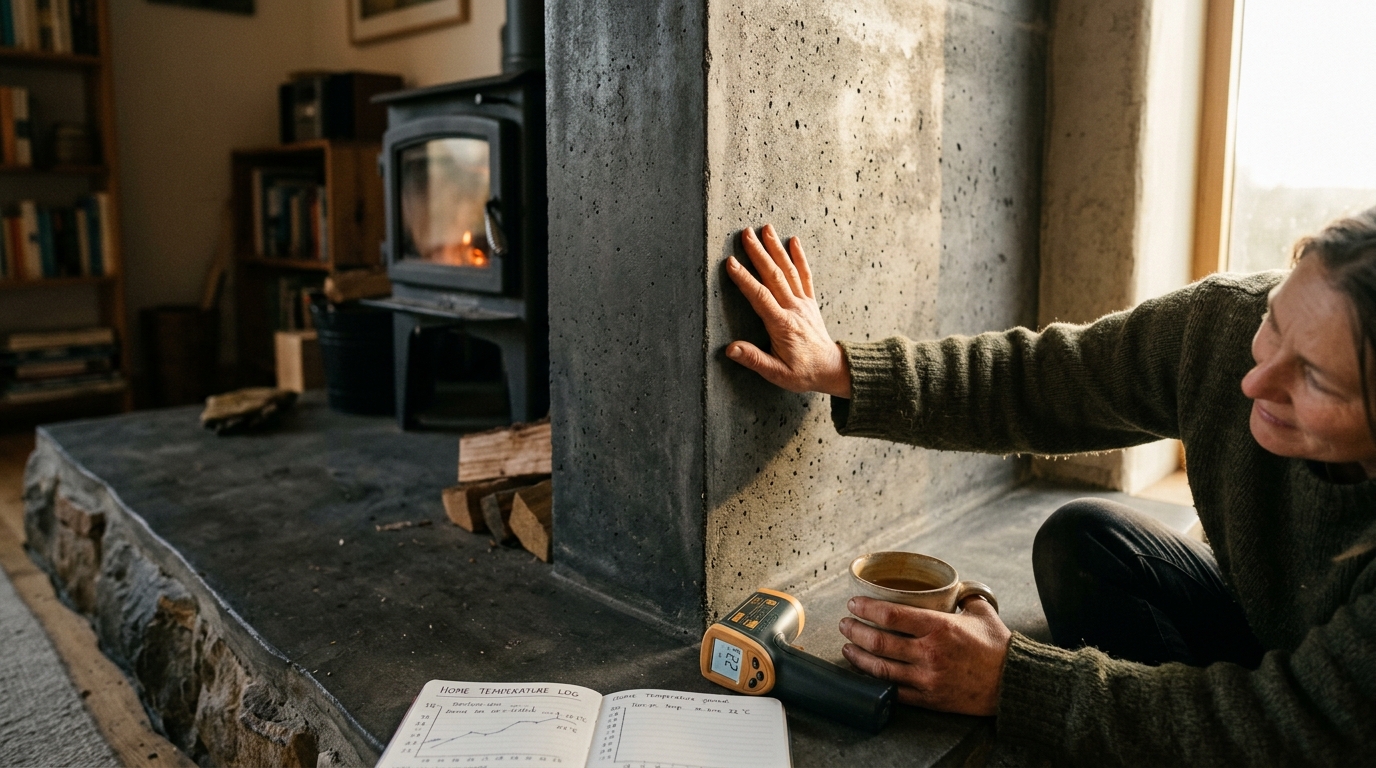
- Add a masonry or tile hearth surround to an existing fireplace if you do not already have one. Even if the fireplace is decorative, the brick or stone absorbs room heat during the day and re-radiates it overnight, reducing overnight temperature drops.
- In a sunroom or greenhouse addition, lay concrete pavers directly on a sand bed over a vapor barrier. At $0.50 to $1.50 per square foot, this is one of the most cost-effective ways to add mass to a space that gets direct sun.
- After completing the installation, monitor room temperatures with a $15 digital min-max thermometer for two weeks before and two weeks after, to measure how much the daily temperature swing narrows. A successful installation typically reduces the swing by 4 to 8 degrees Fahrenheit.
- Hire a building performance consultant or passive solar designer to assess your home’s solar access, current mass-to-glazing ratio, and local climate data. The ideal mass-to-south-glazing ratio is roughly 5.5 square feet of 4-inch-thick mass per square foot of south-facing glass.
- Replace a lightweight partition wall adjacent to south-facing glazing with an insulated concrete form (ICF) or solid masonry wall. This alone can shift the effective thermal mass of a room by several thousand BTU-equivalents.
- Pour a concrete topping slab (2 to 4 inches) over an existing wood subfloor in a renovation. Structural engineers typically approve slabs up to 40 pounds per square foot on standard residential framing, which equates to roughly a 3-inch slab and adds significant buffering capacity.
- Install a Trombe wall on a south-facing exterior: a dark-painted masonry wall behind glazing that absorbs solar heat and convects it into the living space over 8 to 12 hours. A 50-square-foot Trombe wall can offset 50 to 75% of a small room’s winter heating needs on sunny days.
- After construction, commission a blower door test and thermal imaging scan to confirm the new mass is not inadvertently paired with air leaks that would short-circuit the passive system.
Why It Works: The Benefits
Homes with adequate exposed thermal mass can reduce peak HVAC load by 10 to 30% in climates with a daily temperature swing of at least 20 degrees Fahrenheit, because the mass naturally buffers indoor temperatures before the system needs to engage.
Instead of temperatures spiking 5 to 8 degrees when afternoon sun hits west-facing rooms, thermal mass absorbs that energy gradually and releases it over hours, keeping the room within 2 to 3 degrees of your target without the thermostat cycling.
Because mass holds temperature well, you can pre-cool your home during off-peak utility hours (often late night or early morning when rates are 30 to 50% cheaper) and coast through the expensive midday hours with minimal mechanical cooling.
Research published by the American Society of Heating, Refrigerating and Air-Conditioning Engineers (ASHRAE) shows that occupants in rooms with cooler surface temperatures report higher comfort even at air temperatures 2 to 3 degrees warmer, because radiant exchange accounts for roughly 40% of perceived thermal comfort.
Fewer on and off cycles means less mechanical wear on your compressor, blower motor, and heat exchanger. Reducing daily cycles by 15 to 25% through passive buffering can extend equipment service life by 2 to 4 years in typical residential applications.
💰 Savings Impact by Action
Ventilating high-mass surfaces on cool summer nights (below 65 degrees Fahrenheit) can reduce next-day mechanical cooling demand by up to 25% in moderate climates with a 20-plus degree diurnal swing.
Pre-cooling a high-mass home during off-peak rate hours and coasting through peak periods reduces cooling-related electricity costs by 15 to 20% on time-of-use utility rate plans.
Removing carpet and exposing tile or concrete floors in sun-exposed rooms reduces peak cooling load by 10 to 15% by allowing the slab to absorb heat that would otherwise raise air temperature.
Correctly orienting mass surfaces to capture winter solar gain through south-facing glazing can offset 15 to 25% of a home’s heating energy in cold, sunny climates like the U.S. Mountain West.
High-mass homes hold pre-conditioned temperatures 2 to 4 hours longer, allowing wider thermostat setback windows that save roughly 10% per year on combined heating and cooling costs.
🏠 Key Concepts Explained
The Science Behind It
Thermal mass works because of a property called specific heat capacity: the amount of energy required to raise one pound of a material by one degree Fahrenheit. Water has the highest specific heat of any common building-related material at 1.0 BTU per pound per degree Fahrenheit. Concrete and brick come in around 0.2 BTU per pound per degree, and wood framing is around 0.3 BTU per pound per degree. The reason mass materials feel so effective is their density: a cubic foot of concrete weighs 145 pounds and therefore stores about 29 BTU per degree Fahrenheit, while the same volume of wood frame wall stores only 5 to 8 BTU per degree. That difference is your thermal buffer.
The time lag effect is equally important. Heat does not travel through dense materials instantly. It conducts slowly, following Fourier’s Law of heat conduction, which means the rate of transfer depends on the material’s conductivity, its thickness, and the temperature difference across it. A 12-inch poured concrete wall has a time lag of 8 to 10 hours between when the outer surface heats up and when that heat reaches the interior. This is why adobe and rammed-earth homes in desert climates feel cool during the hottest afternoon hours: the heat from a 100-degree day is still working its way through the wall when the sun sets and outdoor temperatures drop, at which point it can be ventilated away instead of warming the interior.
The interaction between thermal mass and radiant heat exchange explains why perceived comfort in high-mass rooms often exceeds what the thermostat reading would predict. ASHRAE’s thermal comfort standard (55-2020) defines comfort as a function of air temperature, mean radiant temperature, humidity, air speed, activity level, and clothing. Mean radiant temperature, which is the average temperature of all surfaces surrounding your body, accounts for roughly 40% of the comfort equation. A room with stone or tile surfaces at 68 degrees Fahrenheit will feel just as comfortable as a carpeted room at 71 or 72 degrees, because your body is losing heat to those cool surfaces through radiation. This is not a psychological effect: it is measurable physics, and it means that strategic use of thermal mass can let you set your thermostat 2 to 3 degrees higher in summer without any loss in comfort.
Frequently Asked Questions
▼ My home has tile floors and brick walls but it still overheats in summer. What am I doing wrong?
Thermal mass only helps if it can release stored heat somewhere. If your home is closed up all night and the mass never gets a chance to dump its heat, it starts each day already warm and quickly becomes a liability instead of an asset. Try opening windows on opposite sides of the home on nights when outdoor temps drop below 65 degrees Fahrenheit for 2 to 4 hours before bed, then close everything by 7 AM. Also check whether west-facing mass surfaces are receiving direct afternoon sun, since shading those surfaces with exterior blinds or awnings is the first fix.
▼ Can renters use thermal mass strategies without modifying the apartment?
Yes, and water is your best friend here. Sealed dark-colored water containers placed near sunny windows cost almost nothing and add meaningful buffering capacity without any permanent changes. Heavy furniture like bookshelves full of books, ceramic or stone decorative objects, and clay planters also add modest mass. Avoid rugs in rooms with concrete or tile floors to maximize the existing mass, and ask your landlord about interior window films to control solar gain without any structural changes.
▼ How long before I notice a difference in my energy bill after adding tile floors or mass surfaces?
In climates with a strong diurnal temperature swing (20-plus degrees between day and night), most homeowners notice a change in room comfort within the first warm week after installation. Bill savings typically show up within the first full billing cycle in the target season, usually as a 5 to 15% reduction in that month’s usage compared to the same period the prior year. Use a utility’s online comparison tool or a kill-a-watt meter on window units to isolate the change.
▼ What if my older home has almost no thermal mass at all?
Pre-1940 wood-frame homes with hardwood floors and plaster walls actually have more thermal mass than typical modern construction, because plaster is denser than drywall and hardwood is denser than engineered flooring. If your home is post-1970 lightweight wood frame with drywall and carpet, your fastest DIY gain is removing carpet in living areas to expose subfloor, then adding tile or laminate with a concrete-based underlayment. Even a 12-inch-thick layer of concrete board under flooring adds measurable mass.
▼ Will adding thermal mass make my home harder to cool quickly when I get home from work?
This is a real tradeoff. High mass homes respond more slowly to thermostat changes, typically taking 20 to 40 minutes longer to cool down by 4 to 5 degrees compared to lightweight homes. The solution is a smart thermostat with a geofencing feature that starts cooling 30 to 45 minutes before you arrive home. This approach actually saves money because the mass holds the pre-cooled temperature well once reached, requiring fewer cycles to maintain it.
Quick Tips
- In summer, shade exterior mass surfaces like brick walls and concrete patios with awnings or deciduous trees to prevent them from storing heat that radiates into the home at night.
- Dark-colored mass surfaces absorb more solar radiation than light-colored ones. A matte black painted concrete floor will store significantly more solar heat than a white one, which matters for passive solar heating but can backfire in cooling-dominated climates.
- Insulation placed on the exterior of a mass wall keeps the mass coupled to the interior temperature and increases its effectiveness. Insulation on the interior side disconnects the mass from the living space and largely defeats its buffering purpose.
- Thermal mass is most effective in climates with a daily temperature swing of 20 degrees Fahrenheit or more. In hot-humid climates with small diurnal swings, the benefit is reduced and moisture management becomes the higher priority.
- Combine thermal mass with a programmable or smart thermostat that can pre-condition the home during off-peak utility hours. The mass will hold the pre-conditioned temperature 2 to 4 hours longer than a lightweight home, extending the savings window.
Variations for Your Situation
- Apartment or Rental: Renters cannot modify flooring or walls, but can add meaningful thermal mass with zero-cost water storage. Fill sealed dark-colored jugs (5-gallon paint buckets work well), place them near south or west windows, and stack heavy ceramic planters along sun-exposed walls. A 20-gallon water setup costs under $20 in materials and adds the equivalent buffering of roughly 200 pounds of concrete. Pair this with interior blackout curtains during peak sun hours and you can reduce afternoon temperature spikes by 3 to 5 degrees in a typical apartment.
- Tight Budget (under $50): Focus on rearranging furniture to expose existing tile or wood floors, removing rugs in sunny rooms, and placing water containers near windows. A digital min-max thermometer ($12 to $18) lets you measure whether the changes are working. If you have a concrete porch or basement slab, leaving the basement door open on hot days allows cool mass to moderate your home’s temperature at zero cost. These behavioral and zero-cost strategies alone can reduce peak room temperatures by 2 to 4 degrees.
- Older Home (pre-1980): Older homes often have plaster walls, masonry chimneys, brick exteriors, and cast-iron radiators, all of which are high-mass assets. The priority in older homes is not adding more mass but removing things that block existing mass: pull up carpet runners over hardwood, clear furniture from brick fireplace surrounds, and ensure south-facing masonry walls are not hidden behind drywall added during a renovation. If your older home has forced air heat, the cast-iron or steel duct boots and registers themselves hold some residual heat. Adding a programmable thermostat to take advantage of mass-buffered setback periods ($25 to $80) is typically the highest-return first step.