Every summer, HVAC technicians get flooded with emergency calls in the first week of a heat wave. The most common culprits are almost always the same: a clogged filter, a dirty condenser coil, or a tripped disconnect, all things that could have been caught in a 10-minute walkthrough before the season started. A little prevention goes a long way when your system is working against 95-degree heat for 8 hours a day.
Your central air conditioner is one of the most energy-hungry appliances in your home, typically accounting for 12 to 27% of your total electricity bill during summer months, according to the U.S. Energy Information Administration. A system running with a dirty filter or restricted airflow can use 15% more electricity while delivering less comfort. That translates to real money, often $50 to $150 extra per cooling season, for a problem that takes five minutes to fix.
This post walks you through a practical start-of-season inspection covering the filter, the outdoor condenser unit, the thermostat, the condensate drain, and the supply and return vents. You will learn what to look for, what to fix yourself, and when to call a professional before a small issue becomes a $400 repair call on the hottest day of the year.
What You’ll Need
Click on an item below to shop for the recommended items for this recipe on Amazon.
As an Amazon Associate, we earn from qualifying purchases.
How to Do It
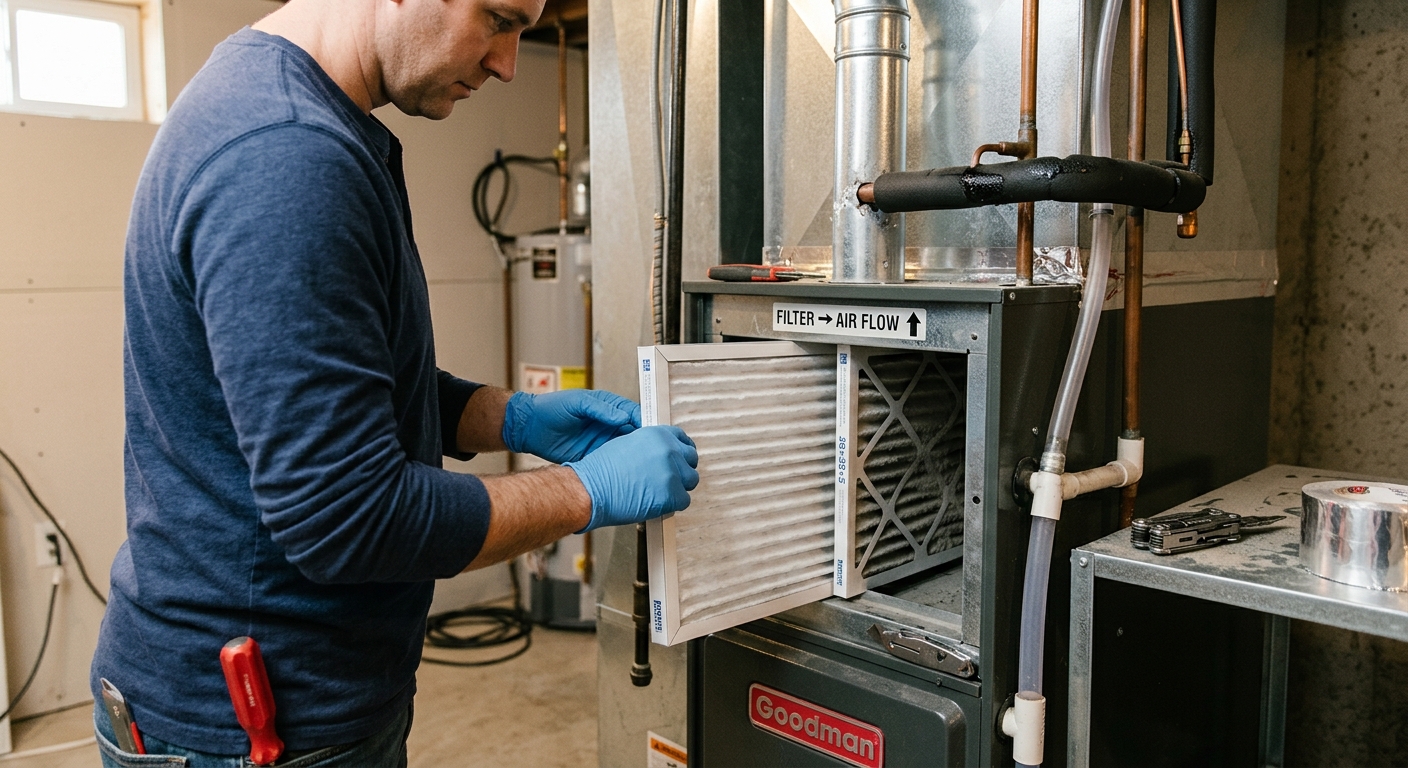
- Check and replace the air filter: Hold it up to a light source. If you cannot see light through it, replace it now. A standard 1-inch filter should be replaced every 30 to 90 days; a dirty filter at season start is the single biggest efficiency drain.
- Walk outside and visually inspect the condenser unit: Remove any leaves, mulch, or debris from the top grate and the sides. Confirm at least 18 to 24 inches of clearance on all sides. Do not run the unit with debris inside the cabinet.
- Check the outdoor electrical disconnect box: It is usually mounted on the wall within a few feet of the condenser. Make sure the disconnect is in the ON position and the cover closes properly. Do not open the box itself.
- Set the thermostat to COOL and set the target temperature 5 degrees below current room temperature: Wait 5 to 10 minutes. You should hear the outdoor unit kick on and feel noticeably cooler air from the supply vents within 5 minutes. If nothing happens, check the circuit breaker.
- Locate the condensate drain line (the white PVC pipe near your indoor air handler) and confirm it is draining: Pour a cup of water into the drain pan and watch it flow freely. If water pools and does not drain in 30 seconds, the line is starting to clog.
- Walk through and confirm all supply and return vents are open and unblocked by furniture or rugs: Blocking more than one or two vents noticeably increases system pressure and reduces efficiency.
- Replace the air filter with a fresh MERV 8 to 11 rated filter and note the date on the filter frame with a marker so you remember when to change it next.
- Turn off power to the outdoor condenser at the disconnect box and the breaker panel. Remove the top grate (usually 4 to 6 screws) and use a wet-dry vacuum to remove any debris from inside the cabinet.
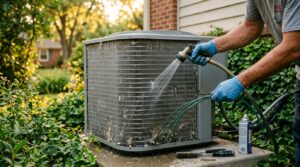
- Rinse the condenser coil fins from the inside out using a regular garden hose set to a gentle stream. Work top to bottom. Do not use a pressure washer as it will bend the fins. Straighten any visibly bent fins with a fin comb ($10 to $15).
- Flush the condensate drain line: Pour a 50/50 mixture of white vinegar and water (about 1 cup total) into the drain pan access port or the standpipe near the air handler. Let it sit 15 minutes, then flush with plain water. This kills algae buildup before it becomes a full clog.
- Inspect the insulation on the refrigerant line (the larger of the two copper lines running from the outdoor unit): It should be a foam sleeve in good condition. If it is cracked, crumbling, or missing, replace it with foam pipe insulation from a hardware store ($5 to $10). Damaged insulation reduces system efficiency and can cause the line to sweat excessively.
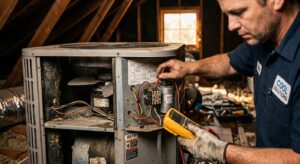
- Restore power and run the system for 15 minutes. Stand at a supply vent and feel the air temperature. A properly functioning system should deliver air that is 14 to 20 degrees cooler than the return air temperature. A bigger gap is normal in very humid conditions; a smaller gap suggests a refrigerant or airflow issue worth having a technician check.
- Book a maintenance visit with a licensed HVAC contractor in spring before demand spikes. Ask specifically for a ‘precision tune-up’ that includes refrigerant level check, not just a filter swap.
- The technician will measure refrigerant pressure and verify the charge is within manufacturer spec. Low refrigerant is not a DIY repair. It requires a licensed technician with an EPA 608 certification to handle refrigerants legally.
- Ask the technician to check the capacitor and contactor in the outdoor unit. Capacitors fail most often in the first hot week after sitting idle all winter, and a replacement typically costs $80 to $200 parts and labor if caught proactively versus $250 to $400 on an emergency call.
- Request a static pressure test if your home has rooms that are consistently hard to cool. High static pressure reveals duct leakage or blockage that can be responsible for 20 to 30% of cooling energy loss.
- Review the technician’s written report and ask for a prioritized list of any findings. Items like a worn contactor or cracked drain pan can wait a season with monitoring; a refrigerant leak or failing compressor bearing should be addressed before summer arrives.
Why It Works: The Benefits
A clean filter and unobstructed condenser coil alone can reduce AC energy consumption by 10 to 15%, saving an average household $40 to $120 over a full cooling season without any equipment purchase.
Catching a clogged drain line or a loose disconnect before the season starts prevents the most common mid-summer failures. Emergency HVAC service calls typically cost $150 to $350 just for the visit, not counting parts.
A compressor running hot due to dirty coils or low refrigerant degrades faster. Regular pre-season checks can add 3 to 5 years to the life of a system that costs $5,000 to $12,000 to replace.
A fresh filter and a clean, dry condensate pan reduce mold spores and dust circulating through your home, which matters especially for allergy sufferers during high-pollen summer months.
Knowing your system has been checked means you are not gambling on reliability when outdoor temps hit 95 degrees and HVAC techs are booked two weeks out.
💰 Savings Impact by Action
Replacing a clogged filter restores full airflow and can reduce AC energy consumption by 10 to 15% immediately.
Rinsing a fouled outdoor condenser coil can recover 10 to 20% of lost cooling efficiency by restoring proper heat rejection.
Keeping the condensate drain clear prevents system shutdowns and the energy wasted on repeated restart cycles.
Sealing leaky duct connections in older homes can recover 20 to 30% of cooling energy currently escaping into unconditioned spaces.
A professional tune-up including refrigerant check, electrical inspection, and coil cleaning delivers a combined 10 to 15% efficiency improvement on average according to ENERGY STAR data.
🏠 Key Concepts Explained
The Science Behind It
Your air conditioner does not create cold air. It moves heat. The refrigerant inside your system absorbs heat from indoor air at the evaporator coil, travels to the outdoor condenser, and releases that heat outside. This cycle works efficiently only when both coils can exchange heat freely, when refrigerant is at the correct pressure, and when enough air moves across both coils continuously. Disrupt any one of these three conditions and the whole system works harder to deliver the same result.
A dirty air filter is the most common disruption. It reduces the volume of warm air reaching the evaporator coil, which causes the refrigerant to get colder than designed. Below a certain threshold (roughly 32 degrees Fahrenheit at the coil surface), moisture in the air freezes on the coil instead of draining away. Ice acts as an insulator, further reducing heat exchange, and the system enters a spiral of declining performance. Restoring airflow with a clean filter is the fastest way to break this cycle.
The outdoor condenser coil works on the same principle in reverse. It needs to dump heat into outside air efficiently. A coil caked with cottonwood fluff, lawn clippings, or dust is essentially wearing a blanket, forcing the refrigerant to condense at a higher pressure. Higher pressure means the compressor works harder, draws more electricity, runs hotter, and wears faster. DOE research shows that a condenser coil with even light fouling can reduce system efficiency by 5 to 10%, and heavy fouling by 20 to 30%. Rinsing the coil once a season is one of the highest-return maintenance tasks a homeowner can do.
Frequently Asked Questions
▼ My AC turned on but the air coming out of the vents is not very cold. What is wrong?
Start by checking the filter and making sure the condenser is clear of debris. If both are fine, feel the larger insulated copper line running into the outdoor unit. It should be cold and may have light condensation. If it is warm or has ice forming on it, you likely have a refrigerant issue or a severely restricted airflow problem that requires a technician. A properly functioning system should deliver supply air 14 to 20 degrees cooler than the air going into the return vent.
▼ My outdoor unit is running but the indoor fan is not blowing. What should I check first?
Check the circuit breaker for the air handler or furnace, which is often on a separate breaker from the outdoor condenser. Also check that the thermostat fan setting is on AUTO, not OFF. If the breaker is fine and the thermostat is set correctly, the indoor blower motor or its capacitor may have failed, which requires a technician.
▼ How do I know if my system is low on refrigerant?
Common signs include ice forming on the refrigerant lines or indoor coil, the system running constantly without reaching the set temperature, and higher-than-normal electricity bills. You cannot check refrigerant level yourself without gauges and EPA certification. If you suspect a low charge, call a licensed HVAC technician. Note that refrigerant does not get used up like fuel. If it is low, there is a leak that also needs to be found and repaired.
▼ Can renters do any of this without landlord permission?
Yes. Renters can safely replace accessible air filters, clear debris from around the outdoor unit, flush the condensate drain with vinegar, and make sure vents are open and unblocked. These are all reversible, non-invasive tasks. Anything involving opening electrical panels, removing unit covers, or adjusting refrigerant is the landlord’s responsibility and should be requested in writing.
▼ My system passed all these checks but my electric bill is still high. What else could be causing it?
A well-maintained AC can still be expensive to run if the home has poor attic insulation, significant air leaks around windows and doors, or single-pane windows letting in radiant heat. Also check that your thermostat schedule is optimized, since the EPA estimates that proper setback scheduling saves about 10% annually on cooling costs. A duct leakage test by an HVAC technician can also reveal if 20 to 30% of your conditioned air is escaping into unconditioned attic or crawl space before reaching your living areas.
Quick Tips
- Change your filter on the same day every season by tying it to a recurring event, like Memorial Day weekend, so it never gets overlooked.
- Keep 18 to 24 inches of clearance around your outdoor condenser year-round. Shrubs grow fast in summer and can restrict airflow significantly by July.
- If your home has a smart thermostat, check for a firmware update at the start of each season. Manufacturers frequently release efficiency improvements and bug fixes.
- Drop a drain pan tablet (available for about $5 at hardware stores) into your condensate pan at the start of the season. These slow-dissolve tablets prevent algae growth and are far easier than clearing a full clog mid-August.
Variations for Your Situation
- Apartment/Rental: Renters typically only have access to the air filter and the vents. Focus on replacing the filter (measure the current one and buy the correct size, usually $8 to $20), making sure all vents are open and unblocked, and reporting any warm air, unusual sounds, or water around the air handler to your landlord or property manager in writing. If you have a window AC unit, unplug it, remove the front panel, and vacuum the filter and evaporator fins before the season starts.
- Tight Budget (under $50): Prioritize the free steps first. Clean debris from the condenser, open all vents, and test the system. Spend $10 to $20 on a quality replacement filter and a bottle of white vinegar for the condensate drain flush. Skip the fin comb and foam insulation for now unless you can see visible damage. These two steps alone (clean filter plus clear condenser) capture roughly 70% of the efficiency gains from the full inspection.
- Older Home (pre-1980): Homes built before 1980 often have original ductwork with significant leakage at joints and connections, single-pane windows, and minimal attic insulation. Do the standard inspection, but also look for obvious gaps at duct connections in the basement, crawl space, or attic and seal them with foil-backed mastic tape ($10 to $15). Duct leakage in older homes can account for 25 to 40% of cooling energy loss, making it a higher priority than almost any other single fix.