Summer nights are brutal in many parts of the country, and the default solution for most homeowners is to crank the AC and leave it running until morning. The problem is that overnight cooling accounts for a disproportionate share of summer energy bills. Running a central AC system for 8 hours at a low setpoint can cost $1.50 to $4.00 per night depending on your climate and utility rates, adding up to $90 to $240 over a single summer.
What most people don’t realize is that their bedroom is fighting against them. Heat stored in walls, bedding that traps body heat, electronics radiating warmth, and east-facing windows letting in morning sun all conspire to keep the room warmer than it needs to be. Your body’s own cooling biology, specifically its need to drop core temperature by about 2°F to fall into deep sleep, is also working against a hot room in ways that go beyond simple comfort.
This post covers the practical, science-backed strategies that let you raise your overnight thermostat setpoint by 4 to 6°F without losing sleep quality. You will learn which quick changes have immediate impact, which small investments pay back in weeks, and exactly how to configure your home for the coolest possible sleep without an energy bill that stings in September.
What You’ll Need
Click on an item below to shop for the recommended items for this recipe on Amazon.
As an Amazon Associate, we earn from qualifying purchases.
How to Do It
- Set your thermostat to 72 to 74°F at bedtime rather than 68°F, and use a ceiling fan on the lowest counterclockwise setting to create a wind chill effect. This feels up to 4°F cooler and costs roughly $0.02 per hour versus $0.25 to $0.50 per hour for AC.
- Unplug or power off all electronics in the bedroom that are not in use, including TVs, gaming consoles, and phone chargers. Standby electronics generate 5 to 50 watts of continuous heat in an enclosed room.
- Switch to your lightest available bedding. A single cotton sheet instead of a comforter reduces the insulating layer trapping your body heat. If you have a spare set of pillowcases, put them in the freezer for 15 minutes before bed.
- Close blinds or curtains on east-facing windows before you go to sleep to pre-block morning sun that will heat the room before your alarm goes off.
- If outdoor temperature is below indoor temperature (check your phone’s weather app), open windows on opposite sides of the bedroom to create cross-ventilation for 20 to 30 minutes before closing up and letting the AC maintain temperature.
- Install blackout curtains or cellular shades on west and south-facing bedroom windows. These block 85 to 99% of solar heat gain and can reduce afternoon room temperature by 5 to 8°F before bedtime. Budget $25 to $60 per window for mid-range options.
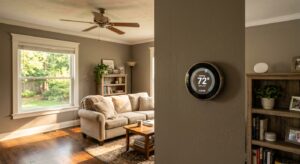
- Add a programmable or smart thermostat if you do not already have one, and create a sleep schedule: set it to pre-cool the bedroom to 70°F starting 30 minutes before your target bedtime, then raise the setpoint to 74°F once you are asleep. Most people sleep comfortably at 74°F with proper airflow. Smart thermostats cost $80 to $150 and typically save $100 to $150 per year on total HVAC costs.
- Place a box fan in a window facing outward on the leeward side of your home (the side away from prevailing wind) and open a window on the windward side. This actively pulls cooler outdoor air through your bedroom. Run this setup from roughly 9 PM until midnight, then close windows and let the AC take over. A quality box fan costs $25 to $50 and uses only 50 to 100 watts.
- Replace your current bedding with moisture-wicking cotton percale or bamboo-derived sheets with a thread count of 200 to 400. Higher thread counts trap more heat. Cooling sheet sets run $40 to $100 and require no installation.
- Seal any gaps around the bedroom window frames and door with adhesive foam weather stripping. Conditioned air escaping around a poorly sealed door or window forces the AC to run longer. A $6 to $12 weather stripping kit takes 20 minutes per door and can reduce cooling load by 5 to 10% in the bedroom alone.
- If your attic hatch is in or near a bedroom hallway, add an attic hatch insulation cover. Uninsulated attic hatches allow significant radiant heat to pour into the ceiling space directly above bedrooms. Covers cost $30 to $60 and install in under 30 minutes.
- Install a ceiling fan if the bedroom does not have one, or replace an old fan with an ENERGY STAR certified model. A properly sized ceiling fan (52 to 60 inches for rooms up to 400 square feet) allows you to raise the thermostat by 4°F while maintaining the same perceived comfort level. ENERGY STAR fans use 20% less energy than standard models. Budget $80 to $250 installed for a mid-range unit.
- Add a portable or window-mounted evaporative cooler if you live in a dry climate with humidity below 50% (common in the Southwest and Mountain West). Evaporative coolers use 75% less electricity than AC and can drop room temperature by 5 to 15°F. Units range from $100 to $350 and do not require professional installation.
- Have an HVAC technician verify that your bedroom registers are balanced and delivering adequate airflow. Undersized or blocked ducts reduce cooling efficiency in specific rooms even when the rest of the house is comfortable. Balancing costs $75 to $150 and can improve room-level cooling by 15 to 25%.
- Add R-38 or higher attic insulation above the bedroom if current insulation is below R-19. Attic temperatures can reach 130 to 150°F in summer, and thin insulation allows that heat to radiate through the ceiling into your bedroom. Blown-in insulation costs $1.50 to $3.00 per square foot and typically delivers a 2 to 4 year payback in hot climates.
Why It Works: The Benefits
Raising your overnight thermostat from 68°F to 74°F reduces overnight AC energy use by roughly 24%, since each degree of setback saves about 3 to 4% on cooling costs. Over a 90-night summer, that translates to $50 to $150 in savings depending on your system and climate.
A bedroom kept at 65 to 68°F with appropriate bedding and airflow supports the natural core temperature drop needed for slow-wave and REM sleep, improving sleep quality measurably even compared to a cooler room with poor airflow or humidity control.
Every hour your AC runs contributes to compressor wear. Cutting overnight runtime by 2 to 3 hours per night extends compressor life and can push your next service interval back by months, saving $100 to $300 in annual maintenance costs over time.
Strategic fan placement and pre-cooling eliminate the hot-and-cold cycling that wakes many people at 2 or 3 AM when the AC shuts off. A more stable ambient temperature between 65 and 72°F produces fewer sleep disruptions than a system cycling on and off.
Studies from the National Sleep Foundation show that a cool sleeping environment reduces sleep onset latency, meaning the time it takes to fall asleep, by an average of 15 to 20 minutes compared to a warm room above 75°F. That adds up to meaningful recovered sleep time across a summer.
💰 Savings Impact by Action
Raising the overnight setpoint from 68°F to 74°F reduces AC energy use by approximately 3 to 4% per degree, saving up to 24% on overnight cooling costs.
Blocking solar heat gain on west and south windows reduces afternoon room heat accumulation by 5 to 8°F, cutting the cooling load the AC must overcome before bedtime by up to 15%.
A ceiling fan creates a wind-chill effect that lets you raise the thermostat by 4°F with no comfort loss, reducing AC energy use by 12 to 14% overnight.
Pre-cooling the bedroom with outside air for 30 to 60 minutes on evenings when outdoor temps fall below indoor temps can eliminate up to 30% of overnight AC runtime in mild climates.
Upgrading attic insulation to R-38 above bedrooms reduces radiant heat transfer through the ceiling by up to 20%, directly lowering the thermal load the AC must manage overnight.
🏠 Key Concepts Explained
The Science Behind It
Your body regulates sleep through a process called thermoregulation. In the 1 to 2 hours before sleep, your brain signals blood vessels near the skin to dilate, flushing heat outward and dropping your core temperature by about 2°F. This temperature drop is a direct trigger for melatonin release and the transition into slow-wave sleep. If your bedroom is too warm, this heat-shedding process is impaired, your core temperature stays elevated, and your brain cycles in lighter sleep stages rather than reaching the restorative deep sleep your body needs.
From a building science standpoint, your bedroom is a thermal storage vessel that works against you at night. Concrete, drywall, and wood framing absorb solar radiation all day and re-emit it as radiant heat over an 8 to 12 hour period. This is why bedrooms often feel warmest between 8 PM and midnight, well after the sun has set. Strategic use of thermal mass in reverse, pre-cooling surfaces with a fan before you sleep, helps discharge some of this stored heat before it migrates into the space you occupy. This is the science behind why sleeping in a room that was well-ventilated in the early evening feels cooler than one that was sealed all day even at the same thermostat setting.
Humidity control amplifies everything. Your skin’s primary heat rejection mechanism is evaporative cooling through sweat. When relative humidity is high, the air near your skin is already saturated with moisture, which slows evaporation and makes you feel hotter than the thermometer indicates. This is the wet-bulb temperature effect in action. Dropping bedroom humidity from 65% to 50% through proper AC operation or a standalone dehumidifier can lower perceived temperature by 3 to 5°F, allowing you to raise the actual thermostat setpoint by the same amount without any loss of comfort. At $0.03 to $0.06 per kilowatt-hour of savings, that is real money over a summer.
Frequently Asked Questions
▼ Why is my bedroom so much hotter than the rest of the house at night?
This usually points to one of three causes: a west or south-facing room with inadequate window coverings absorbing extra solar load all afternoon, undersized or blocked duct registers delivering insufficient airflow to the room, or poor attic insulation above the bedroom ceiling. Start by checking whether the room’s supply register is fully open and unobstructed, then feel the ceiling near an exterior wall after 9 PM to test for radiant heat. If the ceiling feels noticeably warm to the touch, attic insulation is the likely culprit.
▼ Can I sleep with windows open instead of running the AC?
Yes, but only when outdoor temperature has dropped below your indoor temperature, typically after 9 PM in most U.S. climates, and outdoor humidity is below 60%. Check your weather app for both the overnight low and the dew point before opening up. If the dew point is above 60°F, the air is too humid to help and will make things worse. In dry climates like the Southwest, nighttime ventilation alone can often maintain a comfortable sleep temperature without any AC from late spring through early fall.
▼ I raised the thermostat to 74°F but I still wake up sweating at 3 AM. What am I missing?
Waking up overheated at 3 to 4 AM is usually a bedding or humidity problem rather than a room temperature problem. Your body heat builds up under covers over several hours even when the room air is reasonably cool. Try switching to a single cotton percale sheet, adding a portable fan aimed at the bed, and checking whether your AC is actually reaching and holding 74°F or whether the system is short-cycling and allowing the room to climb past the setpoint. A $15 plug-in indoor thermometer near the bed will confirm what temperature the room actually hits overnight.
▼ How long before I see these changes on my electricity bill?
Changes that affect thermostat setpoint or AC runtime, such as scheduling changes and adding window coverings, show up within the first full billing cycle, typically 3 to 4 weeks. Behavior changes like unplugging electronics and improving ventilation before bed have immediate effect but are smaller in scale. Hardware upgrades like ceiling fans or added insulation may take one to three full summers to show clearly on an annual bill comparison, though you will feel the comfort difference within the first week.
▼ Will a portable AC unit in the bedroom work better than trying to cool the whole house overnight?
Potentially yes, especially in larger homes where the central system struggles to cool distant rooms efficiently. A portable AC unit rated at 8,000 to 12,000 BTU for a typical bedroom uses 700 to 1,200 watts and can cool a single room to 68°F for roughly $0.08 to $0.14 per hour, often cheaper than running a whole-house system. The downside is noise, a hose that must vent through a window, and a purchase cost of $300 to $600. If your central system is undersized or your bedroom is consistently 5 to 8°F warmer than the thermostat reading, a portable unit is worth the investment.
Quick Tips
- Put a bowl of ice in front of a fan for a low-tech evaporative boost on especially hot nights. It will not cool the whole room but creates a noticeably cooler microclimate near the bed.
- Wear moisture-wicking sleepwear rather than cotton T-shirts, which hold sweat against your skin. Technical fabric sleepwear can reduce perceived temperature by 2 to 3°F.
- If you share a bed with a partner who runs warmer, use two separate lightweight blankets rather than one shared comforter. Each person can regulate their own microclimate without fighting over covers.
- Do not run the dishwasher, oven, or dryer after 6 PM in summer. These appliances add 1,000 to 5,000 watts of heat to your home’s interior that your AC then must remove, often right before your desired sleep time.
Variations for Your Situation
- Apartment or Rental: Renters cannot modify ductwork or add ceiling fans without landlord approval, but most of the high-impact strategies still apply. Focus on blackout curtains with tension rods (no drilling required, $20 to $40 per window), a quality box or tower fan ($30 to $80), moisture-wicking bedding, and a smart plug with scheduling to cut phantom heat from electronics. A standalone portable evaporative cooler ($100 to $200) is fully renter-safe in dry climates and uses a fraction of the electricity of a window AC unit.
- Tight Budget (under $50): Start with zero-cost behavioral changes: raise the thermostat setpoint, unplug electronics, switch to lighter bedding you already own, and use nighttime cross-ventilation when conditions allow. With a $15 to $25 budget, add a box fan and adhesive foam weather stripping for the bedroom door and windows. These steps alone can cut overnight cooling costs by 15 to 25% with no additional investment. The frozen pillowcase trick and ice-bowl fan hack are also genuinely effective for getting through the hottest nights.
- Older Home (Pre-1980): Homes built before 1980 typically have less than R-11 attic insulation, single-pane windows, and significant air leakage around window frames and door casings. In these homes, the bedroom thermal envelope is so leaky that fan and thermostat strategies have limited effect until some basic sealing is done. Prioritize caulking window frames with paintable latex caulk ($6 per tube), adding door sweep weather stripping ($10 to $20), and hanging heavy thermal curtains ($30 to $60 per window). If the attic is accessible, adding blown-in insulation to reach R-38 is the single highest-return upgrade available for under $500, often cutting cooling costs by 20 to 30% in the first year.