Every winter morning, millions of homeowners wake up to a cold house and a furnace working overtime. Most assume it is just how old homes behave in cold weather. But that temperature drop you feel between bedtime and breakfast is not inevitable. It is a measurable signal that your building envelope has specific, fixable weak points letting conditioned air escape every single night.
Heat loss overnight is one of the most underestimated drivers of high heating bills. According to the U.S. Department of Energy, air leakage alone accounts for 25 to 40 percent of the energy used for heating and cooling in a typical home. The frustrating part is that most of this leakage happens through a handful of predictable locations, and you do not need an energy auditor to find them. A simple five-minute check each morning, combined with a few inexpensive tools, can reveal exactly what is happening in your home while you sleep.
This post walks you through a practical morning diagnostic routine that any homeowner can do. You will learn what temperature drops are normal versus alarming, which rooms and surfaces to check first, and how to use that information to target the repairs that deliver the fastest payback. Whether you start with a free visual inspection or invest a few hours in a proper DIY air sealing project, the data you collect in the morning will tell you exactly where to focus.
What You’ll Need
Click on an item below to shop for the recommended items for this recipe on Amazon.
As an Amazon Associate, we earn from qualifying purchases.
How to Do It
- Before turning up the thermostat, walk to your thermostat and note the actual indoor temperature displayed. Compare it to your setback temperature from the night before. A drop of more than 3 to 4 degrees beyond your scheduled setback on a night above 20 degrees Fahrenheit outside indicates significant leakage.
- Move to the rooms farthest from your furnace or in corners of the house and feel the interior side of exterior walls with your palm. A wall that feels noticeably cold (more than 5 degrees cooler than room air) signals missing or compressed insulation behind it.
- Check each exterior door by running your hand slowly along all four edges without touching the door itself. Any sensation of cold air movement means the weatherstripping has failed and is actively leaking during cold nights.
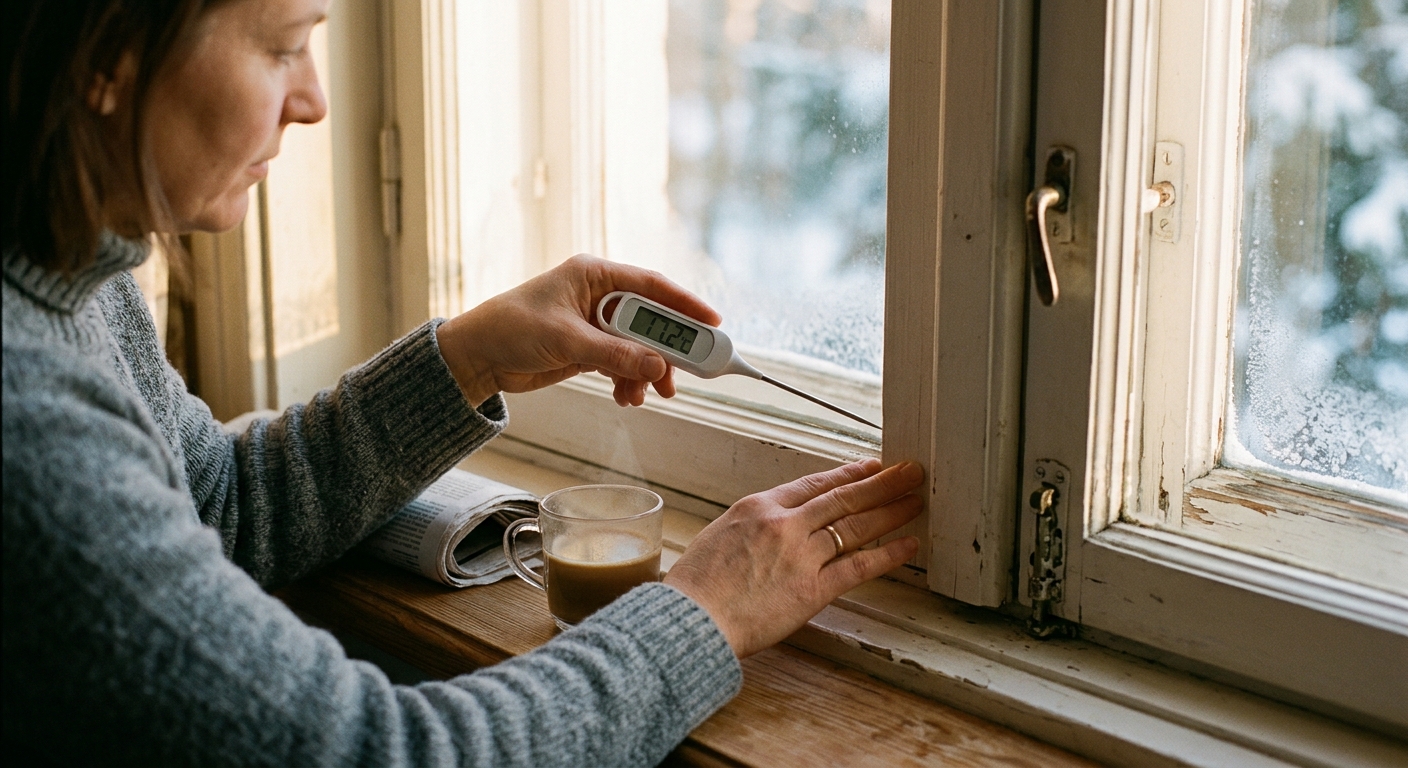
- Stand near your largest windows and hold your palm 2 inches from the glass without touching it. If you feel cold radiating strongly toward you, note that window as a priority. Single-pane windows and poorly sealed frames are major overnight heat loss sites.
- Note your findings in a simple phone note or notebook: which rooms were coldest, which walls felt cold, which doors or windows had drafts. This becomes your repair priority list ranked by severity.
- Buy a box of foam backer rod ($8) and a tube of paintable acrylic caulk ($5) for gaps under 1/4 inch, plus canned low-expansion spray foam ($10 per can) for gaps between 1/4 inch and 3 inches. Pick up self-adhesive door weatherstripping ($15 to $25 per door kit) for every door that showed air movement during your morning check.
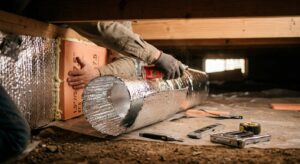
- Start at the top of the house in the attic, since stack effect means air exits there most aggressively. Pull back any attic insulation and seal around every penetration (pipes, wires, light fixture boxes, HVAC chases) with spray foam before replacing insulation. This single step often delivers the largest single reduction in infiltration.
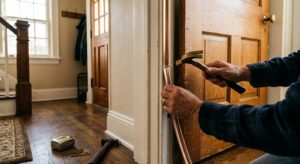
- Working room by room based on your priority list, apply weatherstripping to all exterior door frames that showed leakage. Remove the old compressed foam or felt strip completely, clean the surface with rubbing alcohol, and press the new adhesive-backed foam or V-strip into place. Test by closing the door on a dollar bill: you should feel resistance pulling it out.
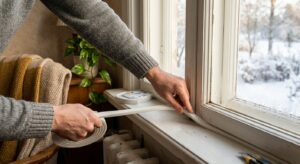
- Caulk around all exterior window frames on the interior side where the frame meets the drywall. Use your fingertip to press the caulk bead into the joint before it skins over. This seals the gap between the rough framing and the window unit, which is often larger than it appears.
- Install foam gaskets behind all electrical outlets and switch plates on exterior walls ($6 for a pack of 12). These small covers are among the highest-return air sealing steps available, taking 30 seconds per outlet and blocking a surprisingly large air pathway.
- After completing the fixes, run your morning check for another week and compare the overnight temperature drop to your baseline numbers. A well-sealed home should show a drop of no more than 1 to 2 degrees per hour during the coldest part of the night when the furnace is not running.
- Schedule a certified energy auditor through your utility company or BPI-certified contractor. Provide your morning diagnostic notes as context so the auditor knows which areas you have already identified as suspects.
- During the blower door test, the auditor depressurizes your home to 50 Pascals and measures total air leakage in CFM50 (cubic feet per minute). A result above 2,000 CFM50 for a 1,500 square foot home strongly confirms significant leakage worth professional remediation.
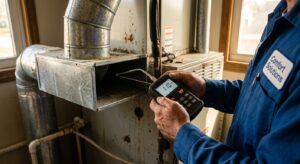
- Request a thermal imaging scan during the blower door test if offered. With the house depressurized and a temperature differential of at least 15 degrees between inside and outside, an infrared camera makes every leak glow visibly, giving you a precise map of problem areas.
- Review the written audit report and prioritize the contractor’s recommended measures by cost-per-dollar-saved. Air sealing and attic insulation typically rank at the top. Ask for itemized quotes so you can choose which items to DIY versus contract out.
- After professional sealing is complete, request a post-work blower door test to verify the improvement. A quality job should reduce your CFM50 number by at least 25 to 40 percent and will typically be documented for any applicable rebates or tax credits.
Why It Works: The Benefits
Identifying and sealing the specific leaks your morning check reveals can cut heating energy use by 15 to 30 percent annually, translating to $150 to $400 per year for a typical home spending $1,200 on winter heating.
A tighter envelope retains more overnight heat, reducing the temperature gap your furnace must bridge each morning. This can shorten that daily recovery cycle by 20 to 45 minutes, reducing furnace runtime and wear.
Locating and fixing the worst leaks eliminates cold drafts and cold spots, bringing room-to-room temperature variation down from a typical 5 to 10 degrees to under 3 degrees in well-sealed homes.
Every degree of overnight heat retained is one less degree the furnace must recover. Reducing peak heating demand extends heat exchanger and burner life, potentially adding years to equipment lifespan.
Uncontrolled air infiltration brings in unfiltered outdoor air, dust, and moisture. Sealing leaks identified by your morning check means your ventilation becomes intentional and filterable rather than random.
💰 Savings Impact by Action
Sealing attic bypasses around plumbing chases and top plates eliminates the primary stack effect exit point, reducing total heating energy use by up to 20 percent.
Replacing failed door weatherstripping on all exterior doors can reduce infiltration-related heat loss by 8 percent and costs under $30 per door.
Foam gaskets behind exterior-wall outlets and switches block a high-traffic air pathway and contribute up to 5 percent reduction in infiltration for under $10 in materials.
Caulking window frames and adding interior film insulation reduces heat loss through the window assembly by 10 to 15 percent compared to unsealed single or double pane windows.
Insulating and air sealing basement rim joists with rigid foam and spray foam eliminates a major cold-air entry point, reducing heating load by up to 12 percent in homes with unfinished basements.
🏠 Key Concepts Explained
The Science Behind It
Heat always moves from warmer areas to cooler ones through three mechanisms: conduction, convection, and radiation. Overnight, all three are working against you simultaneously. Conduction pulls heat through solid materials like wall studs, window frames, and concrete foundations. Convection carries warm air out through gaps and cracks while drawing cold replacement air in. Radiation emits heat from warm interior surfaces toward cold exterior surfaces without requiring any air movement at all. The morning temperature reading you take is the cumulative result of all three processes working uninterrupted for eight or more hours.
The stack effect amplifies all of this significantly. Because warm air is less dense than cold air, it naturally rises. In a leaky home, this creates a consistent pressure differential: the upper half of the house is at slightly positive pressure (pushing warm air out through high leaks), while the lower half is at slightly negative pressure (pulling cold air in through low leaks). This convective loop runs without any mechanical assistance, driven purely by temperature difference, and it accelerates as outdoor temperatures drop. This is why attic bypasses, top-plate gaps, and upper-floor window leaks cause disproportionately large heat losses compared to their physical size.
The R-value of your insulation only tells part of the story. R-value measures resistance to conductive heat flow through a material, but it does nothing to stop air movement. A wall cavity with perfect R-19 fiberglass batts but an unsealed electrical outlet on the exterior wall can lose as much heat through that one outlet as a square foot of uninsulated wall, because moving air bypasses the insulation entirely. This is why the morning diagnostic focuses on air movement first, and why air sealing consistently delivers a better return on investment than adding more insulation in an already-leaky home.
Frequently Asked Questions
▼ My thermostat shows a 6-degree drop overnight but I cannot feel any obvious drafts. Where is the heat going?
Large drops without obvious drafts usually mean the leaks are in hidden locations: attic bypasses around plumbing chases, gaps at the top plates of interior walls that open into the attic, or missing insulation in rim joists in the basement. Rent or borrow an infrared thermometer and scan your attic hatch, basement rim joists, and the tops of interior closets on exterior walls. These are the most common hidden bypass locations and are not detectable by feel at floor level.
▼ Why is one room always colder than the rest every morning?
A single cold room usually points to one of three causes: a disconnected or blocked HVAC duct delivering less heat to that room, a missing or damaged insulation batt in that room’s exterior wall or ceiling, or a window or door in that room with failed sealing. Start by checking airflow at the room’s supply register with a piece of tissue paper. If airflow is good but the room is still cold, use an infrared thermometer on the exterior walls and check the window weatherstripping closely.
▼ How much overnight temperature drop is actually normal and acceptable?
A well-sealed and insulated home on a night where the outdoor temperature is 30 degrees Fahrenheit should lose no more than 1 to 2 degrees per hour when the heating system is not running. If you set a thermostat setback of 5 degrees at 10 PM and wake up at 6 AM to a drop of more than 6 to 7 degrees below your setback target, your home has a meaningful leakage problem worth addressing. A drop of 10 or more degrees in an 8-hour window in moderate cold is a strong indicator of serious envelope issues.
▼ I rent my apartment and cannot do any permanent modifications. Can I still use this diagnostic?
Absolutely. The morning temperature check requires no modifications at all and gives you useful data even as a renter. If the drop is significant, you can add removable interior window insulation film ($25 per window kit), use draft stoppers at door thresholds, and hang heavy thermal curtains on problem windows. These measures are fully removable and typically deliver 5 to 12 percent heating savings without altering the unit. Document any findings and share them with your landlord, since heating losses also cost them money if utilities are included.
▼ My furnace is relatively new but my morning temperatures are still dropping significantly. Is the furnace the problem?
Furnace efficiency affects how economically heat is produced, but it has almost no impact on how well your home retains heat when the furnace is off. A new 96 percent efficient furnace installed in a leaky house will still produce large overnight drops. The issue is the building envelope, not the equipment. Focus your diagnostic on the attic, exterior walls, and window and door sealing rather than the mechanical system.
Quick Tips
- Use a cheap infrared thermometer ($15 to $25) to scan wall and window surface temperatures during your morning check. Any surface reading more than 5 degrees below room air temperature is losing heat faster than it should.
- Record outdoor temperature alongside your indoor readings each morning. This lets you calculate your home’s heat loss rate per degree of temperature difference, making your data meaningful across different weather conditions.
- Pay special attention to rooms above garages. The garage ceiling is often poorly insulated and completely bypassed by air sealing, making it one of the single coldest zones in a home and a major overnight heat drain.
- Check attic hatch covers specifically. An uninsulated or poorly sealed attic hatch is essentially a hole in your ceiling with no insulation value. Adding a rigid foam cover and weatherstripping to the hatch frame typically costs under $30 and can eliminate a major stack-effect bypass.
Variations for Your Situation
- Apartment or Rental: Renters cannot modify the building envelope, but the morning temperature check is still valuable for identifying which windows and doors are the worst offenders. Invest in removable interior insulation film for windows (under $30 per window), heavy thermal blackout curtains ($40 to $80 per panel pair), and door draft stoppers ($10 to $20 each). These non-permanent fixes can reduce heat loss through windows and doors by 10 to 20 percent and require no landlord approval.
- Tight Budget (Under $50): Focus entirely on the free diagnostic plus the three highest-return low-cost fixes: foam outlet gaskets on exterior walls ($6 for 12 pieces), self-adhesive door weatherstripping for the two leakiest doors ($15 to $25 per door), and caulk around window frames ($5 per tube). Done thoroughly, these three steps alone can cut infiltration by 10 to 15 percent in a typical home for a total investment under $50.
- Older Home (Pre-1980): Homes built before 1980 typically have 10 to 15 ACH natural infiltration rates versus 3 to 5 in modern construction, so your morning temperature drops will be more dramatic and your diagnostic findings more numerous. Prioritize in this order: attic air sealing (highest impact), rim joist insulation in the basement (second highest), and door weatherstripping. Do not try to fix everything at once. Address the top three leaks from your morning notes first, measure the improvement over two weeks, then move to the next set. This staged approach keeps costs manageable and keeps you motivated by visible progress.