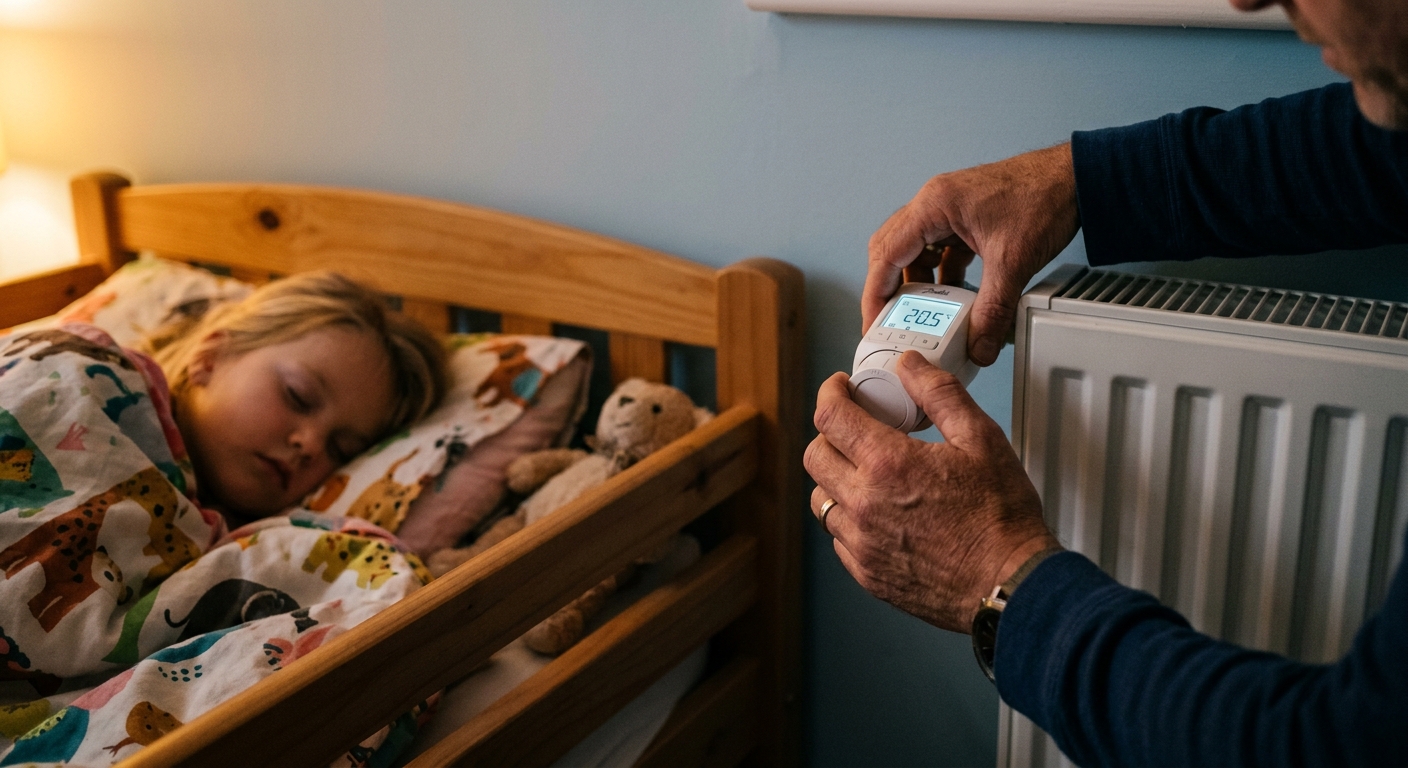
Every parent knows the 2 a.m. routine: your child kicks off their blanket, overheats, wakes up crying, or you find them shivering because the room turned into a freezer after midnight. Kids are more sensitive to temperature swings than adults, and their bedrooms are often the worst-served rooms in the house, located at the end of HVAC runs, above garages, or under attics where heat and cold swing the hardest.
Pediatric sleep guidelines consistently point to a room temperature between 65°F and 70°F as the sweet spot for children. Even a 5-degree swing above that range can increase nighttime wake-ups and reduce deep sleep. The good news is that this is a solvable problem, and you do not need to replace your HVAC system to fix it.
This guide walks you through exactly what causes temperature instability in kids’ bedrooms, and gives you two clear paths to solving it: a same-day quick fix that costs nothing, and a low-cost DIY upgrade that delivers lasting results. You will also find real numbers on energy savings, common mistakes to avoid, and answers to the questions parents actually search for at midnight.
What You’ll Need
Click on an item below to shop for the recommended items for this recipe on Amazon.
As an Amazon Associate, we earn from qualifying purchases.
How to Do It
- Check and fully open the supply register in the child’s room. Many registers are accidentally left at 25 to 50% open by previous occupants or during cleaning. A fully open register can increase airflow to that room by 30 to 50%.
- Walk the perimeter of the room and feel for drafts along the baseboard, around the window frame, and at the electrical outlets on exterior walls. Cover any outlets you find with inexpensive foam outlet gaskets (available at hardware stores for under $5 for a pack of 10).
- Adjust your thermostat’s nighttime setback to no more than 2°F below the daytime comfort setting for the child’s room. An aggressive 5 to 8°F setback is appropriate for adult rooms but causes drift in kids’ rooms.
- If the room runs hot, partially close the supply register in the nearest common room (hallway or living room) by about 25%. This redirects more airflow pressure toward the child’s room without any hardware changes.
- Place a small digital thermometer (under $10) in the room at mattress height and check it at bedtime, midnight, and morning for two nights to establish the actual temperature range you are dealing with.
- Install a smart vent or motorized register in the child’s room supply opening. Products like Flair or Keen Home smart vents connect to a room sensor and automatically open or close based on the actual room temperature, not just the hallway thermostat. Budget $60 to $80 per vent.
- Add a room temperature sensor (included with most smart vent kits, or standalone units from Ecobee or Flair for $30 to $50) and place it at the child’s sleeping height, away from direct vent airflow and exterior walls.
- Seal the window perimeter from the inside using a rope caulk or foam backer rod pressed into the gap between the window frame and the rough opening. This is removable and does not damage the window or trim, making it a good choice for rental-friendly installs as well.
- Check the attic hatch or pull-down stairs if the child’s room is on the top floor. An unsealed attic hatch is equivalent to a 12-square-inch hole in the ceiling. Apply foam weatherstripping around the hatch perimeter and add a rigid foam insulation panel on top of the hatch cover.
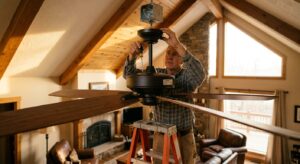
- If the room has a ceiling fan, set it to run counterclockwise (forward) in summer to create a wind-chill effect, and clockwise (reverse) at low speed in winter to gently push warm stratified air back down toward the sleeping area. This can reduce the perceived temperature difference by 2 to 4°F.
- After two weeks of operation, review the sensor data in your smart vent app. Fine-tune the target temperature range to 66 to 68°F for toddlers and school-age children, or 68 to 70°F for infants under 12 months per AAP guidance.
Why It Works: The Benefits
Maintaining a stable 65 to 70°F room temperature reduces nighttime wake-ups linked to thermal discomfort. Studies from the National Sleep Foundation show that temperature is one of the top three environmental factors affecting sleep continuity in children.
Sealing air leaks and balancing airflow in just one bedroom can reduce that zone’s conditioning load by 15 to 20%, which adds up to $80 to $200 per year depending on your climate and energy rates.
Adding a plug-in smart thermostat or fan controller to a child’s room keeps the temperature within a 2°F band all night, compared to a 6 to 10°F drift typical in unmanaged rooms.
When a child’s room is properly sealed and insulated, the HVAC system does not need to run as long to maintain set temperatures, reducing compressor cycling and extending equipment life by reducing wear.
The American Academy of Pediatrics recommends keeping infant sleep environments between 68°F and 72°F to reduce overheating risk. A stable, monitored room temperature removes guesswork and reduces the need for heavy sleep clothing or extra blankets.
💰 Savings Impact by Action
Properly opening and balancing supply registers reduces HVAC runtime in problem rooms by up to 12% by delivering conditioned air more efficiently to where it is needed.
Sealing window perimeters and outlet gaps in a single bedroom reduces infiltration-driven conditioning load by up to 18%, directly cutting the energy needed to hold that room’s temperature overnight.
Upgrading attic insulation to R-38 above a child’s bedroom reduces ceiling heat transfer by 20 to 25%, the single largest source of temperature drift in top-floor rooms.
Reducing nighttime temperature setback from 6°F to 2°F in a child’s zone saves roughly 10% compared to aggressive setbacks that cause costly recovery cycles in the morning.
Thermal blackout curtains on south and west-facing windows reduce solar heat gain by up to 33% in summer and radiant heat loss by up to 25% in winter, cutting room conditioning load by roughly 8% annually.
🏠 Key Concepts Explained
The Science Behind It
The reason children’s bedrooms are so often the hardest rooms to keep comfortable comes down to two compounding problems: HVAC distribution physics and building envelope performance at the perimeter. In a typical forced-air system, the air handler pushes air through a trunk duct that branches into smaller runs. Each branch represents a pressure drop, and by the time conditioned air reaches a register at the far end of the system, it may have only 60 to 70% of the volume and velocity it had at the trunk. The room still gets some conditioning, but not enough to overcome heat gain from a sun-baked exterior wall or heat loss through a poorly insulated ceiling.
At night, the problem is compounded by a phenomenon called temperature stratification. Warm air is less dense and rises toward the ceiling, while cool air settles at floor level. In a room with 8-foot ceilings, the temperature at ceiling level can be 3 to 5°F warmer than at mattress height, and in rooms with vaulted ceilings or loft beds, that gap widens further. Ceiling fans set to low speed in reverse during winter can break up this stratification and recirculate warm air back into the occupied zone without creating a draft.
Air infiltration is the hidden amplifier of both problems. The building envelope of most homes built before 2000 allows 0.5 to 1.5 air changes per hour of uncontrolled outside air. In a typical bedroom, that means the conditioned air your HVAC delivers is constantly being diluted by outdoor air sneaking in around windows, outlets, and baseboards. On a 20°F winter night or a 95°F summer afternoon, that infiltration load can require 20 to 30% more HVAC runtime just to hold a steady temperature in that one room. Sealing those gaps at the source is the highest-leverage single action you can take.
Frequently Asked Questions
▼ Why is my kid’s room always hotter than the rest of the house at night?
The most common causes are a partially closed supply register, insufficient attic insulation directly above the room, or a west-facing window without thermal shading. Start by fully opening the register and checking the attic hatch insulation above the room. If you have less than R-30 above the ceiling, adding blown-in insulation is the single most cost-effective fix and typically costs $300 to $600 for a single room’s ceiling area.
▼ What temperature should I set for my baby’s room at night?
The American Academy of Pediatrics recommends 68°F to 72°F for infant sleep environments. Dress the baby in one more layer than you would be comfortable in at that temperature, and avoid blankets for children under 12 months. A room thermometer placed at crib height gives you the most accurate reading since the floor area where cold air pools is several degrees cooler than the thermostat on the wall.
▼ My smart vent app shows the room is hitting the target temperature but my child still seems too warm. What am I missing?
Air temperature and radiant temperature are not the same thing. If the ceiling above the room is poorly insulated, it can radiate heat downward even when the air temperature reads correctly. Check the ceiling surface temperature with an inexpensive infrared thermometer. If it reads more than 5°F above the air temperature, attic insulation improvement is needed. Also check that the room sensor is not placed directly below a supply vent, which would cause it to over-read cooling and under-condition the rest of the room.
▼ Can I just put a space heater or window AC in my kid’s room instead of doing all this?
A window AC or portable unit can work as a zone cooling solution and costs $150 to $350 for a unit sized for a bedroom (5,000 to 8,000 BTU). For heating, use only a modern thermostatically controlled ceramic space heater with a tip-over shutoff and keep it away from bedding. Space heaters are not recommended for rooms where infants sleep unsupervised. Be aware that running a separate unit alongside your central system increases total energy use, so it is most efficient only if your central system genuinely cannot serve that room well.
▼ Will fixing one room cause other rooms in the house to get worse?
Slightly adjusting one register by 25% typically has a negligible effect on other rooms. However, if you fully close multiple registers to redirect air, you raise static pressure across the whole duct system and can reduce efficiency and airflow everywhere. The smart vent approach is better because it works with your system’s pressure rather than against it, modulating rather than blocking flow.
Quick Tips
- Set a small fan to blow across the doorway threshold if the hallway is significantly warmer or cooler than the child’s room. This passive mixing can reduce the temperature difference by 2 to 3°F without any HVAC changes.
- Use blackout curtains with thermal backing in south or west-facing windows. A quality thermal curtain reduces solar heat gain by up to 33% in summer and reduces radiant heat loss by up to 25% in winter.
- Check the insulation depth in the attic directly above the child’s room. The recommended minimum is R-38 for most U.S. climate zones. If you can see the ceiling joists clearly, you likely have less than R-19 and heat transfer through the ceiling is significant.
- For infants, use a wearable sleep sack rated for the room temperature instead of blankets. This removes the variable of kicked-off covers and lets you manage comfort entirely through room temperature, which is far more controllable.
Variations for Your Situation
- Apartment or Rental: Renters cannot modify ductwork or add permanent fixtures, but can still make significant improvements. Use a plug-in smart thermostat adapter like the Sensibo Sky or Cielo Breez for mini-split or window AC units to enable room-level scheduling. Add removable rope caulk around drafty windows and use foam outlet gaskets on exterior wall outlets. A quality thermal curtain ($40 to $80) and a $10 digital thermometer let you monitor and respond to temperature swings without any permanent changes.
- Tight Budget (under $50): Focus on the free fixes first: open all supply registers fully, adjust the thermostat setback to no more than 2°F at night, and use a reversed ceiling fan in winter. Spend $8 on foam outlet gaskets for all exterior wall outlets, $10 on a digital room thermometer, and $25 to $30 on a thermal blackout curtain for the primary sun-facing window. These steps alone can reduce room temperature swings by 2 to 4°F at zero equipment cost.
- Older Home (pre-1980): Homes built before modern energy codes typically have minimal wall insulation (R-7 or less) and attic insulation well below current R-38 recommendations, making perimeter bedrooms extremely vulnerable to outdoor temperature swings. Prioritize an attic insulation upgrade above the child’s room first, as this offers the fastest payback (typically 2 to 4 years) and the biggest comfort improvement. Also check for knob-and-tube wiring in attic spaces before adding insulation, as covering active knob-and-tube wiring creates a fire hazard and requires an electrician’s assessment before any insulation work proceeds.