Your attic insulation is one of the hardest-working components in your home, yet most homeowners never think about it until something goes wrong. If your upstairs rooms feel like a sauna in July, your furnace runs constantly in January, or your energy bills keep creeping up year after year, your attic insulation may be the culprit. The Department of Energy estimates that a properly insulated and air-sealed attic can reduce heating and cooling costs by 15 to 25%, making it one of the highest-return upgrades available to homeowners.
The tricky part is that insulation degrades silently. It does not break with a loud noise or flash a warning light. Over 10 to 20 years, fiberglass batts can sag and compress, blown-in cellulose can settle and shift, and any type of insulation can become a habitat for moisture, pests, or mold that destroys its effectiveness. Meanwhile, you keep paying the same monthly bills without realizing you are heating and cooling your neighborhood right along with your home.
This guide walks you through exactly how to evaluate your attic insulation using nothing more than a ruler and a flashlight, understand what the numbers mean for your climate, and decide whether a quick DIY fix or a professional upgrade makes the most financial sense. We will cover the signs, the science, and the specific steps to stop wasting money through your ceiling.
What You’ll Need
Click on an item below to shop for the recommended items for this recipe on Amazon.
As an Amazon Associate, we earn from qualifying purchases.
How to Do It
- Gather your tools: a flashlight, a tape measure or ruler, and a notepad. Wear an N95 dust mask and eye protection before entering the attic.
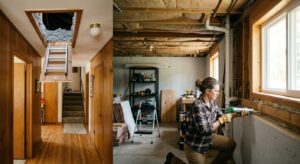
- Locate your attic access hatch and pull down the ladder or open the hatch. Before going up, look at the underside of the hatch door itself. If it has no insulation attached, you have found your first problem: an uninsulated hatch can lose as much heat per square foot as an uninsulated wall.
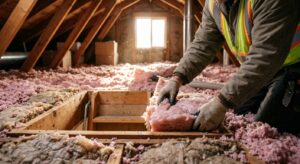
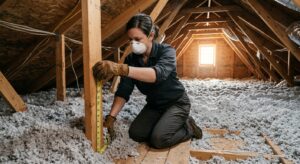
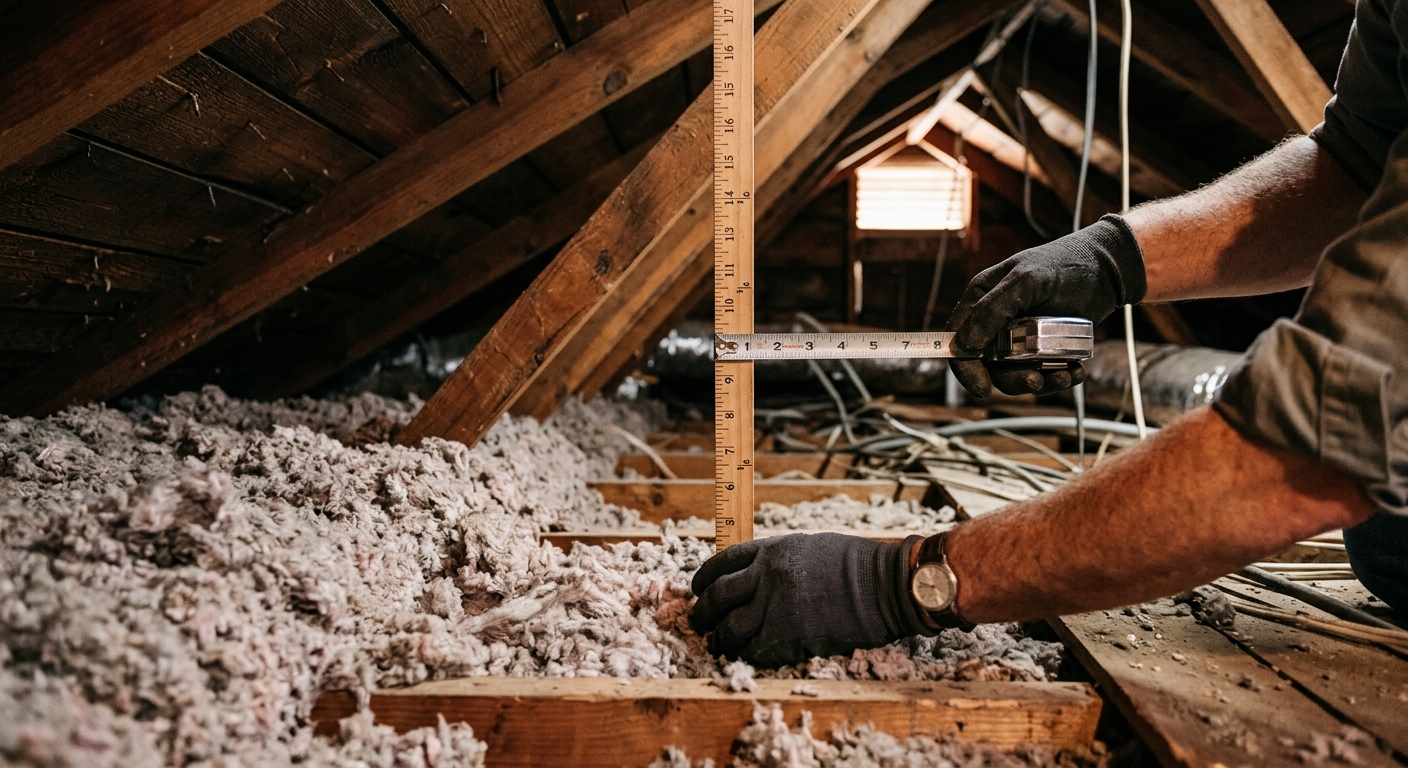
- Once safely in the attic, use your ruler to measure the depth of insulation in several spots across the floor, including the center of the space and the eave edges near the exterior walls. Write down each measurement.
- Convert depth to approximate R-value: fiberglass batts run about R-3 per inch, blown fiberglass about R-2.5 per inch, and cellulose about R-3.7 per inch. Multiply your measured depth by the appropriate factor to get your current R-value.
- Compare your result to the DOE recommendation for your climate zone. Climate Zone 1 to 2 (Deep South) needs R-38, Zone 3 (Mid-Atlantic, Pacific Coast) needs R-38 to R-49, and Zones 4 to 8 (Northern states) need R-49 to R-60. If you are more than 20% below target, an upgrade will pay back within 3 to 5 years.
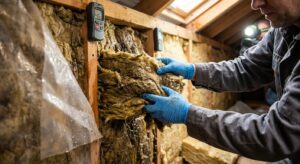
- Scan for visible problems: compressed batts, wet or discolored patches indicating past moisture, bare spots near the eaves, and open gaps around light fixtures or plumbing pipes. Photograph everything so you have a baseline record.
- Air seal before adding insulation. Use canned spray foam to fill gaps around recessed light cans, plumbing penetrations, top plates, and the attic hatch frame. This step alone can reduce air leakage by 20 to 30% and should never be skipped. Blown-in insulation added over unsealed gaps is far less effective.
- Install an insulated cover over your attic hatch. Pre-made insulated hatch covers cost $30 to $80 and provide R-10 to R-20 where previously there may have been nothing.
- Install baffles at each rafter bay along the eaves to maintain at least a 1-inch air channel from soffit vents to the attic space. These cardboard or foam baffles prevent new insulation from blocking ventilation and are critical for moisture control.
- Calculate the square footage of your attic floor and purchase the appropriate bags of blown-in cellulose or fiberglass. Rental blowing machines are typically free with a minimum purchase of insulation bags at home improvement stores. Plan for R-15 of added material to bring a typical older home from R-19 up to R-38.
- Start blowing insulation from the far end of the attic, working toward the hatch. Maintain even depth using depth markers, which are simple stakes you install every 4 to 6 feet. Cellulose at R-38 total requires roughly 10 to 12 inches of new material added over existing insulation.
- After completing the blow-in, install weatherstripping around the attic hatch perimeter and re-check depth in at least five locations to confirm you have hit target R-value before returning your equipment.
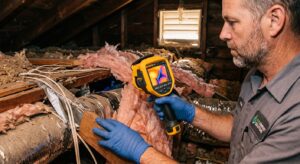
- Hire a BPI-certified or RESNET-certified energy auditor. Many utilities offer subsidized audits for $100 to $200 that include a blower door test. This test depressurizes your home and pinpoints exactly where air is escaping, removing guesswork entirely.
- Request a written report with specific R-value measurements in multiple attic zones, identified air leakage sites, and a cost-benefit analysis for the recommended upgrade. A good auditor will also check for moisture and ventilation problems before recommending insulation.
- Get bids from two to three insulation contractors. Ask specifically whether the quote includes air sealing labor as a separate line item, and confirm they will achieve the DOE-target R-value for your climate zone, not just meet minimum local code.
- Ask your utility company and your state energy office about rebates before signing any contract. Many utilities offer $0.10 to $0.25 per square foot in rebates for attic insulation, and federal tax credits under the Inflation Reduction Act cover 30% of insulation upgrade costs up to $1,200 as of 2024.
- After installation, request a completion certificate documenting the installed R-value, the air sealing locations, and the contractor’s license number. Keep this for your tax credit filing and your future home sale.
Why It Works: The Benefits
Upgrading an under-insulated attic to the DOE-recommended R-value for your climate zone typically saves 15 to 25% on annual heating and cooling costs. For a home spending $2,000 per year on energy, that is $300 to $500 back in your pocket every year.
Adequate insulation eliminates the hot upper floors in summer and cold rooms in winter that stem from heat moving through a poorly insulated ceiling. Homeowners with upgraded attic insulation consistently report that their HVAC systems cycle less and rooms feel more even throughout the day.
When insulation is adequate, your heating and cooling equipment does not have to run as long or as hard to maintain setpoint temperatures. Shorter run cycles extend equipment life by years and reduce maintenance costs, which can easily exceed $200 to $400 per service call.
Sealing attic air leaks as part of an insulation upgrade prevents dust, allergens, and potentially radon from migrating into living spaces through the ceiling. This is especially important for households with allergy sufferers or in regions with elevated radon levels.
An ENERGY STAR-certified attic insulation upgrade adds measurable value at resale and can be a required disclosure item during home inspections. Buyers increasingly ask for energy audit reports, and documented insulation levels above code minimum are a competitive advantage.
💰 Savings Impact by Action
Sealing attic floor penetrations reduces conditioned air loss by up to 20% according to EPA Energy Star data.
Bringing attic insulation from R-19 to R-38 reduces heating and cooling energy use by approximately 15% in most climate zones.
Insulating an uninsulated attic hatch eliminates a thermal weak point responsible for up to 5% of ceiling heat loss.
Adding a radiant barrier in hot climates reduces summer attic temperatures by 20 to 30 degrees Fahrenheit, cutting cooling loads by 5 to 10%.
Air sealing plus insulation top-up together deliver the DOE-cited 15 to 25% total reduction in annual heating and cooling costs.
🏠 Key Concepts Explained
The Science Behind It
Heat moves in three ways: conduction (through solid materials), convection (through air movement), and radiation (through electromagnetic waves). Insulation primarily targets conduction by trapping still air in tiny pockets within its fibers or cells, since still air is an excellent thermal resistor. The R-value system quantifies exactly this resistance: a material rated R-1 allows one BTU of heat to pass through one square foot per hour for every degree Fahrenheit of temperature difference. Double the R-value, and you roughly halve the rate of heat transfer through that assembly.
What R-value does not measure is air leakage. When conditioned air physically escapes through gaps in your ceiling into the attic, it carries its thermal energy with it rather than slowly conducting through a material. This is why a home with R-30 insulation and well-sealed penetrations often outperforms a home with R-49 insulation and significant air leakage. The two strategies work together: insulation resists the slow diffusion of heat through mass, while air sealing stops the fast, direct movement of warm or cool air between living space and attic.
Attic insulation is especially high-impact because of the physics of heat stratification. Warm air naturally rises, so in winter your heated air pools at the ceiling and conducts directly into the attic if insulation is inadequate. In summer, the attic can reach 130 to 150 degrees Fahrenheit on a 90-degree day, creating an enormous temperature differential that drives heat down into your living space regardless of how well your walls are insulated. Adding insulation to the attic floor is almost always a higher return investment than adding it to the walls, because the temperature differentials are larger and the total area is easier to access and treat uniformly.
Frequently Asked Questions
▼ My attic already has insulation. How do I know if it is still working?
Measure its depth and compare to your climate zone’s DOE target R-value. Also check for discoloration, compression, or a musty smell, all of which signal moisture damage that destroys thermal performance. If the insulation is visibly matted or wet, it may have an effective R-value near zero even if it still looks present.
▼ Why is my second floor still hot in summer even though I have attic insulation?
The most likely causes are attic air sealing gaps that bypass the insulation, insufficient insulation depth for your climate zone, or blocked soffit vents that allow the attic to overheat. Start by checking insulation depth and looking for dark streaks in the insulation near the eaves, which indicate air is being pulled through rather than stopped. Also verify that soffit vents are unobstructed and that ridge vents are present and clear.
▼ Can I just add insulation on top of my existing insulation, or do I need to remove the old stuff?
In most cases you can add new insulation directly on top of existing insulation if the existing material is dry and in good condition. Removal is only necessary if there is mold, pest contamination, or knob-and-tube wiring that needs to be addressed first. Blown-in cellulose layered over old fiberglass batts is a common and effective retrofit method.
▼ How do utility rebates and the federal tax credit work for attic insulation?
The federal Inflation Reduction Act offers a 30% tax credit on the cost of attic insulation and air sealing materials up to $1,200 per year through 2032. File IRS Form 5695 with your tax return. Separately, most utility companies offer rebates ranging from $0.05 to $0.25 per square foot of installed insulation. Check your utility’s website or call their energy efficiency line before you purchase materials or hire a contractor.
▼ What if my home was built in the 1960s or 1970s? Is insulation from that era still effective?
Fiberglass batts installed in that era are likely compressed to a fraction of their original R-value and may have absorbed decades of dust and moisture. Homes from this period were also often built with minimal air sealing and may contain asbestos-based insulation materials if any pipe or duct insulation is visible. If you see gray or white fibrous material that crumbles easily around ducts or pipes, do not disturb it and have a sample tested before proceeding with any attic work.
Quick Tips
- Check your attic insulation depth every 5 years. Cellulose and fiberglass both settle over time, and what was R-38 at installation may be R-28 a decade later.
- If you have recessed can lights in your ceiling, look for IC-rated (Insulation Contact) labels before covering them. Non-IC cans must be covered with a sealed box before insulation is added over them.
- In hot climates, consider adding radiant barrier foil to the underside of roof rafters in addition to insulation on the attic floor. A radiant barrier can reduce attic temperature by 20 to 30 degrees Fahrenheit on a hot day, reducing cooling loads by 5 to 10%.
- Do not ignore the attic hatch. An uninsulated 22-by-30-inch hatch can be responsible for 2 to 5% of total attic heat loss, and an insulated cover typically pays back in under one heating season.
Variations for Your Situation
- Apartment or Condo: Residents in multi-unit buildings typically cannot access or modify attic insulation themselves. Focus instead on insulating the area directly above your ceiling by requesting maintenance to inspect and improve attic conditions, and compensate by using draft snakes on doors, thermal curtains on windows, and ceiling fans to reduce the perceived temperature difference. If you have a top-floor unit, document comfort complaints in writing to create a paper trail for required landlord improvements.
- Tight Budget (under $50): Start with the attic hatch. An insulated hatch cover kit costs $30 to $50 and installs in 30 minutes with no special tools. Next, use a $5 to $10 can of spray foam to seal around light fixtures and plumbing penetrations visible from the attic. These two steps together can reduce attic heat loss by 10 to 15% at a fraction of the cost of a full insulation upgrade.
- Older Home (pre-1980): Prioritize a professional energy audit before doing any DIY work. Homes from this era frequently have knob-and-tube wiring, asbestos insulation on pipes, inadequate ventilation, and air leakage rates two to three times higher than a modern home. The audit will identify hazards, qualify you for utility programs designed for older housing stock, and ensure insulation upgrades do not trap moisture in wall cavities or create ice dam conditions on your roof.