Every summer, millions of homeowners notice the same pattern: you cook dinner, and suddenly the living room feels like a sauna. It’s not your imagination. A gas range at full burner output can generate 7,000 to 15,000 BTUs of heat directly into your kitchen air, and an oven running at 375°F radiates heat for the entire time it’s on plus 30 to 45 minutes after you turn it off. That excess heat doesn’t stay in the kitchen. It migrates through open floor plans and doorways, loading up your AC system and driving up your monthly energy bill.
The problem is compounded by poor ventilation. Most builder-grade range hoods recirculate air through a charcoal filter rather than exhausting it outside, which means all that cooking heat stays in your home. Combined with heat-generating appliances like refrigerators, dishwashers, and toasters, your kitchen can become the single biggest source of internal heat gain on your first floor during summer months. The Department of Energy estimates that internal heat gains from cooking and appliances can account for 10 to 15% of a home’s total cooling load.
This post covers practical, proven strategies to reduce kitchen heat gain, from zero-cost habit changes you can start tonight to a ventilation upgrade that pays for itself in a single cooling season. Whether you rent or own, live in a small apartment or a large open-concept home, there are approaches here that will make a real difference in both comfort and energy costs.
What You’ll Need
Click on an item below to shop for the recommended items for this recipe on Amazon.
As an Amazon Associate, we earn from qualifying purchases.
How to Do It
- Shift heavy cooking (roasting, baking, long simmers) to early morning before 10am or after 7pm when outdoor temperatures are lower and your AC is under less strain.
- Use the back burners on your range whenever possible. Back burners sit closer to the range hood intake and capture heat and steam more effectively before it disperses into the room.
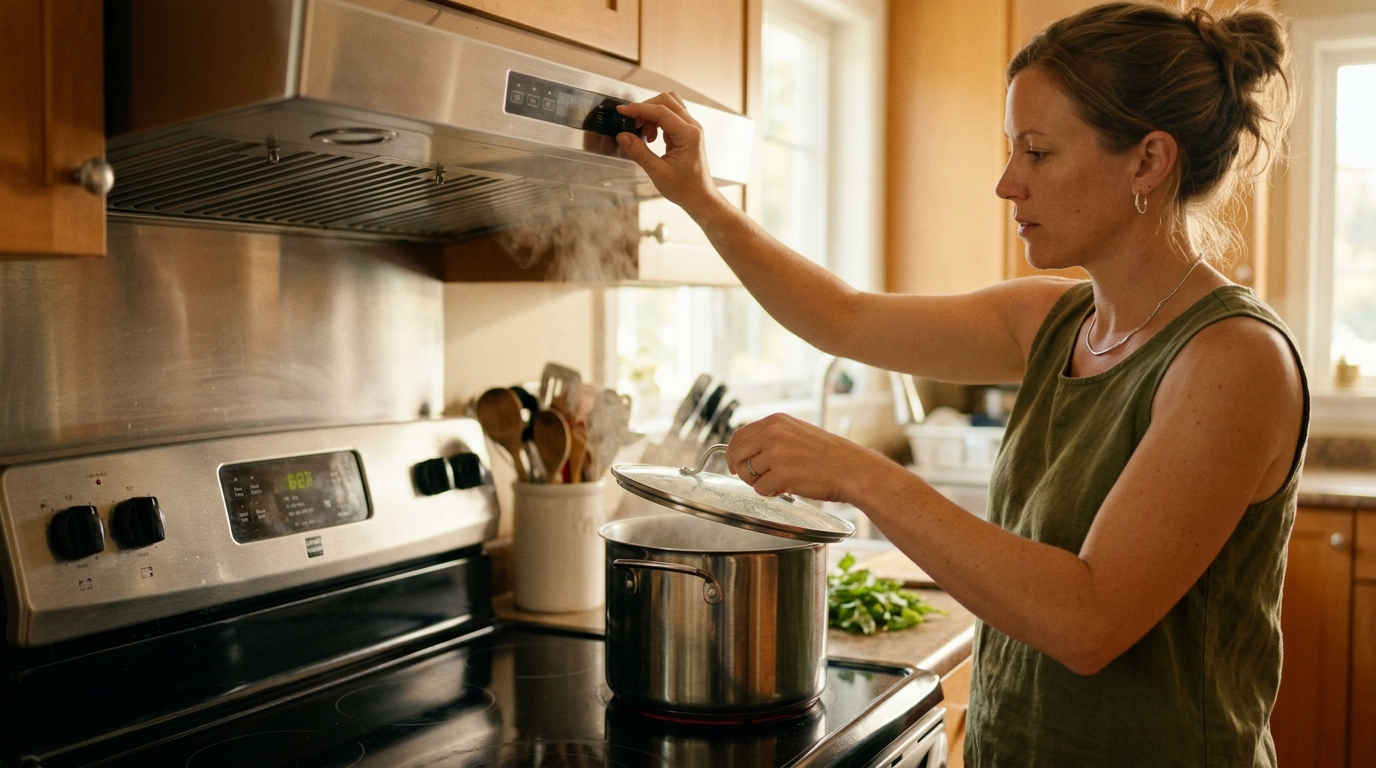
- Run your range hood fan on its highest setting for the entire time you cook plus 15 minutes after you finish. Most homeowners turn it off too early, leaving residual heat and moisture in the kitchen.
- Use the microwave, air fryer, or electric pressure cooker instead of the oven for weeknight meals. These appliances generate 50 to 70% less waste heat than a full-size oven for equivalent cooking tasks.
- Open a window on the opposite side of the house from the kitchen while cooking to create cross-ventilation. This creates a pressure path that pulls hot kitchen air out rather than letting it stagnate and spread.
- Run the dishwasher at night and use the air-dry setting instead of heated dry. A full heated-dry cycle adds roughly 600 BTUs of heat to the kitchen during its hottest part of the day if run after dinner.
- Assess your current range hood by looking for a duct connection at the top or rear. If there is an existing duct path to the exterior, a ducted hood replacement is straightforward. If no duct exists, plan for a new duct run or consider a high-CFM recirculating hood with an external blower as a secondary option.
- Select a ducted range hood rated for at least 300 CFM for a standard 4-burner gas or electric range. For a professional-style range with higher BTU output, target 400 to 600 CFM. Look for models with a sone rating under 4.0 to keep noise acceptable.
- Install the new ducted range hood following the manufacturer’s instructions. Use rigid metal ductwork rather than flexible foil duct for the exhaust run, since rigid duct maintains airflow efficiency and is less prone to grease buildup over time.
- Seal all duct joints with foil HVAC tape rather than standard duct tape, which degrades with heat exposure. A leaky duct connection inside a wall or cabinet defeats the purpose of the upgrade.
- Add a window fan in the kitchen window set to exhaust outward, running it during and after cooking. A 20-inch box fan in exhaust mode moves 2,000 to 3,000 CFM, providing makeup air and additional heat removal that complements the range hood.
- Consider replacing incandescent or halogen under-cabinet lights with LED fixtures if you have not already. Incandescent bulbs above the counter each add 40 to 60 watts of heat at eye level right where you cook. LED replacements cut that heat output by about 90%.
- Hire an HVAC contractor to evaluate your first-floor duct layout. In many homes, the kitchen and adjacent living areas share a single supply zone with no ability to direct extra cooling where heat is generated. A contractor can identify whether adding a supply register or booster fan in the kitchen makes sense.
- Request installation of a dedicated exhaust duct from the range hood to the exterior if one does not exist. A contractor can core through cabinetry and exterior walls cleanly and ensure proper backdraft dampers are installed to prevent conditioned air loss when the hood is not running.
- Ask about a mini-split addition for the kitchen and adjacent area if the first floor is consistently 5 to 8 degrees warmer than the rest of the home. A single-zone 9,000 BTU mini-split costs $1,500 to $2,500 installed and can handle the kitchen zone independently without oversizing the central system.
- Have the contractor install a makeup air system if your new range hood exceeds 400 CFM. In tightly sealed modern homes, a powerful exhaust hood can depressurize the kitchen enough to backdraft combustion appliances. A makeup air damper introduces controlled fresh air to balance the pressure.
Why It Works: The Benefits
Reducing kitchen heat gain through better ventilation and cooking habits can cut summer cooling costs by 8 to 20%, translating to $30 to $120 in savings over a typical cooling season depending on your climate and home size.
Eliminating the kitchen as a major heat source reduces the temperature differential between the kitchen and adjacent rooms from as much as 8 to 12 degrees down to 2 to 3 degrees, making the entire first floor feel consistently comfortable.
Every degree of internal heat gain your AC doesn’t have to fight extends compressor life. Cutting peak kitchen heat loads can reduce AC runtime by 15 to 30 minutes per cooking session, which adds up to meaningfully lower wear over a full summer.
Proper exhaust ventilation removes combustion byproducts from gas burners, cooking fumes, and particulates that would otherwise recirculate through your home’s air, improving respiratory air quality for everyone in the household.
With active exhaust and smart cooking habits, the kitchen returns to ambient room temperature within 15 to 20 minutes of cooking ending, compared to 60 to 90 minutes in a poorly ventilated kitchen that relies on AC alone.
💰 Savings Impact by Action
Switching from a recirculating to a ducted range hood removes cooking heat at the source and can cut kitchen-related cooling load by up to 20% over a full summer.
Moving oven and stovetop use to cooler parts of the day reduces peak cooling demand by 10 to 15%, letting AC catch up before outdoor heat is also at its maximum.
Replacing oven use with a microwave or air fryer for weeknight meals reduces kitchen heat generation by 50 to 70% per cooking session, saving roughly 8 to 12% on overall cooling costs.
Blocking direct sun from a west-facing kitchen window with an exterior shade or film reduces solar heat gain by up to 75% through that window, cutting total first-floor cooling load by 5 to 10%.
Replacing incandescent under-cabinet and ceiling lights in the kitchen with LEDs eliminates up to 90% of lighting heat output, reducing a continuous background heat source by 4 to 6%.
🏠 Key Concepts Explained
The Science Behind It
Your AC system removes heat from your home by cycling refrigerant through an evaporator coil, which absorbs heat from indoor air, and then rejecting that heat outside through the condenser. Every BTU generated inside your home is a BTU your AC must eventually remove, consuming roughly 1 watt of electricity per 3 BTUs of cooling. A gas range running two burners at medium-high can generate 10,000 to 20,000 BTUs per hour, which means your AC could need to run an extra 30 to 60 minutes just to offset a single cooking session. That load is additive on top of solar heat gain, occupant heat, and outdoor air infiltration your AC is already managing.
The reason kitchen heat spreads so effectively to adjacent rooms comes down to buoyancy-driven airflow. Hot air is less dense than cool air and rises naturally. In an open floor plan, the warm air column above the range displaces toward the ceiling and then spreads laterally into the living room and hallway. As it cools slightly and descends, it creates a slow convective loop that maintains elevated temperatures across the entire space. Closing a door between the kitchen and living room while cooking is one of the simplest ways to interrupt this loop, though this only works in homes without fully open-concept layouts.
Ducted range hood ventilation works by intercepting this rising heat plume before it disperses. A properly sized hood captures the thermal column rising from the cooking surface and exhausts it directly to the exterior, removing both sensible heat and the latent heat of steam before either can load your AC. The key is capture velocity: the hood face must generate enough airflow to contain the plume width, which is why an undersized or improperly positioned hood has a disproportionately poor effect. For best results, the hood should extend at least as wide as the cooking surface and be mounted no higher than 24 to 30 inches above the range top.
Frequently Asked Questions
▼ My range hood is on but the kitchen still gets extremely hot when I cook. What am I doing wrong?
The most common cause is a recirculating hood that filters and returns air rather than exhausting it outside. Check behind or above your hood for a duct connection to the exterior. If there is none, the hood is providing zero heat removal. The second most common issue is hood sizing: if your range produces more than 30,000 BTUs total and your hood is rated under 300 CFM, it simply cannot keep up with the heat output. Upgrade to a properly rated ducted model for meaningful results.
▼ Can renters do anything about kitchen overheating without modifying the ventilation system?
Yes, and the zero-cost habit changes in this post are fully renter-friendly and will make a noticeable difference. Additionally, a portable evaporative cooler or a window fan set to exhaust during cooking are both renter-safe options that require no permanent installation. Talk to your landlord about the range hood situation, since many will upgrade to a ducted model if you document the comfort and energy cost impact.
▼ How long before I actually see lower energy bills after fixing this?
Habit changes like shifting cooking times and running the hood longer show up in the very first monthly bill. For a typical household cooking dinner most evenings in summer, expect to see a 5 to 15% reduction in the first month’s cooling costs. A ducted range hood upgrade will show its full impact within the first full cooling season, typically paying back its cost in 1 to 2 summers in hot climates.
▼ My kitchen is separate from the living room but the adjacent dining room still gets hot. Why?
Even in homes without fully open floor plans, heat migrates through doorways, pass-throughs, and gaps at the top of walls. The ceiling-level gap above a doorway acts as a vent that allows the hot air layer near the kitchen ceiling to drift into the dining room. Try keeping the kitchen door mostly closed during cooking and running the range hood to actively exhaust heat rather than letting it accumulate and overflow into adjacent spaces.
▼ We just installed a powerful new range hood and now I smell sewer gas or the furnace pilot seems to flicker. Is this related?
Yes, this is a backdrafting problem caused by the hood depressurizing your home. High-CFM hoods (above 400 CFM) in tightly built homes can create enough negative pressure to pull exhaust gases backward through drain vents or combustion appliances. Stop using the new hood at high speed immediately and contact an HVAC professional to assess makeup air requirements. A makeup air damper kit can resolve this safely and is often required by code for hoods over 400 CFM.
Quick Tips
- Batch cook on Sunday mornings when it’s cooler outside, reducing weekday cooking heat load by 30 to 50% across the week.
- Keep your refrigerator coils clean. Dirty condenser coils make the refrigerator run longer and radiate more heat into the kitchen, adding a continuous background heat source that runs 24 hours a day.
- Use a splatter screen and lids on pots when boiling to reduce steam release. Less steam means a lower latent heat load and less humidity your AC needs to wring out of the air.
- Plant a shade tree or install an awning on the west-facing kitchen window if applicable. Blocking direct afternoon sun from entering the kitchen eliminates up to 200 to 500 BTUs per window per hour before cooking even begins.
Variations for Your Situation
- Apartment/Rental: Renters cannot modify ducted ventilation, but can maximize results through zero-cost habit shifts and portable solutions. A window fan (20 to 24 inch box fan, $25 to $50) set to exhaust in the kitchen window during cooking moves more air than most recirculating hoods and costs almost nothing. Shift oven use to an air fryer or Instant Pot, which produce 60 to 70% less waste heat and require no ventilation upgrades.
- Tight Budget (under $50): Focus on the habit changes first since they cost nothing and deliver 30 to 50% of the total possible improvement. Add a box fan in the kitchen window for $25 to $40 and a roll of white reflective window film for any west-facing kitchen windows for another $15 to $20. Together these steps can cut kitchen heat gain by more than half without any tools or installation.
- Older Home (pre-1980): Older homes often have no range hood at all, or one that vents into the attic rather than through the exterior wall, which is both ineffective and a fire risk from grease accumulation. Before any other steps, confirm where your hood actually vents. Attic terminations must be rerouted to the exterior. Older homes also tend to have more air leakage, which means kitchen heat escapes to upper floors more aggressively via gaps in the ceiling and around light fixtures. Sealing those gaps with fire-rated caulk before upgrading ventilation gives you better results from the same hood upgrade investment.