You walk in from the heat, crank the AC down to 68°F, and still feel sticky and miserable. Sound familiar? The problem probably has nothing to do with your thermostat. Indoor relative humidity (RH) is the invisible comfort factor that most homeowners never measure, yet it drives how hot or cold a space actually feels on your skin. When humidity climbs above 60 percent, your body’s sweat evaporation slows to a crawl, and a 75°F room can feel like 80°F or worse. When it drops below 30 percent in winter, dry air pulls moisture from your skin and makes a 70°F room feel drafty and harsh.
Here’s the kicker: cooling your home to compensate for excess humidity burns serious energy. Running your AC 5 to 8 degrees colder just to offset a muggy feeling can add 10 to 15 percent to your monthly electricity bill, and in humid climates that number climbs even higher. Worse, chronic high humidity above 60 percent creates conditions where dust mites thrive, mold colonies establish themselves in under 48 hours, and wood framing slowly deteriorates. Controlling humidity is not just a comfort issue, it is a health and structural issue.
In this post, you will learn exactly what humidity range to target, how to measure it with a $10 device, and practical steps ranging from free thermostat tweaks to installing a whole-home dehumidifier. Whether you are sweating through a Southern summer or battling dry winter air in the Midwest, there is a humidity strategy here that fits your budget and your situation.
What You’ll Need
Click on an item below to shop for the recommended items for this recipe on Amazon.
As an Amazon Associate, we earn from qualifying purchases.
How to Do It
- Locate your thermostat and find the fan setting. Switch the fan mode from ‘ON’ to ‘AUTO’. This single change prevents the fan from reevaporating moisture off the wet evaporator coil between cooling cycles, which is one of the most common causes of high indoor humidity.
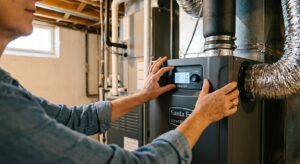
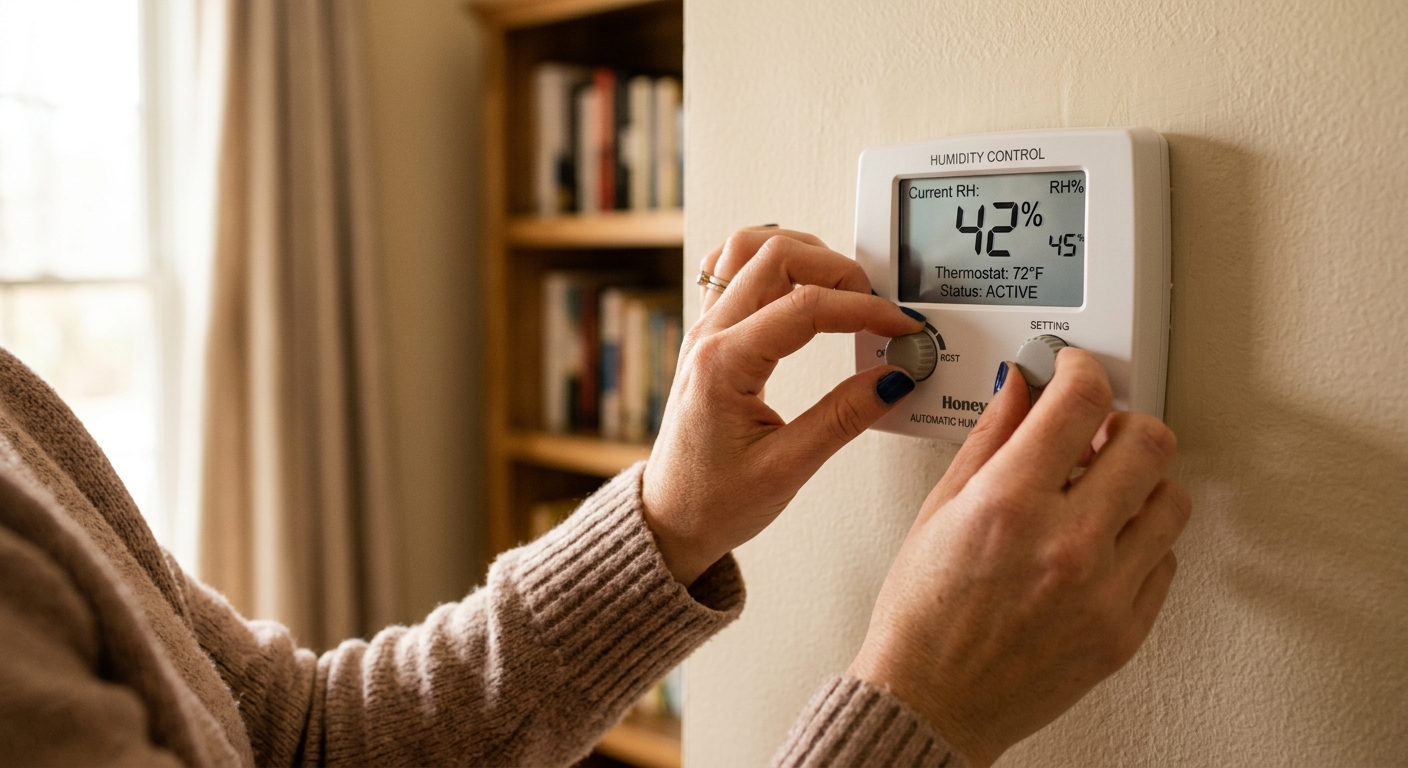
- If your thermostat has a ‘dry’ or ‘dehumidify’ mode, enable it. Many modern smart thermostats (Ecobee, Nest, Honeywell T6 Pro) have a built-in humidity threshold setting that runs the compressor slightly longer at reduced fan speed to wring more moisture out of each cooling cycle.
- Check your thermostat setpoint. If you are currently set at 70 to 72°F partly because the air feels clammy, raise it by 2°F and monitor comfort after making the fan switch. A less humid 74°F feels equivalent to a humid 70°F for most people.
- Walk through your home and close bathroom exhaust fans after showers rather than leaving them running all day. Running exhaust fans continuously depressurizes the home and pulls humid outdoor air in through gaps. Run exhaust fans for 15 to 20 minutes post-shower only.
- Open interior doors throughout the home to allow conditioned, dehumidified air to circulate to all rooms. Closed doors trap moisture in spaces the AC cannot reach, creating pockets of high RH where mold risk is elevated.
- Buy a digital hygrometer (also called a humidity monitor or thermo-hygrometer). Quality options from ThermoPro or Govee cost $10 to $15 each. Place one in your main living area, one in the bedroom, and one in the basement or crawl space. Give them 30 minutes to stabilize and record the readings.
- Identify your humidity problem zones. Basement or crawl space readings above 65% RH signal ground moisture intrusion. Living area readings above 55% RH in summer typically point to envelope air leakage or an undersized or short-cycling AC system.
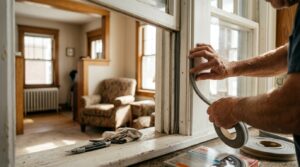
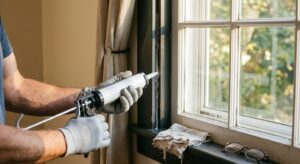
- Seal common air infiltration points with DAP Alex Plus or similar paintable latex caulk. Focus on: gaps around window frames where the frame meets drywall, plumbing penetrations under sinks where pipes enter from outside walls, gaps around electrical outlets and switch plates on exterior walls, and the joint between the baseboard and the floor on exterior walls.
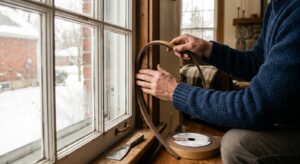
- Apply foam backer rod and caulk or fresh weatherstripping to any exterior door with a visible gap. Hold a lit incense stick near the door frame on a windy day and watch for smoke movement to find leaks. A door gap the size of a nickel allows the equivalent of a 3-inch square hole in your wall.
- Check your AC drain line and drip pan. A clogged drain line causes condensate to back up and evaporate back into the air stream. Flush the drain line with a cup of distilled white vinegar every 3 months to keep it clear. This takes 5 minutes and prevents a common hidden humidity source.
- After sealing, re-check your hygrometer readings over the next 48 hours. If living area RH drops below 55% and stays there, you have solved the infiltration problem. If it remains elevated, your AC may be short-cycling or undersized and a professional assessment is the right next step.
- Determine which type fits your situation. A portable room dehumidifier (50-pint capacity, $250 to $400) handles a single room or small basement and requires emptying the reservoir daily or connecting a drain hose. A whole-home dehumidifier ($800 to $1,800 installed) connects to your HVAC ductwork and treats all conditioned air automatically.
- For a portable unit, choose a model with an ENERGY STAR certification and a built-in humidistat that shuts the unit off at your target RH. Set the target to 50% RH. Place the unit in the most problematic room, away from walls, and run the drain hose to a floor drain or sump if available to avoid daily emptying.
- For a whole-home unit, hire an HVAC technician to install it inline with your return air duct. The technician will cut the duct, mount the unit, connect a condensate drain to your existing AC drain line, and wire it to your system. The whole process takes 3 to 5 hours. Ask the technician to set the humidistat to 50% RH.
- After installation, program the dehumidifier’s target to 45 to 50% RH and leave it. Whole-home units are designed to run independently of your AC compressor, meaning they continue dehumidifying during mild weather when your AC is not running at all. This is a significant advantage over relying solely on your AC.
- Track your electricity bill and thermostat setting for 60 days post-installation. Most homeowners in humid climates find they can raise their thermostat setpoint by 2 to 4°F after installing dehumidification, and the energy savings from the higher setpoint partially offset the dehumidifier’s own electricity use. A whole-home unit typically uses 700 to 1,000 watts, while avoiding 3°F of cooling saves roughly equivalent energy in most climates.
Why It Works: The Benefits
When indoor RH is controlled at 45 to 50%, most people feel comfortable at a thermostat setpoint 3 to 5 degrees higher. Raising your setpoint from 70°F to 74°F saves roughly 6 to 8% per degree per hour of runtime, adding up to 10 to 15% in monthly cooling cost reductions.
The National Sleep Foundation identifies 60 to 67°F as the optimal sleep temperature, but humidity matters equally. High humidity disrupts thermoregulation during sleep, causing restlessness and night sweats. Keeping bedroom RH at 45 to 50% improves sleep comfort without touching the thermostat.
Dust mites require RH above 50% to reproduce, and mold can colonize porous surfaces in as little as 24 to 48 hours when RH exceeds 60%. Holding indoor humidity below 50% dramatically cuts the population of both major allergens, providing real relief for asthma and allergy sufferers.
Wood flooring, cabinetry, and framing all expand and contract with humidity swings. The Wood Flooring Manufacturers Association recommends maintaining indoor RH between 35 and 55% year-round. Consistent humidity control prevents gaps, warping, and squeaks in wood floors, and extends the life of musical instruments and wood furniture.
In winter, indoor RH often drops to 20 to 25% as heating systems dry the air. Low humidity causes dry nasal passages, cracked lips, static electricity, and increased susceptibility to respiratory viruses. Research published in PLOS ONE found influenza virus survival rates drop sharply when RH is maintained above 43%.
💰 Savings Impact by Action
Raising the cooling setpoint by 3°F after achieving proper humidity control saves approximately 6 to 8% per degree, totaling 10 to 15% on cooling costs.
Switching HVAC fan from ON to AUTO prevents moisture reevaporation and can reduce indoor RH by up to 8 points, improving dehumidification efficiency by roughly 5%.
Sealing infiltration pathways reduces the outdoor humidity load entering the home, cutting the AC’s latent cooling work by 10 to 20% in leaky homes.
A whole-home dehumidifier enables a 2 to 4°F thermostat setpoint increase, offsetting 50 to 80% of its own operating cost through reduced AC runtime.
🏠 Key Concepts Explained
The Science Behind It
The discomfort you feel in a humid room comes down to thermodynamics and biology working against each other. Your body maintains a core temperature of 98.6°F by continuously transferring heat to the surrounding air through radiation, convection, and evaporation. At moderate activity levels, evaporation (sweating) accounts for roughly 25 to 50% of your total heat loss. When the air around you is already saturated with water vapor, your sweat cannot evaporate efficiently, heat builds up at your skin surface, and your body’s core temperature regulation becomes strained. This is not a perception issue; it is a measurable physiological response. The heat index scale used by the National Weather Service quantifies exactly this effect: at 80°F and 90% RH, the apparent temperature is 86°F, while at 80°F and 40% RH it feels like 79°F.
On the HVAC side, every pound of water vapor in indoor air carries approximately 1,061 BTUs of latent heat energy that your air conditioner must remove before it can lower air temperature. This is called the latent load, and in humid climates it can account for 30 to 50% of your total cooling load during peak summer months. An AC system that is slightly oversized for your home will reach the thermostat setpoint temperature quickly and shut off before it has had enough runtime to remove adequate moisture from the air. The result is air that is cool but damp, a condition HVAC professionals call ‘cold and clammy.’ This is why bigger is not always better with air conditioners, and why proper Manual J load calculations matter when sizing equipment.
In winter, the humidity equation flips. Outdoor air in cold climates holds very little moisture (cold air has a much lower capacity for water vapor than warm air). When that dry outdoor air infiltrates your home and is heated to 68 to 70°F, its relative humidity drops even further, sometimes to 15 to 20%. At those levels, mucous membranes dry out, static electricity builds up, and wood products begin to shrink and crack. The sweet spot that building scientists and the American Society of Heating, Refrigerating and Air-Conditioning Engineers (ASHRAE) recommend for year-round health and comfort is 40 to 60% RH, with 45 to 50% being ideal. Maintaining this range year-round is the single most impactful comfort improvement most homeowners can make, and it costs far less than upgrading an HVAC system.
Frequently Asked Questions
▼ My AC is running constantly but my home still feels humid. What is wrong?
This almost always points to one of three issues: the AC is undersized for the actual load, there is a significant air leak bringing in outdoor humid air faster than the system can remove it, or the evaporator coil is dirty and not dehumidifying efficiently. Check your air filter first (a clogged filter reduces airflow and dehumidification), then have a technician measure your system’s static pressure and check the coil. If the system is more than 15 years old and undersized, replacement with a properly sized unit is usually the most cost-effective path.
▼ My hygrometer reads 70% RH in the basement but only 50% upstairs. Is that a problem?
Yes, because air naturally moves from basement to upper floors through the stack effect, carrying that basement moisture with it. A basement at 70% RH is both a mold risk (check for visible growth on joists, insulation, and stored items) and a hidden humidity source for your whole home. The fix is a dedicated basement dehumidifier set to 50 to 55% RH, plus checking for any ground water intrusion or missing vapor barrier on a dirt crawl space floor.
▼ Can I control humidity without an air conditioner? I have window units or just fans.
Window AC units do remove some moisture, but they are typically less efficient at dehumidification than central systems. The most effective no-AC humidity control is a standalone ENERGY STAR dehumidifier, which removes 30 to 50 pints of water per day from the air while adding only a modest amount of heat. Pair a dehumidifier with ceiling fans to maintain comfort. Avoid whole-house fans in very humid climates as they pull outside air, and outside air, in summer, is the enemy.
▼ In winter, my home feels dry and I get static shocks constantly. What is the target and how do I get there?
Target 35 to 45% RH indoors during heating season. The most cost-effective solution is a furnace-mounted flow-through humidifier ($200 to $400 installed), which adds moisture directly to your heated air stream and is controlled by a humidistat. Portable ultrasonic humidifiers work for single rooms but require daily cleaning to prevent mold and mineral buildup. Avoid warm-mist humidifiers in homes with children due to burn risk.
▼ Will a whole-home dehumidifier raise my electricity bill significantly?
A quality whole-home dehumidifier uses roughly 700 to 1,000 watts while running, which is comparable to a window AC unit. However, the energy savings from being able to run your central AC setpoint 2 to 4 degrees higher typically offsets 50 to 80% of the dehumidifier’s energy cost in hot humid climates. Most homeowners in the Southeast or Gulf Coast see a net bill increase of $15 to $35 per month in peak summer, with the payback on comfort, health, and reduced AC wear coming in 2 to 4 years.
Quick Tips
- Run kitchen and bathroom exhaust fans during and for 15 minutes after cooking or showering, but turn them off after that. Continuous operation pulls humid outdoor air in through cracks and gaps.
- In summer, keep indoor plants grouped and move them away from AC supply vents. Plants transpire moisture continuously, and a collection of houseplants near an air vent can raise local RH by 5 to 10 percentage points.
- Check your dryer vent connection annually. A partially disconnected dryer vent dumps warm, humid air directly into your living space or wall cavity, creating both a humidity problem and a mold risk behind the scenes.
- In humid climates, set your AC to ‘cool’ rather than relying on ceiling fans alone. Fans make you feel cooler through the wind-chill effect but do nothing to remove moisture from the air. If the room is humid, a fan circulating humid air is only a partial solution.
Variations for Your Situation
- Apartment or Rental: Renters cannot modify ductwork or install whole-home equipment, but a portable ENERGY STAR dehumidifier ($250 to $350) requires no installation and no landlord permission. Place it in the room where you spend the most time, set the humidistat to 50% RH, and connect the drain hose to a bathroom floor drain to avoid emptying the reservoir manually. Also request that property management switch the central fan setting to ‘AUTO’ if accessible, and seal gaps around your unit’s windows with removable foam weatherstripping tape ($8 at any hardware store).
- Tight Budget (under $50): Start with a $12 hygrometer so you know what you are actually dealing with. Switch your HVAC fan to ‘AUTO’ (free). Seal the five most common air leaks with a $6 tube of latex caulk: behind outlet covers on exterior walls, around the bathroom exhaust fan housing, under the kitchen sink where pipes enter, around the dryer vent exterior cap, and along the basement rim joist. These steps cost under $25 total and can drop indoor RH by 3 to 8 points. Flush your AC condensate drain with vinegar for free.
- Older Home (pre-1980): Homes built before modern building codes have far more air infiltration than newer construction, sometimes 10 to 20 air changes per hour versus 0.35 for a modern home. This means outdoor humidity is constantly flooding in. Sealing alone will help but is insufficient on its own. Prioritize a standalone or whole-home dehumidifier and consider an energy audit through your utility company (often free or subsidized) to identify the largest infiltration pathways. Also check for missing or damaged crawl space vapor barriers and open foundation vents, which are major moisture sources in older homes. A 6-mil poly vapor barrier on a dirt crawl space floor costs $150 to $300 in materials and delivers dramatic humidity reductions in the living space above.