Most homeowners treat the garage as a throwaway space when it comes to comfort, but that neglect has real consequences. A garage baking at 120 to 130°F in July doesn’t just make your workbench unusable. It also acts like a radiator against any wall or ceiling it shares with your living space, pushing your AC harder and raising your monthly cooling bill. Studies show that an attached, unconditioned garage can increase the thermal load on adjacent rooms by 10 to 15%.
The good news is that cooling a garage doesn’t have to mean installing a dedicated mini-split and watching your electric meter spin. Most garages lose their battle with summer heat for three fixable reasons: poor ventilation that traps hot air, an uninsulated door that absorbs and radiates solar heat, and no shade or radiant barrier to block heat before it enters. Fix those three things in the right order and you can make the space genuinely comfortable for working, without paying to air-condition a room full of cars and lawnmowers.
This guide covers everything from zero-cost ventilation tricks you can do this afternoon to a full DIY insulation and fan upgrade that pays for itself in one to two summers. Whether you want a cooler workshop, a more comfortable home gym, or just want to stop the garage from cooking the rest of your house, you’ll find a practical path forward here.
What You’ll Need
Click on an item below to shop for the recommended items for this recipe on Amazon.
As an Amazon Associate, we earn from qualifying purchases.
How to Do It
- Open windows and the side door in the morning before the garage heats up, ideally before 8 AM, to flush out overnight-stored heat from the concrete slab and walls before the sun loads up.
- Create cross-ventilation by opening one low vent or door on the cooler side of the garage and one high opening on the opposite side. Hot air rises and exits the high opening while cooler outside air enters low, creating a natural chimney effect.
- Park hot cars outside for 20 to 30 minutes after driving before pulling them into the garage. A recently driven engine adds significant heat load to an enclosed space.
- Hang a light-colored tarp or reflective mylar emergency blanket over the interior face of the garage door on the hottest part of the afternoon. This is a free proof-of-concept for radiant barrier effectiveness.
- If you have a garage door opener with a hold-open feature or a manual latch, raise the door 6 inches at the bottom to create a low inlet while opening any existing upper vents. This simple trick allows convective airflow without fully opening the door.
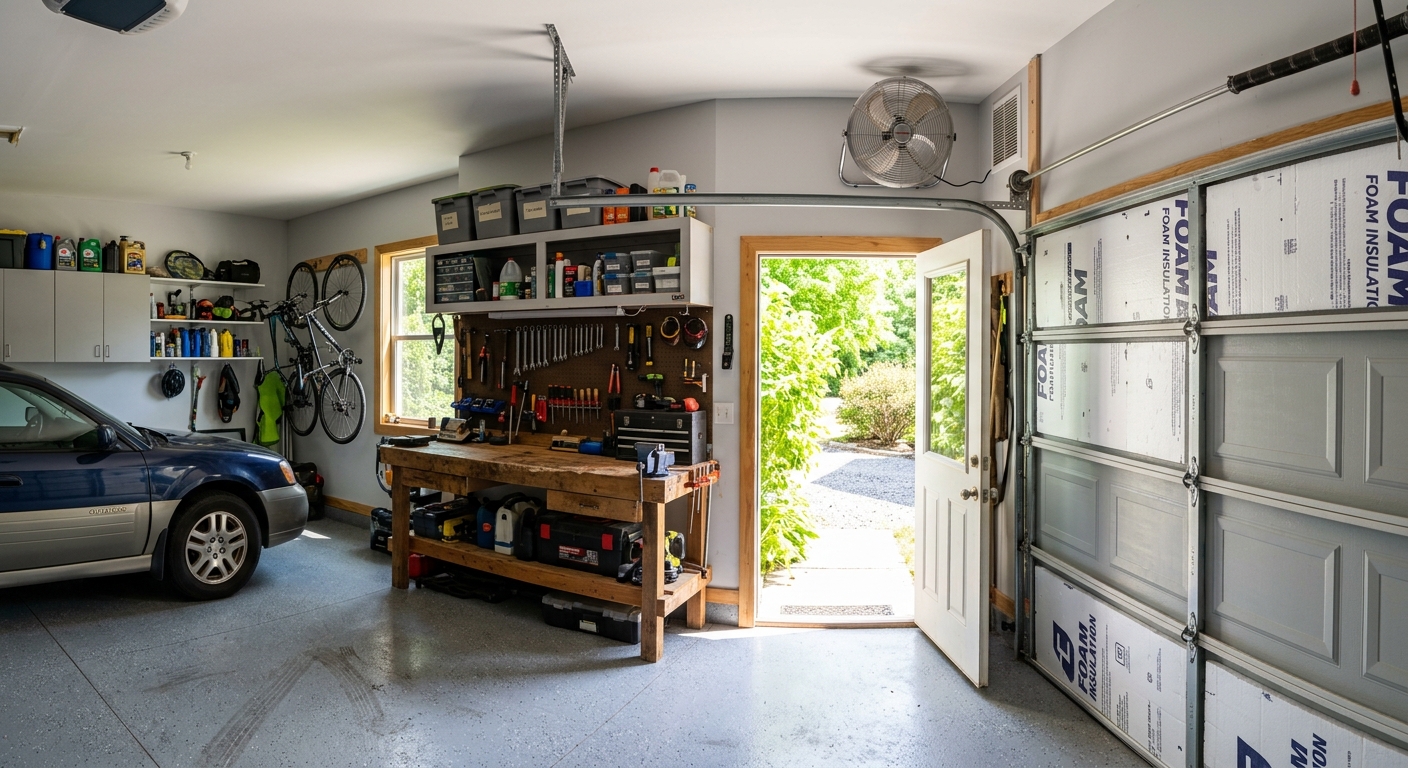
- Install a radiant barrier insulation kit on the interior panels of your garage door. Pre-cut foam board kits (such as Matador or Cellofoam) cost $50 to $100 and can drop the door’s interior surface temperature by 20 to 30°F. Measure each door panel, cut panels to fit, and press them into the recessed frame sections.
- Insulate the shared wall between the garage and living space using R-13 fiberglass batts or rigid foam if studs are exposed. If the wall is drywalled, inject blown-in insulation through small access holes and repatch. This wall has the most direct impact on your home’s cooling bills.
- Install a wall-mounted or gable-mounted exhaust fan rated for 750 to 1,500 CFM depending on garage size. A 2-car garage needs at least 1,000 CFM to fully exchange air every few minutes. Position the fan as high as possible on the hottest wall.
- Cut or open a passive intake vent low on the opposite wall from the exhaust fan to ensure the fan has a proper air source. Without an intake, the fan moves very little air and works against itself.
- Add weatherstripping around the garage door perimeter and caulk any visible gaps around pipes, wires, and the door frame between the garage and house. This prevents hot garage air from migrating into the living space.
- If budget allows, add a smart plug or basic timer to the exhaust fan so it runs automatically during the hottest hours (typically 2 PM to 7 PM) and shuts off at night when it is more efficient to ventilate passively.
- Assess your use case honestly. A mini-split is only cost-effective if you spend 10 or more hours per week in the garage during summer. Otherwise, insulation and a fan deliver 80% of the comfort at 10% of the cost.
- Before getting quotes, complete the insulation and air sealing from the DIY approach. Every dollar spent on the building envelope reduces the size and cost of the AC unit you need.
- Size the unit correctly. A 2-car garage in a hot climate typically needs a 12,000 BTU (1-ton) unit. Oversizing wastes money upfront and causes short-cycling, which reduces efficiency and humidity control.
- Get at least two quotes from licensed HVAC contractors. Ask specifically about SEER2 ratings and look for units rated SEER2 16 or higher for best long-term operating efficiency.
- Confirm electrical capacity with your contractor before installation. A mini-split typically requires a dedicated 240V 20-amp circuit, which may require a panel upgrade in older homes.
- After installation, use the mini-split’s scheduling feature to pre-cool the garage 30 minutes before you plan to use it rather than running it all day. This alone can cut operating costs by 40 to 60% compared to continuous operation.
Why It Works: The Benefits
A combination of ventilation and radiant barrier can reduce peak garage temperatures by 20 to 40°F on a 95°F day, turning a space that was unbearable into one where you can actually work for an hour without heat exhaustion.
Reducing heat transfer through a shared garage wall can cut the cooling load on adjacent rooms by 10 to 15%, which translates to roughly $30 to $80 per summer depending on your climate and electricity rate.
Extreme heat degrades paint, rubber seals, adhesives, batteries, and power tools faster. Keeping the garage below 95°F significantly extends the life of stored items and vehicles, a real but often overlooked financial benefit.
A cooler garage means you can actually use the space as a workshop, gym, or hobby room in summer months, adding functional square footage to your home without a renovation.
Insulation and radiant barriers require zero electricity to operate. Once installed, they deliver savings every single day for 20 or more years with no maintenance cost.
💰 Savings Impact by Action
Adding a radiant barrier to the garage door or ceiling can reduce peak radiant heat gain by up to 25%, lowering the ceiling temperature and the total cooling load on the space.
A properly sized exhaust fan with a matched intake vent can reduce peak air temperature by 15% relative to a sealed garage by continuously replacing hot interior air with outside air during cooler periods.
Insulating the shared wall between the garage and living space to R-13 reduces heat transfer to adjacent conditioned rooms by up to 12%, directly lowering home AC runtime and electricity use.
A foam insulation panel kit on an uninsulated garage door can reduce the door’s heat transmission by up to 20%, measurably lowering interior garage temperatures throughout the day.
Timing exhaust fan operation during the coolest morning and late-evening hours rather than running continuously can reduce fan electricity use by up to 10% while delivering the same or better cooling effect.
🏠 Key Concepts Explained
The Science Behind It
A garage heats up so aggressively because it violates every principle of passive cooling simultaneously. First, the large metal door acts as a solar collector, absorbing radiant energy from the sun and re-radiating it as infrared heat into the interior air. Unlike a wall with insulation and drywall, most uninsulated garage doors have an R-value of 2 or less, meaning heat moves through them almost unrestricted. On a 95°F day with direct sun exposure, the interior face of that door can easily hit 130°F.
Second, garages are typically sealed boxes with no planned airflow. Hot air stratifies at the ceiling and has nowhere to go. The concrete slab and masonry walls act as thermal sponges, absorbing heat all day and releasing it slowly for hours after sunset. This is why a garage can feel hotter at 8 PM than it did at noon. The building materials are releasing stored heat energy into a closed volume. Breaking this cycle requires creating a high exhaust point so hot air can escape via buoyancy (the stack effect), and a low intake so cooler outside air replaces it.
The physics of radiant barriers explain why they are so effective as a first step. All objects emit and absorb infrared radiation based on their surface properties. A surface with high emissivity (like bare steel or asphalt) absorbs and re-radiates most of the energy that hits it. A low-emissivity surface (like polished aluminum foil) reflects up to 97% of incoming radiant energy. By placing a radiant barrier on the inside of the garage door or on the ceiling deck, you interrupt the transfer of heat before it ever reaches the air mass in the room, which is far more effective than trying to cool air that has already absorbed that energy.
Frequently Asked Questions
▼ I installed an exhaust fan but the garage is still unbearably hot. What am I missing?
The most common culprit is a missing or undersized intake vent. An exhaust fan without a proper intake path creates negative pressure and moves very little air. Verify you have an unobstructed low vent or opening on the opposite side of the garage sized to at least equal the fan opening. Also check that the fan CFM rating matches your garage volume. A 500 CFM fan in a 2-car garage is severely undersized and will not create meaningful air exchange.
▼ My garage is attached and shares a wall with my living room. Is there a way to stop the heat from coming through?
Yes, and this is the highest-ROI project for your home cooling bill. Insulate the shared wall to at least R-13 using fiberglass batts or blown-in insulation, and caulk every gap around outlets, pipes, and the door frame. Also make sure the door between the garage and house has weatherstripping and closes fully. These steps alone can reduce the thermal load on adjacent rooms by 10 to 15%, which shows up on your electricity bill within the first billing cycle.
▼ Can I use a window AC unit in my garage?
You can, but it is rarely the most cost-effective first step and works best only after you have addressed insulation and air sealing. An uninsulated 2-car garage can require 18,000 BTU or more just to maintain 80°F on a hot day, meaning you would need a large unit running constantly and still fighting a losing battle. Insulate first, then size an AC unit based on the reduced load. A window unit also requires a properly wired 120V or 240V circuit; do not run it on an extension cord.
▼ How long before I see the savings on my home’s electric bill after insulating the shared wall?
You should see a measurable difference within one to two billing cycles during the cooling season. The savings are most pronounced in climates where summer temperatures regularly exceed 90°F and in homes where the garage wall faces south or west. Track your kWh usage month-over-month against the same month last year to isolate the impact, since weather variation makes direct monthly comparisons misleading.
▼ Does insulating the garage door actually make a noticeable difference?
Yes, and it is often the single fastest-acting change. A $50 to $100 foam panel kit can drop the interior surface temperature of the door by 20 to 30°F, which directly reduces the radiant heat load on the garage air. Homeowners in hot climates routinely report 15 to 25°F drops in peak garage temperature after insulating an uninsulated door, with no other changes made.
Quick Tips
- Paint the exterior of your garage door with a light color or reflective elastomeric paint. A white or light gray door absorbs up to 40% less solar energy than a dark brown or black door and costs nothing beyond the paint itself.
- Add a ridge vent or gable vent to the garage attic space if one exists above the ceiling. Attic heat above a garage can exceed 150°F and radiates through the ceiling into the garage below, adding a heat source that ventilation fans alone cannot fully overcome.
- Use a wireless thermometer with a min-max memory to track how hot your garage actually gets. Knowing whether your peak is 95°F or 130°F helps you right-size the solution and confirm which interventions are working.
- If you use your garage as a gym, place a portable evaporative cooler (swamp cooler) near the intake vent on low-humidity days. In climates with less than 50% relative humidity, evaporative cooling can drop the air temperature by 10 to 20°F at a fraction of the cost of refrigerant-based cooling.
Variations for Your Situation
- Apartment or Condo with Shared Garage: Renters in shared parking structures cannot modify ventilation or insulation, but can use a portable evaporative cooler or a tower fan with a block of ice to improve comfort in their immediate work area. A reflective windshield sunshade for your car and a freestanding oscillating fan ($25 to $50) are both landlord-safe options that require no installation. Focus on working during cooler morning hours when the shared structure has not yet heated up.
- Tight Budget (Under $50): Start with the highest-impact free steps: park cars outside after driving, create cross-ventilation through existing openings, and hang a reflective mylar blanket on the interior of the garage door during peak sun hours. A basic box fan positioned to exhaust hot air out of an upper window costs $20 to $30 and can move enough air in a 1-car garage to make a meaningful difference. These steps alone can reduce peak temperatures by 10 to 15°F with zero ongoing cost.
- Detached Garage or Workshop Used Daily: For a fully detached space used as a serious workshop, the calculus shifts toward a dedicated ductless mini-split. Without shared walls affecting your home’s AC load, the primary goal is making the space personally comfortable and safe for tool use. A 9,000 BTU mini-split ($1,500 to $2,500 installed) paired with ceiling insulation and a radiant barrier door kit delivers reliable 75°F conditions even on 100°F days. Look for rebates from your utility company, which can offset $200 to $600 of the installation cost.