Your bathroom exhaust fan is one of those appliances you probably take for granted. Flip it on, take a shower, maybe forget to turn it off. But that small ceiling fixture is working against you in more ways than one. Older and oversized fans can consume 3 to 4 times more electricity than modern efficient models, and if your fan is vented improperly or left running unnecessarily, it is actively pulling heated or cooled air straight out of your home and replacing it with unconditioned outdoor air.
The hidden cost adds up fast. A typical inefficient bath fan running just one hour per day costs roughly $15 to $25 per year in electricity alone. That might sound minor, but the real damage comes from the conditioned air it exhausts. In cold climates, every cubic foot of warm air that leaves your bathroom is replaced by cold air your furnace must reheat. The Department of Energy estimates that uncontrolled ventilation and air leakage together account for 25 to 40% of heating and cooling energy loss in a typical home.
This post breaks down exactly how your exhaust fan affects your energy bills, what you can do right now to stop the bleeding with zero dollars, and how upgrading to an efficient fan with a timer or humidity sensor can pay for itself in under two years. Whether you are a renter or an owner ready for a full upgrade, there is a path here for you.
What You’ll Need
Click on an item below to shop for the recommended items for this recipe on Amazon.
As an Amazon Associate, we earn from qualifying purchases.
How to Do It
- Set a phone timer or bathroom timer for 15 to 20 minutes after every shower. This is the minimum time needed to remove humidity. Cutting run time from 60 to 20 minutes per shower eliminates up to 66% of daily fan-related air loss.
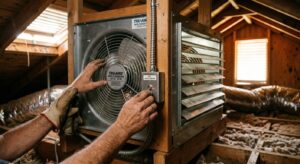
- Turn off the fan and go into your attic or check the exterior vent cap. Look for the backdraft damper flap. If it hangs open instead of closing when the fan is off, the damper is stuck or missing. Note this for repair.
- Hold a single sheet of tissue paper over the fan grille while the fan is on. If it barely moves, your fan is underperforming due to a clogged grille, full duct, or motor failure. Clean the grille cover by removing and washing it in warm soapy water.
- Check your exterior vent cap from outside. Confirm it has a working flap or louvered cover. A missing or broken cover allows wind-driven cold air and pests to enter the duct year-round, even when the fan is off.
- Note the wattage listed on your fan’s label (visible inside the grille or on the housing). If it reads 50 watts or more, flag it as a priority upgrade candidate.
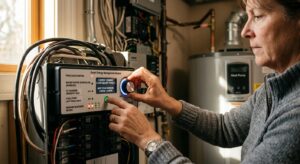
- Turn off the circuit breaker for the bathroom at your panel. Confirm power is off using a non-contact voltage tester at the fan’s wiring.
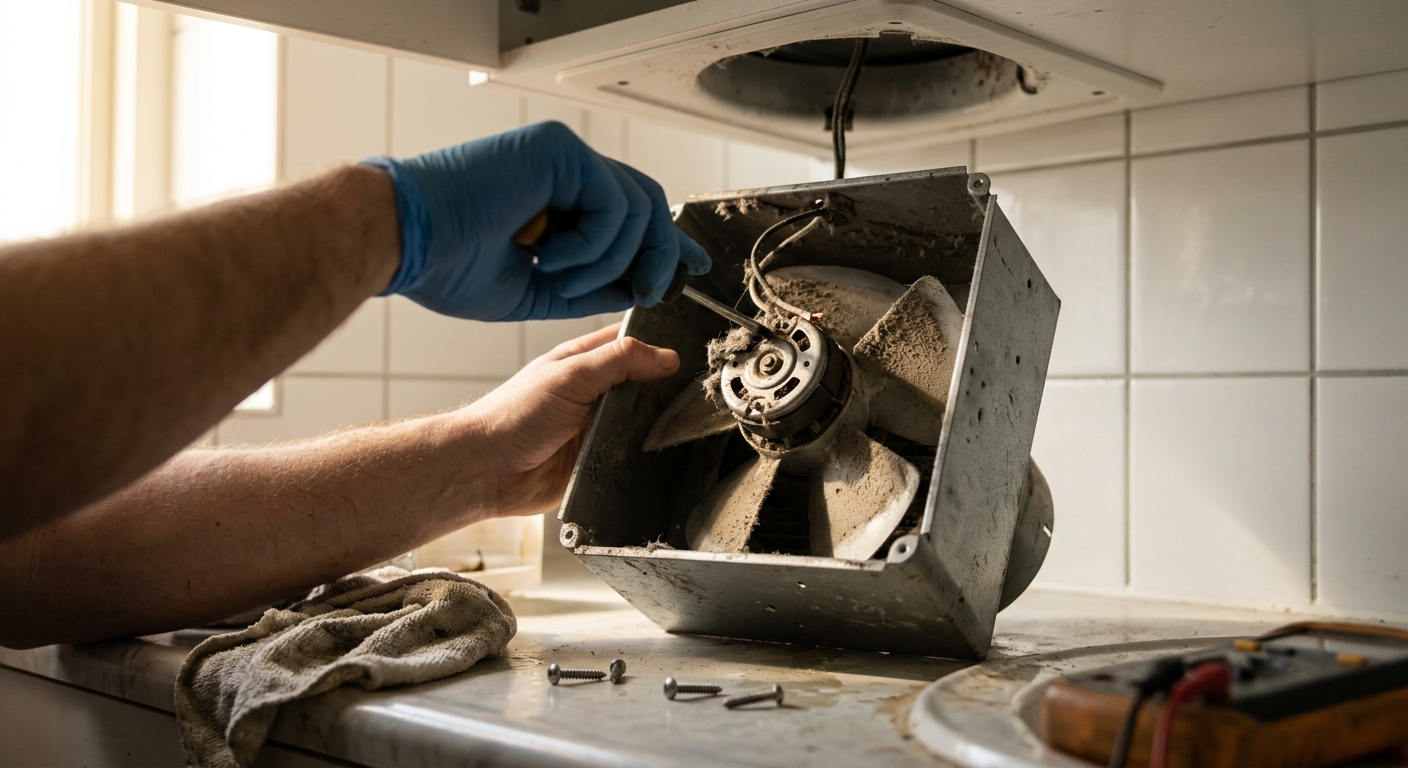
- Remove the old fan grille and unscrew the fan housing from the ceiling. Disconnect the wiring, taking a photo first so you remember the connections.
- Select a replacement ENERGY STAR certified fan rated for your bathroom square footage (1 CFM per sq ft, minimum 50 CFM). Choose a model with a built-in countdown timer or humidity sensor. Brands like Panasonic WhisperCeiling and Broan ULTRA Green are reliable options in the $50 to $110 range.
- Check that the existing duct connects properly to the new fan housing. If using flexible duct, straighten it as much as possible and secure connections with foil HVAC tape (not standard duct tape, which fails over time).
- Wire the new fan according to the manufacturer’s diagram, matching black to black, white to white, and green or bare copper to ground. If the fan has a humidity sensor, follow the included instructions for the sensor wire.
- Restore power, test the fan, and verify the backdraft damper closes fully when the fan shuts off. Set the built-in timer to 15 to 20 minutes or calibrate the humidity sensor per the instructions.
- Hire a licensed HVAC technician or electrician to assess the existing duct path. Ask specifically whether the duct terminates outside the building envelope and whether it is insulated through unconditioned space.
- Request replacement with a proper rigid metal or insulated flexible duct routed to a roof or soffit cap with a functioning damper. Avoid soffit venting if possible since it can allow exhausted moist air to be drawn back into the attic vents.
- Have the technician install an ENERGY STAR fan with a combination humidity sensor and timer switch. Panasonic WhisperSense and similar combo models cost $80 to $150 and automate moisture control without any homeowner effort.
- Ask for the duct joints to be sealed with mastic sealant or foil HVAC tape and confirm all connections are insulated where the duct passes through unconditioned attic space (aim for at least R-6 duct wrap).
- After installation, verify the exterior vent cap opens freely when the fan runs and closes fully when it stops. Request documentation for any permits required in your jurisdiction.
Why It Works: The Benefits
Replacing a 75-watt older fan with an ENERGY STAR model using 20 watts saves approximately 20 kWh per year based on one hour of daily use. At the national average of $0.16 per kWh, that is about $3 per year in direct electricity savings per fan, with more savings if multiple bathrooms are upgraded.
Fixing a stuck backdraft damper or cutting run time by 20 minutes per day can prevent the loss of hundreds of cubic feet of conditioned air daily. In cold climates, this translates to a measurable reduction in furnace runtime and can cut bathroom-related infiltration losses by 15 to 25%.
A properly functioning fan that removes humidity effectively prevents mold growth on walls, grout, and ceilings. Mold remediation costs $500 to $6,000 depending on severity, so a $30 to $80 fan upgrade is an excellent insurance investment.
Correctly sized and vented fans remove VOCs from cleaning products, odors, and excess CO2 from occupied bathrooms, improving the overall air quality in adjacent living spaces without over-exhausting conditioned air.
Modern fans rated below 1.0 sone are nearly silent compared to the grinding noise of older models. Homeowners who upgrade frequently report using the fan more consistently, which improves moisture control and actually reduces long-term mold risk.
💰 Savings Impact by Action
Cutting unnecessary fan run time from 60 to 20 minutes per day reduces conditioned air exhausted by up to 66%, translating to roughly 20 to 25% savings on infiltration-related heating and cooling energy tied to the bathroom.
Replacing a 75-watt older fan with a 20-watt ENERGY STAR model cuts the fan’s direct electricity consumption by about 73%, saving 15 to 20 kWh per year per fan based on one hour of daily use.
Fixing a stuck-open backdraft damper stops passive infiltration through the duct path, reducing whole-home air leakage by a measurable margin and cutting heating and cooling infiltration losses by an estimated 10 to 15%.
Insulating an uninsulated exhaust duct running through the attic to R-6 reduces heat loss from the duct itself and prevents condensation that can cause duct failure, improving system efficiency by approximately 8 to 12%.
🏠 Key Concepts Explained
The Science Behind It
Bathroom exhaust fans work on a straightforward principle: they create a slight negative pressure in the room that forces moist, contaminated air out through a duct to the exterior. The problem is that your home’s air pressure must stay balanced. For every cubic foot of air pushed out, an equal volume is pulled in from somewhere else, through leaky windows, door gaps, electrical outlets, or any other penetration in the building envelope. This is called infiltration, and it is not free: that incoming air must be heated or cooled to match your indoor setpoint.
The energy penalty depends on your climate and how much the outdoor air differs from your indoor temperature. On a 20 degree Fahrenheit winter day, bringing outdoor air to a comfortable 70 degrees requires roughly 0.018 BTUs per cubic foot per degree of temperature difference. A 110 CFM fan running for 30 unnecessary minutes moves 3,300 cubic feet of air. Heating that volume of air from 20 to 70 degrees costs approximately 3,000 BTUs, or about the same as running your furnace for 5 minutes. Repeated daily over a heating season, the losses become significant. This is the same physics that makes whole-house ventilation so important to control in well-sealed modern homes.
The backdraft damper is the mechanical guardian against this infiltration when the fan is off. A functional damper closes by gravity or spring tension and blocks passive airflow through the duct. A failed or missing damper essentially leaves a hole in your wall. Testing is simple: on a cold or windy day, hold your hand near the fan grille with the fan off. Any perceptible airflow indicates a failed damper. Replacing just the damper, which costs $5 to $15, can immediately reduce infiltration through the duct path and improve your home’s overall air sealing performance.
Frequently Asked Questions
▼ My bathroom is still humid after running the fan for 20 minutes. What is wrong?
The most common causes are a clogged grille, a kinked or crushed flexible duct, or a fan that is simply too small for the room. Start by washing the grille and checking the duct path in the attic for kinks or disconnections. If the duct is clear, calculate whether your fan’s CFM rating matches your bathroom square footage at 1 CFM per square foot. A 50 CFM fan in a 100 square foot bathroom will never keep up.
▼ Can I just leave my exhaust fan running all day for better air quality?
This is a common but costly mistake. Running a bath fan continuously exhausts hundreds of cubic feet of conditioned air per hour, dramatically increasing your heating and cooling costs. For whole-home ventilation needs, a dedicated energy recovery ventilator (ERV) or heat recovery ventilator (HRV) is the right tool since it exchanges air while recovering 70 to 80% of the energy from the outgoing air. Use your bath fan for its intended purpose: removing moisture after showers or bathing.
▼ How do I know if my duct is vented outside or just into the attic?
Go into your attic and trace the flexible or rigid duct from the fan housing. A properly installed duct exits through the roof with a vent cap or through a soffit or exterior wall with a louvered cover you can see from outside. If the duct simply ends in the attic space with no cap or termination, it is venting into the attic. Stop using the fan and have an HVAC professional reroute the duct to the exterior before your next shower.
▼ Can renters replace or upgrade a bathroom exhaust fan?
Most renters cannot replace the fan itself without landlord permission, since it involves electrical work and permanent modification to the unit. However, renters can add a plug-in countdown timer to the wall switch if it is a standard switch, clean the grille to improve airflow, and report a stuck backdraft damper or failed fan motor to the landlord in writing. Documenting moisture and mold concerns creates a paper trail that motivates landlords to act.
▼ My new fan is louder than my old one. Did I install it wrong?
Possibly. Excessive noise after installation usually points to a duct restriction, a grille that is not seated flat against the ceiling, or a housing that is vibrating against the ceiling framing. Check that the duct is straight without sharp bends and that the fan housing is firmly secured. If the fan is correctly installed and still loud, compare the sone rating on the box to your old fan. A fan rated above 2 sones will be noticeable in a quiet bathroom.
Quick Tips
- Run your exhaust fan during cooking as well as bathing. Cooking produces moisture, odors, and combustion byproducts that the bathroom fan can help clear if your kitchen lacks adequate ventilation.
- Clean the fan grille and blade assembly every 6 months. Dust buildup reduces airflow by 20 to 30%, forcing the motor to work harder while moving less air, which defeats the purpose of running the fan at all.
- In summer, limit fan run time even more carefully. Humid outdoor air drawn in to replace what the fan exhausts increases your air conditioner’s latent load, meaning the AC must remove that extra moisture before it can cool the air.
- If you are upgrading multiple bathrooms, buy fans from the same manufacturer and model line. This simplifies future parts sourcing and ensures consistent timer or sensor behavior throughout the home.
Variations for Your Situation
- Apartment/Rental: Renters cannot replace the fan but can make meaningful improvements without permission. Clean the grille cover (wash it in the sink), buy a mechanical twist-timer outlet cover that replaces the standard switch plate with a tool-free snap-in timer for around $15, and place a small battery-powered humidity gauge in the bathroom to know exactly when humidity drops below 60% so you can turn the fan off manually. Report any duct or damper issues to your landlord in writing and keep a copy.
- Tight Budget (under $50): Focus first on behavior changes costing nothing: use a phone timer and cut run time to 15 minutes per shower. Then spend $12 to $25 on a mechanical countdown wall timer switch, which requires only a screwdriver to install and no electrical knowledge beyond turning off the breaker. Finally, spend $5 to $8 on a replacement backdraft damper if yours is stuck open. These three steps alone can reduce bathroom-related energy loss by 20 to 30% with minimal investment.
- Older Home (pre-1980): Homes built before 1980 often have bath fans vented directly into the attic (no exterior termination), oversized fans with worn motors drawing 75 to 100 watts, and aluminum wiring that requires a licensed electrician for any fan replacement. Prioritize getting the duct rerouted to the exterior as the single highest-impact fix. Do not attempt wiring work yourself if you see silver-colored wires. Many utilities offer rebates of $25 to $75 on ENERGY STAR fan replacements that can offset professional installation costs.