If you live in a home built before 1980, you are almost certainly paying more to heat it than your neighbors with newer construction. Pre-1970s homes were built when energy was cheap and insulation was an afterthought. Balloon-frame walls often have zero insulation inside them. Attics may have just 2 to 3 inches of original fiberglass batts, delivering an R-value of around R-7 when modern standards call for R-38 to R-60. Every degree your thermostat fights against the cold is costing you money that is literally escaping through your walls and ceiling.
Heat loss in older homes is not just about comfort. A poorly insulated home forces your furnace to run longer cycles, wearing out equipment faster, driving up your monthly energy bill, and creating cold spots, drafts, and humidity imbalances that no amount of thermostat adjustment can fully fix. The U.S. Department of Energy estimates that air sealing and insulation together can reduce heating and cooling costs by 15 to 25% for the average home, and for older homes starting from a low baseline, savings can reach 40% or more.
This post walks you through exactly why older homes bleed heat, which areas to prioritize first, and what you can do right now versus what calls for a contractor. Whether you have an afternoon and $50 or you are ready to invest in a proper weatherization project, there is a practical path forward here.
What You’ll Need
Click on an item below to shop for the recommended items for this recipe on Amazon.
As an Amazon Associate, we earn from qualifying purchases.
How to Do It
- Walk your home on a cold windy day and feel for drafts around electrical outlets on exterior walls, window and door frames, baseboards, and where pipes or wires enter from outside. Use a stick of incense to spot subtle air movement.
- Remove outlet and switch covers on exterior walls and install pre-cut foam gaskets behind each cover plate. These cost about $5 for a pack of 10 and take under a minute each to install.
- Apply weatherstripping to all exterior doors that show daylight at any edge or whose weatherstrip is cracked or flattened. Self-adhesive foam tape costs $6 to $12 per door and cuts under-door drafts significantly.
- Caulk around window frames on the interior where the trim meets the drywall or plaster. Use paintable latex caulk for interior surfaces. A $5 tube covers several windows.
- If you have an attic hatch, add adhesive foam weatherstripping around its perimeter and place rigid foam insulation board on top of the hatch door, sized to fit inside the opening. This single fix can reduce attic-related heat loss noticeably in homes with poor attic access sealing.
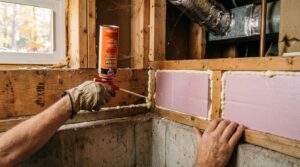
- Check your basement rim joists (the framing where the floor system meets the foundation wall) and stuff pre-cut rigid foam board cut to fit each bay, then seal the edges with spray foam from a can. This one area can account for 15 to 25% of a home’s total air leakage.
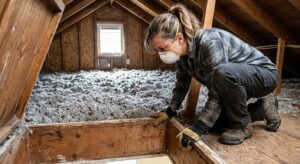
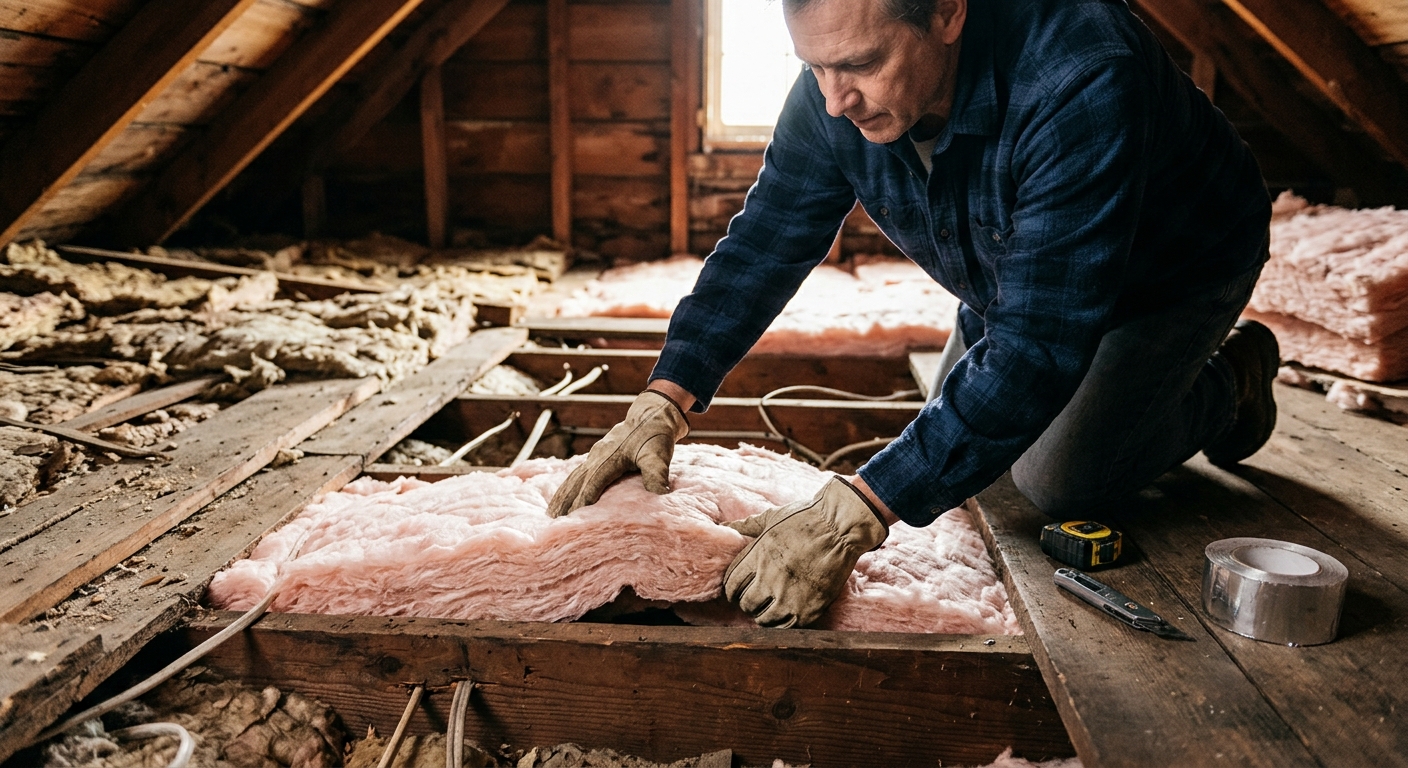
- Measure your attic square footage and existing insulation depth. Use the DOE’s online insulation calculator to determine how many inches of blown-in cellulose or fiberglass you need to reach R-38 (the minimum recommended for most U.S. climates), or R-49 to R-60 for very cold climates (Climate Zones 5 through 7).
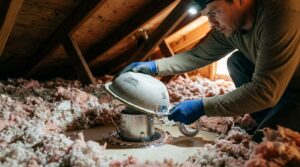
- Before adding any insulation, go into the attic and seal all penetrations from below using canned spray foam or caulk. Target recessed lights (only seal non-IC-rated lights with a drywall box first), plumbing stacks, wiring holes, and any gaps around the tops of interior walls. Do this step first or the new insulation will trap but not stop air leakage.
- Install ventilation baffles (cardboard or plastic rafter baffles) at every eave to maintain the 1-inch minimum air channel between insulation and roof deck. This prevents moisture buildup and maintains proper attic ventilation.
- Rent the insulation blower from your home improvement store. Load cellulose bags (typically $15 to $20 per bag at roughly 40 square feet of coverage per bag at R-38 depth) into the hopper and blow material across the attic floor, working from the far end toward the hatch.
- Use depth markers or a simple ruler to verify you are reaching your target R-value as you work. Blown cellulose settles about 20% over time, so aim slightly above your target depth.
- Re-insulate the attic hatch with rigid foam board cut to the hatch size, glued in layers to achieve at least R-20 on the hatch itself, then weatherstrip the perimeter before closing it up.
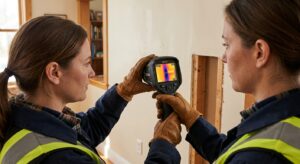
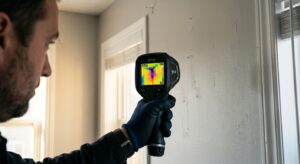
- Hire a certified energy auditor (look for BPI or RESNET credentials) to perform a blower door test and infrared thermal imaging scan. This identifies every major air leakage point and gives you a prioritized upgrade list based on your specific home, not generic advice.
- Request bids from two to three contractors for dense-pack insulation of exterior walls, which involves drilling small holes in siding or drywall bays and blowing in dense-pack cellulose to fill the cavity. This is the most effective wall insulation upgrade for older homes without gutting walls.
- Have the contractor air seal your basement and crawlspace thoroughly, including rim joists, foundation penetrations, and any band joist areas, using two-part spray foam and rigid foam board.
- If your home has no wall insulation at all and dense-pack is cost-prohibitive, discuss injection foam as an alternative. Some contractors inject foam from the exterior, patch the siding, and repaint, minimizing disruption.
- After work is complete, request a post-retrofit blower door test to verify air changes per hour have improved. A quality contractor should be able to reduce your ACH50 reading by 30 to 50% in a typical older home weatherization project.
- Submit documentation to your utility and state energy office for any applicable rebates or tax credits. The federal Inflation Reduction Act (IRA) Energy Efficient Home Improvement Credit covers 30% of insulation costs up to $1,200 per year as of 2024.
Why It Works: The Benefits
Properly air sealing and insulating an older home can reduce annual heating costs by 20 to 40%. On a $2,000 annual heating bill, that is $400 to $800 back in your pocket every year.
Eliminating major air leaks and adding attic insulation reduces cold spots and drafts dramatically. Rooms that previously sat 5 to 10 degrees below the thermostat setting often come within 2 to 3 degrees after proper air sealing.
When your home retains heat better, your furnace runs shorter, less frequent cycles. This extends equipment lifespan and reduces the chance of a mid-winter breakdown, which can cost $500 to $3,000 to repair or replace.
Reducing uncontrolled infiltration means less cold dry outside air, fewer outdoor pollutants, and more consistent humidity. Homes with controlled ventilation and good air sealing see reduced dust, allergen infiltration, and respiratory irritants.
DOE studies show that energy efficiency upgrades return 60 to 80 cents on the dollar at resale, and in energy-conscious markets, a well-insulated older home can command a meaningful premium over comparable unimproved properties.
💰 Savings Impact by Action
Upgrading attic insulation from R-7 to R-38 in an older home reduces heat loss through the ceiling by up to 25% of total heating load.
Sealing attic floor penetrations, rim joists, and outlet gaps can reduce whole-home air infiltration by 30 to 50%, translating to 15 to 20% savings on heating bills.
Dense-pack cellulose in previously uninsulated walls reduces wall heat loss by up to 70% for that assembly, contributing roughly 10 to 15% savings on overall heating costs.
Replacing single-pane windows with double-pane low-e units or adding interior storm film reduces window heat loss by 40 to 50%, saving up to 10% on heating in window-heavy older homes.
Insulating and air sealing basement rim joists with rigid foam and spray foam addresses up to 15 to 25% of total home air leakage, reducing heating costs by roughly 10 to 12%.
🏠 Key Concepts Explained
The Science Behind It
Heat moves in three ways: conduction (direct transfer through solid materials), convection (movement through air), and radiation (electromagnetic energy). In older homes, all three are working against you. Conduction happens through uninsulated walls and single-pane windows. Convection happens every time heated indoor air escapes through a gap and cold outdoor air rushes in to replace it. Radiation happens as heat moves from warm interior surfaces toward colder ones. Insulation primarily addresses conduction, while air sealing addresses convection, and window treatments address radiation. That is why air sealing and insulation together are so much more effective than either one alone.
The stack effect is the core physics problem in older multi-story homes. Warm air is less dense than cold air, so it rises. In a leaky home, warm air finds every gap near the top (attic hatches, plumbing chases, light fixtures) and escapes. This creates slightly negative pressure at the lower levels, which pulls cold outside air in through rim joists, electrical outlets, and foundation cracks. The pressure difference grows with temperature contrast and building height, which is why a two-story Victorian on a cold day leaks far more than a ranch house on a mild day. Sealing the attic floor and the basement rim joists simultaneously attacks both ends of this pressure-driven loop.
R-value math is also worth understanding. The relationship between R-value and heat loss is not linear. Going from R-3 to R-11 cuts heat loss through that assembly by about 73%. Going from R-11 to R-19 cuts it by another 42% of the remaining loss. Each additional increment saves less than the previous one, which is why the first few inches of insulation in an uninsulated attic deliver the most dramatic results. This is called the law of diminishing returns in insulation, and it explains why getting to R-38 is far more important than going from R-38 to R-60, though both have their place in cold climates.
Frequently Asked Questions
▼ I added attic insulation but my heating bill barely changed. What went wrong?
Insulation alone will not fix air leakage, and air leakage is likely your dominant heat loss path. If you added insulation without first sealing penetrations at the attic floor (recessed lights, plumbing stacks, top plates of interior walls), conditioned air is bypassing the insulation through these gaps. Go back into the attic and seal every penetration with spray foam or caulk before evaluating the insulation’s impact.
▼ My 1920s home has no wall insulation. What is the most affordable fix short of gutting the walls?
Dense-pack cellulose blown in by a contractor is your best option without opening walls. Costs typically run $1.50 to $3.00 per square foot of wall area. If that is outside your budget, focus first on attic insulation and air sealing the basement, which together often deliver more savings than wall insulation alone. Adding interior window insulation film or storm windows is another cost-effective move for single-pane windows.
▼ How do I know if my older home has knob-and-tube wiring before I add insulation?
Go into your attic and basement with a flashlight and look for ceramic knobs (used to anchor wires) and ceramic tubes (used where wires pass through framing). The wiring itself is unsheathed cloth-wrapped copper running in separate hot and neutral conductors. If you find active knob-and-tube, call a licensed electrician before proceeding with any insulation work around it.
▼ Can I just put plastic sheeting over my windows to save money this winter?
Yes, interior window insulation film kits (shrink film applied with a hair dryer) genuinely work and cost $3 to $5 per window. They add a layer of dead air that can improve a single-pane window from roughly R-1 to R-2, reducing window heat loss by up to 50%. They are not pretty, but on a tight budget during a cold winter, they are one of the highest-value low-cost steps you can take.
▼ My house feels cold even though my thermostat reads 70 degrees. Why?
You are likely experiencing mean radiant temperature imbalance. Cold wall and window surfaces radiate heat away from your body even when air temperature is correct, making you feel colder than the thermostat suggests. Adding insulation warms those interior surface temperatures, which makes a dramatic comfort difference at the same thermostat setting. Improving wall insulation and adding interior storm windows are the most effective fixes for this specific problem.
Quick Tips
- Check your attic insulation depth on the first cold day of the year. If you can see the tops of your joists, you are losing significant heat and topping up to R-38 should be your first project.
- Prioritize basement rim joists before anything else if you have a basement. They are accessible, inexpensive to insulate yourself with rigid foam and spray foam, and often responsible for 15 to 25% of total home air leakage.
- On a cold sunny day, hold your hand near exterior wall outlets and switch plates. Any perceptible cold air movement means you need foam gaskets, which cost pennies per outlet and install in seconds.
- If you are planning any renovation that opens up walls (kitchen remodel, bathroom tile work), that is your ideal low-cost window to insulate wall cavities with batt insulation before re-drywalling.
Variations for Your Situation
- Apartment/Rental: Renters in older buildings can make a real dent in their heating costs without landlord permission. Start with door draft stoppers ($10 to $20), removable window insulation film kits ($3 to $5 per window), and foam outlet gaskets on exterior walls. These are fully reversible and leave no damage. If your unit has a basement or attic access that the landlord permits, ask about adding a weatherstripped cover to the attic hatch as a no-cost goodwill project.
- Tight Budget (under $50): Focus exclusively on air sealing since it costs almost nothing and delivers the fastest payback. Spend $8 on foam outlet gaskets for all exterior wall outlets, $10 on a roll of door weatherstripping for your two main entry doors, $5 on a tube of latex caulk for window frames, and $12 on a rigid foam attic hatch cover. This entire package can reduce heating bills 10 to 15% and costs under $40 in materials.
- Older Home (pre-1940): Homes from this era present unique challenges including balloon framing, knob-and-tube wiring, plaster walls, and no vapor retarders. Start by having an electrician inspect and document any knob-and-tube before touching insulation. Prioritize attic air sealing and blown-in attic insulation as your first project since walls are harder and more costly to address. Consider a full professional energy audit ($200 to $500) before committing to any major scope since the audit pays for itself by identifying the highest-value upgrades for your specific structure.