Your electric meter spins whether you are home or not, and the biggest reason is not the lights you forgot to turn off. It is the appliances humming quietly in your kitchen, laundry room, and garage that account for the majority of residential energy use. According to the U.S. Energy Information Administration, appliances and electronics make up roughly 35% of a typical home’s total electricity consumption, and a handful of them are responsible for most of that load.
The frustrating part is that many of these energy hogs look perfectly normal. Your refrigerator is doing its job. Your water heater is keeping water hot. Your HVAC system is maintaining a comfortable temperature. But each of these systems has a wide efficiency range, and an older or poorly maintained unit can cost you two to three times more to run than a modern, well-tuned replacement. That gap shows up on your bill every single month.
This post breaks down the five appliances that consistently top energy auditors’ lists, explains exactly how much each one costs to run, and gives you clear steps to reduce that load starting today. Whether you want a free five-minute fix or a full upgrade plan, you will find a practical path forward here.
What You’ll Need
Click on an item below to shop for the recommended items for this recipe on Amazon.
As an Amazon Associate, we earn from qualifying purchases.
How to Do It
- Check your refrigerator temperature settings. The fresh food compartment should be set to 37 to 38 degrees F and the freezer to 0 degrees F. Many households run theirs 5 to 10 degrees colder than needed, increasing compressor run time by up to 25%.
- Vacuum the condenser coils on your refrigerator. On most models they are located on the back or beneath the unit behind a front grille. Dusty coils force the compressor to work harder and can increase energy use by 15%. This takes about 10 minutes with a vacuum and brush attachment.
- Set your water heater to 120 degrees F if it is currently higher. The DOE estimates each 10-degree reduction saves 3 to 5% on water heating costs. Most homes are set to 140 degrees F by default, which wastes energy and is a scalding hazard.
- Plug your television, cable box, gaming console, and audio receiver into a smart power strip or a single switchable surge protector. Switching them all off at once eliminates standby draw that can total 15 to 30 watts continuously.
- Clean or replace your HVAC air filter if it has not been done in the last 60 to 90 days. A clogged filter increases system airflow resistance, forcing the blower motor to work harder and reducing efficiency by 5 to 15%.
- Switch your dryer to a lower heat setting and run full loads only. High heat does not dry clothes faster in most cases; it just consumes more energy. Running full loads instead of half loads effectively cuts energy use per garment by up to 50%.
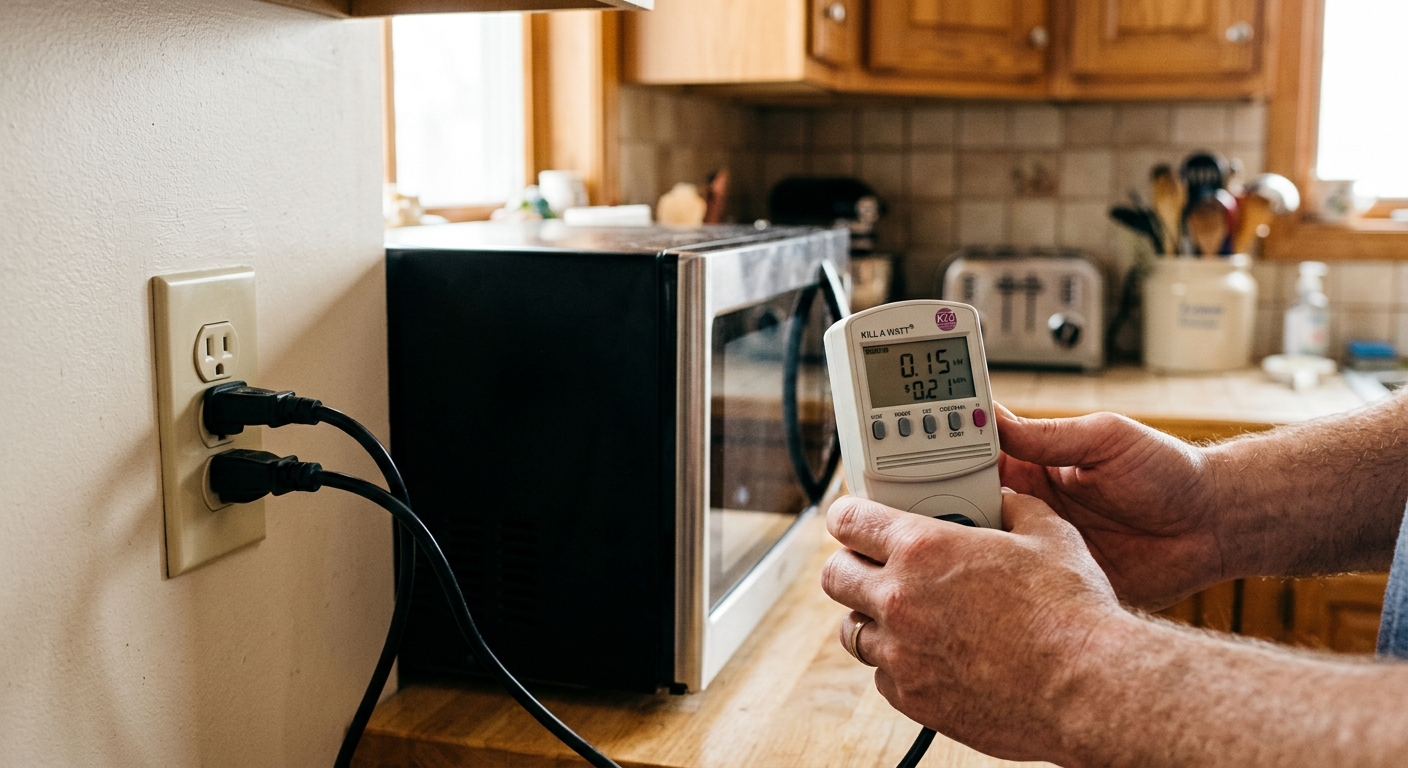
- Purchase a plug-in watt meter such as a Kill A Watt device for around $25. Plug each major appliance in one at a time and record its actual wattage and daily kilowatt-hour consumption over 24 to 48 hours. Compare readings to the appliance’s EnergyGuide estimate.
- Measure your refrigerator’s daily kWh draw. If it is consuming more than 1.5 kWh per day for a standard 18 to 22 cubic foot model, the door seals, coils, or thermostat may be the issue. Test door seals by closing the door on a dollar bill: if it slides out easily, the gasket needs replacing. A replacement gasket costs $20 to $50 and takes about 30 minutes to install.
- Insulate your water heater with a pre-cut insulation blanket if it is an older tank-style unit that feels warm to the touch on the outside. A $30 insulation wrap can cut standby heat loss by 25 to 45%, saving $15 to $40 per year. Skip this step on tankless or newer high-efficiency tank models that are already well-insulated.
- Install a programmable or smart thermostat if you do not already have one. Proper scheduling, setting back 7 to 10 degrees for 8 hours per day, saves approximately 10% per year on heating and cooling costs. Smart thermostats cost $80 to $180 and most homeowners can install them in under an hour using the existing wiring.
- Check your dryer’s exhaust duct for lint buildup and kinks. A partially blocked dryer duct extends cycle time significantly, sometimes doubling energy use per load. Clean the duct with a dryer vent brush kit ($20 to $30) and straighten any sharp bends to restore proper airflow.
- After completing the audit, prioritize replacements only for appliances more than 15 years old that measure significantly above current ENERGY STAR benchmarks. Document your baseline kWh usage from your utility bills before and after changes to measure actual savings.
- Prioritize replacing your HVAC system if it is more than 15 years old or has a SEER rating below 14. A new 18 to 20 SEER heat pump can reduce heating and cooling costs by 30 to 50% compared to an older system. Federal tax credits under the Inflation Reduction Act cover 30% of installation costs up to $2,000 for qualifying heat pumps.
- Replace an electric resistance water heater with a heat pump water heater. Heat pump water heaters use 60 to 70% less electricity than conventional electric resistance models, saving $300 to $500 per year. They qualify for a 30% federal tax credit up to $2,000 and many utilities offer additional rebates of $100 to $400.
- When replacing your refrigerator, choose a current ENERGY STAR certified model. A new ENERGY STAR refrigerator uses about 350 to 450 kWh per year compared to 800 to 1,200 kWh for a unit made before 2000, cutting that appliance’s cost by more than half.
- If your electric dryer is more than 12 years old, consider replacing it with a heat pump dryer. Heat pump dryers use 28 to 50% less energy than conventional electric dryers, qualify for a 30% tax credit up to $600, and are gentler on fabrics. They cost $800 to $1,400 but have a payback period of 3 to 5 years at average electricity rates.
- Contact your utility company before any major appliance purchase to confirm available rebates. Many utilities offer $50 to $400 rebates on ENERGY STAR refrigerators, $100 to $600 on heat pump water heaters, and $200 or more on smart thermostats and HVAC equipment. Stacking rebates with federal tax credits can cut upgrade costs by 40 to 60%.
Why It Works: The Benefits
Addressing all five appliances through a combination of behavioral changes and targeted upgrades can reduce total household electricity consumption by 20 to 35%, saving the average U.S. household $300 to $600 per year based on a typical bill of $1,500 annually.
Cleaning refrigerator coils, replacing worn water heater anode rods, and maintaining HVAC filters reduces mechanical stress on compressors and heating elements, often extending appliance life by 3 to 7 years.
Shifting high-draw appliances like dryers and dishwashers to evenings or weekends can reduce peak demand charges, which some utilities now apply to residential accounts running multiple large appliances simultaneously.
A properly maintained HVAC system and water heater deliver more consistent temperatures and faster hot water recovery, meaning fewer cold showers and more even heating and cooling throughout the home.
Cutting household electricity consumption by 20 to 35% reduces CO2 emissions by roughly 1 to 2 metric tons per year for the average U.S. home, equivalent to planting 50 to 100 trees annually.
💰 Savings Impact by Action
Replacing clogged filters, cleaning coils, and scheduling annual tune-ups restores HVAC efficiency and reduces electricity use by 10 to 15%.
Replacing a conventional electric resistance water heater with a heat pump water heater cuts that appliance’s energy consumption by 60 to 70%.
Using smart power strips and unplugging idle devices eliminates phantom load that typically accounts for 5 to 10% of total household electricity use.
Cleaning dusty condenser coils reduces compressor run time and can cut refrigerator energy use by up to 15% at no cost.
Running full loads on a medium heat setting and maintaining a clear exhaust duct reduces per-load energy consumption by 25 to 50%.
🏠 Key Concepts Explained
The Science Behind It
Every appliance in your home converts electricity into some useful output: cold air, hot water, clean dishes, or dry clothes. The efficiency question is always how much electricity is required to produce one unit of that output. Electric resistance heating, used in older water heaters, baseboard heaters, and conventional dryers, converts electricity to heat at a 1:1 ratio. One unit of electrical energy produces one unit of heat energy. That sounds efficient until you compare it to a heat pump, which moves heat from one place to another instead of generating it from scratch, delivering 2 to 4 units of useful heat for every unit of electricity consumed.
Refrigerators and air conditioners operate on the same heat pump principle using a refrigerant cycle: a compressor pressurizes refrigerant gas, which releases heat as it condenses, then absorbs heat as it evaporates, transferring thermal energy from inside the cold space to the outside environment. When condenser coils are dirty, door seals leak warm air in, or refrigerant charge is low, the compressor must run longer and more frequently to maintain the set temperature. Because the compressor is the highest-draw component in the system, any factor that increases its run time has an outsized effect on total energy consumption.
Standby power, sometimes called phantom load or vampire power, is a different phenomenon. Devices in standby mode power microcontrollers, remote sensors, clocks, and indicator lights continuously. Individually these draws are small, often 1 to 5 watts each. But a home with a cable box drawing 15 watts, a gaming console drawing 10 watts at rest, and several smart devices each drawing 2 to 5 watts can accumulate 50 to 100 watts of continuous load. At the national average electricity rate of about 16 cents per kWh, 75 watts of continuous standby draw costs roughly $105 per year while delivering no useful output whatsoever.
Frequently Asked Questions
▼ My electric bill went up even though I haven’t changed anything. Which appliance should I check first?
Start with your HVAC system and refrigerator, which together typically account for 40 to 50% of a home’s electricity use. A sudden spike often means an HVAC filter is clogged, refrigerant is low, or a refrigerator compressor is struggling due to dirty coils or a failing door seal. Pull the fridge away from the wall, vacuum the coils, and check that the door seals are snug. For the HVAC system, replace the filter and listen for the compressor running continuously without cycling off, which is a sign the system needs professional service.
▼ Is it actually worth replacing an appliance that still works fine?
It depends on the age and type of appliance. For electric resistance water heaters older than 10 years, replacing with a heat pump water heater almost always makes financial sense given the 60 to 70% reduction in operating costs and available tax credits. For refrigerators, run a watt meter for 24 hours: if the unit consumes more than 1.5 kWh per day, the energy cost over 3 to 5 years may exceed the purchase price of a new ENERGY STAR model. For HVAC systems under 15 years old with a SEER rating above 14, maintenance and repair usually beats replacement.
▼ Can renters do any of this without landlord approval?
Renters can implement most of the quick fixes without any landlord involvement, including adjusting appliance temperatures, cleaning refrigerator coils, using smart power strips, and changing HVAC filters if the unit is in their unit. For thermostat replacement or any permanent modifications, written landlord permission is needed. Renters should also document their baseline utility usage and request that their landlord address appliances over 15 years old, as energy efficiency is increasingly considered a habitability factor in some jurisdictions.
▼ How long before these changes actually show up on my electric bill?
Behavioral changes like adjusting thermostat schedules, running full dryer loads, and eliminating standby power will show up in the very next billing cycle. Maintenance tasks like cleaning coils and replacing filters typically show measurable improvement within one to two billing cycles. Major appliance replacements such as a heat pump water heater or new HVAC system will show up immediately in the first full month of operation, and you can calculate exact savings by comparing kWh usage month over month using your utility’s online portal.
▼ My refrigerator is only 8 years old but the watt meter shows it using 2 kWh per day. Is that normal?
That is higher than expected for an 8-year-old unit. First check that the door gaskets are sealing fully and that the condenser coils are clean. Also verify the unit is not located in a hot garage or near a heat source, as ambient temperatures above 90 degrees F can double refrigerator energy consumption. If the coils are clean, the seals are good, and the location is reasonable, the thermostat or compressor may be malfunctioning and a qualified appliance technician should inspect it.
Quick Tips
- Run your dishwasher and dryer after 9 PM if your utility offers time-of-use rates. Off-peak electricity can cost 30 to 50% less per kWh on these plans.
- Keep your refrigerator between 75 and 85% full. A fuller fridge maintains temperature more easily because the thermal mass of cold food helps stabilize temperature when you open the door.
- If you have a second refrigerator or chest freezer in the garage that you rarely use, unplugging it can save $100 to $200 per year immediately.
- Wash clothes in cold water. About 90% of the energy used by a washing machine goes toward heating the water. Cold water detergents clean just as effectively at lower temperatures.
Variations for Your Situation
- Apartment or Rental: Renters cannot replace central HVAC or water heaters, but can focus on the appliances they control directly. Plug a Kill A Watt meter into your refrigerator for 48 hours and share the results with your landlord if consumption is excessive. Use smart power strips ($20 to $35) on entertainment and office equipment to eliminate standby draw. If you have an in-unit washer and dryer, switch to cold water washing and clean the dryer vent yourself with a brush kit ($20). These steps alone can reduce your personal electricity consumption by 10 to 20%.
- Tight Budget (Under $50): Start with zero-cost behavioral changes: set your water heater to 120 degrees F, adjust refrigerator to 37 to 38 degrees F, clean refrigerator coils with a vacuum, and run only full loads in the dryer. Spend $25 on a Kill A Watt meter to measure which appliances are actually costing you the most before spending anything else. Add a $15 to $20 smart power strip for your TV and entertainment equipment to cut standby losses. These three steps together can save $150 to $250 per year with a payback period under two months.
- Older Home (Pre-1980): Homes built before 1980 often have appliances that predate modern efficiency standards, electric resistance water heaters, older refrigerators exceeding 1,500 kWh per year, and HVAC systems with SEER ratings below 10. In these homes, appliance replacement delivers much larger savings than in newer homes. Prioritize the water heater first, since a heat pump water heater replacing an electric resistance unit saves $400 to $550 per year and pays back in 2 to 3 years after rebates and tax credits. Check with your state energy office for low-income weatherization programs that may cover appliance replacement costs at no charge.