Walk into any home improvement conversation about insulation and spray foam will come up fast. It outperforms fiberglass batts, seals air leaks in the same step, and lasts the life of the building. But spray foam is not a single product. Closed-cell and open-cell are fundamentally different materials with different physics, different price points, and different best-use cases. Picking the wrong one does not just mean suboptimal performance, it can mean moisture problems, wasted budget, or an insulation job that needs to be redone.
The stakes are real. Spray foam insulation, when correctly specified and installed, can cut heating and cooling costs by 15 to 40% compared to a home with little or no insulation. The difference between closed-cell at R-6.5 per inch and open-cell at R-3.7 per inch sounds academic until you realize it determines whether you can hit code-minimum R-values in a two-by-four wall cavity, or whether your crawl space vapor barrier doubles as your insulation layer. These are decisions that affect comfort, indoor air quality, and resale value for decades.
This post explains the building science behind both products, gives you a clear decision framework for common applications like attics, crawl spaces, rim joists, and walls, and walks through both a professional installation approach and a practical DIY option for smaller projects. By the end, you will know exactly which foam belongs where in your home and what kind of return to expect on your investment.
What You’ll Need
Click on an item below to shop for the recommended items for this recipe on Amazon.
As an Amazon Associate, we earn from qualifying purchases.
How to Do It
- Identify your target area. Rim joists (the framing above the foundation wall) are the single best DIY spray foam project, responsible for up to 15% of a home’s total heat loss.
- Choose the right foam type for the location. Use closed-cell kits for crawl spaces, rim joists, and any below-grade or moisture-exposed area. Use open-cell kits for interior attic bypasses and interior partition top plates where moisture is not a concern.
- Purchase a two-component spray foam kit sized to your project. A 200-board-foot kit covers roughly a 10 by 20 foot rim joist run at 1 inch depth. For rim joists, plan for 2 to 3 inches of closed-cell to hit R-12 to R-19.
- Wear full PPE before starting: chemical-resistant gloves, safety glasses, a half-face respirator rated for organic vapors, and old clothing. Uncured foam bonds permanently to skin and fabric.
- Warm both component tanks to 70 to 80 degrees Fahrenheit before use. Cold tanks cause off-ratio mixing, which produces foam with dramatically reduced R-value and poor adhesion. Set them in warm water for 30 minutes if your workspace is cold.
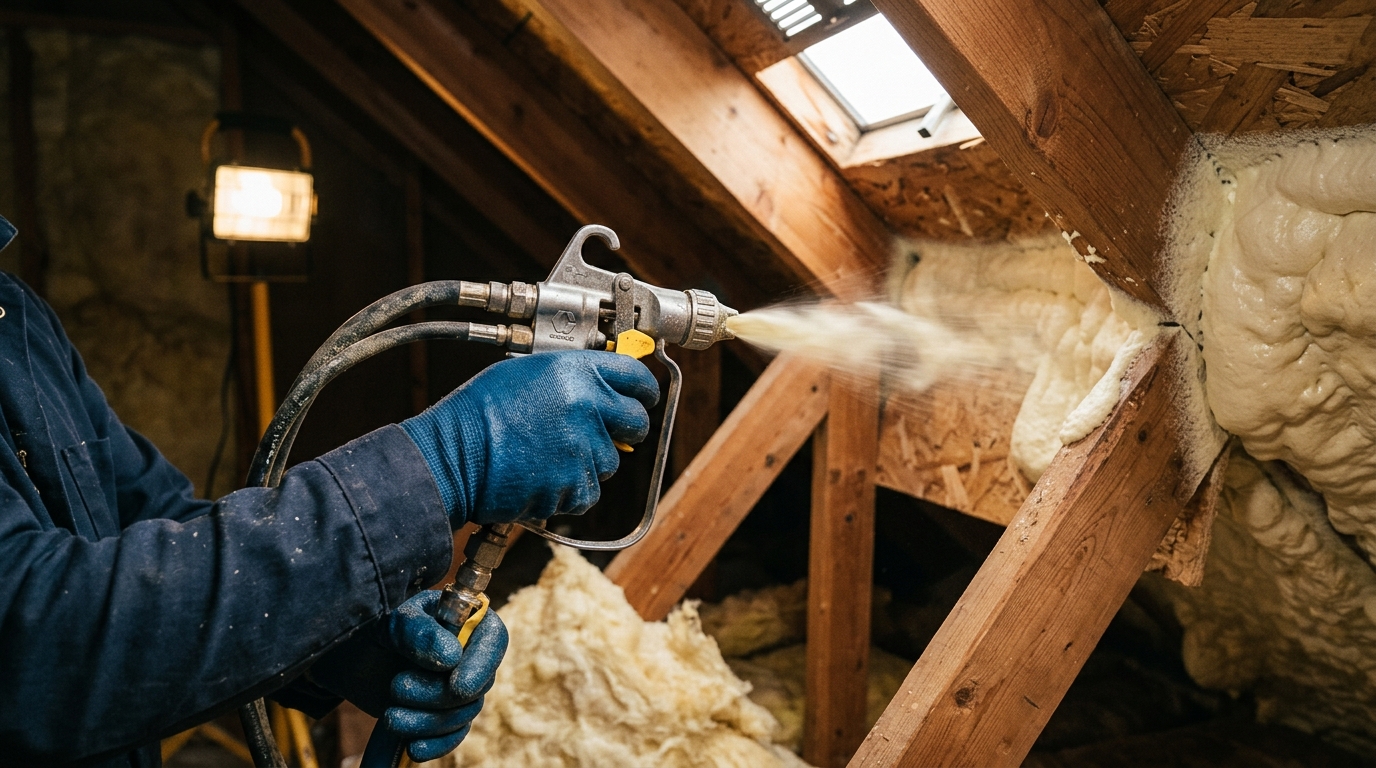
- Apply foam in 1-inch lifts, allowing each lift to tack off (about 30 seconds) before adding the next. Overapplying in a single pass causes exothermic heat buildup that can crack the foam or reduce yield.
- Get three quotes from spray foam contractors. Ask each to specify the product name, manufacturer, R-value per inch, and installed thickness for your application. Low-bid contractors sometimes use off-brand foam with inconsistent yields.
- Confirm whether you need open-cell or closed-cell for each area by sharing your climate zone (find it at energystar.gov) and your goals. A reputable contractor will recommend different foam types for different areas in the same house.
- Prepare the space before the crew arrives. Remove stored items from crawl spaces and attics, protect HVAC equipment with plastic sheeting, and plan to vacate the home for 24 to 48 hours after application while the foam fully cures and off-gasses.
- During installation, ensure the contractor sprays test lifts and checks thickness with a depth probe or by cutting a small sample. Minimum thicknesses for code performance are typically 3 inches of open-cell or 2 inches of closed-cell in most Climate Zones.
- After curing, inspect all surfaces for voids, thin spots, or areas where the foam pulled away from the substrate. Any closed-cell application in a conditioned crawl space should cover the entire rim joist, band joist, and the top 6 inches of the foundation wall with no gaps.
- Apply a thermal or ignition barrier over exposed spray foam in living areas and accessible attics per your local building code. Most jurisdictions require a 15-minute thermal barrier such as half-inch drywall or intumescent paint over any exposed foam.
Why It Works: The Benefits
Spray foam simultaneously insulates and air-seals, eliminating the separate air barrier step. Homes treated with spray foam in key areas like rim joists, attic bypasses, and crawl spaces can reduce air infiltration by 50 to 75%, which directly lowers heating and cooling loads.
The EPA estimates that sealing and insulating with spray foam in the right locations cuts average annual energy costs by 15 to 40%. A home spending $2,400 per year on heating and cooling could save $360 to $960 annually after a proper spray foam upgrade.
Closed-cell foam installed in crawl spaces and rim joists acts as a vapor retarder, preventing the ground moisture and humid outdoor air that feed mold colonies. This can eliminate ongoing mold remediation costs that average $500 to $6,000 per incident.
Closed-cell foam adds measurable racking strength to wall assemblies, with some studies showing a 75 to 100% increase in wall stiffness when two inches of closed-cell is applied to the cavity side of sheathing. This matters most in older homes with aged structural adhesives.
Both foam types maintain their R-value for the life of the building when protected from UV, unlike fiberglass batts that can lose 20 to 40% of effectiveness over decades due to settling, moisture absorption, and compression.
💰 Savings Impact by Action
Closing rim joist gaps with 2 inches of closed-cell foam eliminates up to 15% of a home’s total heating and cooling loss in a single afternoon.
Converting a vented attic to an unvented spray foam assembly reduces cooling load by 20 to 30% by eliminating duct losses and radiant heat gain through the attic floor.
Encapsulating a crawl space with closed-cell foam and a vapor barrier reduces HVAC runtime by 15 to 18% in homes with floor-level ductwork in the crawl.
Filling two-by-six wall cavities with open-cell foam to R-21 reduces wall heat loss by 12 to 20% compared to standard R-19 fiberglass batts due to better air sealing.
A comprehensive spray foam air-sealing strategy targeting all major bypass paths can reduce measured air infiltration by 50 to 75%, translating to 20 to 25% lower annual energy costs.
🏠 Key Concepts Explained
The Science Behind It
Spray foam insulation is a two-component thermoset polymer. When the A-side (isocyanate) and B-side (polyol blend) mix at the gun tip, a rapid chemical reaction generates heat and causes the mixture to expand. In closed-cell foam, a blowing agent trapped inside the cells stays as a gas under pressure, giving each cell its rigid structure and its low thermal conductivity. That gas, typically a hydrofluorocarbon or hydrofluoroolefin, has a lower thermal conductivity than still air, which is why closed-cell achieves R-6 to R-6.5 per inch compared to still air’s effective R-4.35 per inch. Over time, some of this gas slowly exchanges with ambient air, and the R-value of closed-cell foam does decrease slightly in the first year before stabilizing, a process called thermal drift.
Open-cell foam uses water as the blowing agent. The reaction produces carbon dioxide, which expands the foam, but the cell walls rupture during expansion, leaving interconnected air-filled voids. This gives open-cell its soft, spongy texture and its vapor-permeable structure. Because the cells are filled with air rather than a low-conductivity gas, the R-value is lower, around R-3.5 to R-3.7 per inch, but the material costs significantly less per board foot. The vapor permeability of open-cell (10 to 16 perms) means moisture vapor can pass through it freely, which is acceptable in well-ventilated interior applications but problematic in assemblies where you need to control moisture drive from outdoors.
The air-sealing performance of both products comes from their adhesion and their ability to conform to irregular surfaces. When foam expands into a rim joist bay, it flows around pipes, wires, and rough framing edges in a way that rigid foam board cannot replicate without extensive cutting and caulking. ASHRAE research has shown that even a small unsealed gap representing 1% of a wall area can degrade effective thermal performance by 30%, which explains why spray foam’s combined insulation and air sealing consistently outperforms higher-nominal-R-value batt insulation in real-world blower door tests.
Frequently Asked Questions
▼ How do I know if a contractor sprayed the right foam or the right thickness?
Ask to see the product data sheet for the specific foam system used and confirm the brand, product name, and R-value per inch match what was quoted. Check thickness by probing cured foam with a wire in multiple locations. At 2 inches of closed-cell you should read R-13; at 3 inches of open-cell you should read R-11. If numbers do not match, you have grounds to request correction or a partial refund.
▼ My DIY foam kit is producing brittle, crumbly foam instead of firm insulation. What went wrong?
Crumbly foam almost always means off-ratio mixing caused by cold tanks, unequal tank pressures, or a clogged gun tip. Both tanks must be at 70 to 80 degrees Fahrenheit and at balanced pressure before spraying. Discard the first 5 to 10 seconds of output when starting a new application because off-ratio material always comes out first. Crumbly foam has little insulating value and must be removed and redone.
▼ Can I spray foam over existing fiberglass batt insulation?
In most cases, no. Spray foam needs to bond to a clean, dry substrate to adhere and seal properly. Applying it over batts traps moisture between layers and prevents the foam from doing its job as an air barrier. Remove existing batts in the target area before foaming, then reinsert them over the cured foam if the assembly calls for additional R-value.
▼ How long do I really need to stay out of the house after professional spray foam installation?
Most manufacturers and contractors say 24 hours minimum, but 48 to 72 hours is safer for households with children, pregnant individuals, or anyone with respiratory sensitivities. Bring in fresh air aggressively when you return by opening windows for several hours. If you smell a strong chemical or fishy odor more than 72 hours after installation, contact the contractor because it may indicate off-ratio foam that requires removal.
▼ Will spray foam in my crawl space cause moisture problems by trapping ground moisture?
The opposite is true when done correctly. An unvented crawl space with closed-cell foam on the walls and rim joists, combined with a ground vapor barrier, performs significantly better than a vented crawl space in most climate zones. The key is encapsulating the ground cover completely and ensuring no bulk water entry exists first. Do not foam a crawl space with active water intrusion or pooling water present.
Quick Tips
- For rim joists, 2 inches of closed-cell foam is almost always the right answer regardless of climate zone. It hits R-12, acts as a vapor retarder, and takes only one or two DIY kits per typical basement perimeter.
- Never use open-cell foam in a vented attic over conditioned space. If moisture-laden air reaches the cold roof sheathing through permeable open-cell foam, condensation and rot follow. In vented attics, use it only on the attic floor, not the roof deck.
- In Climate Zones 5 and higher, building codes often require closed-cell foam on the exterior side of the wall assembly or a minimum ratio of closed-cell to open-cell foam in a hybrid assembly to prevent wintertime condensation within the cavity.
- Hybrid assemblies (a flash coat of 1 inch of closed-cell followed by open-cell or batt insulation to fill the rest of the cavity) deliver the vapor control of closed-cell at a fraction of the cost, with R-values exceeding code minimums. Ask contractors about this approach for walls.
Variations for Your Situation
- Tight Budget (under $300): Focus exclusively on the rim joist, which delivers the highest return per dollar of any spray foam application. A 600-board-foot DIY closed-cell kit costs $200 to $300 and covers a typical basement rim joist perimeter at 2 inches, delivering R-12 and eliminating a major air leak. Skip wall cavities and attic decks until budget allows professional work.
- Older Home (pre-1980): Homes built before 1980 frequently have knob-and-tube wiring, which prohibits spray foam application in most jurisdictions due to fire risk. Have a licensed electrician assess and document your wiring before any foam work. Also check for vermiculite attic insulation before disturbing the attic floor, as it may contain asbestos requiring professional testing and abatement before any insulation upgrade.
- Apartment or Condo Owner: Spray foam in common walls, shared attics, and structural assemblies requires HOA or building management approval and is rarely appropriate for renters. Instead, focus on DIY-friendly rim joist access from your unit’s interior storage area if applicable, and use canned one-component spray foam (not two-component kits) to seal visible gaps around pipes, electrical penetrations, and window frames within your own unit.