That slight wobble every time you sit down might seem like a minor nuisance, but a rocking toilet is one of the most deceptively destructive problems in a home. Each time the toilet shifts, it breaks down the wax ring seal between the toilet base and the floor flange. Once that seal fails, every flush sends a small amount of wastewater into the subfloor beneath your feet. Over weeks or months, that moisture rots the subfloor, corrodes the flange, grows mold, and eventually shows up as a brown stain on the ceiling of the room below.
The good news is that most rocking toilets have a surprisingly simple cause: the floor is slightly uneven, and the toilet base has a small gap on one or both sides. A $3 pack of toilet shims and 20 minutes of your time can stop the wobble entirely and protect your home from hundreds or even thousands of dollars in structural water damage. In more serious cases where the flange is already damaged or the subfloor is soft, a confident DIYer can still handle the repair over a weekend.
This post walks you through diagnosing why your toilet rocks, choosing the right fix for your situation, and knowing when the damage has already progressed far enough to call a plumber. Whether your toilet has been rocking for a week or a year, acting now is almost always cheaper than waiting.
What You’ll Need
Click on an item below to shop for the recommended items for this recipe on Amazon.
As an Amazon Associate, we earn from qualifying purchases.
How to Do It
- Test the wobble: press down firmly on each side of the toilet base with your hand and identify which side or corner lifts off the floor. Use a flashlight to see the gap clearly.
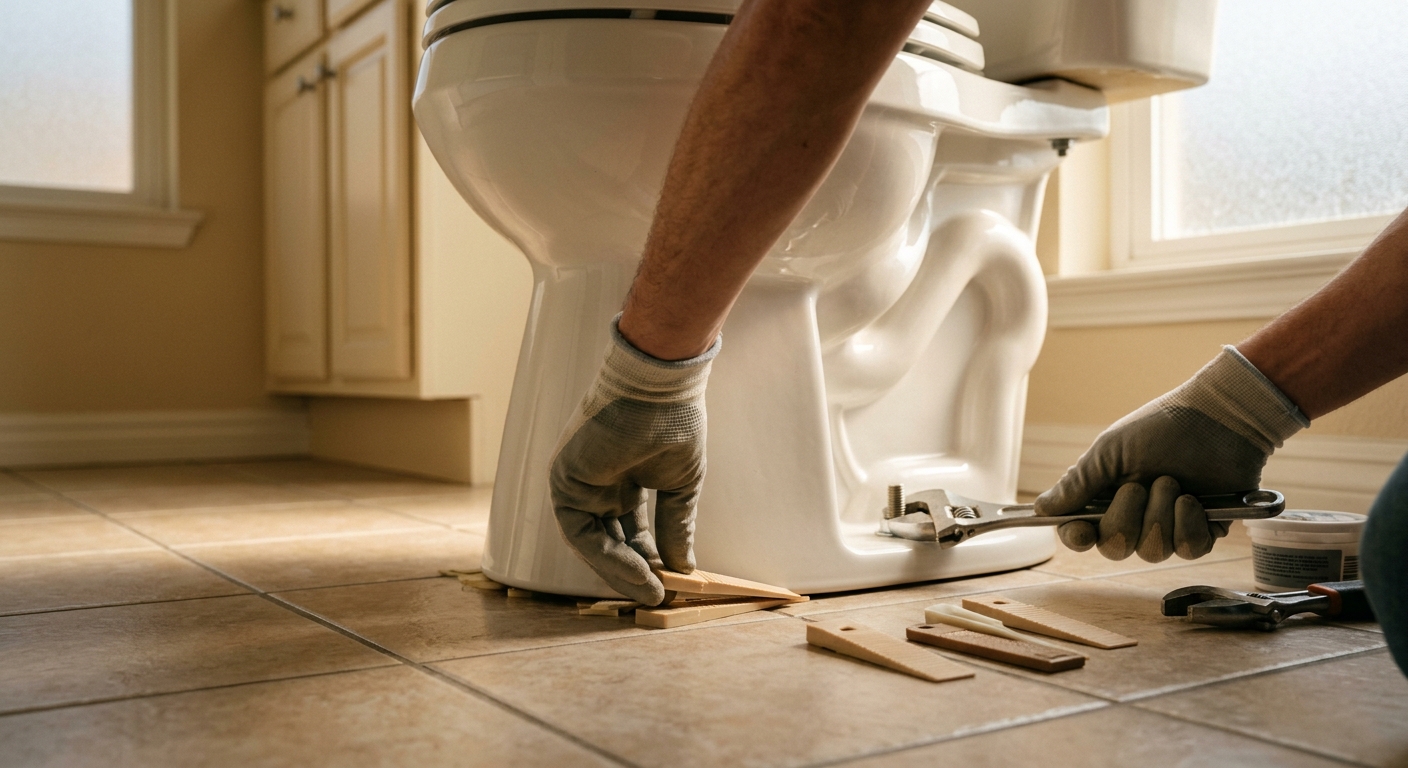
- Check the closet bolts first: remove the plastic caps at the base of the toilet and use an adjustable wrench to snug up the bolts. Do not overtighten – porcelain cracks easily. If this eliminates the wobble, replace the caps and you are done.
- If the toilet still rocks, slide plastic toilet shims (not wood – wood rots) into the gap on the low side. Work them in from both sides until the toilet no longer moves when you press on each corner.
- Score the shims flush with the toilet base using a utility knife, then remove any excess so they do not stick out from under the base.
- Apply a continuous bead of white tub-and-tile caulk around the base of the toilet, leaving a 2-inch gap at the back. This gap allows water to escape visibly if a leak ever develops, rather than hiding underneath.
- Allow caulk to cure for 24 hours before heavy use. Check stability again after the first week – shims occasionally settle slightly.
- Turn off the water supply valve behind the toilet and flush to empty the tank and bowl. Use a sponge to remove remaining water from both the tank and bowl so the toilet is light enough to lift.
- Disconnect the supply line from the tank. Loosen and remove the two closet bolt nuts at the base, keeping the bolts themselves in place in the flange slots.
- Lift the toilet straight up and set it on its side on an old towel. Stuff a rag into the open drain to block sewer gas while you work.
- Scrape the old wax completely off both the flange and the toilet horn using a putty knife. Inspect the flange carefully: it should be a solid ring with no cracks and should sit flush with or slightly above the floor. If the flange is broken or the subfloor around it is soft and spongy, stop and call a licensed plumber.
- Press a new wax ring onto the toilet horn (horn-side down), or set it over the flange opening – both methods work. Remove the rag from the drain, align the toilet over the two closet bolts, and press straight down with your full body weight to compress the wax ring evenly.
- Hand-tighten the nuts onto the closet bolts, alternating sides evenly, then snug with a wrench. Cut the bolts to length with a hacksaw, replace the caps, reconnect the supply line, turn the water back on, and check for leaks at the base after the first three flushes.
- Contact a licensed plumber and describe the symptoms: rocking toilet, duration of the problem, any odors, and whether you have a room below the bathroom. This helps them arrive with the right repair parts.
- Ask the plumber to inspect the flange before pulling the toilet. A cracked cast iron or PVC flange can often be repaired with a stainless steel repair ring rather than full replacement, which reduces cost significantly.
- If the subfloor is wet or soft, a general contractor or handyman will need to cut out the damaged section and sister in new plywood before the plumber can reset the toilet. This is a two-trade job.
- After subfloor repair, have the plumber install a new full flange set at the correct height for your finished floor, then reset the toilet with a new wax ring and closet bolts.
- Request that the plumber caulk the base properly and confirm no sewer gas odor remains before they leave. Get a written receipt noting what was replaced in case issues arise later.
Why It Works: The Benefits
Subfloor replacement runs $500 to $1,500 for a bathroom, and ceiling repairs in the room below add another $300 to $800. A $5 to $30 fix now eliminates that risk entirely.
Restoring the wax ring seal stops hydrogen sulfide from seeping into the bathroom, removing that intermittent rotten-egg smell that can make the entire floor unpleasant.
Moisture from a leaking seal creates ideal mold conditions within 24 to 48 hours. Fixing the rock before the seal fails completely prevents mold remediation costs that average $500 to $3,000.
A properly shimmed and sealed toilet feels solid and secure. Eliminating the wobble also prevents cracking the toilet base, which would require full replacement at $150 to $400 or more.
Home inspectors always check for rocking toilets and soft subfloors. Addressing this before listing avoids buyer price reductions or repair credits that typically run 2 to 3 times the actual cost of the fix.
💰 Savings Impact by Action
A $5 to $15 shim and caulk repair eliminates virtually all risk of subfloor water damage when the wax seal is still intact.
Replacing a compromised wax ring stops active sewer water infiltration and prevents subfloor damage that averages $500 to $1,500 to repair.
Catching a rocking toilet before the seal fails completely avoids mold remediation costs that average $500 to $3,000 per incident.
A $150 to $300 professional flange repair prevents full subfloor and ceiling restoration costs that commonly reach $2,000 to $5,000.
🏠 Key Concepts Explained
The Science Behind It
A toilet connects to the drain system through a floor flange, a circular fitting that sits at floor level and holds two closet bolts that anchor the toilet in place. The wax ring sandwiched between the toilet horn and the flange is the only thing preventing wastewater from escaping into the subfloor cavity. Wax works because it deforms and holds its shape under compression, creating a hermetic seal without any fasteners or adhesive. But wax is not elastic – it does not recover from repeated deformation. Every time a rocking toilet shifts, the wax on one side compresses while the other side releases. Over dozens or hundreds of flush cycles, this asymmetric compression creates gaps in the seal.
Water follows the path of least resistance. Once a gap forms in the wax ring, pressurized flush water travels along the outside of the drain pipe rather than down through it. This water saturates the subfloor, which is almost always plywood or OSB – both materials that lose roughly 50 to 70 percent of their structural strength when continuously wet. Wet wood also creates the perfect environment for Stachybotrys and Aspergillus molds, which can establish colonies within 48 hours of sustained moisture exposure. The reason damage shows up on the ceiling below is that water migrates horizontally through the subfloor before finding a path downward through gaps around pipes or at the wall-floor junction.
Plastic toilet shims work by filling the air gap between the toilet base and the uneven floor, distributing the toilet’s weight across the entire base perimeter rather than concentrating it on two or three high points. This eliminates the lever-arm effect that causes the opposite side to lift. Because the toilet no longer pivots on the flange, the wax ring experiences only vertical compression – the type of load it was designed to handle indefinitely.
Frequently Asked Questions
▼ I shimmed the toilet but it still rocks slightly. What am I missing?
A very small residual movement usually means you have not shimmed all the way to the gap on both sides, or the closet bolts are still loose. Remove the caps and check the bolts first. If they are tight, add a second thin shim layered on top of the first on the affected side. Also check that your shims are pushed far enough under the base to reach the toilet’s contact point with the floor, not just the outer edge of the base.
▼ There is a bad smell coming from around the toilet base. Is it too late for a simple fix?
A sewer gas odor means the wax ring seal has already been compromised enough to allow gas to bypass it – shimming alone will not fix this. You need to remove the toilet and replace the wax ring. Check the flange and subfloor condition while you have it up. If the subfloor feels firm and the flange is intact, a $10 wax ring and two hours will solve it. If you find soft wood or a damaged flange, call a plumber before reinstalling.
▼ Can renters ask their landlord to fix a rocking toilet?
Yes, and you should document it in writing immediately. A rocking toilet that causes water damage to the unit below is a habitability issue in most states, making landlord repair a legal obligation rather than a courtesy request. Text or email your landlord with a photo and the date, keep a copy, and follow up in writing if you get no response within 48 hours. Do not attempt a full wax ring reset yourself as a renter – that is the landlord’s responsibility and your lease may hold you liable for damage from unauthorized repairs.
▼ How do I know if my subfloor is already damaged?
Stand next to the toilet and push down firmly on the floor with your foot in the area immediately surrounding the base. Solid subfloor feels rigid with no give. Damaged subfloor feels soft, spongy, or slightly springy, and you may hear a faint crackling sound. Also check the ceiling of the room directly below the bathroom for any brown or yellowish staining, bubbling paint, or visible moisture. Any of these signs means the damage has already progressed and you need a contractor evaluation before a plumber resets the toilet.
▼ My toilet was rocking for over a year before I noticed. Is a wax ring replacement enough?
Possibly, but you need to check the subfloor and flange condition before assuming so. Remove the toilet and look carefully at the wood around the flange – probe it with a screwdriver. If the screwdriver sinks in easily, the wood is rotted and must be replaced first. Also inspect the flange for cracks or corrosion. If everything looks structurally sound, a new wax ring will restore a proper seal, but consider using a double-thick wax ring for extra margin.
Quick Tips
- Press on all four quadrants of the toilet base before buying anything – you need to know exactly which corner is lifting to place shims accurately.
- Use plastic shims rated specifically for toilets, not wood wedges or folded cardboard. Wood absorbs moisture and rots; plastic lasts indefinitely.
- When resetting a toilet, choose a wax ring with a plastic horn extension if the flange sits below the floor surface – the extra depth compensates for low flange height.
- After any toilet repair, put a few drops of blue food coloring in the tank, wait 15 minutes without flushing, and check the base and ceiling below for any color. If color appears, the seal is not fully seated.
- Check closet bolt tightness annually as part of a simple home maintenance routine. Loose bolts are the most common cause of early wax ring failure and take 60 seconds to check.
Variations for Your Situation
- Apartment or Rental: Renters should not pull the toilet or replace a wax ring without written landlord approval, as this is a structural plumbing repair. However, tightening closet bolts and sliding plastic shims under the base are cosmetic stabilization steps most leases allow. Document the wobble in writing to your landlord immediately, since ongoing water damage from a failed seal is the landlord’s liability in most jurisdictions. Include a photo with a date stamp.
- Tight Budget (under $20): A $3 to $5 pack of plastic toilet shims and a $3 tube of tub caulk are all you need for the quick fix approach. Skip the caulk gun and use a squeeze tube instead. Start by retightening the closet bolts at zero cost, since that alone resolves a mild wobble in many cases. Avoid buying a wax ring preemptively – only purchase one if you confirm the seal has failed by smelling sewer gas or finding moisture.
- Older Home (pre-1980): Homes built before 1980 often have cast iron floor flanges that corrode and crack after decades of use. If you pull the toilet and find a cracked or broken cast iron flange, do not attempt to DIY this repair. Stainless steel repair rings can be glued over a cracked flange for around $15 to $25 and are a legitimate fix, but only if the flange is cracked and not completely collapsed. Corroded or missing sections require full cast iron flange replacement, which is a job for a licensed plumber with the right tools. Also check for lead or oakum packing in older drain connections that may need professional evaluation.