There is a reason why your neighbor’s house feels cool and dry at 76°F while yours feels sticky and oppressive at the same setting. The culprit is not your thermostat, your insulation, or even your AC unit. It is humidity. When indoor relative humidity climbs above 60%, your body’s natural cooling system, sweating, becomes far less effective, making every degree of air temperature feel worse than it actually is. The result is a home that feels hot even when it technically is not, and an AC that runs nonstop trying to compensate.
Most central air conditioners are designed to dehumidify as a side effect of cooling, not as a primary function. On mild days when the AC does not run long enough, or in climates with genuinely humid summers, indoor humidity can creep to 65 to 70% and beyond. That range is not just uncomfortable. It is a breeding ground for mold, dust mites, and the kind of musty smell that no amount of air freshener fixes. It also causes wood floors and trim to swell, electronics to corrode faster, and allergy symptoms to worsen noticeably.
This post walks you through exactly why humidity affects comfort so dramatically, how to choose between a portable and whole-home dehumidifier, and what realistic savings and payback periods look like for each option. Whether you want a same-afternoon fix or a permanent upgrade, there is a path here that fits your budget and your home.
What You’ll Need
Click on an item below to shop for the recommended items for this recipe on Amazon.
As an Amazon Associate, we earn from qualifying purchases.
How to Do It
- Purchase a 50-pint portable dehumidifier rated for your square footage. ENERGY STAR models use 15% less energy than standard units and cost $180 to $280 at most home improvement stores.
- Place the unit in the most central, humid room in your home, typically the basement or main living area. Keep it at least 12 inches from walls and furniture to allow proper airflow.
- Set the target humidity level to 45 to 50% RH. Do not set it lower than 45% or the unit will overwork and you may notice dry skin and static electricity in winter-adjacent months.
- Connect a drain hose to the built-in drain port if available, and route it to a floor drain or utility sink. This eliminates the need to empty the tank manually every 8 to 12 hours.
- Check and clean the air filter every 2 weeks during peak summer operation. A clogged filter reduces efficiency and can cause the unit to ice up, which stops moisture removal entirely.
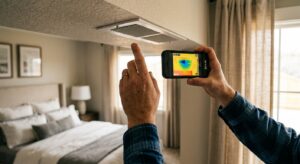
- After 48 hours of operation, note the RH reading on your hygrometer (a $10 to $15 device at any hardware store). If the room still reads above 55%, the unit may be undersized or the space has significant air leaks to address.
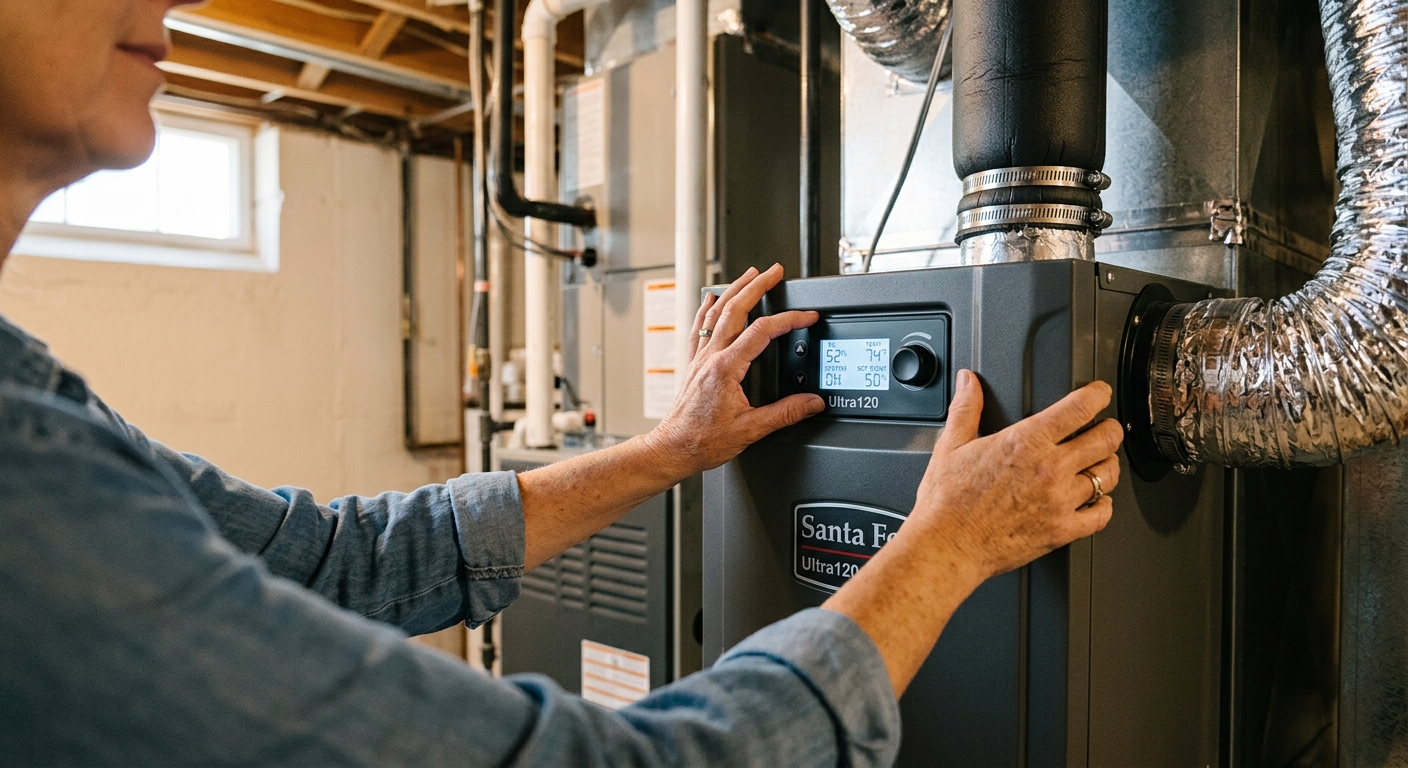
- Get two or three quotes from licensed HVAC contractors for a whole-home dehumidifier installed in your ductwork. Popular units from Aprilaire and Santa Fe are sized in pints-per-day and should be matched to your square footage and climate zone.
- Choose a unit with a built-in humidistat controller so it runs independently of your AC. This matters on mild days when the AC does not run but humidity climbs, which is exactly when humidity problems most often go unnoticed.
- Have the contractor install the unit on the return air side of your air handler, so all circulating air passes through the dehumidifier before reaching the AC coil. This also reduces the latent load on the AC, extending its lifespan.
- Ensure a dedicated condensate drain line is installed. Whole-home units can remove 70 to 130 pints of water per day at peak capacity, so a proper drain connection is not optional.
- After installation, set the whole-home humidistat to 50% RH. Monitor actual RH with a standalone hygrometer in a central room for the first two weeks and adjust the set point by 2 to 3% if needed.
- Schedule annual maintenance each spring to clean the coil, check refrigerant if applicable, and replace the filter. Most whole-home units have a 5-year warranty and a lifespan of 10 to 15 years with proper maintenance.
Why It Works: The Benefits
Dropping indoor RH from 65% to 50% makes 78°F feel closer to 73°F, allowing most households to raise the AC setpoint by 2 to 4 degrees without feeling warmer, which directly reduces runtime and energy cost.
The DOE estimates that properly managing indoor humidity allows homeowners to raise their thermostat setpoint enough to cut cooling energy use by 10 to 15%, translating to $50 to $150 in savings over a typical cooling season depending on home size and climate.
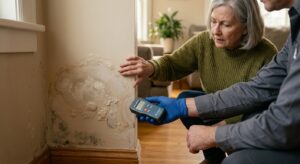
Maintaining RH at or below 50% stops mold growth and reduces dust mite populations by up to 50%, since dust mites cannot survive below 50% RH, making a measurable difference for allergy and asthma sufferers.
Wood expands and contracts with humidity changes. Holding indoor RH between 45 and 55% year-round prevents warping, squeaking floors, sticking doors, and cracking in wood furniture and trim, extending their useful life significantly.
Dry air suppresses musty odors caused by mold and mildew, reduces volatile organic compound (VOC) off-gassing from certain materials, and makes the home smell noticeably cleaner within the first 24 to 48 hours of operation.
💰 Savings Impact by Action
Raising the AC setpoint by 3 degrees due to improved humidity comfort reduces cooling energy consumption by roughly 9 to 12% over the cooling season.
Offloading latent heat removal to a dedicated dehumidifier reduces overall AC compressor runtime by up to 15%, lowering both energy use and mechanical wear.
Combining dehumidification with basic air sealing reduces humidity infiltration, cutting dehumidifier runtime and reducing total cooling load by up to 20%.
Maintaining RH at or below 50% essentially eliminates the moisture conditions required for mold growth, avoiding remediation costs that average $1,500 to $3,500 per incident.
🏠 Key Concepts Explained
The Science Behind It
The discomfort of a humid home comes down to one thermodynamic principle: your body cools itself by evaporating sweat from the surface of your skin. This process requires the surrounding air to have room to absorb more water vapor. When relative humidity is high, the air is already carrying a large fraction of its maximum possible moisture load, which means sweat evaporates slowly or not at all. Your body generates roughly 250 to 400 watts of heat at rest, and if that heat cannot escape efficiently, your core temperature rises and you feel hot even when the thermometer says otherwise.
A dehumidifier works by drawing room air across a refrigerated coil, which chills the air below its dew point and causes moisture to condense out onto the coil, exactly the way a cold glass sweats on a humid day. That liquid water drains away, and the now-drier air is reheated slightly as it passes back over the condenser coil before returning to the room. The net effect is air at roughly the same temperature but with significantly less moisture content. This is why a dehumidifier technically adds a small amount of heat to the room, but still makes you feel cooler. The reduction in humidity more than compensates for the slight temperature increase.
From a whole-home energy standpoint, your air conditioner removes humidity as a byproduct of cooling the air, but it is optimized for sensible (temperature) cooling, not latent (moisture) removal. On a 75°F day with 75% relative humidity, your AC may never run long enough to pull meaningful moisture out of the air. A dedicated dehumidifier fills this gap, removing moisture independently of temperature, which keeps indoor RH stable even on mild days when the AC cycles off early. The result is a home that your AC can cool to comfort at a higher setpoint, running less often and consuming less energy over the course of the season.
Frequently Asked Questions
▼ My dehumidifier is running constantly but the humidity in my home won’t drop below 60%. What is wrong?
The most likely causes are an undersized unit, significant air leaks bringing in outdoor humidity faster than the unit removes it, or a hidden moisture source like a slow plumbing leak or a crawl space without a vapor barrier. First, check that the unit’s pint rating matches your square footage. Then seal obvious gaps around windows and doors. If the problem persists, inspect the crawl space or basement for standing water or missing vapor barrier plastic.
▼ Will a dehumidifier make my house too dry and cause problems like cracking wood or nosebleeds?
Only if you set it too low. Most dehumidifiers can be set to a target RH, so set it to 48 to 50% and leave it there. At 50% RH, your wood floors, furniture, and respiratory system are all in a comfortable and safe range. Cracking and dryness issues typically only appear below 35% RH, which you are unlikely to reach in summer without intentionally forcing the unit to run continuously at maximum output.
▼ Can I use a dehumidifier in my apartment without landlord permission?
Yes. A portable dehumidifier is a plug-in appliance, no different from a fan or an air purifier, and requires no installation or modification to the unit. Just be sure to connect a drain hose to a sink or bathtub if possible, since a unit in a small apartment can fill its tank in as little as 6 to 8 hours on a humid day. Check your lease only if you plan to route a permanent drain line through a wall or cabinet, as that would constitute a modification.
▼ How long before I see the humidity drop after I first turn on a new dehumidifier?
In a typical room or small apartment, you should see RH drop from 65% to 50% within 6 to 12 hours of initial operation, assuming doors and windows are closed. In a full basement or large open floor plan, allow 24 to 48 hours for the first full drawdown. After that initial pull, the unit will cycle on and off to maintain your set point and typically run only a few hours per day.
▼ My whole-home AC already has a dehumidifier setting. Do I still need a dedicated unit?
Possibly not, but it depends on how your system is configured and how humid your climate is. Many thermostats have a humidity setting that tells the AC to run the fan longer to pull more moisture off the coil. This works reasonably well in mild climates, but it also overcools the space in the process, wasting energy. If your indoor RH still exceeds 55% regularly even with that setting active, a dedicated whole-home dehumidifier on the return side will do the job more efficiently without overcooling.
Quick Tips
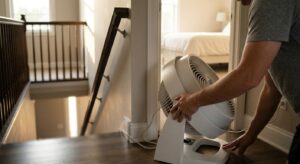
- Keep interior doors open when running a portable dehumidifier so it can circulate air from adjacent rooms rather than just cycling the same contained air.
- Target a year-round indoor RH of 45 to 50%. Below 40% causes dry skin and increases static electricity. Above 55% brings back mold and dust mite risk.
- Pair dehumidification with basic air sealing around window frames, door thresholds, and basement rim joists. Reducing humidity infiltration means your dehumidifier runs less and uses less energy.
- If your basement consistently reads above 65% RH even with a dehumidifier running, check for a vapor barrier on the basement floor and walls. Ground moisture migrating upward through concrete is often the hidden source driving high humidity in lower floors.
Variations for Your Situation
- Apartment or Rental: A 30-pint portable ENERGY STAR dehumidifier for $150 to $200 is the right solution here. No permission needed and no installation required. Place it in the most-used room, connect a drain hose to the kitchen or bathroom sink to avoid constant tank emptying, and set it to 50% RH. In a studio or one-bedroom apartment, one unit is usually enough. For a two-bedroom or larger, consider a 50-pint model or a second smaller unit for the bedroom.
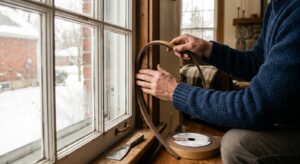
- Tight Budget (under $50): Skip the dehumidifier for now and focus on the behavioral and air-sealing steps that reduce humidity infiltration for free. Keep windows closed from midnight to 10 a.m. when outdoor RH is highest. Run bathroom and kitchen exhaust fans for 20 minutes after any steam-producing activity. Seal the largest gaps around window air conditioner units and basement windows with foam backer rod and weatherstripping, which costs $10 to $20. These steps alone can reduce indoor RH by 5 to 8 percentage points in a tight home.
- Older Home (pre-1980): Homes built before 1980 typically have much higher air infiltration rates, sometimes 3 to 5 times leakier than a modern home, which means outdoor humidity constantly enters the building envelope. A portable unit will often struggle to keep up. Prioritize air sealing the basement rim joists and any visible gaps in the crawl space or attic floor before investing in a dehumidifier. Once infiltration is reduced, a 50-pint portable or a whole-home unit will be far more effective and use significantly less energy to maintain target humidity.