If your floors feel cold in winter, your heating system runs constantly, or you notice a musty smell drifting up from below, your crawl space is likely the culprit. An uninsulated crawl space acts like a giant cold sponge sitting beneath your living area, pulling heat out through your floors in winter and allowing moisture and humid air to seep upward year-round. The U.S. Department of Energy estimates that homes with unconditioned crawl spaces can lose 15 to 25% of their heating and cooling energy through the floor system alone.
The good news is that crawl space insulation is one of the highest-return upgrades a homeowner can make, and it does not require a contractor. With the right materials, a free weekend, and a budget under $500, most homeowners can tackle this project themselves and start seeing savings on the very next energy bill. The challenge is knowing which method is actually best for your specific crawl space type, because the wrong approach can trap moisture and cause more problems than it solves.
This guide covers the two proven methods for insulating a crawl space, the materials that deliver the best results per dollar, how to handle moisture before you insulate, and what the actual payback period looks like based on real energy data. Whether your crawl space is vented or unvented, dry or damp, you will find a clear path forward here.
What You’ll Need
Click on an item below to shop for the recommended items for this recipe on Amazon.
As an Amazon Associate, we earn from qualifying purchases.
How to Do It
- Suit up before entering: wear a respirator (N95 or better), safety glasses, knee pads, and a disposable coverall. Crawl spaces contain dust, mold spores, and occasionally pest debris.
- Clear out any standing water, debris, or old damaged insulation that has fallen from the floor joists. Wet or moldy batts must be removed and bagged for disposal before you do anything else.
- Roll out 6-mil (or heavier) polyethylene sheeting across the entire ground surface, overlapping seams by at least 12 inches. Run the sheeting 6 inches up the foundation walls and tape or staple it in place with a construction adhesive compatible with poly film.
- Seal all seams with a poly vapor barrier tape rated for underground use. Do not use standard duct tape, as it will fail within a year in the damp environment.
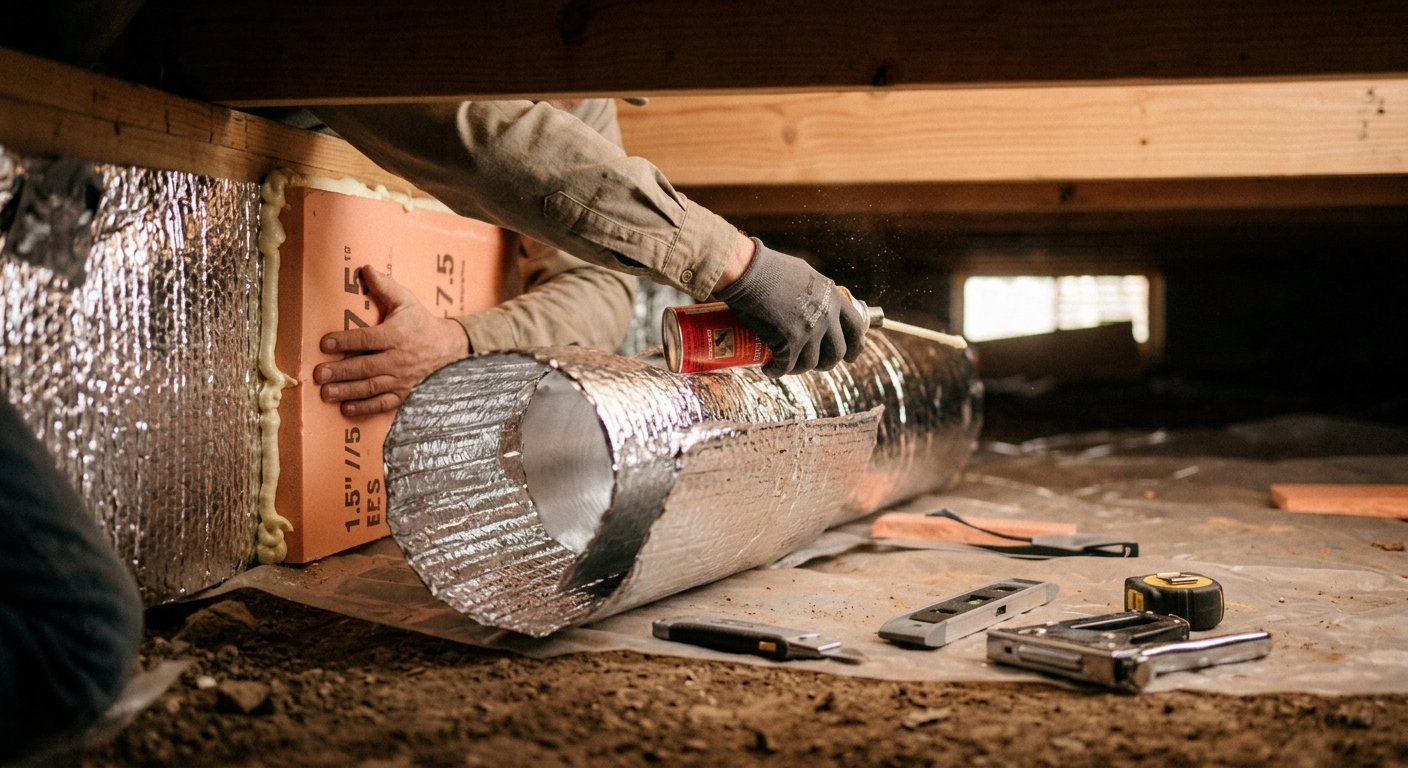
- Move to the rim joists (the framing members sitting on top of your foundation walls at the perimeter). Cut pieces of 2-inch rigid foam board to fit snugly into each rim joist bay. Press them in and seal all four edges with canned spray foam to eliminate air gaps.
- Check that all crawl space vents are operable if you have a vented crawl space. In humid climates, you may want to consider sealing them as part of a full encapsulation later.
- Complete all steps from the vapor barrier approach above first. Insulating over a moisture problem traps water and accelerates rot, so the ground cover and sealing must come first.
- Decide on your insulation placement: foundation wall insulation (preferred for humid climates and encapsulated crawl spaces) or floor-joist batt insulation (acceptable for dry climates with vented crawl spaces). Foundation wall insulation delivers higher performance by eliminating thermal bridging.
- For foundation wall insulation: cut 1.5-inch to 2-inch thick rigid foam boards (XPS or polyisocyanurate) to height and press them firmly against the interior of your foundation walls. Secure with construction adhesive and seal all edges and seams with spray foam. Target R-10 minimum, which most building codes require for crawl space walls.
- For floor-joist batt insulation (vented crawl space method): cut unfaced fiberglass batts to fit snugly between joists with the vapor barrier facing up toward the subfloor. Use insulation support rods or wire hangers spaced every 18 inches to hold batts firmly against the subfloor. Batts that sag or fall lose most of their R-value.
- Regardless of method, install 2-inch rigid foam cut to fit all rim joist bays and seal edges with spray foam. This one step alone is often worth 30 to 40% of the total energy improvement from crawl space work.
- After completing insulation, walk the perimeter with a flashlight and check for any unsealed penetrations where pipes or wires enter from outside. Seal all gaps over 1/4 inch with spray foam, and fill smaller cracks in the foundation wall with hydraulic cement or masonry caulk.
- Install a heavy-duty vapor barrier (20-mil reinforced poly) across the floor and up all walls to the sill plate, securing it with mechanical fasteners and waterproof tape at all seams.
- Seal all foundation vents permanently with rigid foam and spray foam (check local code first, as some jurisdictions require a specific ratio of venting or a mechanical alternative).
- Insulate all foundation walls to at least R-10 with rigid foam board, and install rigid foam on the interior face of any knee walls.
- Seal all penetrations including pipes, wires, and HVAC ducts entering the crawl space from outside.
- Install a crawl space dehumidifier rated for the square footage of your space. Units designed for crawl spaces drain continuously via a gravity drain or pump and maintain relative humidity below 50%.
- If HVAC ducts run through the crawl space, inspect all joints and seal with mastic sealant. Leaky ducts in a now-conditioned crawl space waste the energy you just invested in encapsulation.
Why It Works: The Benefits
Properly insulating a crawl space reduces heat loss through the floor by up to 25%, translating to $150 to $400 in annual savings for a typical 1,500 to 2,500 square foot home depending on climate and fuel type.
Floor surface temperatures can increase by 5 to 10 degrees Fahrenheit after insulating, eliminating that cold-floor effect that makes mornings miserable and often causes homeowners to raise the thermostat unnecessarily.
A ground vapor barrier combined with crawl space insulation can reduce relative humidity under the home by 20 to 30 percentage points, which directly lowers the risk of mold, wood rot, and pest intrusion.
With less heat escaping through the floor, your furnace or heat pump cycles less frequently. Reducing runtime by even 15% extends equipment lifespan and reduces maintenance costs over the long term.
Sealing the crawl space reduces the stack effect that pulls ground-level air including mold spores, radon, and soil gases upward into living spaces, producing measurably better indoor air quality.
💰 Savings Impact by Action
Installing a ground vapor barrier reduces moisture-related R-value loss in existing insulation and cuts humid air infiltration, improving effective floor insulation performance by up to 8%.
Sealing rim joists with rigid foam and spray foam eliminates a primary air leakage pathway responsible for up to 12% of whole-house heating loss in homes with uninsulated crawl spaces.
Adding R-19 fiberglass batts or R-15 rigid foam to the floor assembly reduces conductive heat loss through the floor deck by 15% of total heating and cooling energy use.
Full foundation wall insulation combined with vent sealing reduces crawl space heat loss by treating it as conditioned space, cutting total home heating energy use by up to 20%.
Adding a crawl space dehumidifier in humid climates maintains insulation at rated R-value year-round, preserving the 5% or more of energy savings that moisture degradation would otherwise erode.
🏠 Key Concepts Explained
The Science Behind It
Heat moves through building assemblies in three ways: conduction through solid materials, convection through air movement, and radiation across air gaps. An uninsulated crawl space loses heat through all three simultaneously. The concrete or block foundation walls conduct heat outward continuously during cold months. The bare soil radiates cold upward, chilling the air in the crawl space. And the stack effect drives that cold air upward through every gap in the floor deck into the living space above.
Insulation works by trapping millions of tiny air pockets that resist conductive heat flow. Fiberglass batts achieve this with glass fibers, while rigid foam boards use either expanded or extruded polystyrene cells. The key metric is R-value, which measures resistance to heat flow per inch of material. Rigid XPS foam delivers about R-5 per inch compared to about R-3 per inch for fiberglass batts, making rigid foam the better choice when space is limited. However, R-value only measures conductive resistance. If insulation is installed loosely, sags away from the subfloor, or has gaps at edges, convective air can flow around it and make the listed R-value nearly meaningless in practice. A perfectly air-sealed R-19 floor outperforms a leaky R-30 floor every time.
Moisture matters as much as thermal resistance in crawl spaces. Liquid water and vapor both degrade fiberglass insulation by compressing the fiber matrix and reducing the trapped air volume that gives the material its R-value. A wet batt can lose 40% or more of its rated R-value. This is why the vapor barrier is not optional. The ground beneath a crawl space releases moisture year-round through a process called vapor diffusion, and without a physical barrier, that moisture migrates into insulation, framing, and eventually your subfloor. Polyethylene sheeting with taped seams stops vapor diffusion in its tracks and is the single most protective thing you can do for a crawl space on a limited budget.
Frequently Asked Questions
▼ Why does my crawl space keep getting wet even after I installed a vapor barrier?
A vapor barrier stops moisture rising from the soil, but it does not stop liquid water from entering through cracks in the foundation wall or via poor drainage around the home. Check your gutters, downspouts, and soil grading around the foundation. If water is pooling against the foundation or gutters are overflowing, no vapor barrier will keep the crawl space dry. Address the water source first, then reassess whether you need interior drainage or a sump pump before the insulation can do its job.
▼ My floor is still cold after insulating the joist bays. What went wrong?
The most common cause is insulation that has sagged or fallen away from the subfloor, leaving an air gap that kills its thermal performance. Go back and check that every batt is firmly pressed against the subfloor and supported every 18 inches. Also inspect the rim joists, because even fully insulated floor bays will underperform if the rim joist areas are still open to outside air. Rim joist air sealing is frequently the missing piece.
▼ Can I insulate my crawl space in winter?
Yes, and in some ways winter is ideal because the crawl space is at its driest (cold air holds less moisture). The main concern is temperature: spray foam and some construction adhesives have minimum application temperatures, typically around 40 degrees Fahrenheit. Check your product labels before you start. Vapor barrier installation and batt work have no temperature restrictions, so you can complete most of the project even in cold weather.
▼ Do I need a permit to insulate my crawl space?
Adding insulation to existing bays generally does not require a permit in most jurisdictions. However, permanently sealing foundation vents to create an encapsulated crawl space often does require a permit and may need an inspection because it changes the building envelope classification. Check with your local building department before sealing any vents. Skipping this step can create issues when you sell the home.
▼ I found old fiberglass batts falling out of the floor joists. Should I just push them back up?
Only if they are completely dry and free of mold. Wet, compressed, or moldy batts have lost most of their R-value and should be removed, double-bagged, and disposed of. Installing new batts over or alongside deteriorated ones does not restore performance and can trap moisture. Take the old material out, inspect the framing for any rot or mold, address any issues you find, and then install fresh insulation properly.
Quick Tips
- Measure your crawl space perimeter and square footage before buying materials so you do not make multiple hardware store trips. Sketch out the layout including any piers, pipes, and HVAC equipment.
- Buy vapor barrier in a single roll large enough to cover the floor with minimal seams. Every seam is a potential failure point, and fewer seams means a faster, more reliable installation.
- In cold climates (Zones 5 and above), target R-15 to R-19 for floor-joist insulation or R-10 for foundation walls per DOE recommendations. Going higher than code minimum in the floor assembly often delivers a better payback than upgrading other envelope components.
- If you have PEX or copper water lines in the crawl space, make sure they end up on the warm side of the insulation layer after your project is complete. Pipes left on the cold side of insulation are vulnerable to freezing even if they were fine before you improved the rest of the space.
Variations for Your Situation
- Apartment or Rented Home: Renters with direct access to a crawl space (common in single-family rentals) should ask landlord permission before doing any work. If permitted, the vapor barrier installation requires no tools and costs $50 to $100 in materials, making it an easy approval to get. Focus the conversation on moisture protection to protect the landlord’s structure. Rim joist sealing with canned foam is also reversible and low-cost at roughly $20 to $40 in materials.
- Tight Budget Under $150: Prioritize in this order for maximum return per dollar. First, install a 6-mil poly vapor barrier across the entire crawl space floor ($40 to $80 for most homes). Second, seal rim joists with cut rigid foam scraps and one or two cans of spray foam ($30 to $50). These two steps alone deliver 60 to 70% of the total energy benefit of full insulation and address the moisture risk that destroys insulation over time. Add batt insulation in future seasons as budget allows.
- Older Home Pre-1980: Homes of this era often have minimal or no existing crawl space insulation, balloon-frame construction with open wall cavities communicating with the crawl space, and potentially asbestos pipe insulation or lead paint on foundation walls. Have a home inspector or environmental consultant check for hazardous materials before starting any work. Focus on air sealing first since the baseline leakage rate is very high in these homes and closing major air pathways delivers outsized savings. Budget an additional $100 to $200 for extra spray foam to address the larger gaps and penetrations typical of older construction.