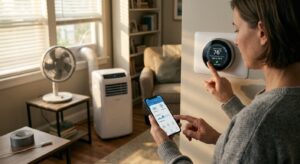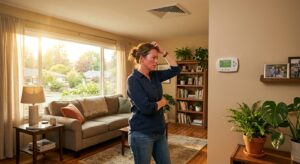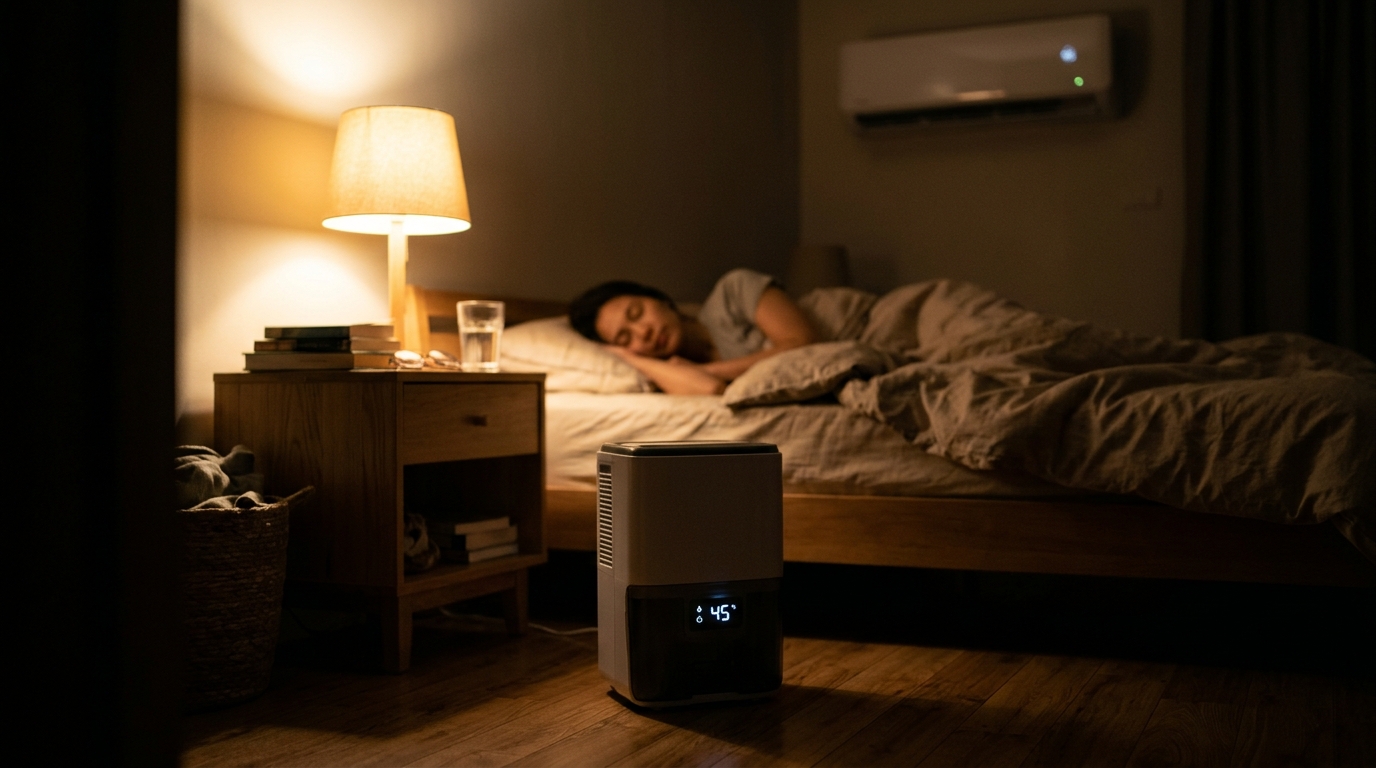
Ever notice that your house feels clammy and sticky even though the thermostat says 74 degrees? That is humidity at work. Your body cools itself by evaporating sweat, and when the air is already loaded with moisture, evaporation slows down. The result is a room that reads 74 on the thermostat but feels like 78.
Your air conditioner removes some moisture as a side effect of cooling, but it is not designed to be a primary dehumidifier. When humidity is high, the AC runs longer to compensate, and it often short cycles at night when the temperature drops but the moisture stays. That means higher bills and a house that never quite feels crisp.
This post covers a simple strategy: running a dehumidifier overnight at a targeted humidity setting so your AC can do less work and your home feels cooler at a higher thermostat setting. We will walk through a no-cost quick fix, a DIY upgrade with a dedicated setup, and the science behind why it works.
What You’ll Need
Click on an item below to shop for the recommended items for this recipe on Amazon.
As an Amazon Associate, we earn from qualifying purchases.
How to Do It
- Place the dehumidifier in the most humid, central part of your home. For many homes this is the basement, main hallway, or living area near the bedrooms. Keep it at least 6 inches from walls for airflow.
- Set the humidistat to 45 to 50 percent. Do not set it lower than 40 percent, because the unit will run constantly and waste energy.
- Close windows and exterior doors so the dehumidifier is not fighting outdoor humidity.
- Use a timer or smart plug to run it from about 9 PM to 7 AM, when the AC short cycles and humidity builds. If your unit has a built-in timer, set it accordingly.
- Raise your thermostat 2 degrees the first night and another 1 to 2 degrees over the following week as you confirm comfort.
- Empty the bucket each morning or connect a gravity drain hose to a floor drain or sump.
- Buy a standalone hygrometer or smart humidity sensor ($10 to $25) and place one on each floor to find your real humidity hot spots.
- Attach a 3/4 inch garden hose or clear vinyl tubing to the dehumidifier’s drain port, and run it to a floor drain, sump pit, or condensate pump. This eliminates daily emptying and allows continuous overnight operation.
- Plug the dehumidifier into a smart plug ($12 to $20) and create a schedule that runs it from sundown through morning. Pair it with a humidity-based trigger if your smart plug supports it.
- Program your thermostat to hold 76 to 78 degrees overnight instead of 72 to 74. The reduced humidity will make that setpoint feel comfortable.
- Check your hygrometers after one week. If readings stay above 55 percent, move the unit closer to the humid area or upgrade to a larger capacity model sized for your square footage.
- Clean the dehumidifier’s air filter monthly and wipe the coils each season to keep efficiency high.
- Have an HVAC contractor perform a load calculation to size the unit correctly for your square footage and climate.
- Ask for a whole-house model rated for your home size, such as 70 to 120 pints per day for typical 2,000 to 3,000 square foot homes.
- Confirm the unit connects to the return and supply ducts and ties into a condensate drain.
- Have the installer set the integrated humidistat to 45 to 50 percent and configure a night-priority mode if available.
- Ask about ENERGY STAR certified models, which use about 15 percent less energy than standard units.
Why It Works: The Benefits
Lowering humidity to 45 to 50 percent typically lets you raise your thermostat 2 to 4 degrees with the same comfort. The DOE estimates roughly 3 percent savings per degree of setback on cooling.
With less latent load, your AC compressor runs fewer minutes per hour, which reduces wear and extends equipment life.
Sleep research shows people sleep best at 60 to 67 degrees and 40 to 50 percent humidity. Damp, sticky air disrupts sleep even when temperatures are fine.
Keeping humidity under 50 percent suppresses mold growth and dust mite populations, which helps allergy sufferers and protects your home.
Cooler apparent temperature means you stop chasing comfort with a colder thermostat, which is the biggest hidden driver of high summer bills.
💰 Savings Impact by Action
Raising your setpoint 3 to 4 degrees thanks to lower humidity can trim cooling costs by roughly 10 to 12 percent.
Reducing latent load cuts compressor run time and extends equipment life, saving about 8 percent on cooling energy.
Running dehumidification overnight on off-peak rates can lower the cost of moisture control by around 5 percent.
Holding humidity under 50 percent can cut mold-related repair and remediation risk by roughly 20 percent over time.
🏠 Key Concepts Explained
The Science Behind It
Your AC is really two machines in one. Its evaporator coil cools air (sensible heat removal) and condenses water vapor into liquid (latent heat removal). In dry climates, nearly all the work is sensible. In humid climates, up to 30 to 40 percent of the energy goes to latent removal. When outdoor temperatures drop at night, the AC hits its setpoint quickly and cycles off, but the moisture already in the air and in your furnishings is not removed. Relative humidity creeps upward even as temperatures fall.
A dedicated dehumidifier uses a small refrigeration loop to pull moisture directly out of the air. Because it is optimized for moisture removal, a modern ENERGY STAR unit removes about 1.8 to 2.2 liters of water per kilowatt-hour, which is significantly cheaper than forcing your AC to run extra cycles to do the same job. The heat the dehumidifier adds to the room is modest, usually 300 to 600 watts.
The comfort gain comes from how your body regulates temperature. When air is dry, sweat evaporates efficiently and carries heat away. At 75 degrees and 45 percent humidity, most people feel comfortable. At 75 degrees and 65 percent, the same temperature feels sticky and warm. By lowering humidity, you shift your comfort zone upward, which lets you raise your thermostat setpoint and cut cooling energy without feeling any difference.
Frequently Asked Questions
▼ Why is my AC still running all day even after I added a dehumidifier?
Check that your dehumidifier is actually reaching its target humidity and not stuck running because the space is too large for its capacity. Also confirm that your windows and doors are sealed, and that your AC is properly sized and its filter is clean. If your AC still runs constantly with indoor humidity under 50 percent, you may have a duct leak, low refrigerant, or an undersized system, and it is time to call an HVAC pro.
▼ Can renters do this without landlord permission?
Yes. A portable dehumidifier plugs into a standard outlet and requires no modification to the property. Use a gravity drain hose into a floor drain or a bucket, and stick to a ENERGY STAR model sized for your unit square footage (typically 20 to 35 pints for apartments up to 1,000 square feet).
▼ How long before I actually notice savings on my bill?
You will feel the comfort difference within one to two nights. Bill savings appear in your next full billing cycle, typically 5 to 15 percent lower cooling costs in humid climates if you raise your thermostat setpoint by 2 to 4 degrees. Track your kilowatt-hour usage before and after to confirm the benefit.
▼ What if my home is older than 30 years?
Older homes usually have leakier envelopes and less vapor control, so outdoor humidity infiltrates more easily. Start by sealing obvious air leaks around windows, doors, and attic penetrations, then add a dehumidifier. In very leaky homes you may need a higher-capacity unit or a whole-house model to keep up.
▼ Will a dehumidifier raise my electric bill more than it saves?
A typical ENERGY STAR 35 pint unit uses about 400 to 500 watts, which costs roughly $0.05 to $0.08 per hour at average rates. Running it 8 hours overnight adds around $12 to $20 per month. If it lets you raise your thermostat 3 degrees, you will typically save $15 to $40 per month on cooling in humid regions, so the net savings are positive.
Quick Tips
- Target 45 to 50 percent relative humidity. Below 40 percent wastes energy, and above 55 percent feels muggy.
- Run the dehumidifier overnight when electricity is often cheaper under time-of-use rates and your AC is short cycling.
- Use a continuous drain whenever possible. A full bucket shuts the unit off and defeats the purpose of overnight operation.
- Place a hygrometer near your bed or main living area so you can verify results instead of guessing.
- Keep bathroom and kitchen exhaust fans running 20 minutes after showers and cooking to prevent humidity spikes.
- Pair dehumidification with ceiling fans on low to improve evaporative cooling at the skin and gain another 2 to 3 degrees of perceived cooling.
Variations for Your Situation
- Apartment/Rental: Use a compact 20 to 25 pint ENERGY STAR dehumidifier ($150 to $220) in the bedroom or main living area with a gravity drain hose or bucket. Skip modifications to the walls or ducts, and use a smart plug ($12 to $20) to automate overnight runs.
- Tight Budget (under $50): Run exhaust fans during and after showers, seal obvious window gaps with weatherstripping ($10 to $20), keep your AC filter clean, and use ceiling fans to improve comfort. If you already own a dehumidifier, simply set it to 45 to 50 percent overnight at zero additional cost.
- Older Home (pre-1980): Prioritize air sealing at the attic, rim joists, and windows before relying on dehumidification alone. Consider a larger 50 to 70 pint unit for the basement and a hygrometer on each floor to find the worst moisture zones.