If you’ve fired up your air conditioner for the season and thought ‘that doesn’t sound right,’ trust your instincts. HVAC systems are remarkably consistent machines, and a change in tone, rhythm, or volume almost always points to a real mechanical shift – whether that’s a worn component, a refrigerant issue, or something as simple as debris in the unit. Catching these changes early is the difference between a $15 fix and a $1,500 compressor replacement.
Most homeowners don’t realize that their AC communicates through sound. A healthy system runs with a steady, low hum when the compressor is on and a smooth whoosh of air from the vents. Anything else – rattling, banging, hissing, clicking, squealing, or short cycling on and off – is a diagnostic signal worth paying attention to. According to ENERGY STAR, a poorly maintained or failing AC system can use 10 to 25% more energy than a properly functioning one, meaning strange noises often show up on your utility bill before your repair bill.
This post walks you through the most common AC sounds homeowners notice at the start of cooling season, what each one means mechanically, which you can address yourself in under an hour, and which ones require a licensed HVAC technician before they turn into a full system failure. We’ll cover both central air systems and window or mini-split units so you can find your situation quickly.
What You’ll Need
Click on an item below to shop for the recommended items for this recipe on Amazon.
As an Amazon Associate, we earn from qualifying purchases.
How to Do It
- Turn off the AC at the thermostat and go to the outdoor condenser unit. Remove the top grille if it lifts off easily and look inside with a flashlight for leaves, twigs, seed pods, or animal nests sitting on or near the fan blades. Remove any debris by hand before restarting.
- Check your indoor air filter. Hold it up to a light source – if you cannot see light through it, it is overdue for replacement. A choked filter creates whistling at vents and can cause ice buildup on the coil. Replace with a MERV 8 filter ($8 to $15) and check monthly during cooling season.
- Walk to each supply and return vent in the house. Make sure none are blocked by furniture, rugs, or curtains. A blocked return creates a low roar or whistle and forces the blower to work against extra resistance. Clear anything within 12 inches of return grilles.
- Listen at the outdoor unit for 2 full minutes after restart. Note exactly when the sound occurs: at startup only, continuously while running, or at shutdown. Startup-only clicking is normal relay noise. Continuous clicking with no cooling points to a failed capacitor – call a technician.
- Feel the two copper refrigerant lines going into your outdoor unit. The larger insulated line (suction line) should feel cold and slightly sweaty. If it is warm or covered in ice, your refrigerant level or airflow is off. Do not run the system and schedule a service call.
- Check that the outdoor unit is level on its pad. A unit that has settled unevenly vibrates more and can damage the compressor over time. If it has tilted more than half an inch, a concrete pad shim ($5 at hardware stores) can correct this.
- Turn off power to the outdoor unit at both the thermostat and the outdoor disconnect box (a gray box on the wall near the unit). Wait 5 minutes for capacitors to discharge before touching any internal components.
- Remove the condenser side panels using a nut driver. Use a garden hose on a gentle spray to rinse the condenser coil fins from the inside out – this removes a season of dust, cottonwood, and debris that causes the unit to run louder and hotter. A clean coil reduces head pressure and can cut energy use by 5 to 10%.
- Inspect the condenser fan blades for cracks, chips, or bends. A damaged blade causes vibration and an out-of-balance wobble sound. Replacement fan blades for common units cost $15 to $40 and are usually held by a single set screw. Match the blade pitch (marked on the original) when ordering.
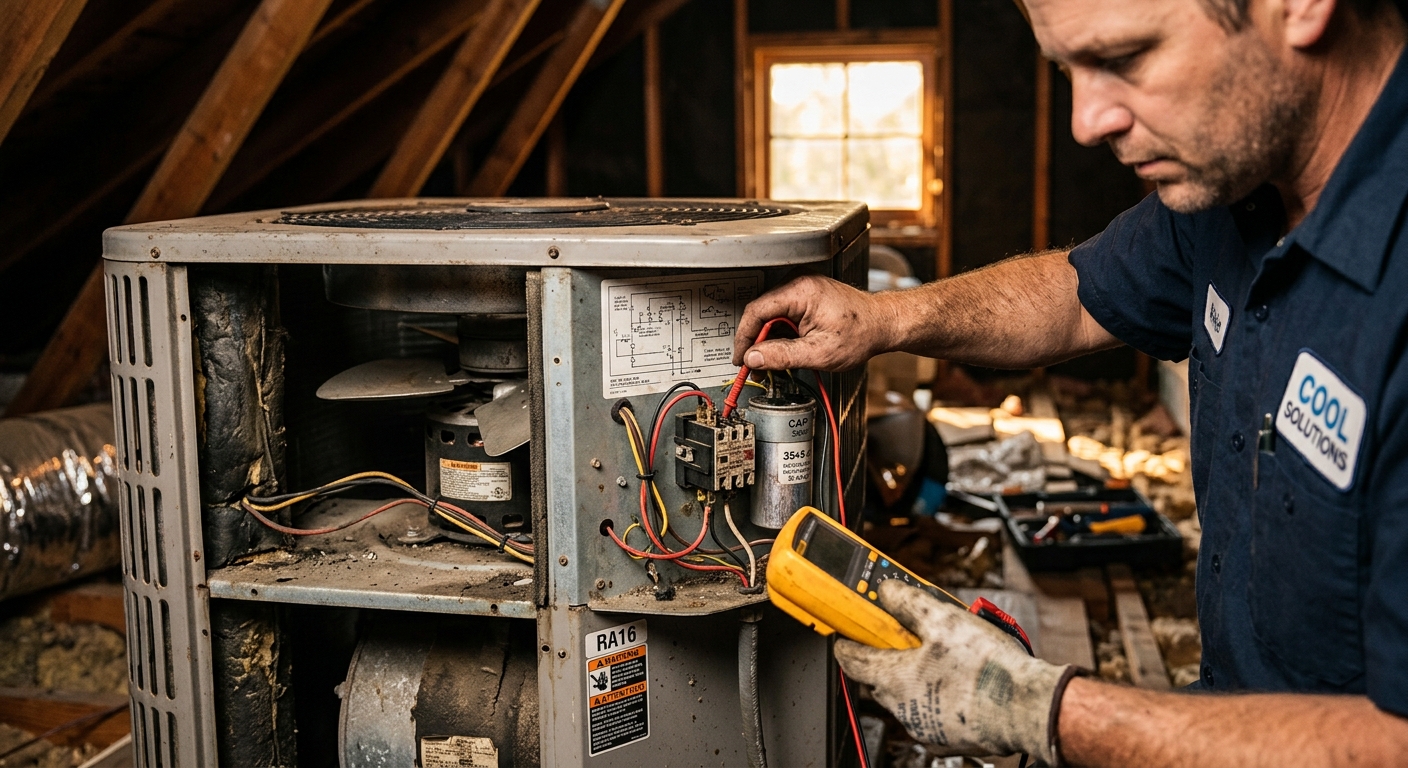
- Locate the capacitor (a silver cylinder inside the electrical compartment). Look for a top that is bulging or has brown residue around it – both are signs of failure. If you have a capacitor tester or multimeter with capacitance mode, test it against the rating printed on the label. A failed capacitor ($10 to $30) is one of the top causes of clicking-then-no-start symptoms and is a straightforward replacement if you label the wire connections with tape before disconnecting.
- Go to the air handler or furnace inside. Remove the blower access panel and inspect the blower wheel for dust buildup. A clogged blower wheel causes imbalance, vibration, and a low rumbling sound. Clean the fins with a stiff brush and vacuum. While the panel is open, check that the blower motor mounts are tight – loose mounts amplify vibration significantly.
- Inspect visible ductwork in the basement, crawlspace, or attic for sections that have separated or that vibrate against joists. Re-secure loose sections with metal HVAC tape (not standard duct tape, which fails within 2 years) and add foam pipe insulation under any duct that rattles against a wood beam.
- Document the sound before calling. Record a 30-second video on your phone with audio while the AC is running. Send it to the HVAC company when you book – many technicians can pre-diagnose from audio and arrive with the likely parts, reducing the visit to one trip.
- Request a full system tune-up alongside the diagnostic if the unit has not been serviced in over 12 months. A tune-up typically includes refrigerant level check, coil cleaning, electrical connection tightening, capacitor test, and lubrication – running $80 to $175 and addressing multiple noise sources in one visit.
- Ask the technician to check refrigerant charge using manifold gauges, not just a visual inspection. Low refrigerant causes hissing sounds, reduced efficiency, and eventual compressor damage. EPA Section 608 requires a licensed technician to handle and recharge refrigerant – this is not a DIY task.
- If the technician recommends a compressor replacement on a system older than 12 years, ask for the cost of a full system replacement as a comparison. A new compressor on an aging system often costs $1,200 to $2,500, while a new 16 SEER2 system starts around $4,000 to $7,000 installed – but comes with a 10-year warranty and 20 to 30% better efficiency.
- After the repair, ask for a written summary of what was found, what was fixed, and the refrigerant charge level (in pounds or ounces). This documentation is useful for warranty claims and helps the next technician understand your system’s history.
Why It Works: The Benefits
Compressors cost $1,200 to $2,800 to replace and are often the end-of-life trigger for an entire system. Identifying refrigerant leaks, low airflow, or electrical faults early keeps stress off the compressor and can extend system life by 5 or more years.
A system struggling with a dirty coil, failing motor bearing, or refrigerant loss can consume 10 to 25% more electricity to deliver the same cooling. Fixing the root cause of an abnormal sound often brings energy use back to baseline, saving $30 to $90 per month in peak summer for an average home.
Many of the conditions that create strange noises also reduce how much cold air your system delivers. Fixing a clogged filter, frozen coil, or failing blower motor can restore 15 to 30% of lost cooling output and eliminate hot spots in the home.
HVAC emergency service calls cost $150 to $300 just for the after-hours dispatch fee, before any parts or labor. Catching a warning sound at the start of the season means you can schedule non-emergency service and save 30 to 50% on the total repair cost.
Some sounds – especially grinding compressors in systems over 15 years old – signal that repair costs will exceed the value of the unit. Diagnosing the noise accurately helps you make a replace-vs-repair decision with real information rather than guessing or being sold an unnecessary full replacement.
💰 Savings Impact by Action
Cleaning a dirty condenser coil reduces head pressure and restores 5 to 10% of lost cooling efficiency by allowing proper heat rejection.
Replacing a clogged filter restores airflow, reducing blower energy use by up to 15% and preventing coil icing that can cut cooling output by 30%.
Correcting a 10% refrigerant undercharge restores up to 20% of lost cooling capacity and reduces compressor runtime proportionally.
Addressing a failing motor or electrical component before full failure avoids the 20 to 25% efficiency loss of a system compensating for a degraded part.
Sealing duct separations that cause rattling noises can recover 20% of conditioned air lost before it reaches living spaces.
🏠 Key Concepts Explained
The Science Behind It
Air conditioners are vapor-compression refrigeration systems, which means they rely on a refrigerant cycling through precise pressure states to absorb heat indoors and release it outside. Every major component in that cycle – the compressor, condenser fan, evaporator coil, expansion valve, and blower motor – operates within a narrow mechanical tolerance. When any component begins to wear, lose lubrication, lose refrigerant charge, or accumulate debris, the system has to compensate by working harder. That extra effort almost always produces sound: higher motor speeds, vibration, turbulent refrigerant flow, or electrical arcing in relays.
Sound travels predictably from its source in HVAC systems, which makes it a reliable diagnostic tool. A noise from the outdoor unit points to the condenser fan, compressor, or refrigerant circuit. A noise from the indoor air handler points to the blower motor, evaporator coil, or ductwork. A noise at the vents points to airflow restriction or duct resonance. The physics of rotating machinery also means that a small imbalance – one bent fan blade, one worn bearing – creates vibration that compounds at operating speed, which is why a small problem in April becomes a loud problem in July after 400 hours of runtime.
Refrigerant-related sounds have a distinct thermodynamic cause. When refrigerant leaks, suction pressure drops, causing the remaining refrigerant to expand more aggressively across the expansion valve – producing a hissing or gurgling sound. The compressor, now moving less mass per cycle, runs hotter and at reduced efficiency. Studies from Lawrence Berkeley National Laboratory show that a system undercharged by just 10% loses approximately 20% of its cooling capacity, meaning the compressor runs far longer to maintain setpoint – accelerating wear on every mechanical component simultaneously.
Frequently Asked Questions
▼ My AC makes a loud banging noise when it first starts up but then runs quietly. Is that serious?
A single loud bang at startup is often the ductwork popping as it pressurizes – especially in homes with older flex duct or thin sheet metal. However, if the bang comes from the outdoor unit itself, it can mean a loose component in the compressor or a broken internal mounting spring, both of which require a technician before they cause total compressor failure. Turn the system off and record the location of the sound to describe it accurately when you call.
▼ There’s a high-pitched squealing sound coming from inside near the air handler. What is it?
Squealing from the air handler almost always points to the blower motor belt (on older belt-drive systems) slipping or the motor bearings failing on direct-drive units. Check first whether your system has a belt visible when you open the blower compartment – a cracked or glazed belt costs $10 to $25 and takes about 30 minutes to replace. If the motor itself is making the sound, lubrication ports on older motors can be oiled with 2 to 3 drops of non-detergent electric motor oil ($5), but if the bearing is fully seized you will need a motor replacement ($150 to $400 installed).
▼ Why does my AC make a hissing or bubbling sound near the outdoor unit?
Hissing from the refrigerant lines or outdoor unit strongly suggests a refrigerant leak, which requires a licensed HVAC technician to locate, repair, and recharge – you cannot legally or safely add refrigerant yourself. Turn off the system to avoid running the compressor dry of refrigerant oil (which travels with the refrigerant), and schedule service within a day or two. A hissing sound that only occurs at shutdown is less urgent and may just be refrigerant equalizing pressure across the system, which is normal.
▼ The AC clicks repeatedly when trying to start but does not actually turn on. What should I check first?
Repeated clicking with no startup is the classic symptom of a failed run capacitor, which is what gives the motors the extra electrical kick they need to reach operating speed. Look at the capacitor inside the outdoor unit’s electrical compartment for a bulging or leaking top. If you have a multimeter with capacitance mode, test it against the rating on the label – a reading more than 6% below rated value means it has failed. Capacitors cost $10 to $30 and replacing one is a manageable DIY task if you are comfortable with basic electrical work and discharge the unit properly first.
▼ Can a new noise mean my AC is actually working better, not worse?
Rarely, but it can happen after a maintenance visit where a technician adjusted refrigerant charge, cleaned coils, or replaced a component – the system may sound slightly different as it runs more efficiently at correct pressures. A new sound after professional service is worth a quick call to the HVAC company to confirm it is expected. In all other cases, an AC that sounds different than it did at the end of last season is signaling a change in mechanical condition that should be investigated.
Quick Tips
- Run your AC for 10 minutes at the start of each cooling season before you actually need it, so you can identify any new sounds in calm conditions rather than on the first hot day when you need the system working immediately.
- A rattling sound that disappears after the first 30 seconds of operation is often just a loose sheet metal panel vibrating at startup speeds. Check all access panel screws on both the indoor and outdoor units before calling for service.
- Ice on the refrigerant lines or indoor coil always means shut down and investigate – running a frozen system forces the compressor to work against liquid refrigerant instead of vapor, which causes catastrophic internal damage within hours.
- If your AC short-cycles (turns on and off every few minutes without reaching setpoint), that behavior is a sound diagnostic on its own: it usually points to an oversized system, a refrigerant problem, or a dirty coil rather than a thermostat issue.
Variations for Your Situation
- Apartment or Renter: If you rent and notice a new AC sound, document it with a video and submit a written maintenance request immediately – in most states, HVAC problems that affect habitability require landlord response within 24 to 48 hours. You can safely replace the air filter yourself (usually $8 to $15 with landlord notification) and clear blocked vents at no cost, but do not attempt to open any panels on the unit. For window AC units you own, the DIY approach applies in full.
- Tight Budget (under $50): Start with the free steps: clear debris from the outdoor unit, check and replace the filter ($10 to $15), unblock all vents, and listen carefully to locate the sound. A $25 multimeter from a hardware store lets you test the capacitor yourself and potentially avoid an $85 to $150 service call. If the problem is beyond a filter or capacitor, get one diagnostic quote and ask explicitly what breaks if you wait 30 days – some repairs are urgent and some are not.
- Older Home (pre-1990 system): Systems over 15 years old are more likely to be belt-drive air handlers, use older R-22 refrigerant (now phased out and expensive at $50 to $100 per pound), and have ductwork that has degraded significantly. A new sound in an older system deserves a full diagnostic rather than just a targeted repair, because one failing component often signals that others are near the end of life. Ask the technician for an honest system assessment and get a replacement quote alongside any repair quote so you can compare the true cost of each option.