Every summer afternoon, your walls, floors, ceilings, and furniture absorb heat. After sunset, they release it back into your living space, which is why a house can feel stuffy at 10 p.m. even when it is 70 degrees outside. Meanwhile your air conditioner keeps running to fight heat that you could simply let out the door.
Night flush cooling (also called night ventilation or nocturnal cooling) flips that script. When outdoor air drops below your indoor temperature, you move that cool air through the house, pull the stored heat out of the structure, and start the next morning with a pre-chilled home. Close things up before the sun climbs and that cool “thermal battery” can delay or reduce your AC use well into the afternoon.
This post covers how the technique works, which climates benefit most, and two practical approaches: a free quick fix using box fans and open windows, and a DIY whole-house fan upgrade that automates the process. You will also find troubleshooting answers, variations for renters and older homes, and honest guidance on when night flushing will not help.
What You’ll Need
Click on an item below to shop for the recommended items for this recipe on Amazon.
As an Amazon Associate, we earn from qualifying purchases.
How to Do It
- Check the evening forecast. Start flushing when the outdoor temperature drops at least 3 to 5 degrees F below the indoor temperature, usually between 8 and 10 p.m. in summer.
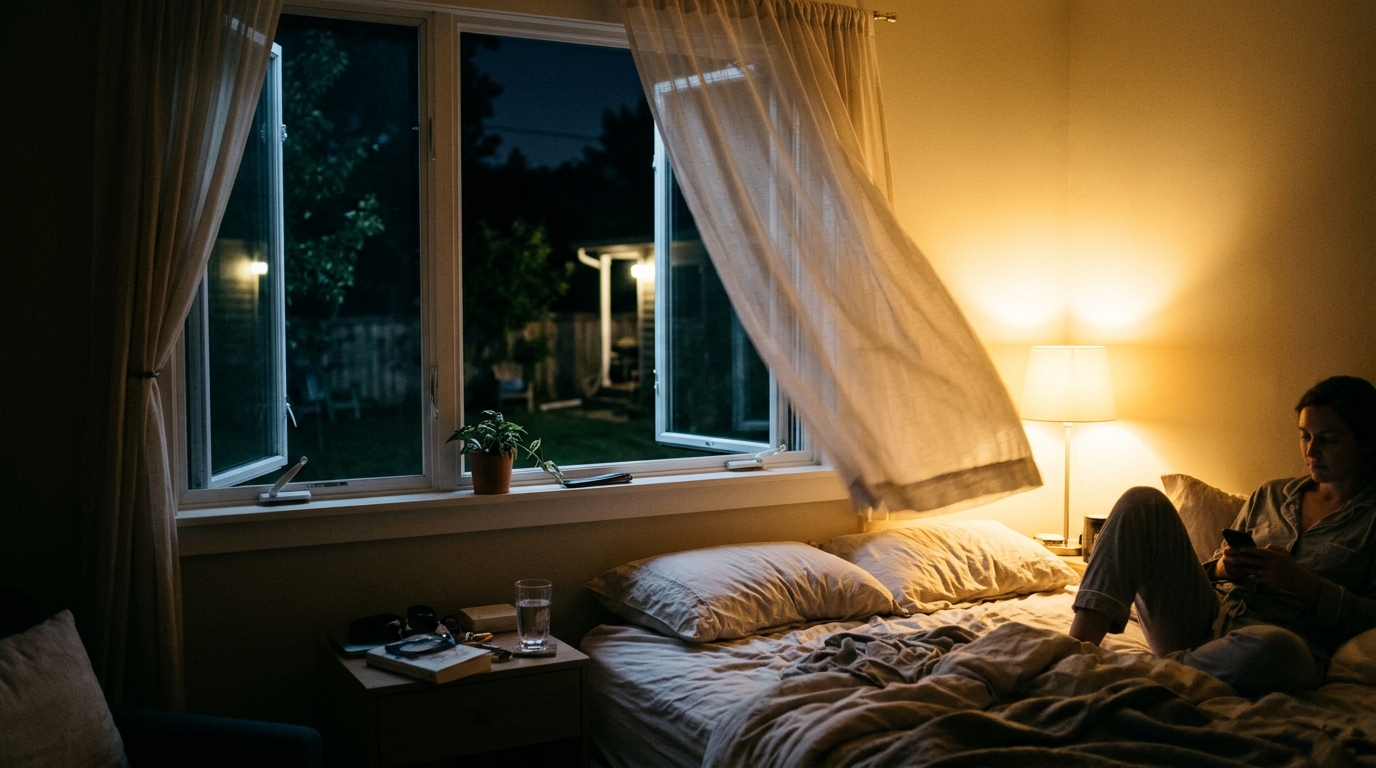
- Open windows on the cool side of the house (typically the shaded or north side) a few inches, and open windows on the opposite side or upper floor slightly wider to create a cross-breeze path.
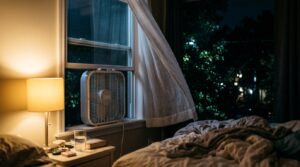
- Place a box fan or window fan in an upstairs window or the window farthest from the entry point, facing outward, so it pulls cool air in through the other windows and pushes hot air out.
- Open interior doors along the airflow path so air can sweep through every room, including bedrooms where you will sleep.
- Leave the fan running through the night or until the indoor temperature settles close to the outdoor temperature. Use a plug-in timer if you worry about leaving it on.
- At first light, before outdoor temperatures climb, turn off the fan and close all windows, blinds, and curtains on sun-facing sides to trap the cool air inside.
- Size the fan: aim for 15 to 20 air changes per hour. Multiply your home’s conditioned square footage by 8 (ceiling height) and by 15 to 20, then divide by 60 to get the CFM you need. A 2,000 sq ft home typically needs a fan rated for 4,000 to 5,000 CFM.
- Confirm your attic has enough free vent area. You need at least 1 square foot of net free vent area per 750 CFM of fan capacity (so roughly 6 square feet for a 4,500 CFM fan), or the fan will struggle and may backdraft.
- Choose a central hallway ceiling location, ideally on the top floor, and cut the opening between joists following the manufacturer’s template. Frame the opening if a joist must be modified.
- Mount the fan and insulated, sealing damper or shutter so it closes tightly in winter and when not in use. Quality models include an insulated cover that prevents heat loss in cold months.
- Wire the unit to a dedicated switch or timer, ideally one with a multi-speed control. Have a licensed electrician handle new circuits or panel connections.
- Operate it in the evening with several windows open (opening size roughly equal to the fan’s required attic vent area), and always open windows before turning on the fan to avoid backdrafting combustion appliances.
Why It Works: The Benefits
Pre-cooling the structure can delay AC startup by 3 to 6 hours on mild days, trimming cooling costs by 10 to 30% depending on climate and home construction.
A whole-house fan uses 100 to 700 watts, compared to 2,000 to 4,000 watts for a central AC system. That is roughly 5 to 10 times less electricity per hour of cooling.
Falling asleep in a house that is steadily cooling toward 68 to 72 degrees F beats a stuffy bedroom retaining the day’s heat. Moving air also increases evaporative comfort on skin.
Shifting cooling to nighttime lowers your use during expensive afternoon peak hours. On time-of-use rate plans, this can cut costs further, with afternoon rates often 2 to 3 times higher than overnight rates.
Flushing the house also dilutes indoor pollutants, cooking odors, and VOCs that build up in tightly sealed homes.
💰 Savings Impact by Action
In regions with 20+ degree F daily temperature swings, night flushing can reduce cooling energy by 20 to 30%.
In moderate climates with 10 to 15 degree F swings, expect about 10 to 20% cooling savings on suitable nights.
A whole-house fan can use about 85% less electricity per hour than a central AC system.
Delaying AC startup by several hours moves usage away from peak rate periods and can cut time-of-use costs by about 25%.
🏠 Key Concepts Explained
The Science Behind It
Night flush cooling works because buildings have thermal mass, the ability of materials like drywall, wood framing, tile, and furniture to absorb and store heat. During the day, that mass soaks up solar gain and warm indoor air. If you do nothing at night, the stored heat slowly radiates back out, keeping indoor temperatures elevated well past sunset and forcing your AC to remove it later.
When you ventilate with cooler outdoor air, you transfer heat from the warm structure to the moving air stream by convection, then expel it outside. The larger the temperature difference between the interior surfaces and incoming air, and the faster the air moves, the more heat you remove. This is why a 20 degree F diurnal swing is so valuable: a 90 degree F afternoon followed by a 65 degree F night gives you a strong driving force for heat transfer.
The next morning, the house starts cooler, so it can absorb additional heat before indoor temperatures climb into discomfort. Typically that delays AC use by several hours. The technique has limits: in humid climates where nights stay warm and sticky (think the Gulf Coast or Southeast in July), the dew point matters more than temperature, and night flushing can raise indoor humidity and increase the next day’s cooling load. DOE and Building America research consistently shows the best results in dry or mixed-dry climates with large daily temperature swings.
Frequently Asked Questions
▼ Why is my AC still running all day even after I tried night flushing?
Check the dew point and morning closing time first. If nights stay above 65 to 70 degrees F or humidity is high, flushing will not remove enough heat and may add moisture. Also make sure you shut windows and block sun-facing glass before outdoor temperatures pass your indoor temperature, usually by 8 a.m.
▼ Can renters do this without landlord permission?
Yes. Box fans and window fans require no modification to the unit. Use a tension-mounted or adjustable window fan, place a thermometer by the window to track conditions, and open windows on opposite sides for cross-ventilation. Whole-house fans are not renter-friendly since they require cutting into the ceiling.
▼ How long before I actually notice savings on my bill?
With a quick fix, you will feel cooler mornings the first day and see the effect on your next utility bill, typically 5 to 15% lower in dry climates with big temperature swings. A whole-house fan usually shows 15 to 30% cooling savings over a season, with payback in 1 to 3 years depending on usage and electricity rates.
▼ What if my home is older than 30 years?
Older homes often have leakier envelopes and less insulation, which means they heat up faster but also flush faster. Night flushing can help significantly, but prioritize attic insulation (R-38 or higher) and air sealing so the cool air you capture is not lost by midday. Confirm attic ventilation is adequate before installing a whole-house fan.
▼ Is it safe to leave windows open all night?
Safety depends on your neighborhood and window type. Use window locks or window-limiting stops that allow a 4 to 6 inch opening, install screens, and consider opening second-floor or high windows instead of ground-level ones. A whole-house fan lets you flush with fewer or smaller openings since it moves air more aggressively.
Quick Tips
- Check the hourly forecast and only flush when the outdoor temperature is at least 5 degrees F below your indoor temperature and the dew point is under about 60 to 65 degrees F.
- Open windows in the rooms you want coolest, like bedrooms, and run the fan from the opposite end so air sweeps through the whole home.
- Use ceiling fans on low speed during flushing to pull stale warm air down and out from upper levels.
- Pair night flushing with daytime solar control: close blinds and curtains on sun-facing windows and use reflective window film to keep the pre-cooled air from heating back up.
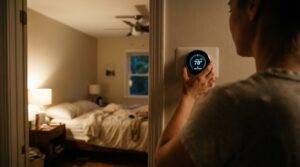
- Set your smart thermostat to a higher cooling setpoint (78 to 80 degrees F) on mornings after a good flush so the AC stays off longer.
Variations for Your Situation
- Apartment/Rental: Use a pair of adjustable window fans (about $30 to $50 each) in opposite windows, one blowing in and one blowing out, to create cross-ventilation. Pair with blackout curtains ($20 to $40 per window) or removable reflective window film to hold the cool air in during the day.
- Tight Budget (under $50): Open windows on opposite sides after sunset, place a single box fan ($25 to $40) in the window facing out, and add a $10 plug-in timer. Close everything at sunrise and draw the curtains. This zero-to-low-cost routine often captures most of the benefit.
- Older Home (pre-1980): Expect faster heat gain and loss. Add attic insulation to R-38 and seal obvious gaps before investing in a whole-house fan. Older homes with balloon framing or leaky ducts often benefit from fans because they have plenty of makeup air pathways. Always check combustion appliances for backdraft risk.