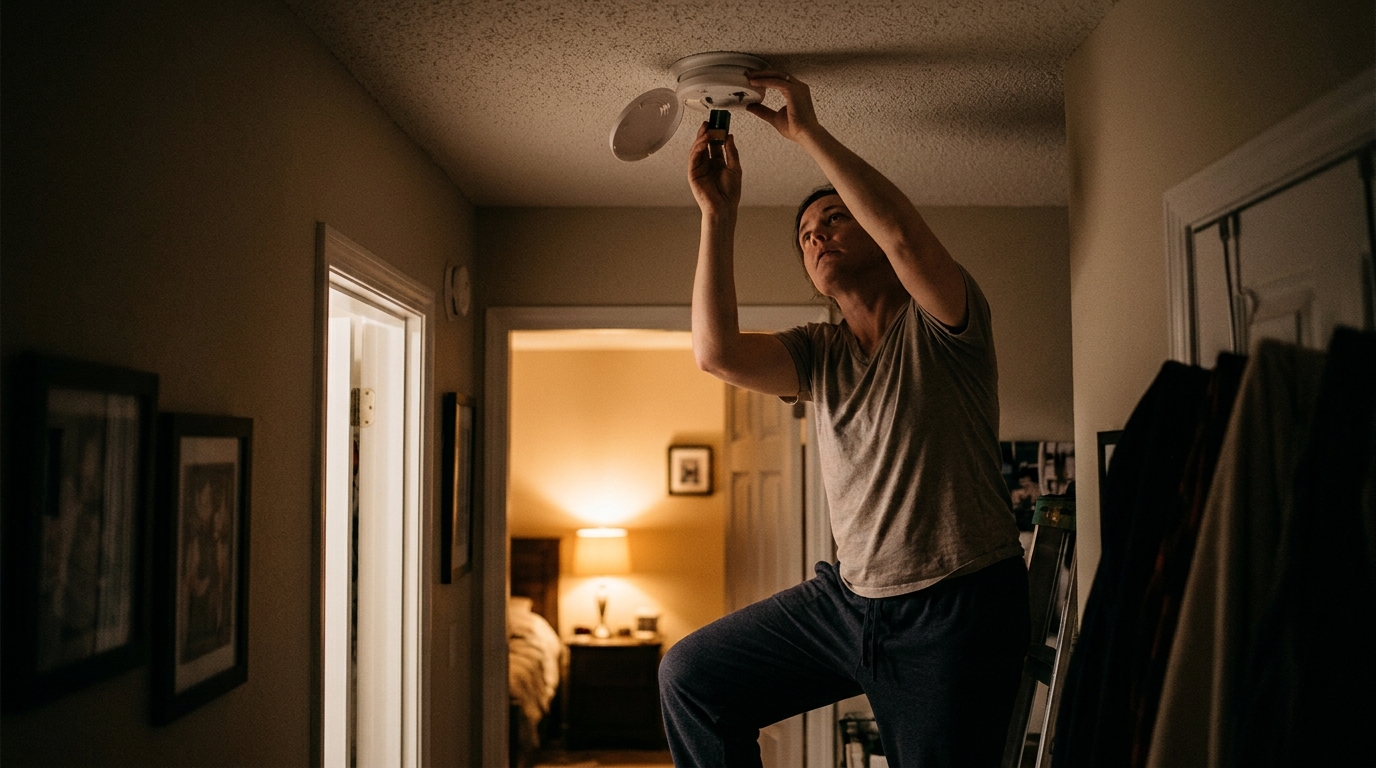
It is 3 a.m., the house is silent, and then it happens: one sharp chirp from somewhere in the ceiling. You lie there waiting for the next one. It comes about 30 to 60 seconds later. You are now awake, and you will stay that way until you find the culprit. If this sounds familiar, you are in good company. Smoke alarm chirping is one of the most common nighttime household annoyances, and the timing is not a coincidence.
The chirp is your detector’s low-battery warning, and it shows up at night because of how batteries behave in cooler temperatures. As your home cools down overnight, often by 3 to 8 degrees Fahrenheit, a battery that is nearly depleted can no longer deliver enough voltage to keep the alarm happy. The detector responds by chirping. By midmorning, when the house warms up, the battery recovers just enough voltage to go quiet again, which makes the problem seem to vanish and return on its own.
In this post, we will explain exactly why the chirp strikes at night, walk through a quick fix you can do in minutes, and cover a more thorough upgrade for detectors that keep chirping after a battery swap. Beyond the peace and quiet, this is also a safety issue. A chirping detector that gets ignored or disconnected is a detector that will not protect your family when it matters.
What You’ll Need
Click on an item below to shop for the recommended items for this recipe on Amazon.
As an Amazon Associate, we earn from qualifying purchases.
How to Do It
- Identify which detector is chirping. Stand under each one and listen, or look for a flashing LED. In multi-alarm homes, interconnected units can make the sound seem to come from everywhere.
- Twist the detector counterclockwise off its mounting bracket. If it is hardwired, unplug the wiring connector from the back.
- Remove the old battery and hold the test button for 15 to 20 seconds. This drains residual charge and clears the stored low-battery signal.
- Install a fresh, name-brand battery (alkaline or lithium, as specified by the manual). Check that the contacts are clean and the battery sits snugly.
- Reattach the detector, press the test button, and confirm you hear the full alarm. Wait a few minutes to be sure the chirp does not return.
- Check the manufacture date printed on the back of each detector. Any unit older than 10 years should be replaced regardless of whether it works.
- Buy replacements that match your setup. For hardwired homes, choose a model with a 10-year sealed lithium battery backup, which eliminates battery swaps and low-battery chirps entirely.
- Turn off power at the breaker, remove the old detector, and disconnect the wiring harness.
- Connect the new unit’s harness, mount it to the existing bracket (or install the new bracket), and restore power.
- Test every detector in the home. Interconnected alarms should all sound when you press one test button.
- Write the install date on the back of each unit with a permanent marker so you know exactly when to replace it.
Why It Works: The Benefits
Fixing the root cause ends the chirping cycle permanently, rather than the temporary quiet you get from ignoring it or pulling the battery.
Working smoke alarms cut the risk of dying in a home fire by roughly half, according to the National Fire Protection Association. A chirping unit that gets disabled provides zero protection.
A fresh battery runs $2 to $5, and a full replacement detector runs $10 to $25. Compare that to the cost of a sleepless week or a disabled alarm.
Using the right battery type and resetting the unit properly typically prevents the problem for 6 to 12 months, instead of the 2 to 3 weeks you get from a rushed swap.
Knowing the manufacture date and testing monthly means you are not guessing whether your alarms will work in an emergency.
💰 Savings Impact by Action
Correctly resetting and using the right battery type cuts premature replacements by about 30 percent over a year.
Switching to 10-year sealed lithium detectors eliminates roughly 90 percent of annual battery purchases and chirp events.
Working smoke alarms cut the risk of dying in a home fire by roughly half, per NFPA data.
🏠 Key Concepts Explained
The Science Behind It
A smoke detector’s battery has to do more than simply be ‘charged.’ The unit continuously compares battery voltage against a built-in threshold, usually around 7.2 volts for a 9-volt battery. When voltage falls below that line, the circuit triggers the periodic chirp that tells you to act. The key is that battery voltage is not fixed. It changes with temperature, load, and age.
In a cooler environment, the electrochemical reactions inside an alkaline or carbon-zinc battery slow down. A fresh battery handles this with ease because it has plenty of margin. A battery near the end of its life has almost no margin left, so a modest temperature drop is enough to push its output below the threshold. That is why the chirp often begins late at night or in the early morning, the coldest part of the day, and fades after sunrise as the house and battery warm up.
Detectors also sit in one of the more temperature-variable spots in the home: high on a wall or ceiling, where warm air collects during the day and heat escapes quickly at night, particularly under attic spaces or near exterior walls. This microclimate effect can make the detector’s local temperature swing farther than your thermostat reading suggests, which amplifies the nighttime chirp pattern.
Frequently Asked Questions
▼ I replaced the battery and it is still chirping. Why?
Most often the detector holds residual charge that has not been cleared. Remove the battery, hold the test button for 15 to 20 seconds, then reinstall a fresh battery. If it still chirps, check the manufacture date. A unit over 10 years old is signaling end of life and needs full replacement.
▼ Why does only one detector chirp when I have several interconnected alarms?
Interconnected alarms share the alarm signal but not the low-battery warning. Each unit monitors its own battery, so the chirp is coming from the single detector with the weakest power. Listen closely or look for a blinking LED to find it.
▼ Can renters fix a chirping smoke detector without landlord permission?
Replacing a battery is generally fine and expected, since it is routine maintenance. If the detector is hardwired and still chirps after a battery swap, or it is more than 10 years old, notify your landlord in writing. Many states require landlords to maintain working alarms.
▼ How long should a new battery last before it chirps again?
A quality alkaline 9-volt battery typically lasts 6 to 12 months in a smoke detector. Lithium batteries last up to 10 years and are worth the extra cost in hard-to-reach locations. If a fresh battery dies in a few weeks, the detector itself may be faulty.
Quick Tips
- Replace batteries at the same time every year on a memorable date, such as daylight saving changes, so you never wait for the chirp.
- Buy batteries from a reputable brand and check the expiration date on the package, since old stock can already be partially drained.
- Test every detector monthly by holding the test button until it sounds, and vacuum dust from the vents at least twice a year.
- Install detectors at least 10 feet from cooking appliances and away from bathroom steam to cut down on nuisance alarms that get mistaken for chirps.
Variations for Your Situation
- Apartment/Rental: Replace the battery yourself ($2 to $5) since it is basic maintenance, and keep the receipt. If the unit is hardwired and keeps chirping, or is clearly older than 10 years, send your landlord a dated written request rather than swapping the unit yourself, since alarm replacement is usually their responsibility.
- Tight Budget (under $50): Focus on the battery swap and reset for $2 to $5 per detector, plus a vacuum pass to clear dust from the vents. Skip full replacements unless a unit is past its 10-year date, and buy batteries in multi-packs to cut the per-battery cost.
- Older Home (pre-1980): Many older homes have outdated or too few detectors, and some still rely on ionization-only models that are slower to detect smoldering fires. Consider upgrading to combination photoelectric and ionization units with 10-year sealed batteries, and add detectors inside every bedroom and on every level.