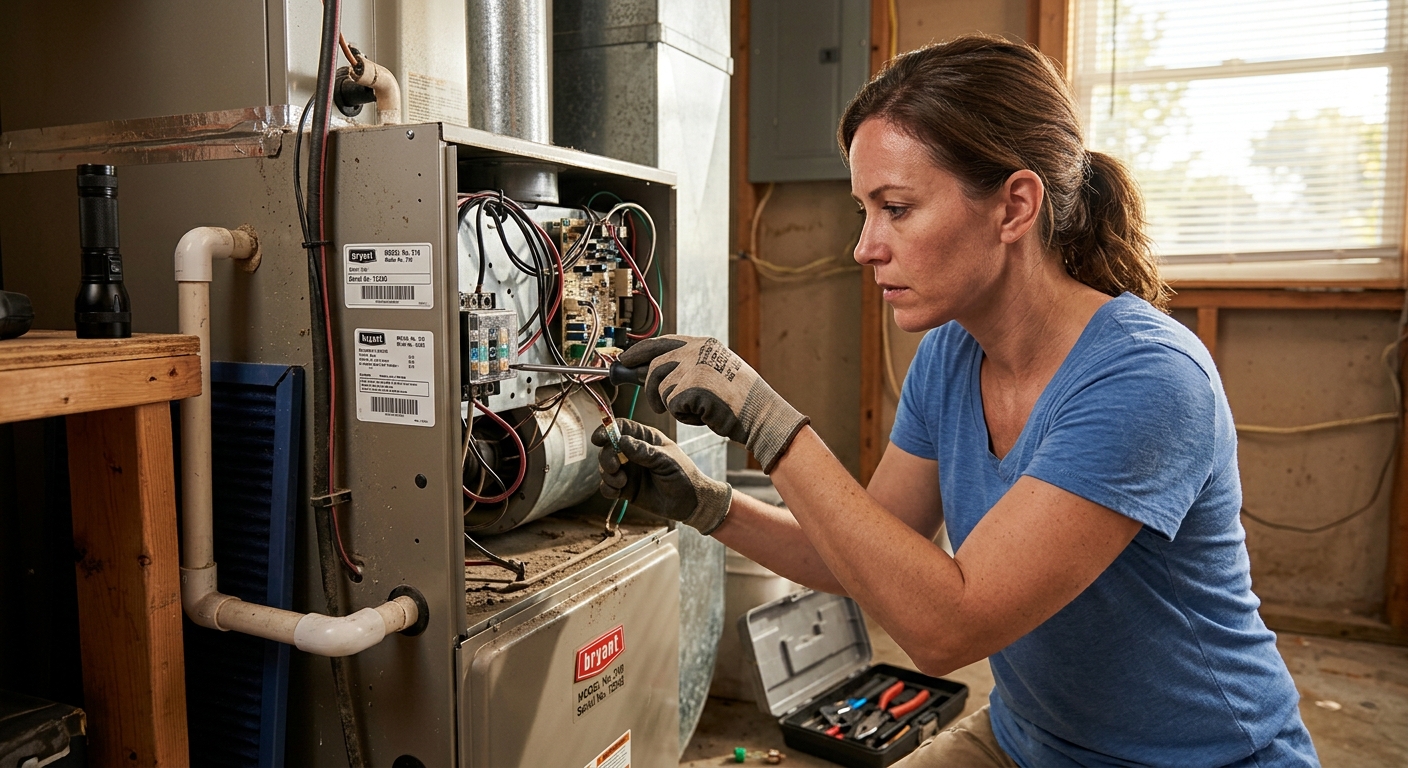
Your AC dies on the hottest day of the year. It happens more often than you’d think, because air conditioners work hardest precisely when outdoor temperatures push into the 90s and 100s, stressing every component in the system. What you do in the first 30 minutes can mean the difference between a quick reset and a $3,000 compressor replacement.
Beyond the discomfort, extreme indoor heat is a real health risk. The CDC reports that heat-related illness becomes dangerous when indoor temperatures exceed 90°F for sustained periods, especially for elderly residents, young children, and anyone with cardiovascular or respiratory conditions. Acting fast is not just about comfort, it is about safety.
This guide walks you through three concrete actions to take the moment your AC stops working, covering zero-cost resets, DIY checks any homeowner can do safely, and the signs that tell you it is time to call a professional before the situation gets worse.
What You’ll Need
Click on an item below to shop for the recommended items for this recipe on Amazon.
As an Amazon Associate, we earn from qualifying purchases.
How to Do It
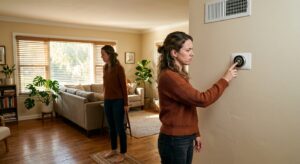
- Step 1: Check the thermostat. Confirm it is set to COOL (not FAN or HEAT), that the temperature setpoint is at least 3 to 5 degrees below the current room temperature, and that the batteries are not dead. A blank thermostat screen almost always means dead batteries, not a system failure.
- Step 2: Check your electrical panel for a tripped breaker. Your AC will have a dedicated 15 to 50 amp double-pole breaker labeled AC, Air Handler, or Compressor. A tripped breaker sits in the middle position, not fully OFF or fully ON. Switch it fully OFF, wait 30 seconds, then switch it firmly back ON. Wait 5 minutes before judging whether the system has restarted.
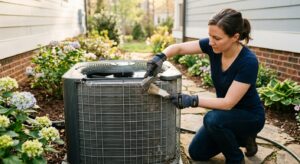
- Step 3: Go outside and inspect the condenser unit. Check that the disconnect box on the wall beside the unit has not been switched off. Look at the condenser fan on top: if the compressor is humming but the fan is not spinning, turn the system off immediately at the breaker to prevent compressor damage, and call a technician. If the unit is running but the air blowing out feels only warm (not hot), suspect low refrigerant and call a pro.
- While you wait or work: close all south and west-facing blinds immediately, turn off ovens, dishwashers, and dryers, and set ceiling fans to spin counterclockwise (forward in summer) to push cool air down. These steps alone can slow indoor temperature rise by 3 to 8°F per hour.
- Check and replace the air filter. A collapsed or severely clogged filter is one of the top causes of frozen coils and low airflow. Pull the filter from your air handler or return vent, hold it up to light, and replace it if you cannot see light through it. A fresh MERV 8 filter costs $8 to $20 and takes 2 minutes to swap.
- Check for a frozen evaporator coil. Open the air handler access panel (usually a removable door on the indoor unit). If you see ice on the copper refrigerant lines or on the coil itself, the coil is frozen. Turn the system to FAN ONLY mode (not cool) and let it thaw for 2 to 4 hours. Do not run it in COOL mode with a frozen coil.
- While the coil thaws, check all supply and return vents in your home. Make sure none are blocked by furniture, rugs, or closed dampers. Restricted return airflow is the primary cause of coil freezing and it is 100% free to fix.
- After thawing, replace the filter if you have not already, restart the system in COOL mode, and check that the evaporator coil area feels cold (not icy) within 20 minutes. If the coil refreezes within an hour of restarting, you have a refrigerant problem that requires a licensed HVAC technician.
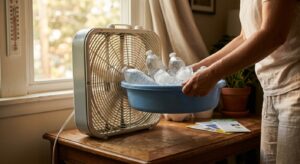
- Set up portable fans in a cross-ventilation pattern to manage heat while you wait. Place one box fan blowing outward in a north-facing window and open windows on the opposite side of the house to pull in cooler outside air, but only do this if outdoor temperature is below indoor temperature, typically in the early morning or after sunset.
- If outdoor temperature is above 85°F and the AC cannot be restored within 2 hours, identify a cooling center, a neighbor, or a hotel as a backup plan, especially if household members are over 65, under 5, or have medical conditions.
- Call immediately if: the compressor hums but the fan does not spin, the circuit breaker trips again within an hour of being reset, you hear grinding or banging noises from the outdoor unit, or the system blows warm air and the refrigerant lines are not cold to the touch.
- Call the same day if: the coil refreezes within 1 to 2 hours of restarting after a thaw, your system is over 12 to 15 years old and has not been serviced in more than a year, or you smell burning from the air handler.
- When you call, describe: the outdoor unit behavior (fan spinning or not, noises), whether the system runs at all or is completely dead, how old the system is, and what the thermostat display shows. This helps the dispatcher prioritize and send the right technician with the right parts.
- Ask for an estimate before authorizing repair. Compressor replacement on a system over 12 years old often costs $1,500 to $2,500. If the system is approaching 15 years old, a full replacement at $4,000 to $8,000 may be a better investment, especially with federal tax credits of up to $600 for high-efficiency systems under current IRA provisions.
- While waiting for the technician: implement all heat management steps from the quick fix approach, keep interior doors open to distribute any remaining cooler air, and check on vulnerable household members every 30 to 60 minutes.
Why It Works: The Benefits
Emergency HVAC service during a heat wave can cost $200 to $600 just for the visit fee. Up to 30% of no-cool calls are traced to tripped breakers, dirty filters, or thermostat issues that a homeowner can resolve in under 30 minutes at zero cost.
A professional technician may not be available for 24 to 72 hours during a regional heat wave. Diagnosing and fixing a tripped breaker or thawing a frozen coil yourself can restore cooling the same day, hours before a technician could arrive.
Indoor temperatures above 90°F sustained for more than 2 hours pose real health risks for vulnerable household members. Acting immediately to reduce heat gain, improve airflow, and restore cooling cuts indoor peak temperatures by 10 to 20°F compared to doing nothing.
Running a struggling AC system with a frozen coil, blocked condenser, or low refrigerant can burn out the compressor, turning a $150 service call into a $1,500 to $3,000 repair or full system replacement.
A home that has been heat-managed during an AC outage (shades closed, fans running, heat sources off) will cool back to 72°F in 1 to 2 hours after the system restarts, versus 3 to 5 hours in a home that was left unchecked.
💰 Savings Impact by Action
Roughly 30% of emergency no-cool service calls are resolved by actions a homeowner can do in under 30 minutes, including breaker resets, thermostat fixes, and filter replacements.
Replacing a clogged air filter restores airflow and can improve system efficiency by 10 to 15%, directly reducing runtime and monthly cooling costs.
Closing blinds and eliminating internal heat sources during an outage slows indoor temperature rise by up to 20%, buying critical time for repairs.
A clean outdoor condenser coil improves heat rejection efficiency by 10 to 16%, reducing strain on the compressor and lowering the risk of heat-wave failures.
Catching a failing capacitor or low refrigerant before full breakdown reduces total repair cost by 25 to 60% by preventing compressor damage.
🏠 Key Concepts Explained
The Science Behind It
Your air conditioner works by exploiting a fundamental law of thermodynamics: when a liquid refrigerant evaporates into a gas, it absorbs a large amount of heat from its surroundings. Inside your home, refrigerant flows through the evaporator coil in its liquid state, absorbs heat from your indoor air, and evaporates. The now-gaseous refrigerant travels outside to the condenser, where it is compressed back into a liquid and releases that captured heat into the outdoor air. The fan blowing over the outdoor condenser is literally dumping your home’s heat outside.
This cycle depends on airflow at both ends. Indoors, the blower fan must push enough air across the evaporator coil. If airflow drops too low (due to a clogged filter, closed vents, or a failed blower motor), the coil gets too cold and ice forms, which further blocks airflow in a self-reinforcing spiral. Outdoors, the condenser must reject heat into outside air. When ambient temperatures are above 95°F, heat rejection becomes harder and the system must work at higher pressures, stressing the compressor. This is precisely why AC failures spike during heat waves: the system is running at its maximum load against its worst operating conditions.
Electrical failures compound the problem. AC compressors draw a large startup surge current (often 4 to 6 times the running current) every time they cycle on. During a heat wave, the compressor cycles on and off more frequently, each time drawing that surge. Combined with elevated grid voltage fluctuations from regional demand spikes, this can trip thermal overload protectors and circuit breakers that are functioning exactly as designed. Understanding this helps you interpret what you see: a tripped breaker is not always a sign of something broken. It is often a sign that a component got too hot and the system protected itself.
Frequently Asked Questions
▼ My AC is running but the house won’t cool down. Is it broken?
Not necessarily. First check that all vents are open, the filter is clean, and the thermostat is set correctly. If outdoor temperatures are above 100°F, a standard AC system may only be able to maintain indoor temperatures 20 to 25 degrees below outdoor air, meaning 78 to 80°F indoors on a 100°F day is actually normal operation. If the system is running continuously and cannot get within 20 degrees of outdoor temperature, call a technician to check refrigerant charge and coil condition.
▼ My breaker keeps tripping every time I reset the AC. What should I do?
Stop resetting it and call a licensed electrician or HVAC technician. A repeatedly tripping breaker almost always indicates a real electrical fault: a failing capacitor, a struggling compressor drawing excess current, a wiring short, or an undersized circuit. Continuing to reset it risks overheating the wiring or damaging the compressor beyond repair. This is a situation where DIY stops and a professional call is the right move.
▼ How do I know if my AC is frozen without opening the unit?
Touch the large copper refrigerant line (the insulated one) coming out of your air handler. It should feel cold and slightly wet with condensation, but not icy or frosted over. If you feel actual ice on the line, the coil inside is frozen. You can also check your supply vents: airflow that drops to nearly nothing despite the system running is a strong sign of a frozen coil blocking the air path.
▼ Can I use window AC units or portable units as a backup while I wait for repair?
Yes, and this is often the right call during a multi-day wait. A single 8,000 to 12,000 BTU window unit costs $150 to $300 and can keep one or two rooms comfortable. Prioritize the bedroom and any room where vulnerable household members spend time. Portable AC units work similarly but cost more and are less efficient. Return them after your central system is repaired or keep one as a long-term backup.
▼ My AC just started working again on its own. Should I still call a technician?
Yes, you should at least schedule a non-emergency checkup within the next few weeks. A system that fails and spontaneously restores has likely tripped a thermal overload that reset after cooling down. This is a warning sign of an underlying issue: a dirty condenser, a struggling capacitor, or low refrigerant causing the system to run harder than it should. Addressing it now costs $100 to $300 and prevents a full breakdown on the next hot day.
Quick Tips
- Keep your condenser coils clean every spring. A quick rinse with a garden hose (system off, spraying from inside out) removes the debris that builds up all winter and makes heat rejection 10 to 20% more efficient.
- Change your air filter every 60 to 90 days (monthly if you have pets). A $12 filter prevents the majority of DIY-solvable AC failures, including frozen coils and blower motor overheating.
- Install a smart thermostat with AC diagnostics. Devices like ecobee or Nest detect when your system runs longer than expected to reach setpoint, alerting you to declining performance weeks before a full failure.
- Keep a spare air filter in the house at all times, especially before summer. During a heat wave, hardware stores frequently sell out of common filter sizes within hours of widespread AC failures.
Variations for Your Situation
- Apartment/Rental: You cannot service the central HVAC yourself, so your first call should be to your landlord or property manager, documented in writing by text or email for a legal record. While you wait, deploy a window AC unit in your bedroom (most leases permit these) for around $150 to $250, and use blackout curtains on sun-facing windows to slow heat gain. If indoor temperature exceeds 90°F and the landlord has not responded within a few hours, contact your local housing authority, as many jurisdictions legally require landlords to maintain habitable temperatures.
- Tight Budget (under $50): Your most impactful zero-cost actions are closing all window coverings on south and west exposures, turning off every heat-generating appliance (oven, dishwasher, dryer, desktop computers), and moving household members to the lowest floor where cooler air naturally settles. For under $30, a 20-inch box fan placed in a window blowing outward (when outdoor air is cooler than indoor) is more effective than most people expect. A fresh air filter for $10 to $20 should be your only paid expenditure since it resolves the most common DIY-fixable failure.
- Older Home (pre-1980): Homes built before 1980 typically have more air leakage, less insulation, and single-pane windows, meaning indoor temperatures rise faster and stay higher during an AC outage. Prioritize getting people and pets out of upper floors immediately, as heat stratification in poorly insulated older homes can produce temperature differences of 15 to 25°F between the ground floor and second floor. Also note that older systems may use R-22 refrigerant (Freon), which is no longer manufactured and costs $50 to $150 per pound for reclaimed supply. If your technician finds a refrigerant leak on an R-22 system, replacement is almost always more cost-effective than repeated recharging.