Most homeowners never think about what’s happening beneath their floors, but your crawl space could be silently responsible for hundreds of dollars in wasted energy every year. Gaps around pipes, missing insulation, open vents, and a bare dirt floor create the perfect conditions for conditioned air to escape and outdoor air to infiltrate your living space. The U.S. Department of Energy estimates that crawl spaces account for up to 15 to 25% of a home’s total heat loss in colder months, and that number climbs even higher in humid climates where moisture compounds the problem.
The frustrating part is that crawl space energy loss is nearly invisible. You won’t see it the way you’d notice a drafty window or a leaking pipe. Instead, you’ll feel it as cold floors in winter, uneven room temperatures, a musty smell creeping into your home, and a heating and cooling bill that never seems to drop no matter what else you do. These are all symptoms of the same root cause: an unconditioned, uncontrolled crawl space that is directly connected to your living area through every gap, joist bay, and subfloor crack above it.
This post walks you through exactly what’s going wrong beneath your home, how to diagnose the severity of the problem, and two practical approaches to fix it ranging from a weekend DIY project to a professional encapsulation system. We’ll cover real costs, real payback periods, and the building science that explains why these fixes work so well.
What You’ll Need
Click on an item below to shop for the recommended items for this recipe on Amazon.
As an Amazon Associate, we earn from qualifying purchases.
How to Do It
- Clear access to the crawl space and do a thorough visual inspection. Look for open foundation vents, gaps around pipes and wires penetrating the subfloor, missing or fallen batt insulation, and any signs of standing water or active moisture damage. Do not proceed if you find active water intrusion or significant mold, as both require professional remediation first.
- Seal all penetrations in the subfloor above and at the rim joists using canned spray foam for gaps under 3 inches and backer rod plus caulk for larger irregular gaps. Pay special attention to where plumbing pipes, electrical conduit, and HVAC ducts pass through the framing, as these are typically the largest air leakage sites.
- Cut rigid foam insulation boards (minimum R-10, preferably R-15) to fit snugly against the interior of the rim joist bays all the way around the perimeter of the crawl space. Seal the edges of each piece with spray foam. This alone can reduce total home air leakage by 5 to 15% and is one of the highest-return insulation steps in any home.
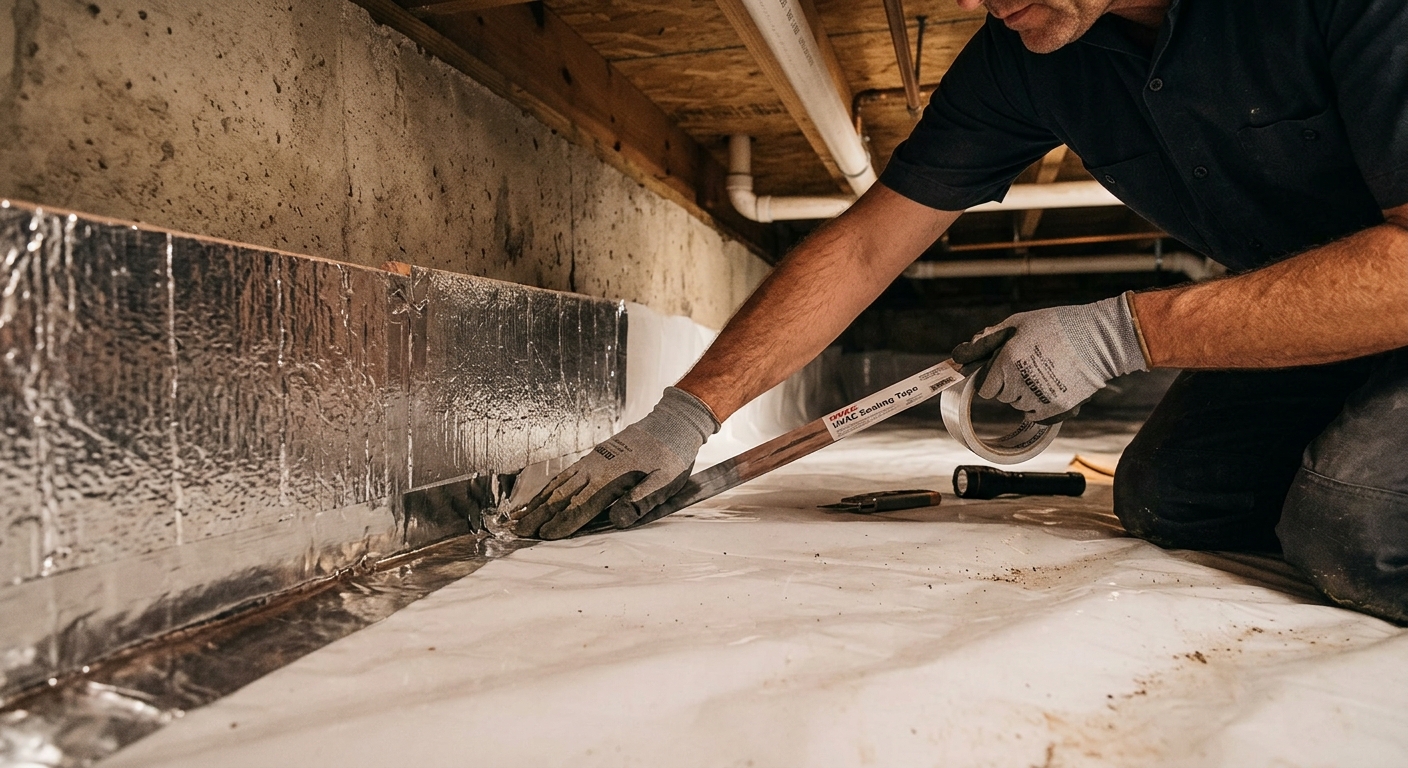
- Install a 6-mil polyethylene vapor barrier across the entire ground surface, overlapping seams by at least 12 inches and taping seams with a purpose-made seam tape rated for below-grade use. Run the barrier up the foundation walls at least 6 inches and secure it with construction adhesive or mechanical fasteners. This is a minimum spec; 10-mil or reinforced barriers last significantly longer.
- If batt insulation between the floor joists above is missing or has fallen, reinstall it with the facing toward the living space (facing up), secured with wire insulation supports spaced every 18 inches to prevent sagging. Do not compress the batts, as compression reduces R-value proportionally.
- Check that any remaining foundation vents close properly in winter months. In vented crawl spaces, keeping vents closed from November through March and open during the warm season reduces cold air intrusion significantly, though a fully encapsulated space performs better year-round.
- Hire a building performance contractor or crawl space specialist for an assessment. Ask specifically for a blower door test before and after to quantify air leakage improvements, and request that they check for radon if you are in a radon-prone area, since encapsulation changes how gases accumulate beneath the home.
- The contractor will install a heavy-duty reinforced vapor barrier (typically 12-mil to 20-mil) across the entire floor and up the foundation walls, sealed airtight at all seams, penetrations, and wall transitions using appropriate tape and adhesive. Quality encapsulation systems include a manufacturer warranty of 15 to 25 years.
- Rigid foam insulation (typically closed-cell spray foam or foam board) is applied to the interior of the foundation walls at R-10 to R-15 minimum, replacing the floor joist insulation approach. This brings the crawl space thermal boundary to the foundation rather than the subfloor, which performs significantly better in both heating and cooling seasons.
- All foundation vents are permanently sealed as part of the encapsulated system. Building codes in most states allow this provided the space is conditioned or mechanically ventilated. The contractor will either connect a small supply from your HVAC system or install a standalone dehumidifier rated for the crawl space square footage to maintain humidity below 60%.
- Duct connections and HVAC equipment in the crawl space are inspected and sealed using mastic (not tape) at all joints. If duct leakage is found to be significant, duct remediation is completed as part of the project, which can add $500 to $1,500 but dramatically improves the energy return on the overall investment.
- After installation, the contractor should provide a post-project blower door result and a humidity monitoring plan. Request a written summary of what was done, the materials used, and any warranty documentation for the vapor barrier and mechanical components.
Why It Works: The Benefits
Sealing and insulating a crawl space typically reduces annual heating and cooling costs by 15 to 25%, which translates to $150 to $300 per year for a home with average utility bills of $1,200 to $1,500 annually.
Insulating the crawl space floor system or encapsulating the space and conditioning it brings floor surface temperatures 5 to 10 degrees Fahrenheit closer to room temperature, eliminating the cold-floor discomfort that many homeowners mistakenly attribute to poor heating.
A properly installed ground vapor barrier reduces moisture evaporation from soil by up to 90%, lowering crawl space relative humidity from the 70 to 90% range common in unprotected spaces down to 50 to 60%, which is below the threshold where mold and wood rot actively grow.
Rooms directly above a sealed and insulated crawl space typically see temperature swings reduced by 3 to 6 degrees, because the floor is no longer acting as a heat sink. This reduces the runtime required from your HVAC system and improves comfort throughout the home.
High humidity in crawl spaces accelerates corrosion on HVAC equipment, ductwork connections, and metal fasteners. Controlling moisture through encapsulation can meaningfully extend the service life of duct systems and air handlers located in or near the crawl space.
💰 Savings Impact by Action
Sealing the rim joist bays with rigid foam and spray foam reduces whole-home air leakage by 5 to 15%, cutting heating and cooling load by up to 10% depending on the home’s baseline leakage.
A properly installed ground vapor barrier reduces soil moisture evaporation by up to 90%, lowering crawl space humidity and restoring effective insulation R-value that moisture degradation had reduced by 20 to 36%.
Professional encapsulation of the crawl space walls and floor reduces annual heating and cooling costs by 15 to 25% by eliminating thermal bridging, air infiltration, and moisture-driven insulation degradation simultaneously.
Sealing leaky HVAC ducts in the crawl space with mastic recovers 20 to 30% of conditioned air that was previously escaping into the unconditioned space before reaching living areas.
Properly installed and secured floor joist insulation at R-19 to R-30 reduces conductive heat loss through the floor assembly by 15 to 20% compared to an uninsulated floor above a vented crawl space.
🏠 Key Concepts Explained
The Science Behind It
Your crawl space sits in a critical location in your home’s thermal and pressure envelope. The stack effect, which is the tendency of warm air to rise and exit through the upper levels of a home, creates a zone of negative pressure at the lower levels. That negative pressure actively pulls air in from the crawl space through every crack, gap, and pipe penetration in your subfloor, carrying cold air in winter and humid air in summer directly into your living areas. This is not a slow passive process; on a cold winter day with a 30-degree temperature difference between inside and outside, the pressure differential across your floor assembly can be substantial enough to drive meaningful airflow even through small gaps.
The moisture physics in an unprotected crawl space compound the energy problem significantly. Soil is never truly dry. Even in arid climates, the ground beneath your home contains moisture that continuously evaporates upward at a rate that can exceed one gallon per hundred square feet per day. That water vapor raises the relative humidity of the crawl space air to levels where it condenses on cold framing, degrades the thermal resistance of fiber insulation by as much as 36% at 75% relative humidity, and creates conditions favorable for mold growth and wood decay. Wet insulation is not just less effective, it becomes a structural liability over time.
Full encapsulation works so well because it addresses all three heat transfer mechanisms simultaneously. It blocks conduction by insulating the foundation walls and reducing the temperature difference across the floor assembly. It blocks convection by eliminating the vented air pathway and sealing all penetrations. And it controls radiation and moisture by creating a sealed vapor barrier that prevents ground moisture from entering the air mass beneath your home. When the crawl space air is conditioned or dehumidified to match indoor conditions, the floor above effectively becomes a non-event from an energy standpoint, and your HVAC system only has to condition the living space it was designed for.
Frequently Asked Questions
▼ I insulated my crawl space but my floors are still cold. What did I miss?
Cold floors after insulation almost always point to one of two issues: air movement is bypassing the insulation, or the insulation has sagged and lost contact with the subfloor. Check that your rim joists are sealed with rigid foam, not just batts, since batts alone do not stop airflow. Also confirm that the insulation is flush against the subfloor above and secured with wire supports every 12 to 18 inches. If both look correct, the issue may be that the vented crawl space is still allowing wind-washing through the batts, and switching to a wall-insulated encapsulated approach will give you the improvement you expected.
▼ How do I know if my crawl space problem is bad enough to justify the cost of professional encapsulation?
Three indicators point strongly toward professional encapsulation: first, if your crawl space consistently reads above 70% relative humidity in multiple seasons, DIY vapor barriers often cannot control that level of moisture adequately. Second, if you have HVAC equipment or significant ductwork in the crawl space, the energy return on encapsulation is dramatically higher because you are bringing the mechanical systems inside the thermal boundary. Third, if your home is in climate zones 4 through 7 (most of the northern and central US) and your annual heating and cooling bills exceed $1,800, the math on professional encapsulation typically pencils out within five to seven years.
▼ Can I just close my foundation vents permanently without doing the full encapsulation?
Closing vents without controlling moisture is risky and not recommended. Foundation vents were intended to flush moisture out of the crawl space, and while research shows this approach works poorly in humid climates, simply sealing the vents without a vapor barrier and humidity control can trap moisture and accelerate wood rot. If you want to close the vents permanently, you must pair that with a complete ground vapor barrier and either a conditioned air supply or a standalone dehumidifier to maintain relative humidity below 60% year-round.
▼ I found mold in my crawl space. Can I still do the DIY sealing approach?
Small areas of surface mold (under 10 square feet) on framing can sometimes be treated with a biocide and encapsulating paint before sealing, but any active mold covering more than 10 square feet, or any mold on insulation materials, should be professionally remediated before you seal anything. Encapsulating over active mold does not kill it; it creates a sealed environment where mold can continue to spread unseen and damage structural framing. Get a mold inspection first, then proceed with the crawl space improvements once the moisture source and existing growth are properly addressed.
▼ Will crawl space improvements affect my indoor air quality as well as my energy bills?
Yes, often dramatically. Because of the stack effect, 30 to 50% of the air in your lower living level on a given day has previously passed through or near your crawl space. Musty odors, elevated indoor humidity, and elevated concentrations of soil gases including radon can all be traced back to an uncontrolled crawl space. Homeowners frequently report that musty basement or first-floor smells disappear entirely after encapsulation, and indoor humidity levels often drop 5 to 10 percentage points without any change to HVAC settings.
Quick Tips
- Use a humidity monitor ($15 to $30) inside your crawl space for two to four weeks before starting any work. If readings consistently exceed 70%, address the moisture source before adding insulation or you risk trapping it.
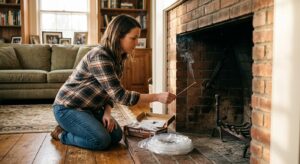
- Tape a piece of tissue paper near the bottom of an interior wall or at a floor register on a windy day. If it flutters, you have significant air infiltration from below that is actively costing you money.
- In climates with hot, humid summers, do not leave foundation vents open during summer thinking it helps. Warm humid outdoor air enters the crawl space, hits cool surfaces, and condenses. Keeping vents closed and using a dehumidifier performs better in most humid climates.
- If you have HVAC ducts in the crawl space, use mastic sealant (a gray paste) rather than foil tape to seal joints. Mastic lasts decades without shrinking or peeling, while even good foil tape can fail within five to ten years in temperature-cycling environments.
Variations for Your Situation
- Tight Budget (under $300): Focus exclusively on the two highest-return steps: rim joist sealing with rigid foam board and spray foam ($80 to $150 in materials) and a basic 6-mil poly vapor barrier laid loosely on the ground and overlapped at seams ($50 to $100 for a 1,000 square foot crawl space). These two steps alone can deliver 60 to 70% of the energy benefit of a full encapsulation for roughly 5 to 10% of the cost. Skip the batt re-installation for now and prioritize stopping airflow and ground moisture first.
- Older Home (pre-1980): Homes built before 1980 often have balloon framing, which means the wall cavities run continuously from the crawl space to the attic with no blocking, creating a direct air chimney that multiplies the energy impact of crawl space infiltration. Before sealing the crawl space, locate and seal the wall bottom plates at the subfloor perimeter with spray foam. Also have the existing insulation tested for asbestos before removal, as vermiculite and some batt materials from this era may contain it. Budget an extra $100 to $300 for material testing and disposal if needed.
- High Humidity or Coastal Climate: In climate zones with consistently high outdoor humidity (Gulf Coast, Southeast, Pacific Northwest), a DIY vapor barrier and vented approach will frequently fail to control moisture adequately. In these climates, invest directly in a sealed encapsulation with a mechanical dehumidifier sized at 30 to 70 pints per day depending on crawl space square footage. A quality crawl space dehumidifier costs $250 to $600 and is the difference between a system that maintains 55% humidity and one that never drops below 75%. Consider a unit with a built-in hygrometer and automatic drainage rather than a manual bucket.