Winter energy bills catch most homeowners off guard. You crank up the thermostat, the furnace runs constantly, and somehow the house still feels drafty in the bedroom and stuffy in the living room. The reason is simple: heat does not escape your home uniformly. Your attic loses heat differently than your basement, your windows lose heat differently than your walls, and what works in the kitchen does not necessarily apply to the garage. Treating your home as one big energy problem leads to generic advice and underwhelming results.
The average U.S. household spends about $1,000 to $1,500 per year on heating, according to the U.S. Energy Information Administration. Studies from the Department of Energy show that air leakage alone accounts for 25 to 40% of heating energy loss in a typical home, and most of that leakage is concentrated in specific rooms and transition zones. Knowing where to focus your effort means you get far better savings per hour spent, whether you have 20 minutes or a full weekend.
This guide breaks your home into seven key zones: the attic and ceiling, living areas, bedrooms, kitchen, bathroom, basement and crawl space, and the garage. For each room, you will find the specific heat-loss mechanisms at work, the fastest free or cheap fixes, and the upgrades worth investing in. Real payback periods and savings percentages are included throughout so you can prioritize based on your budget and the time you have before the cold sets in.
What You’ll Need
Click on an item below to shop for the recommended items for this recipe on Amazon.
As an Amazon Associate, we earn from qualifying purchases.
How to Do It
- Attic hatch: Glue 2-inch rigid foam board to the back of the attic access panel and add adhesive foam weatherstripping around the frame. This single fix can save 3 to 5% on heating bills because the hatch is one of the biggest stack-effect entry points in the home.
- Thermostat setback: Program your thermostat to 68 degrees when home and active, 60 to 62 degrees overnight, and 60 degrees when away for 8 or more hours. Use the DOE benchmark of 10% savings per 8-hour setback period.
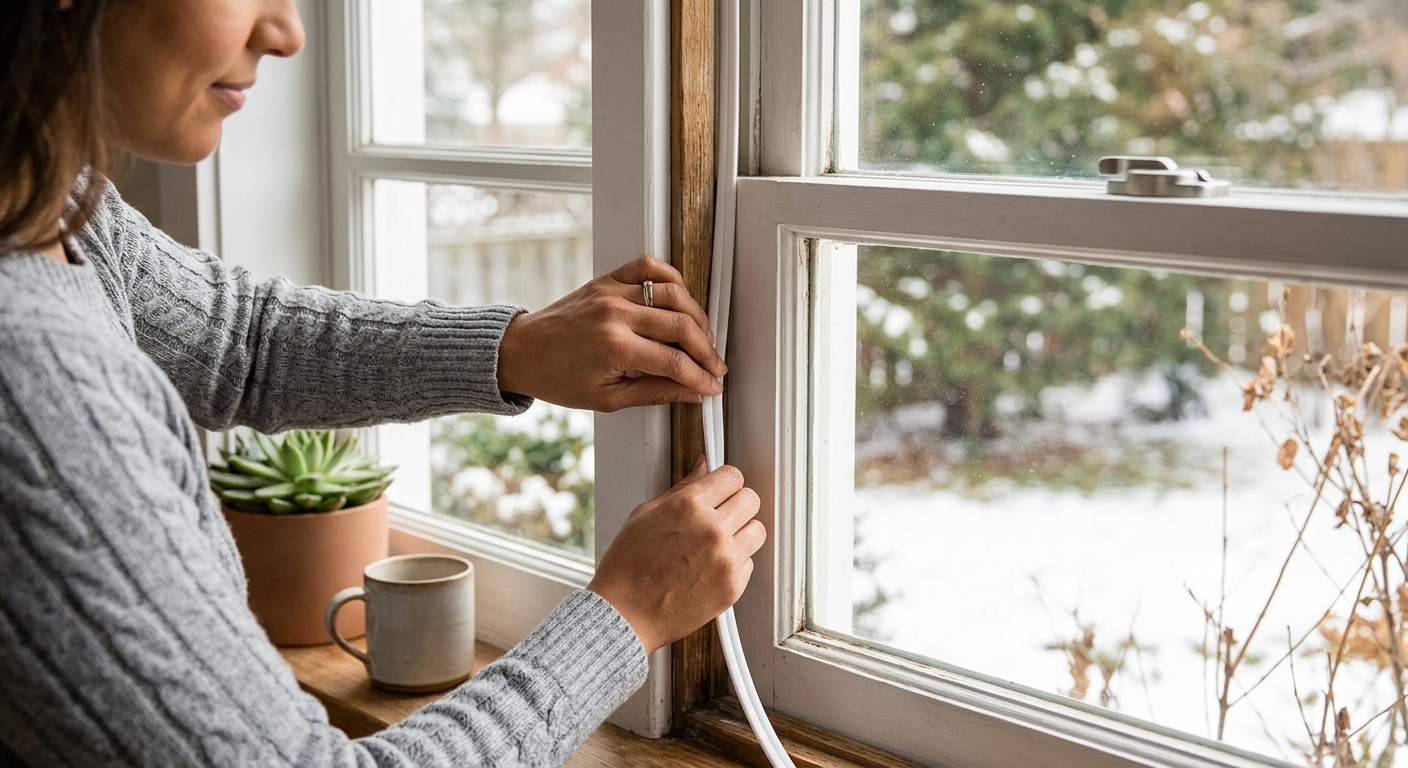
- Window and door draft check: Light a stick of incense near every window frame, exterior door frame, and electrical outlet on exterior walls. Mark drafty spots with painter’s tape, then apply rope caulk (removable at season end) to window gaps and self-adhesive foam weatherstripping to door frames.
- Basement rim joist inspection: Go to the basement and look for daylight or feel for cold air along the band of wood where the floor framing meets the foundation wall. Press pre-cut pieces of 2-inch rigid foam into those cavities and seal the perimeter with canned spray foam.
- Radiator or baseboard reflectors: If you have hot-water baseboard or cast-iron radiators, slide foil-faced reflector panels behind each unit. This directs radiant heat back into the room instead of into the wall, improving output by 10 to 15% per unit at zero operating cost.
- Ceiling fan reversal: Switch ceiling fans to run clockwise on the lowest speed setting. This pulls cool air up and pushes the warm air collected near the ceiling back down along the walls, reducing the temperature gradient between floor and ceiling by 2 to 4 degrees.
- Living areas: Install heavy thermal curtains (minimum two layers, floor to ceiling) on all north- and west-facing windows. Close them at sunset and open them on south-facing windows during daylight to capture passive solar gain. Thermal curtains reduce window heat loss by up to 25% compared to standard drapes.
- Bedrooms: Add door draft stoppers to all bedroom doors and apply V-strip weatherstripping to window sashes that rattle in the wind. Lower the bedroom thermostat zone or use a programmable window AC (in older homes with zone heating) to hold 65 degrees at night. The body sleeps better below 68 degrees, so this doubles as a comfort improvement.
- Kitchen: Seal the gap around the range hood duct penetration through the ceiling or exterior wall with fire-rated caulk or intumescent sealant. Replace the range hood damper if it no longer closes tightly; a stuck-open damper is a continuous source of heat loss equivalent to leaving a window cracked all winter.
- Bathrooms: Insulate the exhaust fan housing in the attic above each bathroom by setting a pre-formed rigid foam box over the fan (available at home centers for $15 to $25). Also caulk around the tub or shower surround where it meets the exterior wall, since that interior wall cavity often connects directly to the outside.
- Basement and crawl space: Install a 6-mil polyethylene vapor barrier across the entire crawl space floor, lapping it 12 inches up the foundation walls and taping seams. This alone can reduce ground-cold infiltration and moisture significantly. Follow up by insulating the crawl space walls with rigid foam if the space is semi-conditioned.
- Garage: If you have an attached garage, apply commercial-grade door bottom seals and jamb weatherstripping to the garage door, and add a door sweep to the door connecting the garage to the house. Seal all penetrations through the garage-to-house wall (pipes, wires, HVAC ducts) with fire-rated caulk or spray foam, since this wall is a major pathway for cold and carbon monoxide infiltration.
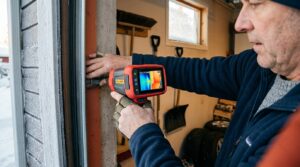
- Schedule a professional energy audit with a blower door test. A certified auditor will pressurize your home and identify every significant air leakage point with an infrared camera. The audit costs $200 to $400 and creates a prioritized punch list that prevents guesswork. Many utilities offer this service free or subsidized.
- Attic air sealing and insulation: Have a contractor seal all attic floor penetrations (top plates, electrical boxes, plumbing chases) with spray foam before blowing in cellulose or fiberglass to bring attic insulation to R-49 to R-60. This combined measure typically saves 15 to 25% on heating bills with a payback of 3 to 5 years, often shortened to 1 to 2 years with rebates.
- Smart thermostat installation: Replace your existing thermostat with an ENERGY STAR-certified smart thermostat (Ecobee, Nest, or similar). These devices use occupancy sensing and learning algorithms to optimize setbacks automatically. The DOE estimates 8 to 12% annual savings. Cost is $130 to $250 and most utilities offer a $50 to $100 rebate.
- Window replacement or secondary glazing: If you have single-pane windows, replacing them with double-pane low-E units reduces window heat loss by 30 to 50%. If full replacement is not in the budget, interior window insulation kits with a secondary acrylic or film layer cost $10 to $30 per window and deliver 30 to 40% of the benefit at a fraction of the cost.
- Rim joist spray foam by a contractor: A professional can spray two-component closed-cell foam into all rim joist cavities in an afternoon. Closed-cell foam at 2 inches achieves R-13 and acts as both an air barrier and vapor retarder. Cost is $500 to $1,500 for an average basement perimeter, with a payback of 2 to 4 years.
Why It Works: The Benefits
Homeowners who systematically air-seal and add insulation see heating bill reductions of 20 to 40%, translating to $200 to $600 in annual savings on a typical $1,200 heating budget.
Sealing the stack effect and adding insulation in key zones eliminates the cold-floor-hot-ceiling imbalance that forces homeowners to overheat one room to make another comfortable, which is a common source of wasted energy.
Every improvement to the building envelope means the furnace runs fewer cycles per day. Shorter run time reduces wear on the heat exchanger, blower motor, and igniter, extending equipment life by several years and deferring a $3,000 to $7,000 replacement.
Strategic air sealing reduces infiltration of outdoor pollutants, vehicle exhaust from attached garages, and ground gases like radon. When combined with controlled ventilation, tighter homes deliver cleaner indoor air throughout the heating season.
Energy-efficient homes consistently sell faster and at a premium. ENERGY STAR certified homes command 2 to 6% higher sale prices on average, and visible upgrades like smart thermostats and spray-foamed rim joists are positive selling points during inspections.
💰 Savings Impact by Action
Sealing attic floor penetrations and bringing insulation to R-49 reduces heating energy use by 15 to 25% in most climate zones.
Insulating and air-sealing basement rim joists with closed-cell spray foam eliminates a major stack-effect entry point, saving up to 10% on heating bills.
Programming a 7 to 10 degree setback for 8 hours per day saves approximately 10% annually on heating according to DOE data.
Replacing single-pane windows with double-pane low-E units or adding interior window film reduces window heat loss by 30 to 50%, contributing up to 15% total heating savings.
Comprehensive air sealing of all major leakage zones can reduce whole-home infiltration by 30 to 40%, cutting heating load by up to 20%.
🏠 Key Concepts Explained
The Science Behind It
Heat always moves from warm to cold through three mechanisms: conduction (direct contact through materials), convection (air moving heat from one place to another), and radiation (energy traveling as infrared waves through air or space). In a cold climate, all three mechanisms are working against you simultaneously. Your walls conduct heat outward through every stud and fastener. Your leaky envelope drives convective air loops that drag warm air out and pull cold air in. And your body radiates heat toward cold window glass just like it radiates heat toward an open freezer door.
The stack effect is the most powerful convective force at work in your home each winter. Since warm air is less dense than cold air, it rises continuously and pressurizes the upper half of the house. At the same time, the lower half of the house depressurizes, actively pulling in cold outside air through every crack in the foundation, basement walls, and floor system. The pressure difference can be surprisingly strong on very cold days, creating air movement equivalent to several windows being open at once. This is why sealing the attic floor and the basement rim joist together delivers the biggest combined return: you are cutting off both ends of the natural draft that drives infiltration.
Insulation works by trapping still air in small pockets, preventing convection within the material itself. The R-value system measures resistance to conductive heat flow per inch of material. Fiberglass batt at R-3.5 per inch and closed-cell spray foam at R-6 to R-7 per inch both slow conduction, but only spray foam also acts as an air barrier. This is why two inches of spray foam on a rim joist outperforms six inches of fiberglass batt in real-world performance: the foam eliminates both conduction and convection, while the batt only addresses conduction and still allows air to move through it.
Frequently Asked Questions
▼ I sealed my windows and doors but my heating bill barely changed. What am I missing?
Windows and doors are visible and easy to reach, but they are rarely the biggest sources of heat loss. The largest leakage points are typically the attic floor penetrations, basement rim joists, and recessed light cans on the top floor. Start your next session by using an incense stick or thermal camera to check the attic hatch, top-floor ceiling fixtures, and the band of framing around your basement perimeter. Fixing these areas often delivers 3 to 5 times more savings than window weatherstripping alone.
▼ My house feels cold even though the thermostat says 70 degrees. Why?
Perceived comfort depends on both air temperature and mean radiant temperature, which is the average temperature of all the surfaces surrounding you. Cold windows, exterior walls with poor insulation, and uninsulated slab floors can make a 70-degree room feel like 63 degrees. Adding thermal curtains, area rugs over cold floors, and door draft stoppers addresses the radiant and convective losses that cause this disconnect. If the problem is severe, consider an infrared thermometer scan of your walls and ceiling to find cold spots that indicate missing or settled insulation.
▼ Can I do all of these upgrades myself or do I need permits?
Air sealing, weatherstripping, insulation in existing cavities, and thermostat replacement generally do not require permits in most jurisdictions. Window replacement and any work involving the HVAC system, gas lines, or electrical panel typically does require a permit. When in doubt, call your local building department before starting, since unpermitted work on major systems can create problems at resale. A professional energy audit is always a smart first step because it identifies which measures will give you the best return before you spend money on materials.
▼ My home was built in the 1960s. Are these tips still relevant or is it too leaky to help?
Older homes actually benefit more from air sealing and insulation than newer construction because they start from a much higher baseline of energy waste. A 1960s home may have an infiltration rate of 1.5 to 2.5 ACH compared to 0.3 to 0.6 ACH for a modern home, which means there is proportionally more room for improvement. Prioritize the attic floor, rim joists, and any visible gaps around plumbing or wiring penetrations first. Even modest air sealing in a leaky older home can cut heating bills by 20 to 30% in the first season.
▼ How do I know if my insulation is already adequate before adding more?
In the attic, you can measure directly with a ruler. The DOE recommends R-49 to R-60 for most U.S. climate zones (zones 4 through 7), which corresponds to roughly 14 to 18 inches of blown cellulose or fiberglass. If you can see the tops of your attic floor joists, your insulation is definitely undersized. For walls, an infrared thermometer or a professional blower door test with thermal imaging is the most reliable way to identify gaps without opening up finished surfaces.
Quick Tips
- Check your heating filter first. A clogged MERV 8 filter increases static pressure, reduces airflow by up to 15%, and makes the furnace run longer to deliver the same heat. Replace filters every 60 to 90 days during heavy heating season.
- South-facing windows are free solar heaters on clear winter days. Open thermal curtains or blinds on south-facing glass by 9 a.m. and close them within 30 minutes of sunset to capture passive solar gain and then retain it overnight.
- Zone your heating by closing vents or using door draft stoppers in unused rooms. Reducing the conditioned volume of your home by 20 to 30% can meaningfully cut heating demand if you have a traditional forced-air system with manual dampers.
- Use a $15 infrared thermometer gun to scan outlet covers, switch plates, and baseboards on exterior walls. Any reading more than 5 degrees colder than the surrounding wall surface indicates air leakage behind that fixture, which is easily fixed with foam outlet gaskets available for about $5 per pack.
Variations for Your Situation
- Apartment or Rental: Renters cannot modify HVAC systems or add insulation, but there is still meaningful ground to cover. Use removable rope caulk on drafty window frames (it peels off cleanly in spring), add under-door draft stoppers, and hang heavy thermal curtains with tension rods (no drilling required). Plug-in smart thermostat accessories for baseboard heat systems cost $50 to $80 per unit and require no wiring. These combined steps can cut renter heating costs by 10 to 20% with zero permanent modifications.
- Tight Budget Under $50: Start with the four zero-cost or near-zero-cost moves that deliver the most return. First, reprogram your thermostat to 60 degrees overnight. Second, reverse your ceiling fans. Third, close interior doors to unheated or rarely used rooms and stuff a rolled towel at the base. Fourth, use an incense stick to find the single biggest draft source in the home and seal it with a $4 can of rope caulk or a $6 can of spray foam. These four actions alone can cut your heating bill by 10 to 15% before you spend a dollar on hardware.
- Older Home Pre-1980: Pre-1980 construction often lacks any vapor barrier, has open wall cavities that connect to the attic, and uses single-pane aluminum-framed windows. Prioritize in this order: attic air sealing before adding insulation (do not just pile on top of existing), rim joist foam insulation in the basement, and window interior insulation kits for the worst single-pane offenders. Avoid spray-foaming old balloon-framed walls from the exterior without professional advice, since these walls rely on their open cavities for drying and blocking them can trap moisture and rot the framing.