That cold breeze creeping past your ankles in January or the warm humid air sneaking in around your front door in August is not just a comfort problem – it is a money problem. The U.S. Department of Energy estimates that air leakage accounts for 25 to 40 percent of the energy used for heating and cooling in a typical home. That is a significant chunk of your utility bill escaping through gaps you could seal in a single afternoon.
Not all drafts are created equal, though. A draft near your window sill has a completely different cause than the cold floor you feel in your living room, and fixing the wrong one first wastes your time and money. There are four distinct types of drafts – infiltration leaks, window and door frame gaps, mechanical bypasses, and stack effect drafts – and each requires its own solution. Understanding which type you are dealing with is the first step toward actually solving the problem.
This post walks you through all four draft types, how to find them, and exactly what to do to stop each one. Whether you have 15 minutes or a free weekend, there are fixes at every level. Real savings numbers and payback periods are included so you know what to expect from your effort.
What You’ll Need
Click on an item below to shop for the recommended items for this recipe on Amazon.
As an Amazon Associate, we earn from qualifying purchases.
How to Do It
- Walk your home on a cold windy day and hold your hand near window frames, door frames, electrical outlets on exterior walls, and where baseboards meet exterior walls. Feel for moving air or temperature differences.
- Apply self-adhesive foam weatherstripping to the door stop on any exterior door where you can feel air movement when the door is closed. Cut to length and press firmly into the channel where the door contacts the frame.
- Install a door sweep on any exterior door with a visible gap at the bottom. Most sweeps screw onto the door face in under 10 minutes and immediately block the single largest draft point in most homes.
- Press foam gaskets behind the cover plates of electrical outlets and light switches on exterior walls. These $5 packs from any hardware store take two minutes per outlet and are one of the most overlooked fixes.
- Check your fireplace damper and make sure it closes fully. An open fireplace flue is equivalent to leaving a 48-square-inch hole in your ceiling. Close it when not in use and consider an inflatable chimney balloon for a tight seal.
- Buy a roll of incense sticks or a smoke pencil to find hidden leaks. Light one and slowly trace it around window frames, door frames, baseboards, attic hatches, plumbing penetrations, and any place two different building materials meet. Watch for the smoke to deflect or get pulled in.
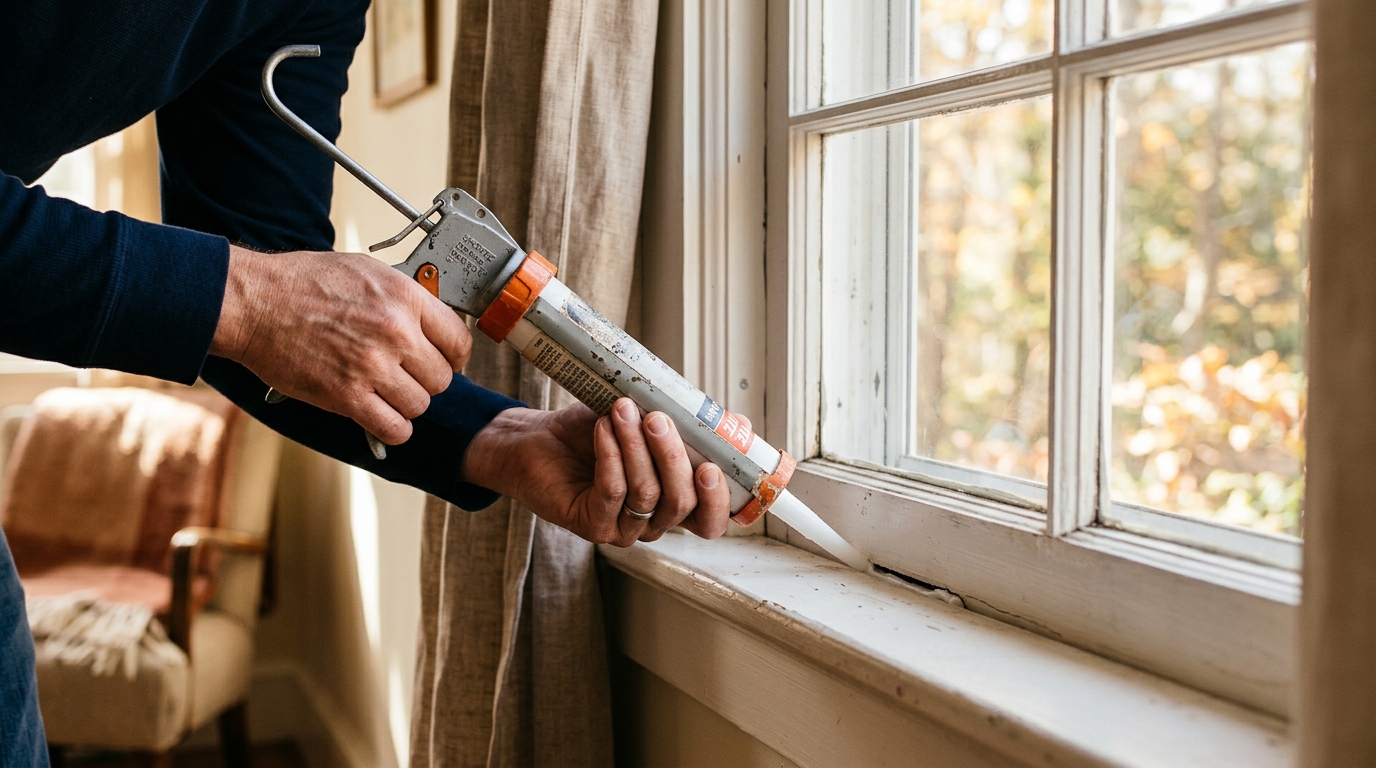
- Caulk all stationary gaps under 1/4 inch wide around window frames, door frames, and where the bottom plate of walls meets the subfloor. Use paintable latex caulk for interior finished surfaces and exterior-grade silicone for exterior applications. Cut the tip to a 1/8-inch opening for a clean bead.
- Use low-expansion spray foam (not the high-expansion type which can bow frames) to seal gaps larger than 1/4 inch around pipe penetrations, wire chases, recessed light fixtures in the ceiling, and where ductwork passes through walls or floors.
- Insulate and air-seal the attic hatch. This is consistently one of the top five leakage points in any home. Cut rigid foam board to fit the attic-side of the hatch, glue it on with foam adhesive, and add weatherstripping to the frame so it seals when closed.
- Replace or upgrade weatherstripping on all exterior doors. V-strip tension seal is more durable than foam and works well on the sides and top of door frames. Combine with an adjustable door sweep for full perimeter sealing.
- After completing the sealing work, do a final smoke-pencil pass on a windy day to confirm the problem areas are resolved. Check again after the first cold snap to catch any spots you missed.
- Schedule a home energy audit with a certified BPI or RESNET auditor. Many utility companies offer this free or at a subsidized cost of $100 to $200. Check your utility’s website for rebate programs before paying full price.
- During the blower door test, walk through the home with the auditor and mark every leak location. Pay attention to the attic floor, rim joists in the basement, and plumbing chases – these are the three largest hidden bypass categories.
- Request a detailed written report listing ACH50 (air changes per hour at 50 pascals of pressure), the locations of the top leakage points, and a prioritized list of recommended repairs with estimated savings.
- Have the auditor or a weatherization contractor seal the identified bypasses, focusing on the attic air barrier and rim joist first. These two locations alone often account for 30 to 40 percent of total air leakage in older homes.
- Schedule a follow-up blower door test after the work is complete to verify the improvement. Many rebate programs require this final test to qualify for incentives. A well-sealed home should target ACH50 below 3.0, with high-performance homes reaching below 1.0.
Why It Works: The Benefits
Thorough air sealing can reduce annual energy costs by 15 to 30 percent. A home spending $2,400 per year on utilities could save $360 to $720 annually from sealing alone.
Eliminating drafts removes the sensation of cold air movement, which makes a room feel several degrees warmer at the same thermostat setting – allowing you to dial back without losing comfort.
Every draft forces your furnace or AC to run longer cycles to maintain setpoint. Sealing leaks can shorten run times by 20 percent or more, extending the life of your equipment and reducing maintenance costs.
Uncontrolled air infiltration pulls in outdoor pollutants, allergens, mold spores, and humidity through whatever gaps exist. Sealing those gaps gives you control over where fresh air enters, reducing particulate load indoors.
Homes with low blower door test scores command a premium in many markets and score better on energy efficiency disclosures, which are increasingly required or requested in home sales.
💰 Savings Impact by Action
Sealing open top plates and bypasses at the attic floor reduces total home air leakage by up to 20 percent because warm air exits fastest at the highest point.
Spray-foaming the rim joist in the basement or crawlspace addresses 15 percent or more of total infiltration in homes built before 1990.
Replacing weatherstripping and adding door sweeps to all exterior doors reduces infiltration at those penetrations by up to 10 percent of whole-house air leakage.
Foam gaskets behind outlet and switch covers on exterior walls contribute roughly 5 percent of whole-house leakage reduction for a cost under $15.
A comprehensive DIY or professional air sealing project addressing all four draft types can cut total annual heating and cooling costs by 15 to 30 percent according to DOE data.
🏠 Key Concepts Explained
The Science Behind It
Air movement in a home is driven by three forces: wind pressure pushing against the building envelope from outside, the stack effect pulling air from bottom to top as warm air rises, and mechanical depressurization from exhaust fans and combustion appliances pulling air in to replace what they expel. These three forces are always acting simultaneously, which is why sealing one area sometimes makes another area feel draftier – the same pressure difference is now pulling through fewer openings with more force.
The stack effect is especially important in winter. Because warm air is less dense than cool air, it rises toward the ceiling, exits through gaps at the top of the house (attic bypasses, ceiling light fixtures, top-floor outlets), and creates a low-pressure zone at the bottom that actively pulls cold outdoor air in through foundation cracks, rim joists, and lower-floor penetrations. The taller the house and the greater the temperature difference between inside and outside, the stronger this draft engine becomes. A two-story home in a cold climate can experience enough stack pressure to drive meaningful airflow through gaps as small as 1/8 inch.
Thermal bridging adds another layer of perceived discomfort. Metal window frames and uninsulated structural members conduct heat much faster than the wall assembly around them. Even with no air movement, standing near a cold thermal bridge radiates heat away from your body at an accelerated rate, which your nervous system interprets as a draft. This is why a room can feel cold and drafty even after you have sealed every visible gap: if the window frame itself is aluminum or the wall behind you has an uninsulated stud bay, radiant heat loss from your body is creating the sensation. Addressing thermal bridging requires either interior insulated sheathing or window replacement, both of which are longer-term investments.
Frequently Asked Questions
▼ I sealed my windows and doors but my house still feels drafty. What am I missing?
The most common hidden culprits are attic bypasses, rim joists in the basement or crawlspace, and recessed light fixtures in the ceiling. Take a flashlight into your attic and look for open top plates where interior walls meet the attic floor – these are often completely open to the wall cavity below. Spray foam those gaps and you will likely feel an immediate difference. Also check that your fireplace damper closes completely.
▼ Can renters fix drafts without landlord permission?
Yes, with limitations. Renters can safely use removable weatherstripping products, foam outlet gaskets, draft stoppers at door bottoms, and temporary window insulation film without any permanent modification. Avoid anything that involves caulk or spray foam, which permanently alters the unit. If drafts are severe, document them with photos and a written complaint to your landlord – in many states, excessive air infiltration qualifies as a habitability issue the landlord is required to address.
▼ How long before I see lower utility bills after air sealing?
You should see the impact on the very next full billing cycle after completing the work, assuming the weather is similar to the prior period. For heating, savings are most visible in the coldest months when the temperature difference is greatest. Most homeowners who do a thorough DIY air sealing weekend report 10 to 20 percent reductions in their heating bill the following month.
▼ What if my home is older than 30 years?
Older homes built before 1990 were rarely air-sealed intentionally, so total leakage is often two to three times that of a modern home. The good news is that the savings potential from fixing this is proportionally larger. Start with the attic floor and rim joist since these are almost certainly unsealed. Be aware that older homes may also have asbestos-containing materials in insulation or pipe wrap – do not disturb any suspicious gray or white fibrous material without having it tested first.
▼ Is it possible to seal a home too tight?
Yes, and it is a real concern, especially with combustion appliances. Modern building science targets a balance of controlled ventilation rather than maximum tightness. If you seal a home below about 3 ACH50, best practice is to add a small mechanical fresh air intake or an energy recovery ventilator (ERV) to bring in controlled, filtered outdoor air. At typical DIY sealing levels, most existing homes will not reach that threshold, but it is worth knowing the limit.
Quick Tips
- Do your draft detection on the coldest, windiest day of the season – temperature and pressure differences are highest then, making leaks much easier to find.
- Caulk from the inside whenever possible. Interior caulk stays protected from UV and weathering and lasts two to three times longer than exterior caulk applied to the same joint.
- When replacing weatherstripping on a door, clean the old adhesive off the door stop with rubbing alcohol before applying new material. New weatherstripping bonded over old residue fails within one season.
- Check your dryer vent, bathroom exhaust fan covers, and range hood dampers. These backdraft dampers often warp or stick open over time and become a direct hole to the outside that is easy to overlook.
Variations for Your Situation
- Apartment or Rental: Focus entirely on non-permanent solutions. Use removable rope caulk (a putty-like product that peels off cleanly) for window gaps, place draft snakes or door sweep adhesive strips at exterior door bottoms, and install foam gaskets behind outlet covers. Budget around $20 to $40 for a one-bedroom apartment and expect 8 to 12 percent improvement in comfort and bills.
- Tight Budget (under $50): Buy one tube of latex caulk ($5), one can of low-expansion foam ($8), a pack of outlet gaskets ($5), and a self-adhesive door sweep ($12). Prioritize in this order: attic hatch, the rim joist if accessible, outlet gaskets, and the worst exterior door. These four steps alone can deliver 60 to 70 percent of what a full air sealing job would achieve.
- Older Home (pre-1980): Assume the home has no intentional air sealing anywhere. Begin with a professional blower door test if your utility subsidizes it, because older homes often have concealed bypasses inside wall cavities that cannot be found visually. Also check that original single-pane windows are not a primary draft source – interior window insulation kits ($25 to $40 per window) are a cost-effective bridge solution while you plan for eventual window replacement.