If your air conditioner suddenly stops cooling, triggers a float switch shutdown, or you notice water pooling near your indoor unit, a clogged condensate drain line is almost certainly to blame. This is the single most common AC service call during summer, and the frustrating part is that it is almost entirely preventable. A blocked drain line forces your system offline just when you need it most, and if left unaddressed, it can cause water damage to ceilings, walls, and flooring.
The drain line exists because your AC does two jobs at once: it cools the air and removes humidity from it. That moisture has to go somewhere. It drips off the evaporator coil into a condensate pan and flows out through a PVC drain line, usually to a floor drain, utility sink, or outside. The problem is that this slow-moving, dark, moist pipe is a perfect breeding ground for algae, mold, and mineral scale. Over a single cooling season, enough buildup can accumulate to block the line completely.
The good news is that clearing a clogged drain line takes about 10 minutes and costs next to nothing. And a simple monthly maintenance habit can prevent the clog from ever coming back. This post covers what causes the buildup, two approaches to clearing it yourself, and how to set up a prevention routine that protects your system all season long.
What You’ll Need
Click on an item below to shop for the recommended items for this recipe on Amazon.
As an Amazon Associate, we earn from qualifying purchases.
How to Do It
- Locate the condensate drain line access point, usually a capped T-fitting or cleanout port on the PVC pipe near your indoor air handler. Remove the cap.
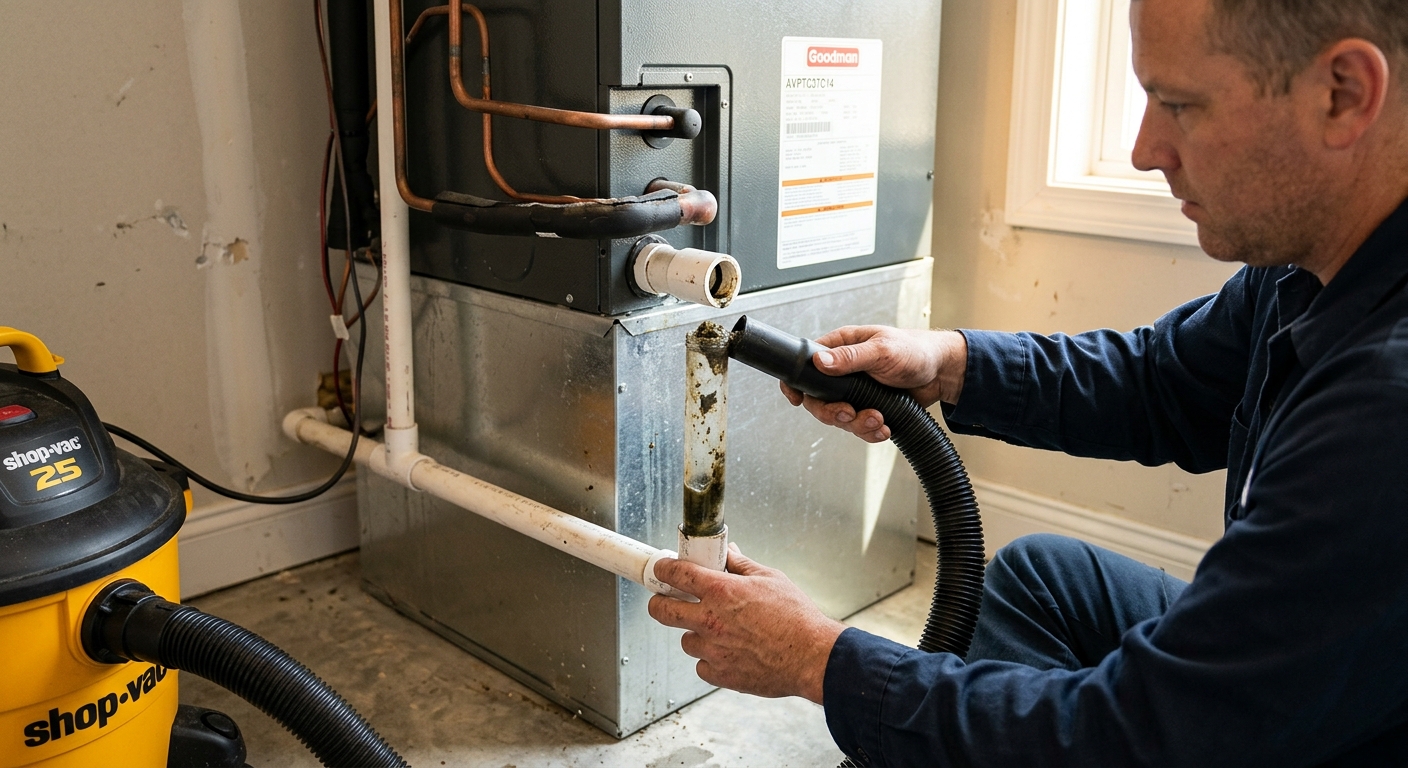
- Attach a wet-dry vacuum hose directly to the end of the drain line where it exits your home, typically a white PVC pipe near the foundation or in a utility area. Hold it firmly in place or use duct tape to create a seal.
- Run the wet-dry vacuum for 2 to 3 minutes to pull the clog material toward the exit point. You should hear suction change tone as the blockage clears.
- Pour 1 cup of distilled white vinegar into the cleanout port at the indoor access point. The mild acetic acid kills remaining algae and dissolves light mineral buildup.
- Wait 30 minutes, then flush with 1 cup of warm water to rinse the line. Confirm water flows freely out of the exterior exit pipe.
- Replace the access port cap, reset the float switch if your system shut down by restoring power at the breaker, and verify the system is cooling normally.
- Turn off the AC system at the thermostat and shut off power at the air handler disconnect or breaker before accessing internal components.
- Remove the access panel on your air handler to locate the condensate pan directly beneath the evaporator coil. Use a flashlight to inspect for standing water, rust, mold, or debris.
- Use a wet-dry vacuum with a narrow nozzle to remove all standing water and any visible sludge from the condensate pan. Wipe the pan with a rag dampened with diluted bleach, one tablespoon per quart of water, to kill mold and bacteria.
- At the indoor cleanout port, slowly pour a mixture of half a cup of distilled white vinegar and half a cup of warm water into the drain line. For heavier mineral buildup, use a commercial condensate pan treatment product rated for PVC lines.
- For stubborn clogs that suction alone cannot clear, use a flexible drain line brush or a plumber’s hand snake inserted into the cleanout port to physically break up hardened scale or debris before flushing.
- Drop one or two HVAC condensate pan treatment tablets into the clean pan before replacing the access panel. These slow-dissolving tablets release algaecide with each drain cycle and typically last 30 to 90 days.
- Restore power, run the system for 15 minutes, and confirm water is draining freely from the exterior exit point. Set a monthly reminder to pour a cup of vinegar into the cleanout port through the rest of the cooling season.
- Call a licensed HVAC technician and describe the symptoms: system shutting off unexpectedly, water near the air handler, or standing water in the condensate pan. This helps them arrive prepared.
- The technician will use a nitrogen pressure flush or professional-grade vacuum to clear the full length of the drain line, including any secondary traps or p-traps that are difficult to reach with DIY tools.
- Ask the technician to inspect the condensate pan for cracks, the float switch for proper function, and the drain line slope for any sections where water may pool due to improper pitch.
- Request that they treat the line and pan with a commercial algaecide and install or replace condensate pan tablets before leaving.
- Ask for documentation of what caused the clog and whether any pipe fittings, the pan, or the float switch need replacement. Use this to build your own maintenance schedule going forward.
Why It Works: The Benefits
A standard HVAC technician visit to clear a drain line costs $75 to $200. Doing it yourself with a wet-dry vacuum or a bottle of vinegar eliminates that expense entirely.
An overflowing condensate pan can damage drywall, insulation, flooring, and ceilings. Water damage repairs average $1,200 to $5,000 depending on extent, making a 10-minute maintenance task one of the highest-value jobs in your home.
A clear drain line allows the evaporator coil to operate at its designed efficiency. Homeowners with chronic partial clogs often see a 5 to 10% reduction in cooling energy use after clearing the line and maintaining it regularly.
Standing water in the condensate pan corrodes the pan itself and the base of the air handler. Keeping the drain clear prevents rust and microbial contamination that can shorten system life by years.
Stagnant water in a clogged condensate pan grows mold and bacteria that can be circulated into your living space. Clearing the line and keeping it clean directly reduces biological contaminants in your conditioned air.
💰 Savings Impact by Action
Clearing the drain line yourself eliminates a $75 to $200 technician visit fee every time a clog occurs.
Restoring free drainage eliminates the 5 to 10% efficiency penalty caused by a waterlogged evaporator environment and restricted airflow around the coil.
Regular drain maintenance combined with a float switch eliminates nearly all risk of the $1,200 to $5,000 average water damage repair cost from condensate overflow.
Keeping the drain line and pan clean reduces debris recirculation onto the evaporator coil, helping maintain the 10 to 15% efficiency loss that a dirty coil causes over a season.
🏠 Key Concepts Explained
The Science Behind It
Your air conditioner cools your home by cycling refrigerant through an evaporator coil, which gets cold enough, typically 35 to 55 degrees Fahrenheit, to cause moisture from warm indoor air to condense on the coil surface. This is the same physics behind a cold glass of water forming droplets on a humid day. That condensed water drips into a collection pan and exits through the drain line by gravity. On a humid summer day, a 3-ton central AC system can remove 15 to 20 gallons of water from your air in 24 hours.
The drain line environment is almost perfectly designed to grow algae. It is dark, consistently moist, and sits at temperatures between 60 and 80 degrees Fahrenheit inside the pipe, which is the ideal growth range for common AC algae species like Cladosporium and Aspergillus. These organisms form a biofilm that adheres to the inner pipe wall and grows thicker with each passing week. Mineral deposits from hard water provide additional surface area for this growth and narrow the pipe bore over time. A 3/4-inch drain line can be functionally blocked by a biofilm layer as thin as 3/16 of an inch around the full circumference.
Vinegar works as a preventive treatment because its acetic acid content, typically 5% in distilled white vinegar, lowers the pH inside the drain line enough to inhibit algae cell respiration without harming PVC pipe or drain pan coatings. It is not strong enough to dissolve a fully formed clog on its own, which is why mechanical suction is the first step. Used monthly as a flush, however, it prevents biofilm from establishing in the first place. Commercial condensate tablets work on a similar principle, slowly releasing EPA-registered biocides like isothiazolinone that keep the pan and upper drain line free of organic growth between manual treatments.
Frequently Asked Questions
▼ I cleared the drain line but my AC still won’t turn on. What’s wrong?
After a float switch shutdown, simply clearing the clog is not always enough. Make sure the condensate pan is fully emptied of standing water so the float drops back to its resting position, then try resetting the system at the breaker. If the system still does not start, the float switch itself may be stuck or faulty and will need to be replaced, which costs $15 to $40 as a DIY fix or slightly more with a technician.
▼ How do I find my condensate drain line if I can’t see where it goes?
Start at your indoor air handler and look for a 3/4-inch or 1-inch white PVC pipe exiting the unit near the bottom. Trace it to where it exits the home, usually through a wall to the outside near the foundation, into a floor drain, or into a utility sink. If the line runs through a finished ceiling or wall and you cannot trace it visually, your HVAC system diagram or the original installation manual will show the routing. A technician can also trace it with a drain camera if needed.
▼ Can I use bleach instead of vinegar to clean the drain line?
Yes, diluted bleach works well for killing algae and mold in the drain line and pan. Use no more than one tablespoon of household bleach per cup of water. Do not use bleach if your drain connects to a septic system, and avoid using it frequently since repeated exposure can degrade the rubber float switch components over time. Vinegar is gentler and effective enough for routine monthly maintenance.
▼ My drain line clogs every 4 to 6 weeks no matter what I do. Is something wrong with my system?
Frequent reclogging usually points to one of three root causes: the drain line has inadequate slope and water is sitting stagnant, the evaporator coil is dirty and shedding debris into the pan, or you have an unusually high humidity load that generates more condensate than average. Have a technician check the coil for dirt buildup and confirm the drain line pitch meets code. Adding condensate pan tablets on a monthly schedule after cleaning almost always extends the clog-free interval significantly.
▼ Is there water damage I should check for after a drain line clog?
Yes, especially if the condensate pan overflowed before the float switch triggered or if your system lacks a float switch. Check the ceiling and walls around and below the air handler for soft drywall, water stains, or discoloration. In attic installations, inspect the attic floor for wet insulation. Even minor water intrusion left unaddressed can lead to mold growth within 24 to 48 hours, so dry any wet materials promptly and use a fan or dehumidifier in the affected area.
Quick Tips
- Pour a cup of distilled white vinegar into your condensate drain cleanout port every month during cooling season. Set a recurring calendar reminder so it actually happens.
- Note where your exterior drain line exits the house so you can do a quick visual check during the season. If you do not see occasional drips on humid days, the line may be draining slowly.
- If your home has hard water above 120 mg/L, add a monthly dose of a citric acid drain treatment in addition to vinegar to address mineral scale that vinegar alone cannot fully prevent.
- Check that your condensate drain line has a proper slope of at least 1/8 inch per foot toward the exit. A line that sags or runs level will hold standing water and clog far more frequently.
Variations for Your Situation
- Apartment/Rental: Renters typically cannot access the air handler or drain line cleanout without landlord permission. If you notice water near your indoor unit or the system shuts off unexpectedly, notify your landlord or property manager in writing immediately since drain line maintenance is almost always the owner’s responsibility. You can request they install condensate pan tablets during seasonal servicing. For window AC units, which you likely own, clean the drain hole at the back of the unit monthly with a pipe cleaner and diluted vinegar to prevent overflow onto your windowsill.
- Tight Budget (under $20): Skip commercial drain treatments entirely and rely on distilled white vinegar, which costs about $2 per gallon. A monthly pour of one cup into the cleanout port is genuinely effective prevention at near-zero cost. A wet-dry vacuum is the only tool investment worth making if you do not own one, and even a small 2-gallon model costs $25 to $35 and handles this job perfectly. Many hardware stores also rent wet-dry vacuums for under $10 per day if you only need it once.
- Older Home (pre-1980): Homes of this era often have drain lines routed into old cast iron or clay floor drains that may themselves be partially blocked or slow. If you clear the condensate line but water still drains slowly, the problem may be downstream. These systems also frequently lack float switches entirely, putting you at much higher risk of overflow damage before you notice a problem. Installing an aftermarket float switch in the condensate pan is a strongly recommended upgrade that costs $15 to $30 in parts and takes about 20 minutes for someone comfortable with basic electrical work.