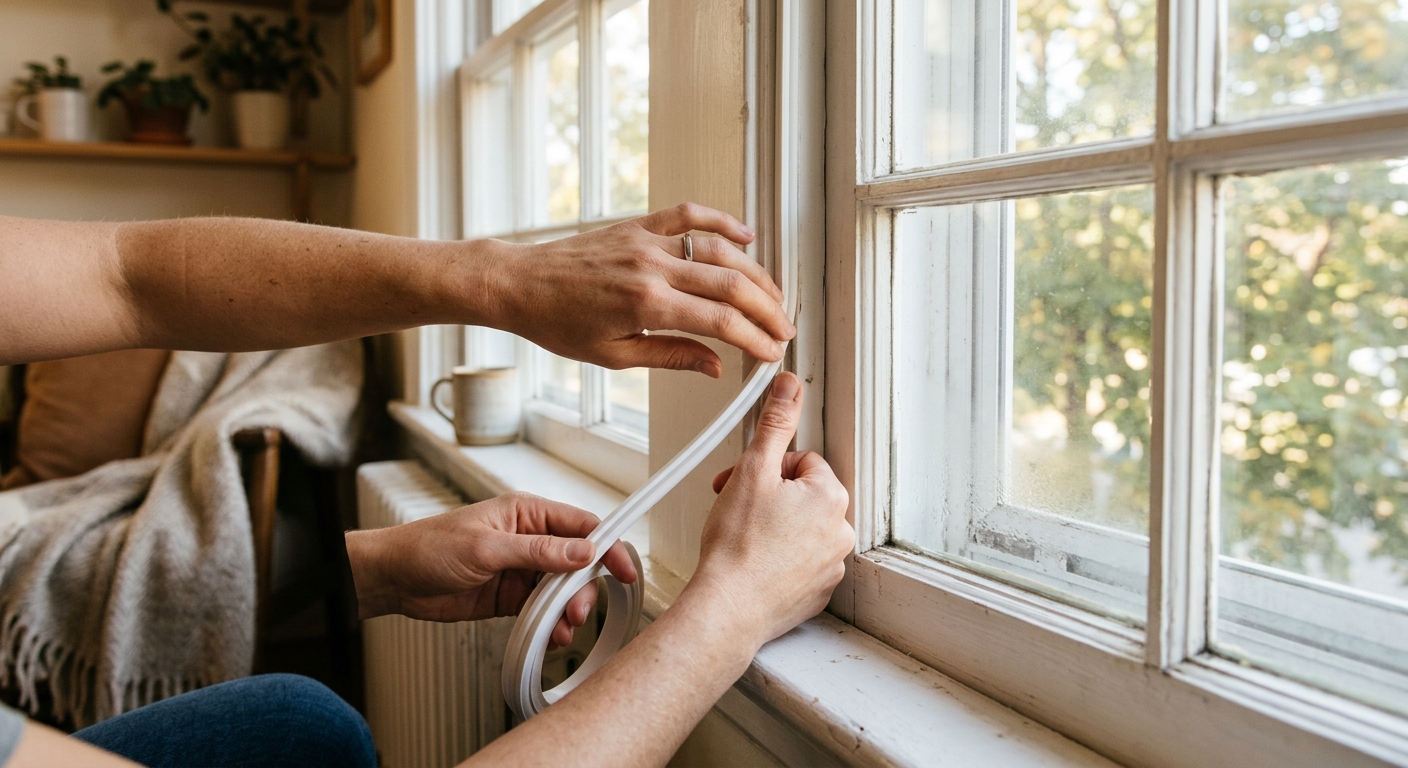
You can feel it every winter: that invisible cold creeping in around your window frames, pooling near the floor and forcing your furnace to run longer just to keep up. Drafty windows are one of the most common comfort complaints homeowners have, and they are also one of the most solvable. The U.S. Department of Energy estimates that air leaks around windows and doors account for 25 to 30% of the average home’s heating and cooling load.
The good news is you do not need to replace your windows to fix the problem. In most cases, a Saturday morning and about $30 worth of weatherstripping, rope caulk, or window film will eliminate the majority of drafts. These are targeted, reversible fixes that work on rentals, older homes, and even newer construction where gaps have developed over time.
This post walks you through exactly how to find drafts, choose the right sealing method for your window type, and apply it correctly the first time. We will cover a zero-cost quick fix, a proper DIY seal-up, and when it actually makes sense to call a professional. Real payback numbers and savings estimates are included so you can decide where to spend your time first.
What You’ll Need
Click on an item below to shop for the recommended items for this recipe on Amazon.
As an Amazon Associate, we earn from qualifying purchases.
How to Do It
- On a cold day, hold a lit incense stick or thin strip of tissue paper around the full perimeter of each window frame, including the seam where the sash meets the sill. Watch for the smoke or paper to deflect, marking every air leak location.
- Purchase gray or white rope caulk (also called weatherstrip caulk) from any hardware store for about $3 to $5 per roll. One roll covers roughly four standard double-hung windows.
- Press rope caulk into the gap between the movable sash and the window frame, following the line of the gap as you would push clay into a crack. No tools required; your fingertip is enough.
- For the gap at the bottom of the window sill or between the window and the interior trim, roll a thin bead of rope caulk and press it firmly into the seam.
- Place a rolled towel or a purpose-made draft snake ($5 to $10) along the interior window sill if there is a gap at the very bottom where the sash meets the stool. This handles any remaining floor-level draft.
- Remove and discard rope caulk each spring when you want to open windows again. The surface underneath will be undamaged.
- Clean the window channels and stops with a damp cloth and let them dry fully. Weatherstripping adheres poorly to dusty or painted-over surfaces, and a clean surface doubles the product lifespan.
- Measure the total linear footage of all window sash channels in your home. A standard two-story home with 15 windows typically needs 60 to 80 feet of V-seal weatherstrip. Buy 10% extra for cuts and overlaps.
- Cut V-seal (also called tension seal) weatherstrip to length for each sash channel, which is the vertical track the window slides in. Fold the strip so the open side of the V faces outward, then press it firmly into the channel with the adhesive side against the wood or vinyl frame.
- For the bottom sash meeting the sill, apply a foam compression strip (door and window foam tape, 3/8-inch width works for most windows) to the top of the sill or the bottom rail of the sash. This compresses when the window closes and creates an airtight seal.
- For the joint between the upper and lower sash on double-hung windows (the meeting rail), apply a thin foam compression strip to the top of the lower sash’s upper rail. This stops the most common and largest single gap on older double-hung windows.
- Test each window by closing it and running your hand around the full perimeter. If you still feel airflow, press the weatherstrip more firmly into the channel or add a second layer of foam tape at any remaining gap.
- Check the exterior window casing where the frame meets the house siding. Apply a bead of paintable silicone or acrylic caulk with a caulk gun along any gaps wider than 1/16 inch. Smooth with a wet finger and let cure for 24 hours before painting.
- Purchase a shrink-film window insulation kit, such as 3M Indoor Window Insulator, which covers five standard windows for about $20 to $25. These kits include double-sided tape and clear plastic film.
- Clean the interior window trim thoroughly. The double-sided tape must bond to clean, dry paint or wood. Any dust or grease will cause the tape to release mid-winter.
- Apply the double-sided tape to the flat face of the interior window trim, not to the glass or the sash. Press firmly at all four corners and cut tape neatly at each corner.
- Peel the backing from the tape and press the plastic film onto it, leaving slight slack in the film. Do not stretch the film tight at this stage.
- Use a hair dryer on medium heat, moving in slow passes 2 to 3 inches from the surface. The film will shrink taut and become nearly invisible within 30 to 60 seconds per window.
- Trim any excess film with scissors along the outer tape edge for a clean look. The film creates a 1-inch dead-air space that can add R-1 to R-2 of insulating value to the window assembly.
- Remove at the end of the heating season by pulling the tape away from the trim. Most interior paint is unaffected, but test one corner first on older or freshly painted surfaces.
Why It Works: The Benefits
Sealing window air leaks can reduce heating and cooling costs by 10 to 20% annually, according to DOE estimates. For a home spending $1,800 per year on energy, that is $180 to $360 back in your pocket.
Eliminating cold drafts near windows raises the mean radiant temperature in the room, which is how warm you actually feel, often making a 68F room feel like 70 to 71F without touching the thermostat.
Less infiltration means your furnace or air conditioner reaches setpoint faster and cycles off sooner. Homeowners commonly report a 10 to 15% drop in system runtime after a thorough window air-sealing weekend.
Gaps around window frames are entry points for pollen, dust, and outdoor particulates. Sealing them reduces the volume of unfiltered air entering the home, improving indoor air quality measurably.
Cold drafts lower surface temperatures at the window frame, often below the dew point of interior air. Sealing those drafts eliminates the condensation cycle that leads to mold, wood rot, and paint peeling.
💰 Savings Impact by Action
Sealing gaps around window frames with weatherstrip and caulk reduces infiltration-driven heat loss by up to 20% of total heating and cooling costs in drafty older homes.
Interior shrink film adds R-1 to R-2 of insulation to a single-pane window, reducing heat loss through the glass by up to 14% compared to bare single-pane glass.
Sealing the horizontal gap where the upper and lower sash meet on a double-hung window eliminates the largest single air leak point, reducing that window’s infiltration by up to 10% of whole-house air leakage.
Caulking the gap between window frames and exterior siding seals the rough-opening perimeter, which the DOE identifies as contributing up to 12% of total home air leakage.
🏠 Key Concepts Explained
The Science Behind It
Windows lose energy in two distinct ways: conduction through the glass and frame, and infiltration through gaps. Weatherstripping and caulk address only infiltration, but infiltration is often the larger problem in older homes. A single 1/16-inch gap running across a 36-inch-wide window has an equivalent area of about 2.25 square inches of open hole, and at a wind speed of 15 mph, that gap can push 30 to 50 cubic feet of cold air per hour into the room. Your furnace must then heat that air from, say, 25F to 70F, burning fuel continuously to compensate for what amounts to a hole in the wall.
Weatherstripping works by creating a compression seal that eliminates the air pathway entirely. V-seal tension strips use their spring shape to maintain consistent contact pressure against the sash as it moves up and down, while foam compression tapes deform under the weight of the closed sash to fill irregular gaps. The key physics principle is that still air is an excellent insulator with a thermal conductivity of about 0.024 W/mK. Every gap you seal replaces moving, heat-stealing air with trapped, still air. Window film kits exploit this directly by creating a sealed air pocket, essentially adding a low-cost third pane to your window assembly.
The stack effect makes upper-story windows on the windward side of your home the highest-priority targets. Because warm air is positively buoyant, it tends to escape from the top of the house, creating a negative pressure zone at lower levels that actively pulls outdoor air in through any available gap. Sealing windows on both floors disrupts this chimney loop. Research from Lawrence Berkeley National Laboratory shows that comprehensive air sealing of a home’s envelope, of which windows and doors are the primary contributors, can reduce total air infiltration by 20 to 40%, with the majority of that improvement coming from just the lowest-cost interventions like weatherstripping and caulk.
Frequently Asked Questions
▼ I sealed my windows but the room still feels cold. What did I miss?
Cold feelings near windows often have two sources: air infiltration and radiant cold from the glass surface itself. Weatherstripping addresses infiltration, but a single-pane or failed double-pane window radiates cold even with no air movement. Add window insulation film or cellular shades to create a thermal barrier between you and the glass. Also recheck the exterior caulk line where the frame meets the siding, as this gap is often larger than interior gaps and is commonly overlooked.
▼ Can renters use these fixes without getting in trouble with their landlord?
Rope caulk and window insulation film kits are fully reversible and leave no damage, making them safe for renters in virtually all cases. V-seal weatherstrip with adhesive backing is also generally safe since it peels off cleanly from painted surfaces. Avoid any permanent caulk on interior trim or sashes, and document the window condition with photos before and after. When in doubt, a quick email to your landlord noting that you plan to add removable weatherstripping is usually enough.
▼ How long before I see savings on my energy bill after sealing my windows?
For gas or oil heat, you should see a measurable drop in the very first billing cycle after sealing during cold weather, since furnace runtime is reduced immediately. Most homeowners report 10 to 20% reductions in heating costs visible within one month. For electric heat or in moderate climates, the savings are real but may take two to three billing cycles to stand out clearly from normal month-to-month variation.
▼ My windows are newer but I still have drafts. Is something wrong?
New windows can develop gaps at the exterior rough opening, which is the space between the window frame and the structural framing inside the wall. This is commonly filled with low-expanding spray foam at installation, but it shrinks or voids over time. Check the interior window trim for any gap between the trim and the wall surface, and check the exterior caulk line between the window flange and the siding. These are the two most common failure points on windows that are only 5 to 15 years old.
▼ Is it worth sealing windows if I plan to replace them in a few years anyway?
Yes, absolutely. A $30 weatherstripping job saves $150 to $300 in heating costs over two winters, which is money you keep regardless of when you replace the windows. New window installation does not eliminate the need for caulking and weatherstripping either, since installer workmanship varies significantly. Treat the two investments as independent decisions, because they are.
Quick Tips
- Do your draft test on a cold, windy day for the clearest results. Gaps that are invisible on a calm day will reveal themselves immediately when outdoor pressure is higher.
- Replace weatherstripping every 5 to 7 years. Foam compression tape hardens and loses its sealing ability over time, often without looking obviously worn.
- For casement windows that crank open, check the seal around the full perimeter of the sash when it is closed. A worn gasket on a casement is a single-part replacement that typically costs under $10 and restores a complete seal.
- After sealing windows, check your bathroom and kitchen exhaust fans. Tightening the envelope makes makeup air pathways more important. If fans seem sluggish, cracking a window briefly while running them is appropriate.
- Prioritize north-facing and windward-facing windows first. These experience the highest pressure differential in winter and deliver the greatest comfort and savings improvement per hour of work.
Variations for Your Situation
- Apartment/Rental: Focus entirely on rope caulk and window insulation film kits since both are reversible and damage-free. Rope caulk costs about $3 to $5 per roll and requires no tools. A 5-window film kit runs $20 to $25 and can be removed at the end of the season with no trace. Draft snakes along the sill add another layer for zero landlord-risk. Total investment is typically under $40 for a full apartment, with immediate warmth improvement.
- Tight Budget (under $15): Start with a free draft test using a stick of incense, then target only the worst offenders. A single roll of rope caulk ($4) and a homemade draft snake made from a rolled bath towel in a pillowcase can address the most impactful gaps at no additional cost. Prioritize windows on the north and windward sides, and windows in the rooms where you spend the most time. Even sealing two or three problem windows delivers a noticeable comfort improvement.
- Older Home (pre-1980): Homes from this era typically have single-pane glass, wood sash channels swollen or warped from decades of painting, and no factory weatherstripping. The meeting rail gap on old double-hung windows is often a full 1/4 inch or more. Use closed-cell foam tape at 3/8-inch width for meeting rails, and consider adding window insulation film on all north-facing and bedroom windows for the full thermal benefit. Budget $60 to $100 to cover the whole house properly, and check for lead paint before scraping or sanding any surfaces.