If your utility bill keeps climbing but your thermostat settings haven’t changed, poor air circulation is likely the invisible culprit. When air can’t move freely through your home, your HVAC system has to run longer cycles to compensate, pumping conditioned air into spaces where it gets trapped rather than distributed evenly. The result is a system that’s working overtime while you’re still sweating in the bedroom and freezing in the living room.
The financial hit is real. The U.S. Department of Energy estimates that inefficient air distribution can waste 20 to 30% of the energy your HVAC system produces. On a typical American household’s annual energy bill of around $2,200, that’s $440 to $660 disappearing every year because air isn’t moving the way it should. That’s not a small rounding error, that’s a car payment.
In this post, you’ll learn exactly how to diagnose poor circulation in your home, which fixes deliver the fastest payback, and how to approach the problem whether you have 15 minutes or a free weekend. We’ll cover everything from free thermostat fan tweaks to strategic ceiling fan placement and duct balancing, with real cost and savings numbers at every step.
What You’ll Need
Click on an item below to shop for the recommended items for this recipe on Amazon.
As an Amazon Associate, we earn from qualifying purchases.
How to Do It
- Switch your thermostat fan setting from AUTO to ON or, if you have a smart thermostat, enable the circulate mode and set it to run 30 minutes per hour. This redistributes air without running the compressor and costs roughly $3 to $5 extra per month in blower electricity.
- Walk through every room and confirm that interior doors have at least a 1-inch gap at the bottom to allow return air to flow freely. If a door is sitting tight on carpet, this alone can restore proper airflow balance to that room.
- Reverse your ceiling fans for the correct season. In summer, fans should spin counterclockwise (looking up) to push air downward and create a wind-chill effect. In winter, spin them clockwise on low speed to push warm stratified air off the ceiling without creating a draft.
- Check every supply and return vent in the house. Remove any furniture, rugs, or drapes blocking them. A single blocked return vent can drop system airflow by 10 to 15% and cause the entire house to feel stuffy.
- Set ceiling fan speeds to medium in living areas during peak occupancy. Running fans only in occupied rooms at the right speed costs 20 to 50 cents per day and lets you raise the thermostat 4 degrees Fahrenheit without any comfort penalty.
- Replace any ceiling fans older than 10 years with ENERGY STAR certified models. Modern DC motor fans use 25 to 40 watts versus 60 to 75 watts for older AC motor fans, and move more air per watt. Budget $60 to $150 per fan installed yourself.
- Install transfer grilles or door undercuts in rooms that feel consistently stuffy despite open vents. A door undercut of 1 inch costs nothing and takes 10 minutes with a hand saw or oscillating tool. A transfer grille kit costs $15 to $30 and allows return air to bypass a closed door entirely.
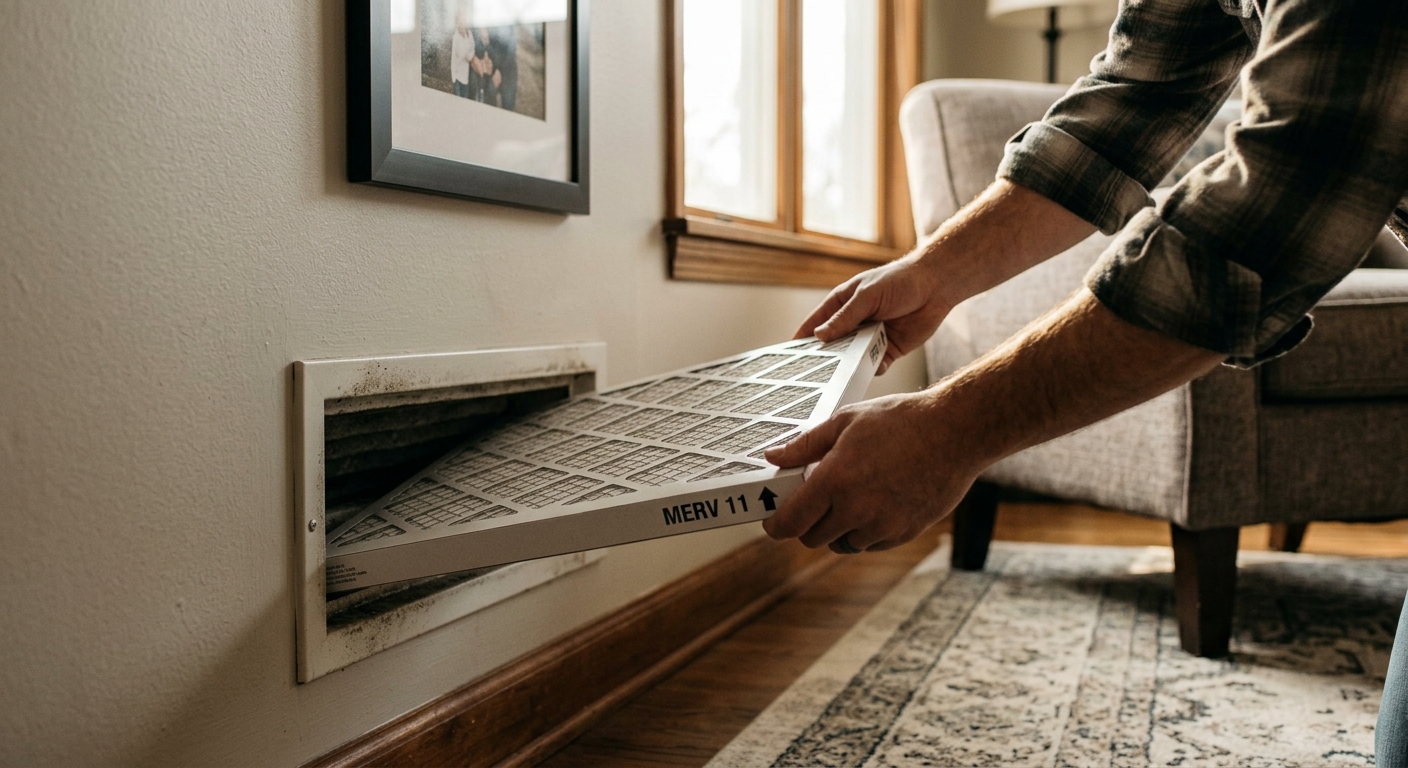
- Upgrade your HVAC air filter to a MERV 8 to 11 rated pleated filter. Dirty or incorrect filters restrict airflow across the entire system. Check the filter monthly and replace it every 60 to 90 days. A restricted filter can reduce system airflow by 15% or more.
- Add a box fan or standalone pedestal fan to any room more than 15 feet from the nearest supply vent. Positioning a fan to draw air from the vent side of the room toward the occupied side closes the temperature gap between that room and the rest of the house for a $30 to $60 one-time cost.
- Seal visible duct joints in accessible areas like the attic, basement, or crawlspace using UL-181 rated foil tape or mastic duct sealant. A single 6-inch gap in a supply duct can dump 10 to 20% of conditioned air into an unconditioned space. A tube of mastic costs $8 to $12 and covers several joints.
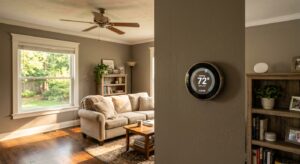
- Install a smart thermostat with a built-in circulation scheduler if you haven’t already. Models in the $100 to $150 range allow you to program fan-only circulation periods during morning and evening when temperatures drift, saving 10 to 15% annually compared to simple AUTO mode operation.
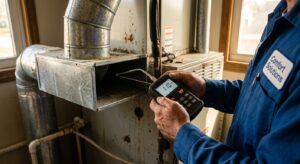
- Hire an HVAC technician to perform a duct blaster or blower door test. This identifies exactly how much air your duct system is losing and where the leaks are located. Expect to pay $150 to $300 for the diagnostic. The test typically reveals duct leakage rates of 20 to 40% in older homes.
- Request a duct balancing service where the technician adjusts dampers or restricts certain supply registers to redistribute airflow more evenly across all zones. This service costs $200 to $500 and can eliminate temperature differences of 8 degrees or more between rooms.
- Ask about adding a whole-house ventilation fan or energy recovery ventilator (ERV) if your home feels stale even when the HVAC runs frequently. An ERV exchanges stale indoor air with fresh outdoor air while recovering 70 to 80% of the conditioned air’s energy, improving circulation without wasting heating or cooling.
- If specific rooms remain problematic after duct work, have the contractor evaluate adding a mini-split or supplemental duct branch. A single-zone mini-split starting at $1,500 installed provides precise temperature control for a problem room without stressing the central system.
Why It Works: The Benefits
Improving circulation allows you to raise your cooling setpoint by 4 degrees Fahrenheit using ceiling fans alone, which cuts air conditioning energy use by roughly 8% per degree, adding up to a 15 to 25% reduction in cooling costs each month.
Addressing return air balance and running the HVAC blower in circulate mode can reduce room-to-room temperature swings from 8 to 10 degrees down to 2 to 3 degrees, eliminating the hot and cold spots that make rooms unusable.
When air circulates freely, the system runs in shorter, more efficient cycles rather than long, strained ones. Reducing average run time by even 15% can meaningfully extend compressor and blower motor life, delaying a $5,000 to $12,000 replacement.
Stagnant air allows dust, allergens, and humidity to concentrate in specific zones. Continuous air movement cycles air through filters more frequently, reducing airborne particulates and keeping relative humidity more consistent across rooms.
A well-circulated home recovers to the thermostat setpoint up to 30% faster after doors have been opened or temperatures have drifted, meaning the system runs a shorter recovery cycle and uses less energy to get back on track.
💰 Savings Impact by Action
Using ceiling fans correctly allows a 4-degree thermostat setback, cutting cooling energy use by roughly 14% with no comfort loss.
Sealing accessible duct leaks stops the 20 to 30% of conditioned air lost to unconditioned spaces before it reaches living areas.
Keeping a clean MERV 8 to 11 filter in place maintains designed airflow and prevents the 10 to 15% efficiency drop caused by restriction.
Scheduling the HVAC blower to circulate 20 to 30 minutes per hour reduces thermostat overshoot cycles and saves up to 10% on annual heating and cooling.
Adding door undercuts or transfer grilles restores return air paths, reducing system static pressure and cutting blower energy use by up to 8%.
🏠 Key Concepts Explained
The Science Behind It
Air in your home behaves according to basic fluid dynamics: it moves from areas of higher pressure to areas of lower pressure, and warm air rises while cooler, denser air sinks. Your HVAC system is designed around this by placing supply registers high on walls or in ceilings to deliver conditioned air and return registers low to pull it back. When doors are closed, furniture blocks vents, or ducts leak, this pressure balance breaks down and air stalls in pockets throughout the house, creating the hot and cold zones most homeowners accept as normal.
Thermal stratification is the main reason a ceiling thermostat reading of 72 degrees Fahrenheit can feel like 78 degrees at seated height. In a room with poor air movement, temperature layers can stack in bands of 2 to 3 degrees per foot of vertical height. A ceiling fan set correctly disrupts these layers by creating gentle turbulence that mixes the air column. The wind-chill effect of moving air on skin also allows perceived comfort at 4 degrees higher than the actual air temperature, which is why the DOE quantifies that offset as a direct thermostat setback opportunity.
Duct leakage compounds every other circulation problem. When conditioned air escapes into wall cavities or attic spaces before reaching a room, that room stays underserved while the blower tries to compensate by running longer. Longer run cycles drive up energy use and can create a negative pressure situation in the living space, pulling unconditioned air in through cracks and gaps in the building envelope. Studies from Lawrence Berkeley National Laboratory have consistently found that fixing duct leakage in the average home is one of the highest return-on-investment energy upgrades available, with payback periods of 2 to 4 years even at modest energy prices.
Frequently Asked Questions
▼ Why is one room always hotter than the rest no matter what I try?
The most common causes are an undersized supply duct branch, a damper stuck in the partially closed position, or a return air path that’s blocked by a tight door. Start by checking the duct run serving that room in your attic or basement for visible kinks, disconnections, or manual damper levers. If the duct looks intact, try installing a transfer grille in the door or cutting a 1-inch gap at the bottom to restore the return air path.
▼ My energy bill went up after I started running the fan continuously. Is that normal?
A small increase of $3 to $8 per month from continuous blower operation is normal, but a larger spike suggests your filter is restricting airflow and causing the motor to work harder. Check and replace the air filter immediately. If bills remain elevated, have a technician measure your system’s static pressure to confirm the blower is operating within its designed range.
▼ Can I fix circulation problems in an apartment without touching the HVAC system?
Yes. Focus on ceiling fans (most apartments allow installation if you restore the fixture on move-out), box fans placed to move air between rooms, and keeping interior doors open as much as possible to allow air to circulate. You can also ask your building manager to check whether the building’s air handling system is balanced for your unit, since multi-unit buildings frequently have imbalanced distribution.
▼ How quickly will I see the savings on my utility bill after making these changes?
Free thermostat adjustments and fan reversals show up in the very next billing cycle. Filter replacements and vent unblocking typically reflect savings within one to two billing cycles. Duct sealing and ceiling fan upgrades usually produce measurable reductions within two to three months, depending on your climate and how much you’re heating or cooling.
▼ What if my home is older and the ducts are in the walls where I can’t reach them?
Focus your efforts on the accessible portions first: the connections at the air handler and any exposed duct runs in the attic, basement, or crawlspace. For wall-buried ducts, the most cost-effective option is often aeroseal duct sealing, a professional service where a technician pressurizes the duct system and injects aerosolized sealant particles that bind to and plug leaks from the inside. Cost runs $1,500 to $3,000 but can reduce duct leakage by 70 to 90%.
Quick Tips
- Set ceiling fans to the lowest speed that you can still feel from your normal seating position. Higher is not always better and wastes electricity without improving comfort.
- Close vents in rarely used rooms only partially, never completely. Fully closing a vent pressurizes the duct branch and can cause leaks to worsen or force air into unintended spaces.
- Check your attic hatch for a weather seal. An unsealed attic hatch creates a stack-effect shortcut that pulls warm attic air down in summer and drains heated air in winter, disrupting circulation throughout the entire house.
- On mild days when outdoor temperatures are between 65 and 75 degrees Fahrenheit, open windows on opposite sides of the house to create cross-ventilation. This moves 10 to 20 times more air than any fan and costs nothing.
Variations for Your Situation
- Apartment/Rental: You likely have no access to ductwork or the building’s central air handler, so focus on portable and reversible solutions. A $40 to $80 tower fan placed in the hallway to push air between rooms makes an immediate difference. For ceiling fans, check your lease, many landlords approve installation if you keep the original fixture for reinstallation. A smart plug with a scheduling feature lets you automate a box fan to run during peak temperature drift times without any permanent modification.
- Tight Budget (under $50): Start with the four completely free steps: switch the thermostat fan to circulate mode, open interior door gaps, reverse ceiling fan direction, and unblock all vents. If you have $10 to $20 to spend, replace your air filter, which is the single highest-impact low-cost fix available. With $30 to $50, add one well-placed box fan in your most problematic room. These steps alone can recover 10 to 15% on monthly bills with zero installation complexity.
- Older Home (pre-1980): Homes built before 1980 were rarely designed with return air systems adequate by modern standards, and duct insulation is often degraded or absent. Prioritize duct sealing in accessible areas using mastic sealant before any other upgrade, since leakage rates of 30 to 40% are common. Also check whether supply ducts running through unconditioned attic or crawlspace have intact insulation wrap rated at least R-6. Replacing missing duct insulation costs $1 to $2 per linear foot as a DIY project and can reduce heat gain into supply air by 10 to 20% in summer.