December is the most expensive month on the electric bill for millions of homeowners, and holiday lighting is a surprisingly large reason why. A typical home decorated with incandescent string lights running 6 hours per night for 30 days can easily burn through an extra $50 to $100 in electricity, depending on local rates and the scale of the display. Larger displays with roofline lights, lawn inflatables with built-in bulbs, and interior tree lights can push that number well past $100.
The good news is that the technology has never been better or more affordable. LED holiday lighting uses up to 90% less electricity than incandescent bulbs, lasts 10 to 25 times longer, and runs cool enough to reduce fire risk. Pair that with a programmable timer and a smarter decorating strategy, and most homeowners can hold their holiday lighting cost to $10 to $20 for the entire season, even with a generous display.
This post breaks down exactly where the electricity cost is coming from, how to calculate your own holiday lighting bill, and two practical approaches you can take this season to cut costs without cutting back on the look you love.
What You’ll Need
Click on an item below to shop for the recommended items for this recipe on Amazon.
As an Amazon Associate, we earn from qualifying purchases.
How to Do It
- Calculate your current nightly runtime by thinking back to when you typically turn your lights on and off. Most people run lights from 5 PM to midnight, which is 7 hours. Target 5 to 6 hours as your new maximum.
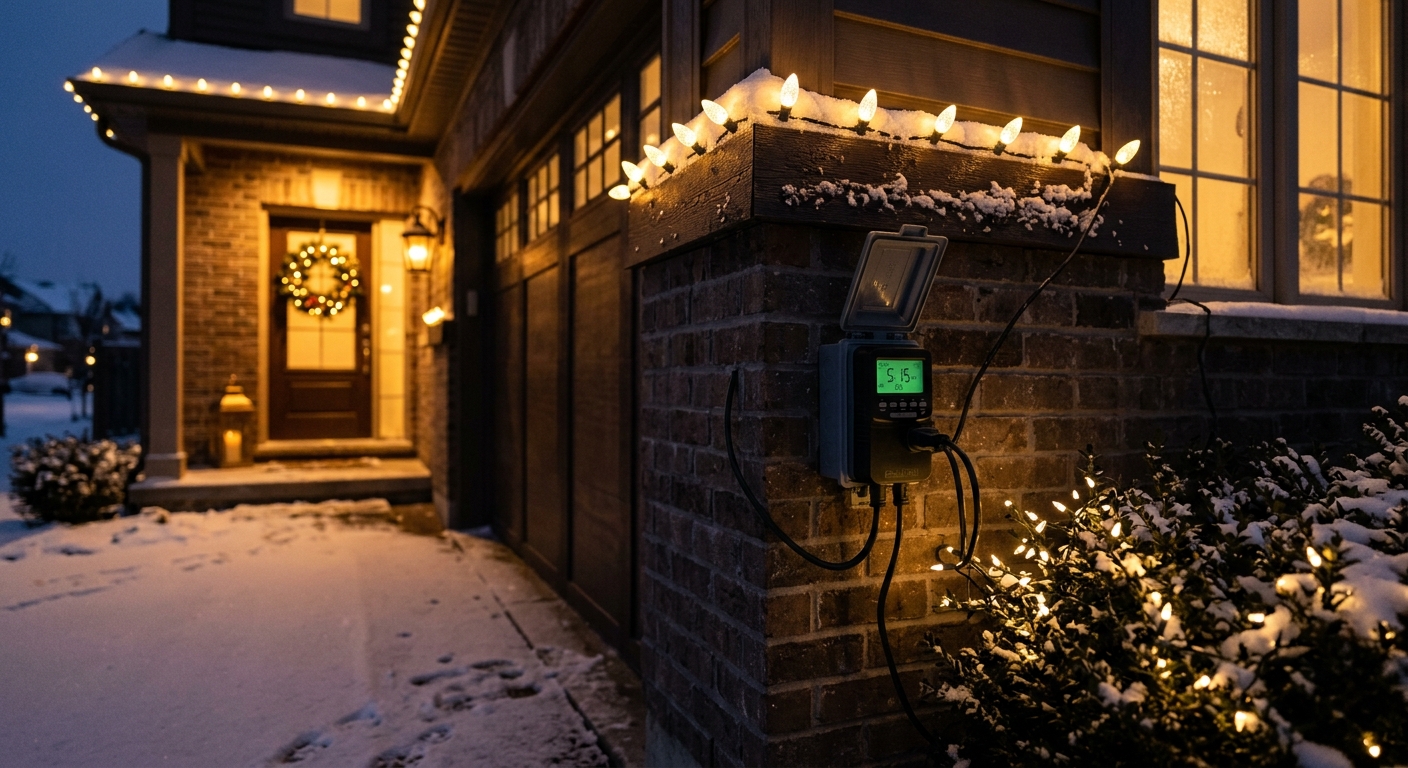
- Purchase a mechanical or digital plug-in timer rated for at least 1,875 watts (15 amps) to safely handle multiple strands. Mechanical timers cost $10 to $12 and work reliably for this application.
- Plug all your extension cords and light strands into a power strip, then plug the power strip into the timer. Set the timer to turn on at dusk (around 5 PM in December) and off at 10 or 10:30 PM.
- If you have a smart home setup, use a smart plug with a scheduling app instead. Smart plugs from brands like Kasa or Wyze cost $15 to $20 and let you set sunrise and sunset-based schedules automatically.
- Turn off any lights in rooms where no one is present during the evening. Interior tree lights left on in empty rooms are pure waste. Assign the tree to the same timer or a secondary smart plug.
- Inventory all your current holiday light strands. Count the total number of strands and note whether they are incandescent (warm, slightly yellow glow, bulbs feel warm to the touch) or LED (brighter, cooler to the touch, color stays consistent).
- Calculate your current annual cost using this formula: (total watts divided by 1,000) multiplied by hours per night multiplied by nights multiplied by your rate per kWh. A typical 10-strand incandescent setup at 40 watts per strand equals 400 watts, times 6 hours, times 30 nights, times $0.16 equals $11.52. LED strands at 4.5 watts each drop that to $1.30.
- Replace all incandescent strands with LED equivalents this season. Look for strands labeled C7, C9, or mini LED. Bulk packs of 100-light mini LED strands run $8 to $15 each. Home improvement stores stock these heavily in November.
- Replace any large incandescent pathway stakes or net lights with LED versions. LED net lights covering a 4×6 foot area draw only 3 to 5 watts compared to 25 to 40 watts for incandescent versions.
- Evaluate each inflatable separately. Inflatables with incandescent interior spotlights can have those bulbs swapped for LED PAR20 or LED candelabra bulbs in the same socket. The blower motor itself cannot be changed, so minimize the nightly runtime of inflatables to 4 to 5 hours.
- Store your new LED strands coiled loosely in sealable plastic bags or purpose-made reel organizers to prevent strand damage. LED strands stored properly last 10 to 15 years, making the upfront cost a true long-term investment.
Why It Works: The Benefits
Replacing incandescent holiday lights with LEDs and adding a timer can reduce holiday lighting costs from $50 to $100 down to $5 to $20 for the entire month, a savings of $50 to $90 in December alone.
LED holiday light strands are rated for 10,000 to 50,000 hours of use compared to 1,000 to 3,000 hours for incandescents, meaning you replace them far less often and spend less over time on replacement sets.
Incandescent holiday lights generate significant heat and are a leading cause of Christmas tree fires. LED lights run at near-room temperature, substantially reducing fire risk, especially on live or dry trees.
Incandescent lights indoors convert roughly 90% of their energy to heat. A large indoor display can noticeably raise room temperature, increasing cooling load in mild climates or creating uneven warmth in heated spaces.
A $10 to $20 plug-in timer or a smart plug eliminates the hassle of remembering to turn lights on and off every day while ensuring your display runs only during the hours people actually see it.
💰 Savings Impact by Action
Replacing incandescent holiday strands with LED equivalents reduces lighting electricity use by up to 88% for the same number of bulbs and the same runtime.
Setting lights to run 5 hours per night instead of 7 to 8 reduces total seasonal runtime by 30 to 38%, cutting cost proportionally with no change to equipment.
Limiting inflatable blower runtime from 10 hours to 5 to 6 hours per night cuts inflatable electricity cost by 40 to 50% for the season.
Turning off interior tree and mantle lights when leaving the room or going to bed reduces indoor holiday lighting runtime by 15 to 25% on average.
🏠 Key Concepts Explained
The Science Behind It
Incandescent bulbs produce light through resistive heating. An electrical current passes through a thin tungsten filament, which gets so hot it glows. The problem is that roughly 90% of the energy consumed is released as infrared heat, not visible light. You are essentially paying for a space heater that happens to glow. In a holiday light context, this means a 40-watt incandescent string is delivering only about 4 watts worth of visible light output while dumping 36 watts of heat into your living room or onto your roof.
LED bulbs work through electroluminescence. When current passes through a semiconductor material, electrons move between energy levels and release photons of light directly. This process is dramatically more efficient, with modern LEDs converting 40 to 60% of input energy into visible light versus the roughly 10% efficiency of incandescent bulbs. The result is the same perceived brightness at a fraction of the wattage, and because little energy is wasted as heat, the bulbs run cool and last far longer before the semiconductor material degrades.
The timer strategy works on a simple but often underappreciated principle: energy use is the product of power and time. Cutting your nightly runtime from 8 hours to 5 hours reduces your lighting cost for that circuit by 37.5%, with zero change to the equipment. Combined with LED conversion, the two strategies together are multiplicative. A display that cost $80 to run in December with incandescent lights and no timer management might cost $7 to $10 with LEDs and a properly set timer, a reduction that compounds every single holiday season going forward.
Frequently Asked Questions
▼ How much will switching to LED holiday lights actually save me this December?
The savings depend on your display size and local electricity rate, but a typical 10-strand setup running 6 hours per night for 30 days saves roughly $10 at the national average rate of $0.16 per kWh. Larger displays of 20 to 30 strands in states with higher rates can save $30 to $60 in December alone. Use the formula (watts divided by 1,000) times hours times days times your rate to calculate your specific number.
▼ My LED lights look too blue or harsh compared to my old incandescent ones. What should I buy?
Look for LED holiday light strands labeled ‘warm white’ with a color temperature of 2700K to 3000K. These produce a soft, amber-tinted white light very close to the incandescent look most people prefer. Avoid strands labeled ‘cool white,’ ‘daylight,’ or anything above 4000K, which will look noticeably blue or clinical compared to traditional lighting.
▼ I added a timer but my lights are still on for hours after I go to bed. What is happening?
Mechanical timers need to be set precisely because the tabs or dial settings are easy to misread. Double-check that the off-time tab is firmly pushed in and set to the correct hour, and confirm the timer is oriented correctly (the outlet socket facing the right direction). If you want foolproof scheduling, switch to a smart plug with an app, which lets you set exact on and off times in minutes and will notify you if the schedule changes.
▼ Can I just add more strands to my existing outlet to expand my display?
A standard 15-amp household circuit can safely handle about 1,440 watts continuously (80% of 1,800 watts). Before adding more strands, add up the wattage of everything on that circuit. LED strands make this much easier since 20 LED strands typically total only 80 to 100 watts, leaving plenty of headroom, while 20 incandescent strands at 40 watts each equal 800 watts and can stress the circuit when combined with other loads.
▼ Do inflatable decorations use a lot of electricity?
Yes, inflatables are often the hidden energy hog in a holiday display. The continuous blower motors typically draw 25 to 75 watts each and cannot be swapped for more efficient motors. Running a 50-watt inflatable for 8 hours per night for 30 nights at $0.16 per kWh costs about $1.92 per inflatable for the season, which is modest individually but adds up if you have five or more. The most effective strategy is to put inflatables on a timer and limit runtime to 4 to 5 hours per night.
Quick Tips
- Buy LED holiday lights in late December or early January when retailers discount them by 50 to 75% to clear seasonal inventory. Stock up for next year at half price.
- If your outdoor outlets are not GFCI protected, pick up a GFCI outlet adapter for $12 to $15 at any hardware store rather than leaving unprotected outlets exposed to moisture.
- Use warm white LED strands (2700K to 3000K color temperature) if you want the closest match to the look of traditional incandescent lights. Cool white LEDs at 5000K look noticeably bluer and may not match your existing decor.
- Label your LED strands by location with masking tape tags before storing them so setup next year takes half the time.
Variations for Your Situation
- Apartment or Renter: Renters who cannot do exterior lighting can still benefit by focusing on indoor LED string lights and window silhouette displays. A 20-strand indoor LED setup running 5 hours per night costs around $1.50 for the month. Use smart plugs with scheduling to eliminate the habit of leaving lights on overnight, and look for battery-powered LED options for areas without convenient outlet access.
- Tight Budget (under $20): Skip the strand replacement this year and focus entirely on the timer strategy. A $10 mechanical timer pays for itself in the first week by eliminating unnecessary overnight runtime. If you run 6 strands of incandescent lights, cutting from 8 hours to 5 hours per night saves about $4 to $8 over the season at average rates, and the timer is reusable every year.
- Large Exterior Display (over 20 strands): At this scale, LED conversion is not optional if you care about your bill. Twenty incandescent strands at 40 watts each total 800 watts. Running those 7 hours per night for 30 nights at $0.16 per kWh costs $26.88 for just the string lights, not counting inflatables or spotlights. The same display in LED strands costs under $3. Budget $80 to $150 to replace everything at once and expect full payback within one to two seasons.