You set your oven to 375°F, go prep your ingredients, and come back 25 minutes later to find it still hasn’t beeped. Sound familiar? Most ovens should reach 350°F in 10 to 15 minutes. If yours is taking 25 to 40 minutes, something is wrong, and it is costing you real money in wasted electricity or gas every single time you cook.
The frustrating part is that a slow preheat can have several causes, from a simple calibration drift to a failing bake element or a worn door gasket. Some fixes take five minutes and cost nothing. Others require a $15 to $50 part and a basic screwdriver. Very few actually need a service call. The key is knowing how to diagnose the problem before you spend money on the wrong solution.
This guide walks you through exactly how to test your oven’s actual temperature, identify the most common culprits, and fix the problem yourself in most cases. We will also cover when a slow oven genuinely signals a safety concern or a repair that warrants calling a professional.
What You’ll Need
Click on an item below to shop for the recommended items for this recipe on Amazon.
As an Amazon Associate, we earn from qualifying purchases.
How to Do It
- Buy or borrow a standalone oven thermometer (available for $8 to $15 at any kitchen or hardware store). Do not trust your oven’s built-in display alone.
- Place the thermometer in the center of the middle rack. Set your oven to exactly 350°F and start a timer.
- Check the thermometer at 10 minutes, 15 minutes, and 20 minutes. A healthy oven reaches 350°F within 15 minutes. Record how far off the reading is from 350°F once the preheat alert sounds.
- If the thermometer reads 25°F or more below your set temperature when the oven signals ready, your thermostat needs calibration. Access your oven’s calibration offset setting through the control panel (check your owner’s manual for the model-specific button sequence) and adjust by the measured difference.
- Inspect the door gasket while the oven is cool. Run your finger along the full perimeter of the seal. Any section that is flat, cracked, torn, or hard rather than pliable is a heat leak. A healthy gasket feels soft and springs back when pressed.
- Remove any extra racks, heavy bakeware, or pizza stones you leave stored in the oven. Test preheat time again. A loaded oven can take 30 to 50% longer to reach temperature.
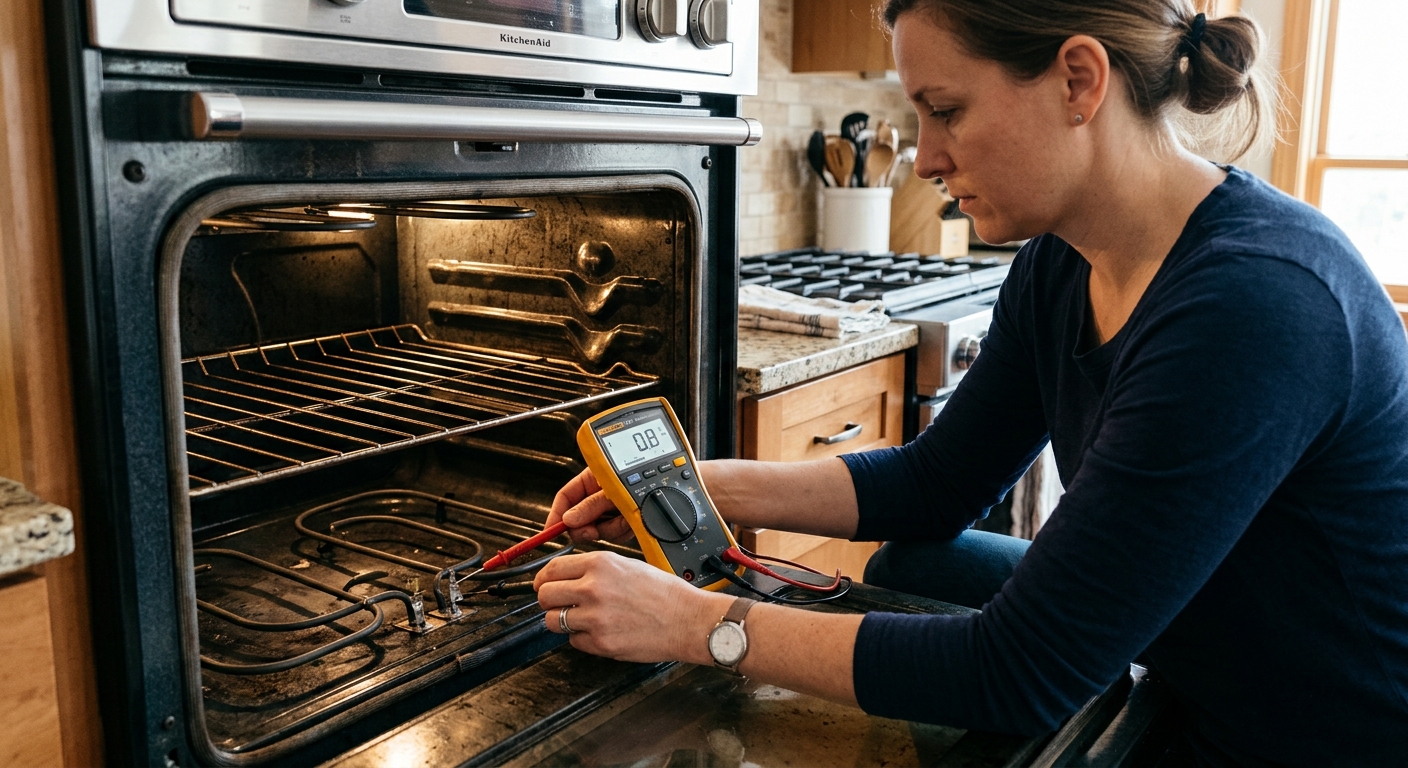
- For electric ovens: with the oven unplugged, visually inspect the bake element (bottom of the oven cavity) and broil element (top) for visible cracks, blistering, holes, or burn marks. A damaged element is almost always the cause of slow preheat in electric ovens.
- Order a replacement bake element by searching your oven’s model number (printed inside the door frame) on a parts site such as RepairClinic or PartSelect. Elements typically cost $20 to $50 and take 15 minutes to swap using only a screwdriver.
- For gas ovens: use a multimeter set to measure amps or resistance to test the igniter. An igniter drawing less than 3.2 amps or measuring above 1,200 ohms resistance is weak and should be replaced. Replacement igniters cost $15 to $40.
- To replace the door gasket on either oven type: pull the old gasket out of its channel or unscrew any retaining clips, order the exact replacement by model number, and press or clip the new gasket into place. No tools are needed for most models.
- After any repair, run the oven thermometer test again from Step 3 of the quick fix approach. Confirm it reaches 350°F within 15 minutes and holds temperature within 10 to 15 degrees of the set point during a 30-minute hold.
- If replacing elements or the igniter does not resolve the issue, the control board or temperature sensor probe may be at fault. At this stage, weigh the cost of a service call ($75 to $150 diagnostic fee) against the age and replacement value of the appliance.
Why It Works: The Benefits
A properly functioning oven hits 350°F in 10 to 15 minutes. Fixing a degraded element or recalibrating your thermostat can cut preheat time in half, saving 10 to 25 minutes per cooking session.
An oven running 20 extra minutes per use at roughly 4 kWh draws about 1.3 extra kWh per session. At $0.15 per kWh, that is $0.20 wasted per cook, adding up to $25 to $50 per year for households that cook daily.
Recalibrating a thermostat that has drifted 25 to 50 degrees eliminates the guesswork that leads to undercooked roasts or burnt cookies, since your oven will actually match the temperature you set.
Catching a partially failed igniter or a stressed bake element early prevents the kind of complete failure that can damage oven components further and turn a $25 repair into a $150 service call.
A leaking door gasket spills heat into your kitchen, raising ambient temperature during cooking. Replacing a worn gasket keeps heat where it belongs, reducing cooling load in summer by a measurable amount in smaller kitchens.
💰 Savings Impact by Action
Replacing a degraded bake element restores full wattage output and can cut preheat time by up to 40% compared to a partially failed element.
Replacing a cracked or worn door gasket reduces heat loss during cooking by up to 20%, cutting the time the element must run to maintain temperature.
Correcting a 40-degree thermostat drift eliminates the extra cycling time wasted while the oven undershoots its target, reducing effective energy use by roughly 15% per session.
Removing heavy bakeware and extra racks stored inside the oven reduces thermal mass load and can shorten preheat time by 20 to 30% at zero cost.
🏠 Key Concepts Explained
The Science Behind It
Your oven maintains temperature through a simple feedback loop: a temperature sensor or thermostat reads the cavity air temperature, signals the control board when it drops below the set point, and triggers the heating element or gas burner to fire. In a healthy electric oven, the 2,500-watt bake element draws about 10 amps at 240 volts and dumps enough heat into the cavity to raise air temperature roughly 35 to 50 degrees per minute when empty. That is how a typical oven reaches 350°F from cold in about 10 to 12 minutes.
When any part of this loop degrades, the math breaks down. A bake element with internal cracking may only deliver 60 to 70% of its rated wattage, cutting heat output dramatically. A thermostat that has drifted 40 degrees high tells the control board the oven is already at 390°F when it has only reached 350°F, so the element shuts off too soon and the oven cycles slowly around a temperature 40 degrees below what you set. Either failure mode looks identical from the outside: a very slow preheat and inconsistent cooking results.
Door gaskets matter more than most people realize. Ovens are not perfectly sealed, but a good gasket maintains enough pressure that the hot air inside has to do real work to escape. When the gasket fails, convective currents carry heat out continuously, and your element runs almost constantly just to compensate. In addition to wasting energy, this sustained high element duty cycle shortens element life significantly, turning a $10 gasket replacement into an eventual $50 element replacement if ignored long enough.
Frequently Asked Questions
▼ My oven beeps that it is preheated but the thermometer says it is 50 degrees too cold. What is wrong?
This is almost always thermostat calibration drift or a failing oven temperature sensor probe. First, try adjusting the calibration offset in your oven’s settings menu to add 50 degrees. If the oven still cannot reach temperature accurately after calibration adjustment, the RTD sensor probe (a thin metal rod inside the cavity, usually at the back wall) is likely failing and costs $20 to $40 to replace yourself.
▼ My electric oven preheats fine but takes much longer than it used to. Nothing looks broken inside.
A partially failed bake element can still glow and produce some heat without showing visible damage. Unplug the oven, remove the element, and check it with a multimeter set to resistance mode. A healthy bake element reads between 10 and 40 ohms depending on wattage. An open circuit reading (OL or infinite resistance) confirms the element has failed internally and needs replacement even if it looks intact.
▼ Can I use my oven while it is slow to preheat, or is it a safety risk?
A slow preheat due to a degraded element, weak igniter, or thermostat drift is generally not a safety hazard in the short term, just an energy and accuracy problem. However, a cracked bake element that is arcing can cause sparks and should be replaced immediately. If you see any sparking, flashing, or smell burning plastic, stop using the oven and replace the element before cooking again.
▼ How do I know if my gas oven igniter is weak without a multimeter?
Watch the igniter glow after you set the oven to bake. A healthy igniter glows bright orange-white within 30 to 45 seconds and opens the gas valve, causing the burner to light within about 60 seconds of turning the oven on. A weak igniter glows dull orange-red, takes 90 seconds or longer to light the burner, or causes the oven to click repeatedly before igniting. Any of those signs means the igniter should be replaced.
▼ My oven is 15 years old and slow to preheat. Is it worth repairing or should I replace it?
If the diagnosis points to a bake element, igniter, gasket, or sensor probe, a repair costing $20 to $75 is almost always worth it on a 15-year-old oven that is otherwise functioning. If the control board is the culprit, boards often cost $100 to $250 plus labor, at which point comparing that to the cost of a new entry-level oven ($400 to $600) makes sense. The general rule is to avoid repairs that exceed 50% of the appliance’s current replacement value.
Quick Tips
- Write your oven’s model number on a sticky note inside a cabinet door so you can quickly look up parts without pulling the appliance out from the wall.
- Run the thermometer test once every six months to catch calibration drift early before it affects your cooking or energy use.
- Never line the oven bottom with aluminum foil. It blocks airflow from the bake element and can cause temperature readings to be wildly inaccurate, mimicking a thermostat failure.
- On convection ovens, always verify the fan is actually spinning during preheat. Open the oven briefly 5 minutes in and listen or look for fan movement. A silent fan in convection mode is a clear sign of motor failure.
Variations for Your Situation
- Apartment/Rental: You cannot replace elements or gaskets without landlord approval in most leases, but you can absolutely run the oven thermometer test and document the results. If your oven reads 50 degrees or more below the set temperature, present the written thermometer readings to your landlord or property manager as evidence of a needed repair. Many states require landlords to maintain working appliances, and a written request with data is far more effective than a verbal complaint.
- Tight Budget (under $50): An $8 to $15 oven thermometer is the single most impactful purchase you can make. It diagnoses calibration drift for free and can be corrected in minutes at zero cost using the control panel offset setting. Removing stored bakeware and extra racks costs nothing and can cut preheat time by 20 to 30%. If your gasket is worn, replacement gaskets for common oven models often cost $10 to $20 on parts sites and require no tools.
- Older Home (pre-1990 appliances): Ovens from the 1980s and early 1990s often use mechanical thermostat bulb systems rather than electronic RTD probes, and calibration offset menus do not exist on these models. Your option for calibration is to manually adjust a small screw on the temperature knob shaft, which varies by model. For these older units, a slow preheat almost always means the element or igniter is worn and should be prioritized for replacement since parts are still widely available for most major brands at $15 to $50.