If you have ever walked into a brand-new home and noticed how still and even the air feels, you were experiencing the result of modern building codes at work. New builds constructed after 2012 are typically required to meet strict air-tightness standards, often testing at 3 air changes per hour or fewer. Older homes, especially those built before 1980, routinely leak at 10 to 20 air changes per hour. That difference shows up as drafts near windows, cold floors in winter, stuffy upstairs bedrooms in summer, and monthly energy bills that seem impossible to control.
The good news is that comfort is a fixable problem. Unlike a leaky roof or a failing foundation, the issues that make old houses uncomfortable are almost entirely related to air sealing, insulation, and mechanical systems. Each of these can be addressed incrementally, and many improvements pay for themselves in under two years through energy savings alone. You do not need to gut your walls or take out a home equity loan to feel a dramatic difference.
This guide walks you through the most impactful upgrades in order of effort and cost, from free fixes you can do in an afternoon to professional-grade improvements worth every dollar. By the end, you will know exactly where your house is losing comfort and money, and how to stop it.
What You’ll Need
Click on an item below to shop for the recommended items for this recipe on Amazon.
As an Amazon Associate, we earn from qualifying purchases.
How to Do It
- On a cold or windy day, walk slowly around your home holding a stick of incense or a damp hand near window frames, door edges, electrical outlets on exterior walls, and baseboards. Mark any spots where you feel air movement with a sticky note.
- Purchase foam outlet and switch plate gaskets (about $5 for a pack of 10) and install them behind every cover plate on exterior walls. This alone can reduce infiltration by 5 to 10% in older homes.
- Apply self-adhesive foam or V-strip weather stripping to all exterior door edges. Press the door closed against the stripping to confirm contact. Replace door sweeps on any door where you can see light under it when closed.
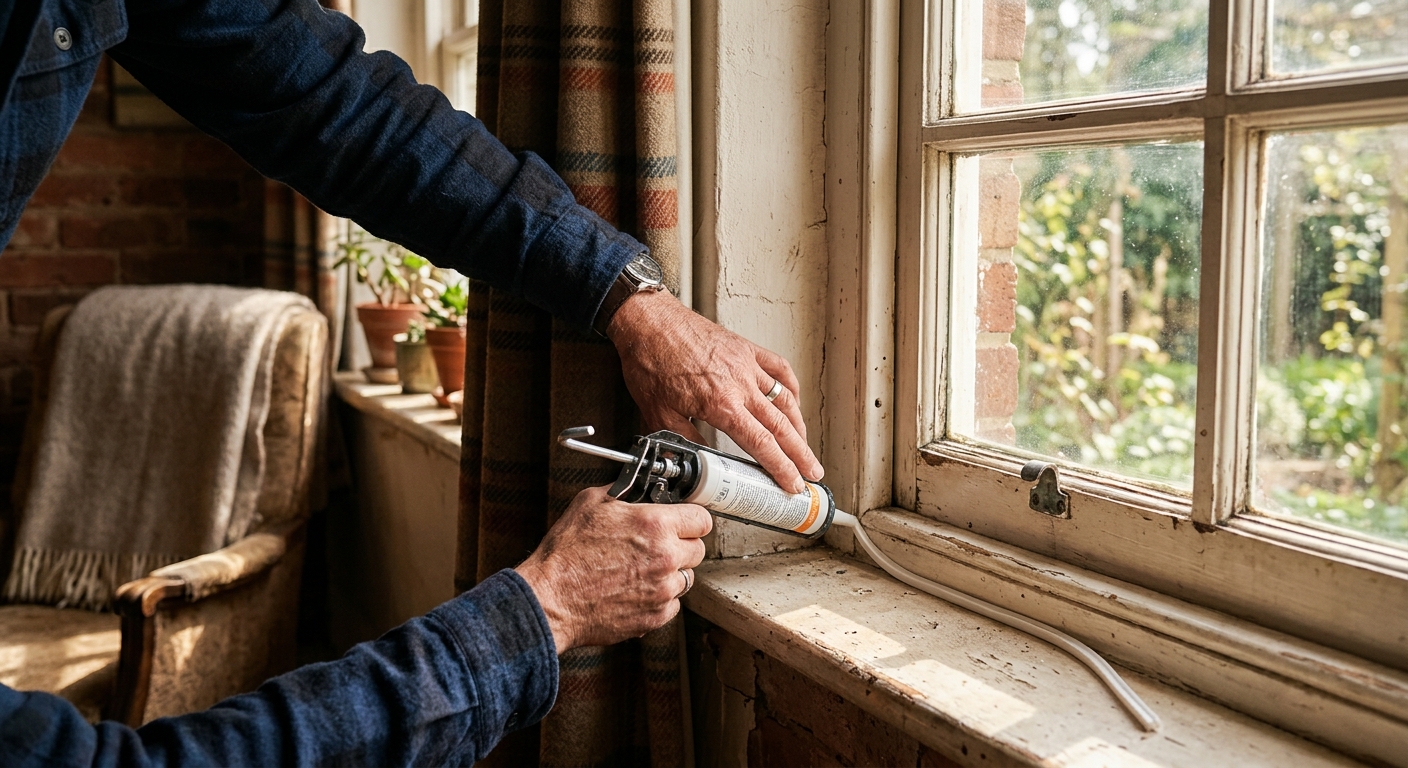
- Re-caulk around every window frame on the interior where the frame meets the drywall or plaster. Use a paintable latex caulk. Run a continuous bead and smooth it with a damp finger. This seals the gap between the rough framing and the window unit that installers often leave open.
- Check your attic hatch. If it has no weatherstripping and no insulation on top, add both. Glue a 4-inch-thick piece of rigid foam board to the top of the hatch door. This single fix can save 1 to 2% on annual energy bills by itself.
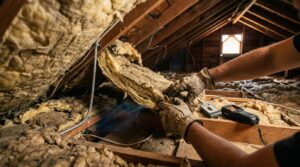
- Before entering the attic, check your current insulation depth. Older homes often have R-11 to R-19 (3.5 to 6 inches of fiberglass). The DOE recommends R-38 to R-60 in most climates. Calculate how many bags of blown cellulose or fiberglass you need using the bag calculator on the insulation packaging.
- Rent a blow-in insulation machine from a home improvement store (usually free when you purchase a minimum number of bags). Wear a respirator, safety glasses, and long sleeves. Lay plywood boards across joists to work from.
- Before adding any insulation, seal every penetration you can find using canned spray foam. Key targets include: plumbing stacks, electrical wire holes, gaps around recessed light cans (use fire-rated foam), the top of interior partition walls (often open to the attic), and the attic hatch frame.
- Install cardboard or foam baffles at each rafter bay along the eaves to maintain ventilation from soffit vents. Without these, blown insulation will block airflow and cause moisture problems.
- Blow in insulation to the target depth. Use a ruler or depth markers (sticks pushed into the insulation) to ensure even coverage. Do not cover soffit baffles or any attic ventilation.
- Check for and seal any duct connections in the attic. Leaky ducts in unconditioned attics are responsible for 20 to 30% HVAC efficiency losses. Use mastic sealant (not duct tape) on all joints and seams.
- Hire a BPI-certified energy auditor or request a free or subsidized audit through your utility company. Ask specifically for a blower door test and thermal imaging scan, not just a visual walkthrough.
- Review the audit report, which will rank improvements by cost-effectiveness. Prioritize any items in the top tier, which typically includes attic air sealing, attic insulation, and basement rim joist sealing.
- Have a weatherization contractor seal the rim joist (the band of framing where the floor meets the foundation walls) with two-component spray foam. This area accounts for up to 15% of total air leakage in many older homes and is difficult to access effectively without professional equipment.
- If your HVAC system is more than 15 years old or was never properly sized, have a contractor perform a Manual J load calculation. An oversized system is a major comfort problem that no amount of insulation will fully fix. A properly sized heat pump or furnace with variable-speed blower will distribute air far more evenly.
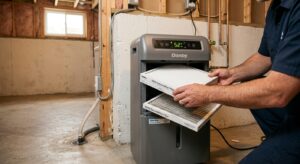
- Consider adding a heat recovery ventilator (HRV) or energy recovery ventilator (ERV) once the home is significantly tightened. A very tight house needs controlled ventilation to maintain air quality. An HRV exchanges stale indoor air for fresh outdoor air while recovering 70 to 80% of the heat in that outgoing air.
Why It Works: The Benefits
Combining air sealing and attic insulation typically cuts heating and cooling costs by 20 to 40% annually, according to DOE data. On a $200 monthly energy bill, that is $480 to $960 back in your pocket each year.
Sealing the top 20 bypass points in an older home, including around plumbing penetrations, attic hatches, and recessed lights, can reduce air infiltration by 30 to 50%, making rooms feel noticeably warmer in winter without touching the thermostat.
A tighter home allows your HVAC system to properly dehumidify in summer. Homes that feel muggy at 74 degrees often feel comfortable at 76 degrees once infiltration is reduced, letting you raise the thermostat setpoint and save an additional 6 to 8% on cooling.
Properly air-sealed and insulated homes show temperature variation of 2 to 3 degrees between rooms. Leaky older homes routinely have 8 to 12 degree swings between floors and corners, which no thermostat setting can fully correct.
Air sealing and added insulation also reduce sound transmission from outside. Homeowners often report a noticeably quieter home after comprehensive air sealing, a comfort benefit that does not show up on an energy bill but is immediately felt.
💰 Savings Impact by Action
Sealing attic bypasses before adding insulation recovers effective R-value and cuts heating and cooling loads by 10 to 15% in older homes.
Upgrading attic insulation from R-11 to R-38 reduces heat gain and loss through the ceiling by up to 20%, the largest single efficiency gain available in most older homes.
Replacing worn weather stripping and re-caulking window frames eliminates 10 to 15% of total air infiltration in a typical pre-1980 home.
Professionally sealing the rim joist with two-component spray foam addresses up to 15% of total air leakage in older two-story homes.
Installing a programmable or smart thermostat and using proper setback schedules saves 8 to 12% on annual heating and cooling independent of any physical upgrades.
🏠 Key Concepts Explained
The Science Behind It
The comfort gap between old and new homes is fundamentally a physics problem rooted in pressure, heat transfer, and moisture. In a leaky older home, the stack effect creates a constant low-pressure zone at the bottom of the house and a high-pressure zone at the top. This pressure difference pulls cold outdoor air in through every crack at floor level while warm indoor air escapes through the attic. Your furnace is essentially heating the outdoors, just slowly. Reducing air changes per hour from 15 to 5 does not just save energy proportionally. It changes the entire thermal behavior of the house.
Insulation works by trapping air in tiny pockets, slowing conductive heat transfer. But insulation only performs at its rated R-value when air is not moving through it. A fiberglass batt rated R-19 that sits against a gap or bypasses drops to an effective R-value of R-5 or lower when air can short-circuit around it. This is why air sealing before insulating is not optional. It is what makes the insulation work. Building scientists refer to this as the difference between the nominal R-value and the whole-assembly R-value, and in older homes the gap between those two numbers is enormous.
Modern new builds use advanced framing techniques, continuous exterior insulation, and factory-sealed windows to minimize thermal bridging and infiltration simultaneously. You cannot replicate all of that without gutting walls, but you can achieve 70 to 80% of the benefit by focusing on the attic plane and the foundation plane, which together account for roughly 50 to 60% of all heat loss in a typical two-story older home. That is where building science directs the effort first, and where your money will go furthest.
Frequently Asked Questions
▼ I sealed everything I could find but my house still feels drafty in winter. What am I missing?
The biggest leaks in most older homes are invisible from inside: the top plates of interior walls in the attic, the rim joist at the foundation, and recessed light cans that open directly into the attic. A professional blower door test with thermal imaging can locate these hidden bypasses in about two hours. This is where professional audits earn their cost, because they find what DIY inspections almost always miss.
▼ My upstairs bedrooms are always 8 to 10 degrees hotter than the rest of the house in summer. What causes this?
This is almost always a combination of inadequate attic insulation, air leakage from the stack effect pushing hot air upward, and potentially undersized or poorly balanced ductwork serving the upper floor. Start with the attic air sealing and insulation upgrade. If the problem persists after that, have an HVAC tech check static pressure and airflow at the upper floor registers, as balancing dampers or adding a return air duct are often the next fix.
▼ How long before I actually see lower energy bills after doing these upgrades?
You will see the first measurable change on the bill that covers the month you complete the work, but the most reliable comparison is year-over-year for the same season. Air sealing results are often visible within one billing cycle. Insulation improvements take a full heating or cooling season to show their full value. Track your pre- and post-upgrade usage in kilowatt-hours or therms rather than dollars, since fuel prices fluctuate.
▼ My house was built in 1955 and has plaster walls. Can I still improve insulation without ripping everything out?
Yes. The attic and basement are your primary targets and do not require touching plaster walls at all. For wall insulation in a plaster home, the most practical retrofit option is dense-pack cellulose blown in through small holes drilled from the exterior, then patched and repainted. This preserves the plaster, adds R-13 to R-15 per wall cavity, and typically costs $1,500 to $4,000 for an average home. Get two or three contractor quotes and check for utility rebates.
▼ Will tightening my house cause air quality or mold problems?
Only if you over-tighten without adding mechanical ventilation, which is unlikely with DIY methods. True over-tightening requires professional-grade spray foam applied throughout, not caulk and weatherstripping. However, if you complete the professional approach and bring your home near 3 ACH, adding a bath fan on a timer or an HRV unit is a worthwhile next step. ASHRAE standard 62.2 recommends 0.35 ACH of fresh air as a minimum for healthy indoor air quality.
Quick Tips
- Do your air sealing work on a cold or windy day so air movement is easier to detect with a hand or incense stick.
- Check your local utility company website before buying any materials. Many offer rebates of 20 to 50% on insulation, smart thermostats, and air sealing supplies.
- A programmable or smart thermostat adds 8 to 12% savings on top of any physical improvements by optimizing setback schedules. Install one before the heating or cooling season peaks.
- Thermal curtains on north-facing windows cost $20 to $40 per window and reduce radiant heat loss in winter by up to 25%, giving an immediate comfort boost with zero tools required.
Variations for Your Situation
- Apartment/Rental: Renters cannot modify HVAC or insulation, but can still close 30 to 40% of the comfort gap. Focus on interior window insulation film ($15 to $25 per window), draft snakes at door bases, foam outlet gaskets, and thermal curtains. A portable smart thermostat is not an option, but a personal space heater with a built-in thermostat for a single room can cut overnight heating costs significantly without any landlord approval needed.
- Tight Budget (under $50): Spend $10 on foam outlet gaskets for all exterior walls, $12 on a roll of V-strip weather stripping for your worst door, $8 on a door sweep, and use leftover caulk to seal visible window frame gaps. This combination targets the easiest 10 to 15% of air leakage and costs almost nothing. Prioritize whichever room you spend the most time in for the biggest perceived comfort return.
- Older Home (pre-1960) with Knob-and-Tube Wiring: Do not use spray foam or blown insulation in wall cavities or attic spaces containing active knob-and-tube wiring without an electrician’s clearance first. Focus on the attic only after having the wiring assessed, and address rim joists and windows in the meantime. Budget an additional $1,500 to $4,000 to rewire affected attic circuits if you want to proceed with full insulation upgrades, but the long-term safety and comfort payoff is substantial.