Your attic is the single biggest source of heat loss in winter and heat gain in summer, responsible for up to 25% of a home’s total energy transfer. Yet most homeowners either have no idea what R-value their attic holds, or assume that once insulation is installed, the job is done forever. The truth is, many homes built before 2000 are significantly under-insulated by today’s standards, and the gap between R-38 and R-60 can translate to hundreds of dollars per year in wasted energy.
R-value measures thermal resistance – how effectively insulation slows heat movement. The higher the number, the better it resists heat flow. But here’s the part most people miss: the relationship between R-value and savings is not linear. Going from R-11 to R-38 cuts heat loss dramatically, but going from R-38 to R-60 delivers a smaller, though still real, improvement. Whether that upgrade pencils out depends on your climate, your current insulation depth, and your energy costs.
This post gives you a clear, honest breakdown of what R-38 and R-60 actually mean in practice, how much upgrading typically saves, and whether adding more insulation to your attic is a smart investment for your specific situation. You’ll walk away knowing exactly what to check, what to expect, and how to get it done.
What You’ll Need
Click on an item below to shop for the recommended items for this recipe on Amazon.
As an Amazon Associate, we earn from qualifying purchases.
How to Do It
- Access your attic hatch safely using a ladder rated for your weight. Wear a dust mask, safety glasses, and long sleeves since attic insulation irritates skin and lungs.
- Use a ruler or tape measure to check the depth of your existing insulation in several spots across the attic floor, including near the eaves and in the center.
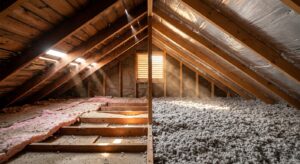
- Identify the insulation type: fiberglass batts are fluffy and yellow or pink, cellulose is gray and paper-like, and spray foam is rigid and often yellow or off-white. Each material has a different R-value per inch (fiberglass batts average R-2.5 per inch, blown cellulose averages R-3.7 per inch).
- Multiply depth in inches by the R-value per inch to estimate your current total R-value. If you have 6 inches of fiberglass batts, that is roughly R-15, well below the R-38 minimum recommended for most US climates.
- Check the DOE’s Zip Code Insulation Estimator (available at energysaver.gov) to find the recommended R-value for your specific climate zone and compare it to what you measured.
- Note any visible air bypasses while you are up there: gaps around light fixtures, plumbing penetrations, attic hatches without insulation, or open stud cavities. Sealing these before adding insulation significantly improves results.
- Before adding insulation, seal all air bypasses with caulk or foam: light fixture boxes, top plates of interior walls, plumbing and electrical penetrations, and the attic access hatch. This step alone can save 15 to 20% on energy bills and costs almost nothing.
- Install an insulated attic hatch cover or insulated attic stair cover if your current hatch lacks insulation. These are available for $50 to $150 and are one of the highest return attic improvements you can make.
- Install ventilation baffles (also called rafter baffles or insulation stops) in each rafter bay along the eaves to prevent blown-in insulation from blocking soffit vents. This is critical for moisture management and takes about 30 minutes.
- Rent the blower machine and load your first bag of blown-in insulation (cellulose is recommended for DIY because it is lower cost, made from recycled material, and performs well at R-3.7 per inch). Have a helper feed bags while you handle the hose.
- Work from the far corners of the attic toward the access hatch, distributing insulation evenly. Use depth rulers or stake markers (cut from cardboard or purchased) every few feet so you can confirm you are hitting your target depth. For R-38 with cellulose, you need approximately 10 to 11 inches. For R-60, you need approximately 16 inches.
- After the job, check that soffit vents remain clear and that no insulation is blocking airflow at the eaves. Confirm depth in at least 10 locations across the attic floor to ensure even coverage.
- Request quotes from at least three insulation contractors. Ask each for a written proposal specifying the insulation type, installed R-value, depth at completion, and whether air sealing is included as a separate line item.
- Ask the contractor to perform or recommend a blower door test before and after installation. This confirms that air sealing work actually reduced infiltration and is increasingly required for utility rebate programs.
- Have the contractor address any existing moisture issues, damaged batts, or pest damage before adding new insulation on top. Installing over compromised insulation significantly reduces real-world performance.
- Confirm that the contractor will install baffles at the eaves and will not block soffit or ridge ventilation. Proper attic ventilation is non-negotiable for long-term moisture control.
- After installation, ask for photos of the completed attic and a written statement of the installed R-value and square footage covered. This documentation is required to claim the federal 30% Inflation Reduction Act tax credit.
- File IRS Form 5695 with your tax return to claim the Residential Clean Energy Credit for insulation upgrades meeting ENERGY STAR specifications, up to $1,200 per year.
Why It Works: The Benefits
Upgrading from R-19 to R-38 typically saves 15 to 30% on heating and cooling costs annually. Moving from R-38 to R-60 adds another 8 to 12%, with the biggest gains seen in climates with extreme winters or hot summers.
Rooms directly under the attic, especially bedrooms, stay 2 to 5 degrees more stable year-round once the ceiling assembly reaches R-38 or above, reducing the hot and cold spots that make you reach for the thermostat.
When the thermal envelope is tighter, your furnace and air conditioner run fewer cycles to maintain temperature. This can extend equipment lifespan by several years and reduce maintenance costs over time.
Homes with attic insulation at or above DOE recommended levels score better on energy audits and HERS ratings, which increasingly appear in real estate listings and can influence buyer decisions and appraised value.
Through 2032, the Inflation Reduction Act allows homeowners to claim a 30% tax credit (up to $1,200 per year) on insulation upgrades that meet ENERGY STAR requirements, significantly shortening the payback period.
💰 Savings Impact by Action
Upgrading from minimal insulation to R-38 reduces ceiling heat loss by up to 70%, translating to roughly 20 to 28% savings on total heating and cooling costs for most homes.
Adding insulation from R-38 to R-60 delivers an additional 10 to 12% reduction in ceiling heat loss, worth $80 to $180 per year in cold climate zones.
Sealing attic bypasses before insulating reduces whole-house air infiltration by 15 to 20%, which multiplies the effectiveness of every R-value improvement above it.
An uninsulated attic hatch can have an effective R-value of R-0 to R-1, and sealing and insulating it alone can reduce attic heat loss by 5 to 8% at very low cost.
Leaky ducts running through an uninsulated attic can waste 20 to 30% of conditioned air before it reaches living spaces, and sealing them recovers 10 to 15% of total HVAC energy use.
🏠 Key Concepts Explained
The Science Behind It
Heat always moves from warm areas to cold ones, and it does so through three mechanisms: conduction (direct transfer through a solid material), convection (movement through air currents), and radiation (infrared transfer through space). Insulation primarily addresses conduction by trapping air in tiny pockets within fibers or foam, where it cannot move freely enough to carry heat efficiently. The R-value rating tells you how many hours it takes for one BTU of heat to move through one square foot of material per degree Fahrenheit of temperature difference – the higher the number, the slower the transfer.
The diminishing returns principle is central to understanding why R-38 versus R-60 is not a simple doubling of benefit. Heat loss through a ceiling assembly is calculated as: Heat Loss = Area x Temperature Difference divided by R-value. At R-19, one square foot loses roughly 5.3% as much heat as uninsulated space. At R-38, that drops to 2.6%. At R-60, it drops to 1.7%. Each step delivers real improvement, but the jump from R-19 to R-38 delivers more than twice the benefit of the jump from R-38 to R-60. This is why the DOE recommends prioritizing under-insulated homes (below R-30) before chasing diminishing returns at higher levels.
Blown-in insulation outperforms batt insulation at equivalent R-values in real-world conditions because it fills irregular spaces, eliminates gaps around wiring and framing, and covers joists continuously rather than just between them. Wood framing has an R-value of about R-1.25 per inch compared to R-3.7 for cellulose, so every joist represents a thermal bridge. A continuous blanket of blown-in material reduces this bridging effect significantly, meaning a blown-in R-49 attic often performs comparably to a batt-insulated R-54 attic in practice.
Frequently Asked Questions
▼ My attic already has R-38. Is upgrading to R-60 actually worth the money?
It depends heavily on your climate and energy costs. In climate zones 5 through 7 (northern states, mountain regions), upgrading from R-38 to R-60 typically saves 8 to 12% on ceiling heat loss, which may translate to $80 to $180 per year depending on your heating bills. At a DIY cost of $300 to $500 for a 1,500 square foot attic, payback runs roughly 3 to 5 years in cold climates. In zones 2 through 4, the payback stretches to 6 to 10 years, making it lower priority compared to other improvements like air sealing or duct insulation.
▼ How do I know if my existing insulation is still working properly?
Insulation degrades when it gets wet, compressed, or contaminated. Look for water stains, discoloration, or a matted appearance, all of which indicate moisture damage that has reduced R-value. Fiberglass batts that have been compressed by foot traffic or stored items lose R-value proportionally to how much they are compressed. If your insulation looks thin, stained, or has visible gaps, have an energy auditor assess it before adding more on top.
▼ Can I just add batts on top of my existing insulation?
Yes, with one important rule: any new batts laid on top of existing insulation must be unfaced (no kraft paper or foil vapor barrier facing). Faced batts installed on top create a moisture trap that can cause condensation and mold in the ceiling assembly. Lay unfaced batts perpendicular to the existing joists to cover framing members and reduce thermal bridging. Blown-in cellulose or fiberglass is generally easier and more effective than adding batts for a top-up layer.
▼ My energy bills haven’t dropped after I added attic insulation. What went wrong?
The most common cause is that air sealing was skipped before insulation was added. Insulation slows conductive heat loss but does nothing to stop air leakage through gaps and penetrations, which can account for a large portion of actual heat loss. Return to the attic and look for gaps around top plates, light fixtures, duct boots, and the attic hatch. Sealing these with foam and caulk after the fact still delivers significant savings. Also check whether your ducts run through the attic unconditioned space – leaky attic ducts are one of the most common reasons insulation upgrades underperform.
▼ What if I have a finished attic or cathedral ceiling instead of a standard attic floor?
Cathedral ceilings and finished attic spaces are significantly more complex because there is limited rafter cavity depth for insulation and ventilation must be maintained simultaneously. Standard blown-in approaches do not apply here. Options include spray foam (which can achieve R-38 in 6 to 7 inches with closed-cell foam), rigid foam above the roof deck during a re-roofing project, or a hybrid assembly combining cavity insulation with continuous foam. These projects require a building scientist or experienced insulation contractor to avoid moisture problems.
Quick Tips
- Mark your attic’s current insulation depth on a piece of tape stuck near the access hatch so you always know where you are starting from when assessing future upgrades.
- If you are in DOE climate zones 4 through 7 and your attic is below R-38, you are likely leaving $150 to $400 per year on the table in energy costs – prioritize this upgrade before any HVAC equipment replacement.
- Check with your utility company before starting: many offer rebates of $0.05 to $0.20 per square foot of insulation added, which can reduce total project cost by $100 to $400 on a typical home.
- Cellulose blown-in insulation settles about 15 to 20% after installation, so installers should overshoot the target depth slightly to account for this. Ask your contractor or bag calculator to include a settling factor.
Variations for Your Situation
- Apartment/Rental: Renters cannot modify attic insulation directly, but you can still reduce heat loss at the ceiling level by hanging insulated curtains on skylights, adding a draft snake at door bottoms, and placing foam backer rod behind electrical outlets on exterior walls. For significant savings, ask your landlord in writing to conduct an energy audit, since landlords in many states are incentivized through utility rebate programs to upgrade insulation.
- Tight Budget (under $50): Focus entirely on air sealing, which costs almost nothing and delivers outsized results. A $15 can of expanding foam and a $10 tube of acoustic caulk can seal dozens of penetrations around top plates, light fixtures, and the attic hatch. Adding an insulated attic hatch cover ($50 to $100) or a DIY rigid foam lid ($10 to $15 in materials) addresses one of the most overlooked heat loss points in the entire house without touching the main insulation at all.
- Older Home (pre-1980): Homes built before 1980 often have knob-and-tube wiring in the attic, which cannot be covered with insulation under most local codes without an electrician certifying it is safe or replacing it. Have an electrician inspect the attic before any insulation work. These homes also frequently have uninsulated attic hatches, open balloon-frame cavities, and no soffit baffles installed, making a professional energy audit the best first step to prioritize improvements correctly. Budget $200 to $300 for the audit; many utilities subsidize or fully cover the cost.