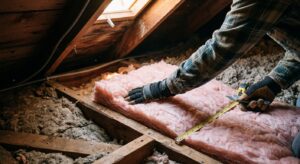
Adding insulation to your attic sounds like a straightforward win, and it is, but only if you do one critical step first. Air sealing the attic floor before laying down new insulation is the single most overlooked upgrade in home energy efficiency. Without it, you can pile on R-60 of fluffy insulation and still lose a shocking amount of conditioned air through hidden gaps around pipes, wires, recessed lights, and wall top plates.
Here is the problem: warm air rises. In winter, that warm air carries heat straight up through every tiny gap in your ceiling and into the cold attic, dragging your heating bills with it. In summer, the same stack effect pulls hot, humid attic air down into your living space, overworking your air conditioner. The Department of Energy estimates that air leakage accounts for 25 to 40% of the energy used for heating and cooling in a typical home, and the attic is the single biggest contributor.
This guide walks you through exactly how to find and seal those leaks before your insulation contractor shows up, or before you roll out that next bale of batts yourself. Whether you are a weekend DIYer or planning to hire a pro, understanding this process will save you real money and make your home dramatically more comfortable year-round.
What You’ll Need
Click on an item below to shop for the recommended items for this recipe on Amazon.
As an Amazon Associate, we earn from qualifying purchases.
How to Do It
- On a cool morning, put on a respirator rated N95 or better, safety glasses, gloves, and long sleeves before entering the attic. Lay planks or boards across joists to kneel on so you do not fall through the ceiling.
- Use a bright flashlight or headlamp to locate the major leak points: tops of interior walls (top plates), wiring and plumbing penetrations, recessed light cans poking through the ceiling, attic hatch framing, and any dropped soffits above kitchen cabinets or bathrooms.
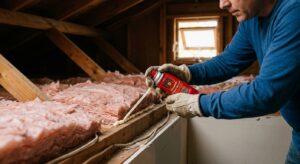
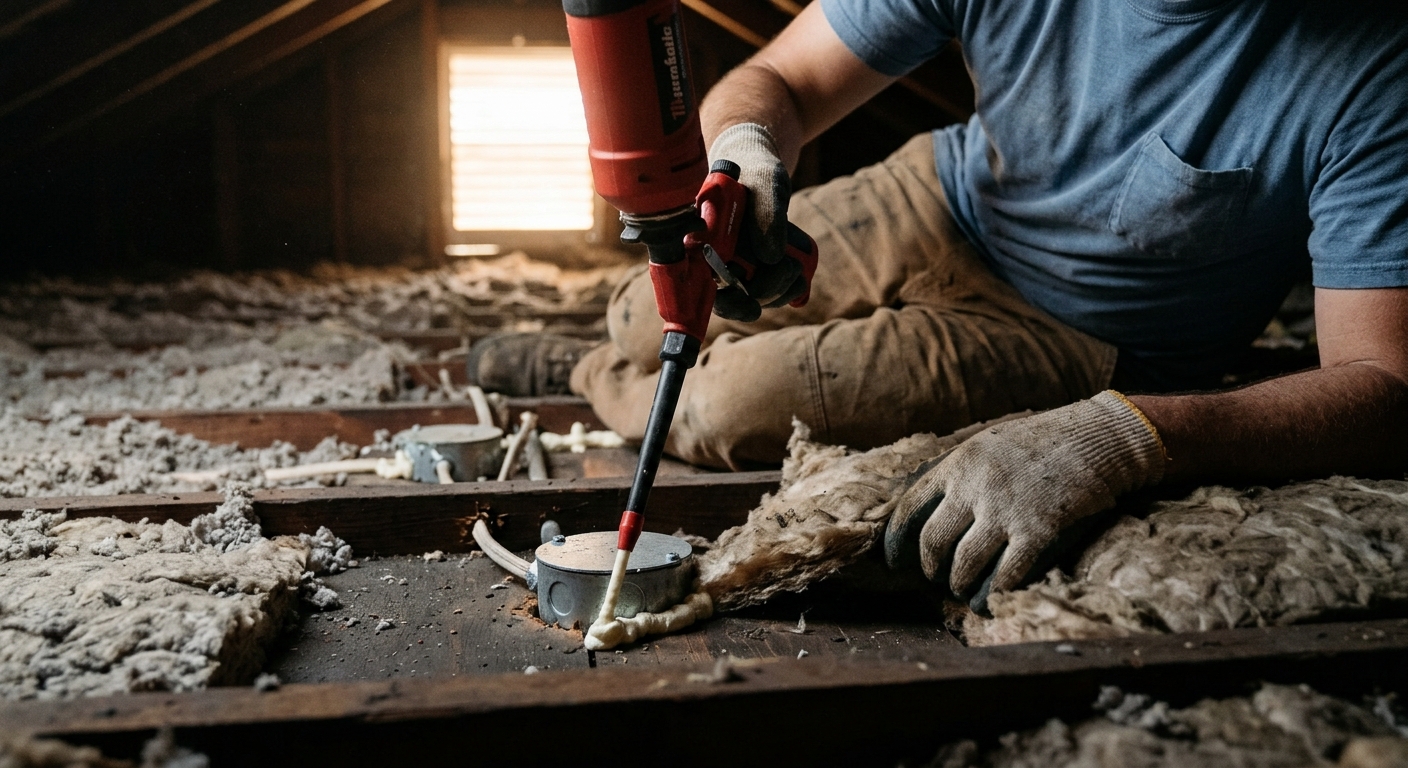
- Seal small gaps around wires, pipes, and conduit under 3 inches using canned spray foam (low-expansion type). Hold the nozzle inside the gap and fill from the back out to prevent blowout. Wipe excess while still tacky.
- Seal larger gaps and open top plates over interior walls using either acoustical caulk for thin cracks or rigid foam board cut to fit and glued with foam, then taped with foil tape for gaps wider than 1 inch.
- For recessed light cans that are not rated IC (insulation contact), build an airtight cover from rigid foam board using 2-inch foam, cut into a box shape, sealed at every seam with foil tape, and caulked to the ceiling drywall around the base. Leave 3 inches of air space around the can for heat dissipation.
- Seal the attic hatch by weatherstripping the frame perimeter and gluing rigid foam board to the back of the hatch door to add R-10 or more. After all sealing is complete, add or redistribute insulation to achieve a minimum R-38 for most US climate zones, or R-49 to R-60 in colder zones.
- Hire a BPI-certified building analyst or an ENERGY STAR contractor to perform a blower door test first. This pressurizes the home and quantifies exactly how leaky your house is, giving you a baseline number (ACH50) to measure improvement against.
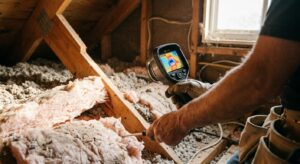
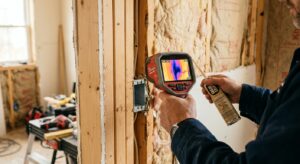
- Ask the contractor to use a thermal camera during the blower door test to map leak locations on the ceiling before entering the attic. This step alone makes the sealing far more targeted and effective than guessing.
- The contractor will apply two-part spray polyurethane foam to all major penetrations, top plates, and bypasses. Two-part foam cures rigid, fills large voids completely, and provides R-6 to R-7 per inch where applied, far superior to canned foam for large areas.
- Request that the contractor seal dropped soffits and chases, which are the single largest source of attic air leakage in homes built before 1990. These hollow cavities connect living space directly to the attic and are rarely sealed at the attic floor.
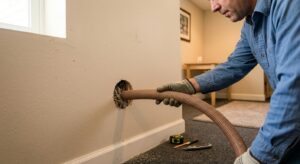
- After sealing, have blown-in cellulose or fiberglass installed to the depth needed for your climate zone (R-38 to R-60). Blown insulation conforms around obstructions better than batts and is the preferred finish after professional air sealing.
- Request a post-project blower door test to verify the air sealing achieved a meaningful reduction. A well-sealed attic can reduce whole-house ACH50 by 30 to 50%, which directly correlates to the energy savings you will see on your bills.
Why It Works: The Benefits
Combining attic air sealing with insulation can reduce annual heating and cooling costs by 20 to 30%, with the DOE estimating air sealing alone saving 10 to 20% on total energy bills in leaky homes.
Air sealing before insulating ensures your new insulation performs at its rated R-value. Without sealing first, studies show effective R-value can drop by 30 to 50% due to thermal bypass from air movement.
Eliminating attic air leaks reduces drafts, cold spots, and uneven room temperatures, especially in upper-floor rooms that are notoriously hard to heat or cool consistently.
Sealing pathways that allow humid interior air to reach cold attic surfaces prevents condensation, which is a leading cause of wood rot, mold growth, and structural damage in attics.
With less conditioned air escaping, your furnace and air conditioner cycle less frequently. Shorter runtimes extend equipment life and reduce maintenance costs over time.
💰 Savings Impact by Action
Sealing attic air leaks alone can reduce whole-house heating and cooling energy use by 10 to 20% according to DOE estimates for typical leaky homes.
Upgrading attic insulation from R-11 to R-38 reduces ceiling heat transfer by up to 15% of total heating and cooling load in a well-sealed assembly.
Air sealing and insulation together deliver a compounding effect, with most homeowners seeing 20 to 30% total reduction in annual energy costs.
Reduced air leakage and better thermal resistance cut HVAC runtime by an estimated 20 to 25%, extending equipment life and reducing maintenance costs.
🏠 Key Concepts Explained
The Science Behind It
Your attic sits at the top of the stack effect, which is the natural tendency of warm air to rise and escape at the highest available openings in a building. In winter, interior air at 70 degrees Fahrenheit is significantly less dense than cold attic air, so it pushes upward through every gap it can find, carrying heat and humidity with it. This creates a slight negative pressure at the bottom of the house that draws cold outside air in through foundation gaps and lower-level cracks, creating a continuous loop of air exchange that your heating system must constantly compensate for.
Insulation works by slowing conductive heat transfer, the movement of heat through solid materials. But it does almost nothing to stop convective heat transfer, the movement of heat carried by moving air. When air can flow freely through or around insulation, that air carries far more thermal energy per unit of time than conduction through fibers ever could. This is why a perfectly intact R-30 batt sitting over an open top plate can have an effective R-value closer to R-15 or lower. The air short-circuits the insulation entirely.
Spray foam and caulk work on a different principle than insulation. They stop air movement at the source by creating a continuous, rigid air barrier that physically blocks the pressure-driven flow. When you seal penetrations with low-expansion foam, you are creating a bond between two materials that resists both air pressure and the seasonal expansion and contraction that causes caulk to crack over time. The combination of air sealing plus insulation works so well because each addresses a different heat transfer mechanism: sealing stops convection and air-carried moisture, while insulation reduces conduction. Together, they bring your attic assembly close to its theoretical thermal performance rating.
Frequently Asked Questions
▼ How do I find air leaks in my attic if I cannot see obvious gaps?
The most reliable DIY method is to run your HVAC blower on fan-only mode, then move a stick of incense or a smoke pen slowly along the attic floor near top plates, penetrations, and recessed lights. Air movement will swirl or deflect the smoke visibly. For a more precise result, rent a blower door from a local tool rental shop or hire an energy auditor, which typically costs $150 to $400 and includes an infrared scan that maps every major leak location.
▼ Can I just add more insulation without air sealing first?
You can, but you will leave significant savings on the table. Insulation without air sealing often delivers only 30 to 50% of the expected energy reduction because air bypasses the insulation through gaps. Worse, additional insulation can trap moisture from unchecked air leaks, leading to mold inside the insulation itself. If you are spending money on insulation, spending an extra few hours and $100 on sealing first is almost always worth it.
▼ My attic already has 8 inches of insulation. Do I still need to air seal?
Yes, and here is why: existing insulation was almost certainly installed without sealing first. Pull back a section near an interior wall or recessed light and look at the ceiling below. You will very likely find open gaps. Air sealing under existing insulation is harder but still worthwhile, especially around recessed lights and plumbing stacks. A professional with a blower door and thermal camera can confirm whether your current setup has significant bypasses before you invest in more insulation.
▼ Is spray foam safe to use in my attic near electrical wiring?
Low-expansion canned spray foam is safe to apply around standard modern wiring (Romex or NM-B cable) as long as it is not an ignition source. Do not use it directly on junction boxes or near exposed wire terminals. Keep it away from any knob-and-tube wiring entirely. If you are unsure what type of wiring you have, take a photo and have an electrician identify it before you proceed with any sealing work in those areas.
▼ How long before I see the savings show up on my utility bill?
Most homeowners notice a measurable reduction within the first full heating or cooling season after the work is done. Because bills vary month to month based on weather, the clearest way to measure is to compare the same calendar month year over year, ideally normalized for any temperature differences between those two periods. Many utility companies offer free online tools to do exactly this comparison for your account.
Quick Tips
- Work in early morning in summer when attic temperatures are lowest. Attics can exceed 140 degrees Fahrenheit by midday, which is a genuine heat stroke risk.
- Use a can of theatrical smoke or incense near suspected leak points on a windy day with the HVAC fan running to visualize air movement before you seal.
- Seal the attic access hatch last, after all other work is done. It is one of the worst offenders and the easiest to forget.
- Use foil tape specifically, not standard duct tape, to seal rigid foam board seams. Standard duct tape fails within a few years in attic temperature extremes.
Variations for Your Situation
- Apartment/Rental: Renters typically cannot access or modify the attic, but you can still reduce heat gain through your top-floor ceiling. Ask your landlord in writing to have the attic air sealed and insulated, pointing to the energy savings as an incentive. In the meantime, use thermal curtains, a programmable thermostat, and ceiling fans to reduce the impact of a poorly insulated ceiling above you. If you have a landlord willing to split costs, share the DOE’s estimate that air sealing and insulation can reduce energy costs by 20 to 30%, which translates directly to lower utility bills they may be paying.
- Tight Budget (under $50): Focus exclusively on the three highest-impact leak points you can seal with one or two cans of spray foam and a tube of caulk. Those are the attic hatch (weatherstrip the frame for about $8 and add a foam board layer on the hatch door itself), the top plates of interior walls visible from the attic, and any plumbing vent pipes passing through the ceiling. These three areas alone can account for 40 to 60% of total attic air leakage in a typical home and cost almost nothing to address.
- Older Home (pre-1980): Homes built before 1980 often have open balloon framing where wall cavities connect directly to the attic with no blocking, creating massive air channels running the full height of the house. These require rigid foam board or two-part spray foam poured into the open stud bays at the attic floor, not just surface caulking. Also check for knob-and-tube wiring before touching anything and verify that any gas appliances are not atmospherically vented in a way that depends on natural indoor air infiltration for safe combustion. A professional energy audit is strongly recommended before DIY sealing in pre-1980 homes.