You crank the AC, it runs for hours, and your house still feels like a sauna by 3pm. The thermostat reads 78 but it feels like 85. Your energy bill is climbing and nothing seems to help. Before you assume your AC unit is dying, consider this: the most common culprit behind a constantly running air conditioner isn’t the equipment at all. It’s your home’s envelope, its shell of walls, attic, windows, and ductwork, working against the system every step of the way.
The average home loses 20 to 30 percent of its conditioned air through leaky ducts alone, according to the U.S. Department of Energy. Add poorly sealed windows, an under-insulated attic baking at 140 degrees Fahrenheit, and air gaps around outlets and plumbing, and your AC is essentially trying to cool the neighborhood. It’s a losing battle no matter how new or efficient your equipment is.
This post breaks down the real science behind why your AC runs endlessly without results, and gives you a clear path from a free 15-minute diagnosis all the way through targeted DIY fixes and professional upgrades. You’ll learn what to check first, what the biggest energy leaks in a typical home are, and how to prioritize repairs that actually move the needle on your comfort and your bill.
What You’ll Need
Click on an item below to shop for the recommended items for this recipe on Amazon.
As an Amazon Associate, we earn from qualifying purchases.
How to Do It
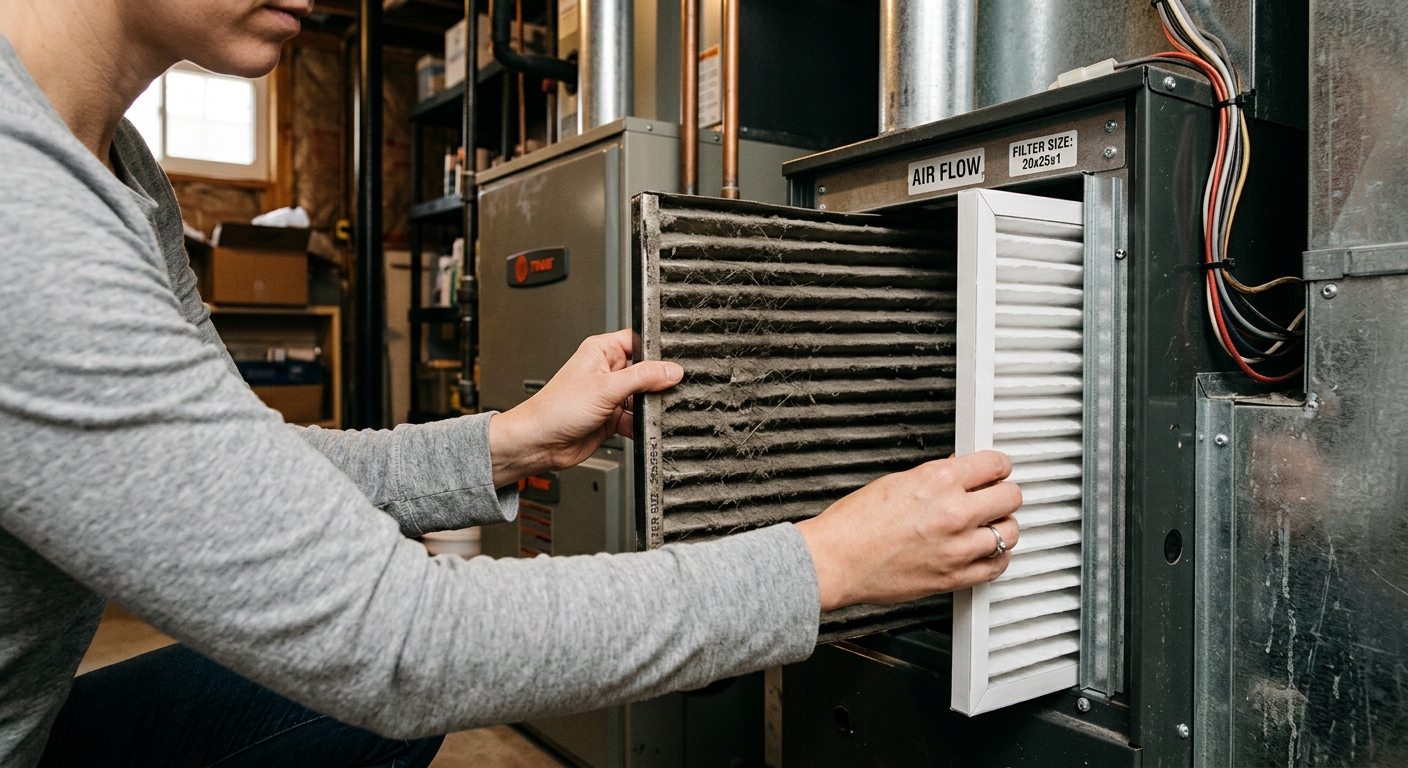
- Check and replace your air filter if it hasn’t been changed in the last 30 to 90 days. A clogged filter is the single most common cause of reduced airflow and poor cooling. Hold it up to a window light and if you can’t see through it, replace it immediately.
- Walk to your thermostat and make sure it’s set to COOL and AUTO, not ON. The ON setting runs the fan continuously even when the system isn’t actively cooling, circulating warm air and making it seem like the AC is running without effect.
- Locate your outdoor condenser unit and check that nothing is blocking airflow within 18 inches on all sides. Remove leaves, trim shrubs, and rinse coil fins gently with a garden hose from the inside out if they look clogged with debris.
- Check every supply vent inside the house. Make sure none are blocked by furniture, rugs, or drapes. Restricted supply vents cause pressure imbalances that force conditioned air out through envelope cracks before it reaches occupied spaces.
- Do a quick hand-draft test around your front door, sliding doors, and attic hatch on a windy day. If you feel air movement, you have infiltration that’s adding heat load. Note the locations for the DIY approach below.
- Buy one can of low-expansion spray foam and one tube of paintable latex caulk. Seal every penetration you can access in your attic floor: plumbing stacks, wiring holes, recessed light housings (use fire-rated foam), and the gap where interior walls meet the attic floor. A single weekend of attic air sealing typically reduces whole-home air leakage by 20 to 35 percent.
- Inspect your visible ductwork in the attic, crawl space, or basement. Look for disconnected joints, tears in duct wrap, or sections held together only by deteriorating tape. Use UL 181-rated foil mastic tape or brush-on duct mastic to seal every joint. Do not use standard silver duct tape, which fails within a year.
- Add weatherstripping to any exterior door that shows daylight around the frame or has a gap you can feel air through. Foam compression weatherstripping costs $8 to $15 per door and takes 20 minutes to install. For the door bottom, add a door sweep to block the largest single gap in most homes.
- Caulk around every window frame where it meets the interior wall, and around any wall-mounted AC or cable TV penetrations. Use silicone caulk for exterior applications and paintable latex for interior gaps near drywall.
- Check your attic insulation depth. R-38 is the DOE minimum recommendation for most of the U.S., which is roughly 12 inches of fiberglass batts or 10 inches of blown cellulose. If you can see your ceiling joists above the insulation, you almost certainly need more. Adding insulation to reach R-38 typically reduces cooling load by 15 to 25 percent in poorly insulated homes.
- Schedule a blower door test with a certified energy auditor or HVAC contractor. This test pressurizes your home and precisely measures total air leakage in ACH50 (air changes per hour at 50 pascals). Most existing homes test at 8 to 15 ACH50. A well-sealed home targets 3 ACH50 or lower. This test costs $150 to $400 and tells you exactly how leaky your home is before and after repairs.
- Request a duct leakage test (duct blaster) at the same time. This measures what percentage of your system’s airflow is being lost to unconditioned space. Results above 15 percent leakage indicate your ducts need professional sealing or Aeroseal treatment. Aeroseal is an injected sealant that seals duct leaks from the inside and can reduce leakage by 90 percent. It costs $1,500 to $3,500 but qualifies for federal tax credits under the Inflation Reduction Act.
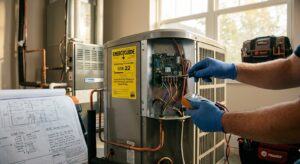
- Have your HVAC technician check refrigerant charge using manifold gauges, not just visual inspection. Low refrigerant must be repaired at the source leak before recharging. Refrigerant recharge and leak repair typically costs $200 to $600, and improper charge is the cause of inadequate cooling in roughly 25 percent of service calls.
- Ask for a Manual J load calculation if your contractor has never done one for your home. This is the ACCA-standard method for sizing HVAC equipment to your actual home. An oversized or undersized system will never perform correctly regardless of how well-sealed your home is. Proper sizing can be confirmed during an equipment replacement, and a Manual J costs $150 to $300 as a standalone service.
Why It Works: The Benefits
Addressing duct leakage and air sealing together can cut cooling costs by 20 to 40 percent. A home spending $200 per month on summer cooling could save $40 to $80 every month from June through September.
When your home’s envelope and ducts are sealed properly, your AC can satisfy the thermostat and cycle off normally, reducing runtime by 30 to 50 percent and dramatically extending equipment lifespan.
An AC that runs in shorter, complete cycles removes more moisture per hour than one struggling to keep up. Proper envelope sealing reduces outdoor humid air infiltration, often dropping indoor relative humidity from an uncomfortable 65 percent down to a healthy 50 percent or less.
Sealing duct leaks and improving insulation eliminates the hot-room problem that affects 80 percent of homes with forced-air systems, according to ACCA load analysis data.
An AC that runs 16 hours a day instead of 8 accumulates wear twice as fast. Fixing the underlying envelope problems can cut compressor run hours in half, potentially adding years to your system’s life and avoiding a $4,000 to $8,000 early replacement.
💰 Savings Impact by Action
Sealing leaky ducts prevents 20 to 30 percent of conditioned air from escaping into unconditioned attic and crawl spaces, directly reducing runtime.
Upgrading attic insulation to R-38 reduces ceiling heat gain by 15 to 25 percent, cutting the steady-state cooling load your AC must fight all day.
Sealing envelope gaps reduces hot, humid outdoor air infiltration, lowering both sensible and latent cooling load by up to 15 percent.
Replacing a clogged filter and cleaning a dirty evaporator coil restores full airflow and heat transfer, recovering up to 15 to 20 percent of lost cooling capacity.
Setting back the thermostat 7 to 10 degrees for 8 hours per day (when away or asleep) saves approximately 10 percent on annual cooling costs according to DOE data.
🏠 Key Concepts Explained
The Science Behind It
Your air conditioner doesn’t actually create cold. It moves heat from inside your home to the outside using a refrigerant cycle. The evaporator coil inside your air handler absorbs heat from your indoor air, the refrigerant carries that heat to the outdoor condenser, and the condenser releases it outside. This process works beautifully when the only heat your AC has to remove is what’s already inside your home. The problem is that in a leaky, under-insulated house, new heat is entering faster than your AC can remove it.
Think of it like trying to fill a bathtub with the drain partly open. Your AC is the faucet, and the heat load from your leaky envelope is the drain. If enough heat is pouring in through your attic ceiling (which can radiate at temperatures equivalent to a 140-degree surface), through infiltrating hot outdoor air, and through conduction across poorly insulated walls, the drain is open wider than your faucet can fill. The AC runs all day because it’s genuinely losing the race, not because it’s broken. This is called an unmet load, and it’s the core reason systems run continuously without reaching setpoint.
When you seal your home’s envelope and fix duct leaks, you’re closing the drain. Your AC can now remove heat faster than it enters, reach the thermostat setpoint, and cycle off. Shorter, complete cycles are actually more efficient at removing humidity because the evaporator coil has time to get cold enough to condense moisture from the air. A system that short-cycles or runs constantly in a losing battle often leaves indoor humidity high even when it does manage to lower the temperature slightly, because it’s never running a full, efficient cycle.
Frequently Asked Questions
▼ Why is my AC still running all day even after I tried these fixes?
If you’ve sealed air leaks, replaced the filter, and cleared the condenser, the next most likely culprits are low refrigerant, a dirty evaporator coil, or genuine equipment undersizing. Call a licensed HVAC technician to check refrigerant charge and coil condition. Also ask them to compare your system’s BTU capacity against a Manual J load calculation for your home’s square footage and climate zone.
▼ Can renters do this without landlord permission?
Renters can safely do the filter replacement, thermostat setting check, and window covering steps without any permission. Weatherstripping on doors and window AC unit sealing are also generally acceptable and removable. For anything involving attic access, ductwork, or permanent caulking, check your lease and notify your landlord in writing since these repairs benefit the property and landlords often approve them or offer to cover costs.
▼ How long before I actually notice savings on my bill?
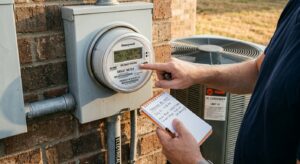
Air sealing and filter changes produce results within the first full billing cycle after repairs, typically 30 days. Attic insulation upgrades show clear impact on the first summer bill after installation. Duct sealing shows results immediately in comfort and within one billing cycle on cost. For precise tracking, note your kWh usage on your current bill before repairs and compare it to the same month the following year.
▼ What if my home is older than 30 years?
Homes built before 1990 typically have 2 to 4 times more air leakage than modern construction and often have original ductwork with failing tape joints. Start with the blower door test from the professional approach to understand your baseline, then prioritize attic air sealing and duct sealing before adding insulation. Also check that your ductwork hasn’t developed disconnected sections, which is common in older flex duct systems in attics.
▼ My house has two floors and the upstairs is always 10 degrees hotter. Is that normal?
A 10-degree difference between floors is not normal and points to a combination of problems: insufficient return air on the upper floor, duct leakage in the attic dumping conditioned air before it reaches upstairs registers, and high attic heat load radiating through the ceiling. Start by checking that all upstairs supply vents are fully open and unblocked, then have a contractor test your duct system and evaluate whether a dedicated return air path exists on the upper level.
Quick Tips
- Set your thermostat no lower than 72 to 74 degrees Fahrenheit when home. Every degree lower increases cooling energy use by 3 to 5 percent, and it doesn’t cool your home faster, it just runs the system longer.
- Run bathroom and kitchen exhaust fans for no more than 15 minutes after use. Leaving them on longer actively pulls cool air out of your home and draws hot outside air in through gaps in your envelope.
- Close blinds and curtains on south and west-facing windows between 10am and 4pm. Interior window coverings can reduce solar heat gain through glass by 45 percent, significantly reducing cooling load with zero cost.
- Check that your condensate drain line is clear by pouring a cup of water into the drain pan near your air handler. If it doesn’t drain within 30 seconds, the line is clogged. A blocked drain can trigger a safety shutoff or cause the system to run without dehumidifying properly.
Variations for Your Situation
- Apartment or Rental: Renters can’t touch central ductwork, but they can tackle the biggest wins available to them. Seal gaps around your window AC unit with foam backer rod and tape ($8 to $12). Add insulating cellular blinds to south and west windows ($25 to $60 each) to cut solar heat gain by 40 percent. Use a smart plug with energy monitoring to see exactly how many hours your window unit runs per day, which reveals whether your problem is the unit or the space. Request a filter replacement from your landlord if the central system has one you can’t access.
- Tight Budget Under $50: Focus on the three highest-return free and near-free steps. First, change the filter ($8 to $15). Second, set your thermostat fan to AUTO and bump the setpoint up to 76 degrees Fahrenheit when sleeping or away, which saves 10 percent per degree per 8 hours. Third, use a $5 rope caulk (removable, no tools needed) to temporarily seal drafty window frames. These three steps alone can reduce cooling runtime by 15 to 25 percent at minimal cost.
- Older Home Pre-1980: Homes of this era were built with little thought to air sealing and often have open top plates connecting every interior wall cavity directly to the attic. This makes them dramatically leakier than newer homes. Prioritize attic air sealing above all other fixes, since it addresses both insulation performance and infiltration simultaneously. Budget $500 to $1,500 for a professional attic air sealing and insulation job, which typically pays back in 2 to 4 cooling seasons. Also have the ductwork inspected since original 1970s duct tape has almost certainly failed on all joints.