Replacing a central air conditioner is one of the biggest home expenses you’ll face, often landing between $4,000 and $12,000 depending on system size, efficiency rating, and your region. Yet most homeowners accept the first quote they receive, not realizing that HVAC pricing has significant built-in margin and that contractors routinely negotiate. The difference between a prepared buyer and an unprepared one can easily be $1,000 or more for identical equipment.
The good news is that negotiating an AC replacement doesn’t require confrontation or industry insider knowledge. It requires understanding what you’re actually buying, knowing the real cost of equipment versus labor, and timing your purchase strategically. Contractors want your business, especially during slower seasons, and a confident, informed homeowner is in a much stronger position than someone who just calls whoever shows up first in a Google search.
This guide walks you through exactly how to research fair pricing, collect and compare bids, identify upsells you don’t need, and use proven negotiating tactics to get the best value on a system that will run for 15 to 20 years. Whether you’re replacing a failed unit or proactively upgrading, these steps will save you money and help you avoid costly mistakes.
What You’ll Need
Click on an item below to shop for the recommended items for this recipe on Amazon.
As an Amazon Associate, we earn from qualifying purchases.
How to Do It
- Look up your existing system’s model number (on the outdoor condenser unit nameplate) and identify its tonnage, typically 2, 2.5, 3, 3.5, or 5 tons for residential units. This tells you the size class you’ll be replacing.
- Check equipment prices on sites like HVAC Direct, Ingram’s Water and Air, or Carrier and Trane dealer locator pages to understand retail cost ranges for comparable units in your tonnage and SEER2 tier. A 3-ton 16 SEER2 system runs $1,200 to $2,000 in equipment alone.
- Look up federal tax credit eligibility at energystar.gov and your utility’s rebate program at dsireusa.org. Note the specific models or efficiency thresholds that qualify so you can request them by name.
- Write down your home’s square footage, number of floors, and any comfort complaints (hot rooms, humidity issues) so you can describe your actual needs rather than just accepting a like-for-like swap.
- Decide in advance on your target total budget range and your walk-away number so you are not making decisions under pressure during a sales call.
- Contact at least three licensed HVAC contractors, ideally including one large company, one mid-size regional firm, and one owner-operator. Request written, itemized quotes that separate equipment model and cost from labor, permits, refrigerant, and any duct work.
- Ask each contractor to perform or reference a Manual J load calculation before recommending system size. Any contractor who just says ‘we’ll put in the same size you had’ without checking your insulation levels and duct condition is giving you a lazy quote, not a professional one.
- Compare the equipment models quoted across bids. Contractors often quote different brands at similar price points. Use AHRI certification lookup (ahridirectory.org) to verify efficiency ratings and cross-reference with your rebate eligibility list.
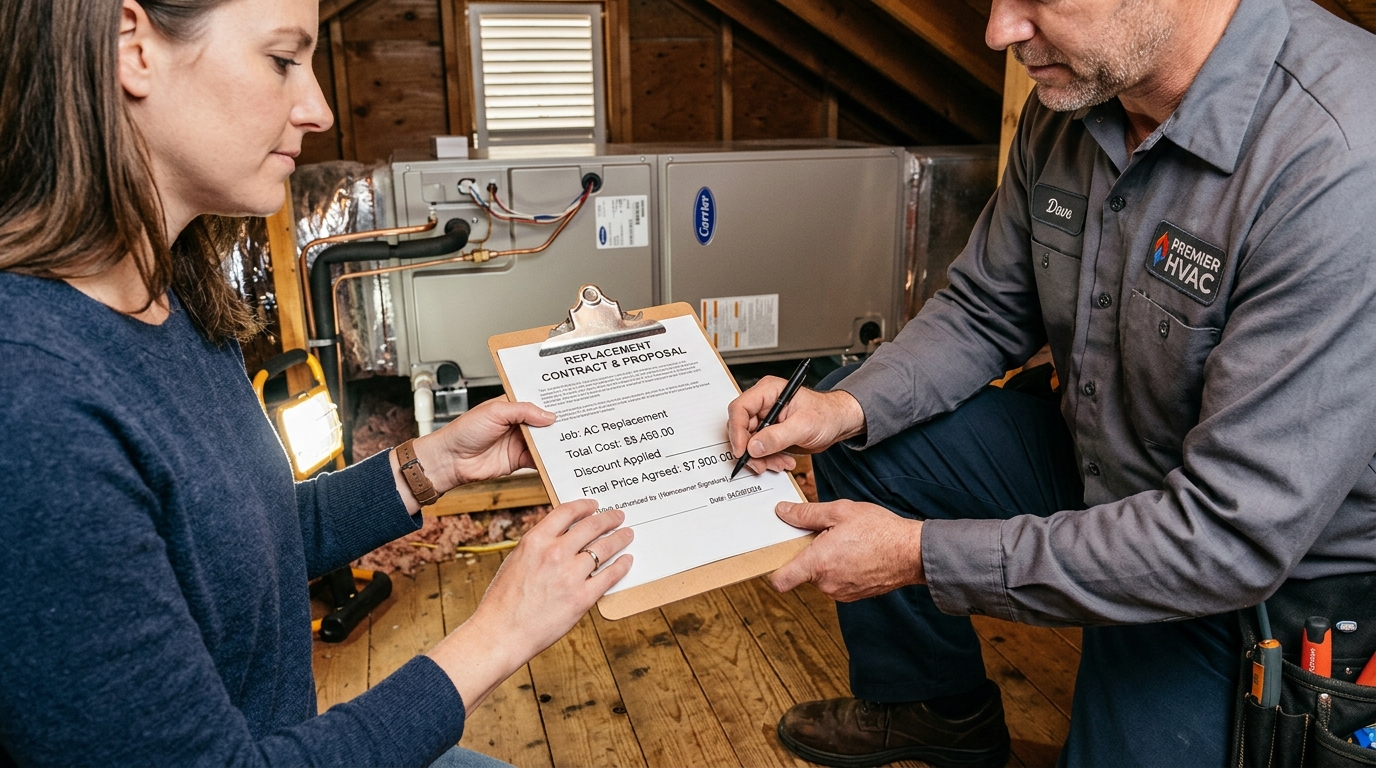
- Once you have all bids, go back to your top one or two preferred contractors and say directly: ‘I have a competing quote for $X less. I prefer to work with you. Can you match it or get closer?’ Many contractors will drop $300 to $700 without hesitation when they know they are in competition.
- Negotiate add-ons separately. Ask for the labor warranty extended to 2 years, a free first-year maintenance visit, or refrigerant top-off at no charge after 90 days. These items cost the contractor little and add real value to you.
- Confirm the contractor will pull the required permits, register your equipment warranty with the manufacturer (required for full warranty in most cases), and provide a written completion checklist before you sign anything.
- Schedule your replacement for September through November or February through March when HVAC contractors have reduced demand and are more willing to negotiate on price and scheduling. Off-peak quotes are routinely 10 to 15% lower than peak-summer quotes.
- Select a system that qualifies for the federal Energy Efficient Home Improvement Credit, which covers 30% of cost up to $600 for qualifying central AC units under the IRA. Combine this with your utility rebate for a total incentive of $700 to $1,100 or more.
- Ask contractors if they have any previous-model inventory or open-box units they need to move. A 2023-model unit being cleared out in favor of 2024 inventory may be discounted $400 to $800 with no performance difference for your application.
- If you are replacing both the air handler and the condenser (a full system), negotiate a package price and ask what the contractor’s cost would be if you supply the equipment yourself through a third-party HVAC supplier. Even if they decline, it signals you have done your research and resets their pricing expectations.
- Before finalizing, check if your contractor is a Carrier, Trane, Lennox, or Rheem dealer with an active manufacturer promotion. Factory rebates of $100 to $500 are common in spring and fall and can be applied to reduce your final invoice.
Why It Works: The Benefits
Homeowners who collect three or more bids and actively negotiate report savings of $500 to $2,000 compared to accepting the first quote, on the same or equivalent equipment and installation quality.
Negotiating toward a correctly sized, higher-SEER2 unit rather than accepting whatever is in stock can reduce annual cooling bills by $150 to $400 compared to a baseline-efficiency replacement.
Price negotiation often opens the door to better terms. Requesting a 2-year labor warranty instead of the standard 1-year, or a free first-year tune-up, adds $150 to $300 in value at no extra equipment cost.
Informed buyers are less likely to accept $800 to $2,000 in add-ons like oversized air handlers, unnecessary duct modifications, or whole-home air purifiers that don’t fit their actual needs.
The bidding process itself filters out contractors who refuse to provide written quotes, pull permits, or perform load calculations, reducing the risk of a botched install that costs thousands to correct.
💰 Savings Impact by Action
Collecting three or more competitive bids and negotiating reduces total installation cost by an average of 12 to 18% compared to accepting the first quote.
Scheduling replacement in September through November or February through March can reduce quotes by 10 to 15% due to lower contractor demand.
Upgrading from a 14 SEER2 to an 18 SEER2 system reduces annual cooling electricity use by approximately 22%, saving $150 to $300 per year on a typical home.
Qualifying high-efficiency central AC units are eligible for a 30% federal tax credit on equipment cost up to $600 under the Inflation Reduction Act.
Replacing an oversized unit with a correctly Manual J-sized system can reduce cooling energy use by 20 to 25% by eliminating short cycling and improving dehumidification.
🏠 Key Concepts Explained
The Science Behind It
AC replacement pricing is not fixed, it is demand-driven and margin-based. HVAC equipment is sold through a tiered wholesale distribution system where the contractor buys at a significant discount below retail, typically 30 to 50% off list price, and marks up to cover overhead, warranty liability, and profit. This means there is real room between their cost and their quote, and knowing that the equipment in a $9,000 bid may have cost the contractor $2,200 to $2,800 in wholesale equipment cost clarifies why negotiation is reasonable, not rude.
The Manual J load calculation is the engineering foundation of a proper replacement. It uses your home’s square footage, insulation R-values, window area and orientation, local design temperatures, and duct system characteristics to calculate the actual peak cooling load in BTUs per hour. Oversizing a system by even one ton causes short cycling, where the unit cools the air too quickly, shuts off before removing adequate humidity, and restarts repeatedly. This increases energy consumption by 20 to 30%, accelerates compressor wear, and leaves your home feeling clammy. A correctly sized system runs in longer cycles, removes more moisture, and uses less energy doing it.
SEER2 (Seasonal Energy Efficiency Ratio 2) measures how many BTUs of cooling you get per watt-hour of electricity consumed over an entire cooling season, under revised DOE test conditions introduced in 2023. A system with an 18 SEER2 rating uses roughly 22% less electricity than a 14 SEER2 unit for the same cooling output. If you spend $1,200 per year cooling a typical 2,000-square-foot home with a 14 SEER2 system, upgrading to 18 SEER2 saves approximately $260 per year, helping offset a higher upfront equipment cost over 4 to 7 years even before factoring in the federal tax credit.
Frequently Asked Questions
▼ Why are all my quotes within $200 of each other even though I called three contractors?
This often means contractors in your area are quoting similar equipment tiers and have similar overhead. Try adding a fourth bid from an owner-operator or independent contractor rather than a franchise dealer. You can also ask each contractor specifically what it would cost to supply the equipment yourself, which isolates the labor-only price and reveals where the margin is concentrated.
▼ The contractor says my ducts need to be replaced too. Is that a legitimate upsell?
It can be legitimate or it can be padding. Ask the contractor to show you specifically which sections of ductwork are failing and why, and to quantify the leakage rate if possible. A duct leakage test or blower door test can verify the claim. Minor duct sealing with mastic costs $300 to $600 and solves most leakage issues without full replacement. Full duct replacement is warranted only when ducts are physically deteriorating, crushed, or severely undersized for the new system.
▼ Can I really negotiate with a large national HVAC company or only with small shops?
You can negotiate with both, but smaller owner-operated companies typically have more flexibility on price because there is no corporate pricing floor. Large companies may be less flexible on equipment cost but more willing to negotiate on service agreements, extended labor warranties, or scheduling priority. Lead with the competing bid number in all cases and let the contractor decide how to respond.
▼ My system died in the middle of summer. Am I stuck paying full price?
Not necessarily, but your leverage is reduced. Ask for a window unit loaner or rental for 24 to 48 hours while you collect a second bid. Even one comparison quote gives you something to push back with. Also ask the contractor directly if there is any flexibility on price given the emergency, since some contractors will reduce margin slightly to close a same-day job rather than risk you cooling down and shopping around.
▼ How do I know if the SEER2 upgrade is worth the extra cost?
Calculate the simple payback: divide the price difference between the higher and lower efficiency unit by your estimated annual savings. If a 18 SEER2 system costs $800 more than a 14 SEER2 and saves you $220 per year in electricity, the payback is about 3.6 years. Factor in the federal tax credit, which can cover 30% of the equipment cost up to $600, and the payback often drops below 2 years on qualifying units.
Quick Tips
- Always ask for an itemized quote that separates equipment cost from labor, permits, refrigerant, and any duct work. A lump-sum quote gives you nothing to negotiate against.
- Check if your contractor is running a manufacturer promotion. Trane, Carrier, and Lennox run seasonal rebates of $100 to $500 that should be passed through to you, not absorbed by the contractor.
- Request that the contractor register your equipment warranty with the manufacturer on your behalf. Most brands require registration within 90 days for the full 10-year parts warranty, and many homeowners miss this step.
- If you are in a hurry due to a system failure, call your utility company first. Many utilities have emergency weatherization or AC assistance programs for income-qualifying households that can cover part of the replacement cost.
Variations for Your Situation
- Apartment or Rental: Renters dealing with a landlord-controlled central AC replacement can still use this guide by sharing it with their property manager and offering to help collect bids. In units with window or through-wall AC, the homeowner renegotiation tactics apply directly since you own the unit. Focus on purchasing during off-peak months and look for ENERGY STAR certified window units under $500 that qualify for smaller utility rebates of $25 to $75.
- Tight Budget (under $500 to spend now): If cash is the constraint, focus entirely on timing and incentive stacking rather than equipment upgrades. Accept a baseline-efficiency system now if needed, but make sure it qualifies for your utility rebate (typically $100 to $300) and negotiate at minimum for a 2-year labor warranty and free first-year tune-up. Avoid financing offers from contractors with rates above 12% APR since a HELOC or personal loan will almost always be cheaper.
- Older Home (pre-1980): Homes built before 1980 often have undersized duct systems, original single-pane windows, and attic insulation below R-19, all of which inflate how large a replacement AC seems to need to be. Before replacing, get an energy audit ($100 to $400) to identify the biggest heat gain sources. Air sealing and adding insulation may reduce your required system size by half a ton, saving $400 to $800 on equipment alone and lowering operating costs permanently.